
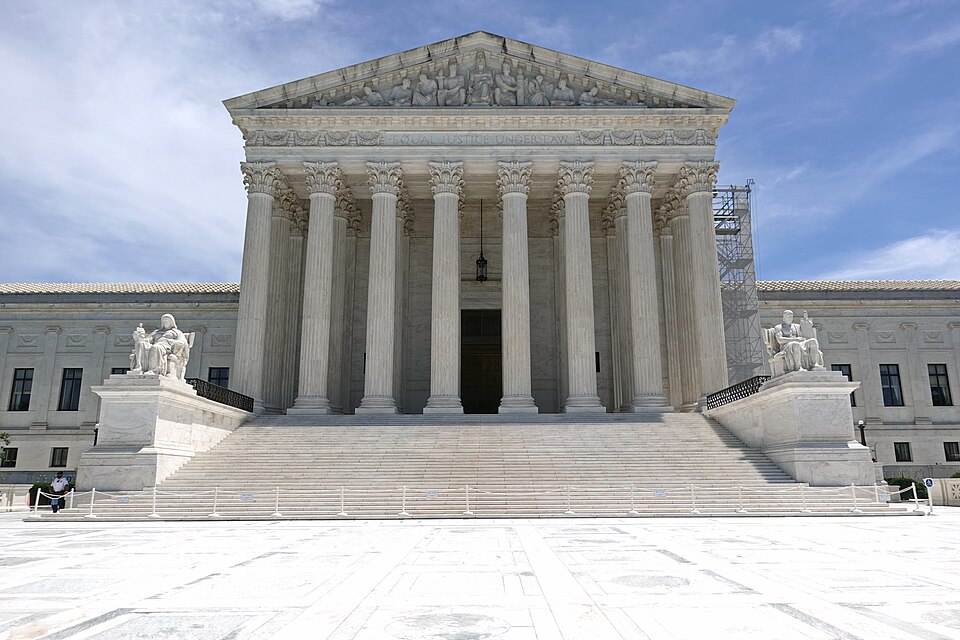
Supreme Court Justice Thomas Seeks Rapid Briefing On Alabama GOP Map After Lower Court Reimposes 2024 Plan
Supreme Court Justice Clarence Thomas declined to immediately reinstate Alabama's 2023 legislature-drawn congressional map and ordered Voting Rights Act plaintiffs to file a response by Monday, June 1, 2026, in the state's emergency bid to use that map for the 2026 elections.[1]
Alabama filed the emergency application with the U.S. Supreme Court asking for a stay of the three-judge panel's injunction on Wednesday, May 27, 2026.[2] The panel had ordered the state, at least for now, to keep using the court-drawn map that elected its U.S. House members in 2024.[3] That court-drawn map includes two districts with a significant proportion of Black residents.[3] The three-judge panel said it "cannot understand the 2023 Plan as anything other than intentionally discriminatory" and refused to have voters cast ballots in 2026 under a "tainted" plan.[4]
On May 26, 2026, the three-judge federal panel reissued a preliminary injunction after being ordered to reconsider the case in light of the Supreme Court's April decision in Louisiana v. Callais.[4] The judges said their intentional-discrimination finding is independent of Callais and that, on the existing record, Black voters would likely satisfy the Court's new Voting Rights Act standard.[4] Alabama's emergency filing tells the Court the 2023 map "was lawful then, and it is lawful now," and asks the justices to let the legislature-drawn plan govern the 2026 midterms.[2] Attorney General Steve Marshall has said the state did not intentionally discriminate and vowed a quick appeal.[5]
Early coverage framed the conflict mainly as a partisan fight over which party would gain seats if the legislature map were restored.[6] Later reporting and the panel's renewed opinion stressed that the court's finding of intentional race-based discrimination stands on its own and is not erased by the Supreme Court's recent Voting Rights Act ruling.[4] Justice Thomas's tight briefing schedule sets up a fast docket that could force the Supreme Court to act before special primaries Gov. Kay Ivey set for August 11 proceed under the court-drawn districts.[5]
Show source details & analysis (12 sources)
📌 Key Facts
- On Tuesday, May 26, 2026, a three-judge federal panel issued a preliminary injunction blocking Alabama Republicans from using the legislature-drawn 2023 congressional map in the 2026 elections and ordered the state to continue using the court-imposed map under which its U.S. House members were elected in 2024, which includes two districts with a significant proportion of Black residents (three-judge federal panel).
- The panel concluded the 2023 Plan was intentionally discriminatory, saying it “cannot understand the 2023 Plan as anything other than intentionally discriminatory,” and said it would not require Alabamians to vote in 2026 under a “tainted” plan (2023 Plan).
- After being ordered to reconsider in light of the Supreme Court’s April 2026 decision in Louisiana v. Callais, the panel on May 26, 2026 reaffirmed that its intentional-discrimination finding is independent of Callais and said Black voters would likely satisfy the Court’s new Voting Rights Act test based on the existing record (Louisiana v. Callais).
- Alabama filed an emergency application with the U.S. Supreme Court on Wednesday, May 27, 2026 asking the justices to stay the district court’s order and allow use of the 2023 map for the 2026 midterms, arguing the map “was lawful then, and it is lawful now” and contending the lower court’s decision conflicts with Callais (emergency application).
- Justice Clarence Thomas, acting as the Circuit Justice for the 11th Circuit, declined to immediately reinstate the legislature-drawn map and instead ordered the Voting Rights Act plaintiffs to file a response by Monday, June 1, 2026 explaining why the 2023 map should not be used (Justice Clarence Thomas).
- Attorney General Steve Marshall said the state did not intentionally discriminate and vowed a quick appeal to the U.S. Supreme Court, and Gov. Kay Ivey — who had set special primaries for August 11, 2026 in four affected districts — was told those contests must proceed under the court-drawn districts for now (Attorney General Steve Marshall).
- The three-judge panel is composed of appellate Judge Stanley Marcus and district Judges Anna Manasco and Terry Moorer — Marcus was originally appointed to the district court by Ronald Reagan and later elevated to the appellate bench by Bill Clinton, while Manasco and Moorer were appointed by President Donald Trump — highlighting the bipartisan makeup behind the panel’s intentional-discrimination finding (Judge Stanley Marcus).
📰 Source Timeline (12)
Follow how coverage of this story developed over time
- On Wednesday, May 27, 2026, Justice Clarence Thomas, as the justice for the 11th Circuit, declined to immediately reinstate Alabama's 2023 legislature‑drawn congressional map in response to the state's emergency application.
- Thomas ordered the Voting Rights Act plaintiffs challenging the 2023 map to file a response by Monday, June 1, 2026, explaining why the legislature‑drawn map should not be used.
- The article reiterates that Alabama's emergency filing argues the lower court's May 26 decision "defies" the Supreme Court's April 2026 ruling in Louisiana v. Callais, "manipulates" the Purcell principle, and violates equal protection.
- The piece notes Alabama officials had already begun preparing to revert to the 2023 map, with Gov. Kay Ivey calling August 11, 2026 special primaries for the 1st, 2nd, 6th and 7th Districts following the Supreme Court's May 11 remand order.
- On Wednesday, May 27, 2026, Alabama filed an emergency appeal with the U.S. Supreme Court seeking permission to use its 2023 legislature-drawn congressional map for this year's elections.
- Attorney General Steve Marshall told the Court the state did not intentionally discriminate against Black residents and argued elections should proceed under a map chosen by lawmakers rather than by judges.
- The article links the Alabama litigation to the Supreme Court's recent Louisiana redistricting ruling that weakened the Voting Rights Act and has prompted GOP-led efforts across Southern states to reshape minority-heavy districts.
- Gov. Kay Ivey had already set special primaries for August 11, 2026, in four districts affected by the attempted switch back to the 2023 map, but the three-judge panel has ordered those to proceed under the court-drawn districts instead.
- On Wednesday, May 27, 2026, Alabama formally returned to the U.S. Supreme Court seeking emergency relief to use its 2023 congressional map in the 2026 midterms.
- The three-judge panel issued a fresh opinion on Tuesday, May 26, 2026, after being ordered to reconsider in light of Louisiana v. Callais, and again held that the 2023 plan is intentionally discriminatory and unconstitutional.
- The panel stated it "cannot see our way clear to requiring Alabamians to cast their votes in the 2026 elections under a districting plan tainted by intentional race-based discrimination."
- Alabama’s emergency filing argues that the panel’s latest ruling conflicts with the Supreme Court’s 6-3 decision in Callais and asks the justices to halt the lower court’s order by Monday morning, June 1, 2026.
- The article confirms the panel consists of Judge Stanley Marcus (originally appointed to the district court by Ronald Reagan and later to the appellate bench by Bill Clinton) and two Trump-appointed district judges, Anna Manasco and Terry Moorer, underscoring the bipartisan composition behind the intentional-discrimination finding.
- On Tuesday, May 26, 2026, Alabama Attorney General Steve Marshall said he is appealing to the U.S. Supreme Court to overturn the three-judge panel’s preliminary injunction blocking the state’s Republican-drawn mid-decade congressional map for the 2026 elections.
- The article underscores that the federal panel’s order requires Alabama to keep using the court-imposed map with two districts where Black residents form a majority or close to it for the upcoming midterms, both currently held by Democrats.
- On Wednesday, May 27, 2026, Alabama Republicans filed an emergency application asking the U.S. Supreme Court to allow use of the state’s 2023 congressional map for the 2026 elections.
- The application seeks a stay of the three-judge district court’s order requiring Alabama to use a court-drawn map with two majority-Black districts.
- Alabama’s filing argues the 2023 map "was lawful then, and it is lawful now," and claims voters will otherwise be forced to vote under a "court-drawn racially gerrymandered map."
- Republicans are specifically aiming to reimpose the 2023 map in hopes of flipping the seat currently held by Rep. Shomari Figures, a Black Democrat, which is one of the two majority-Black districts under the court-ordered plan.
- The move follows the Supreme Court’s April 2026 decision weakening a key Voting Rights Act provision in a Louisiana redistricting case, which Alabama Republicans cite as a basis to revert to the 2023 map.
- CBS News aired a May 26, 2026 segment explicitly stating that a federal court has blocked Alabama's GOP-backed congressional redistricting plan after finding it intentionally discriminated against Black voters.
- The segment notes that Alabama Republicans plan to appeal the ruling to the U.S. Supreme Court.
- The piece is framed as a legal breakdown of the decision and its implications for Alabama's 2026 congressional elections.
- Article reiterates that on Tuesday, May 26, 2026, the three-judge panel issued a preliminary injunction blocking Alabama from using the Republican-drawn 2023 congressional map in 2026 elections.
- The piece restates that the panel found the map intentionally discriminated based on race by including only one Black-majority district and ordered continued use of the court-imposed map with two districts containing a significant proportion of Black residents.
- Alabama Attorney General Steve Marshall, a Republican, again vowed a quick appeal to the U.S. Supreme Court and predicted an eventual victory.
- CBS segment on May 26, 2026, reiterates that the three-judge federal panel has blocked Alabama Republicans' attempt to use the 2023 congressional map that was previously ruled unconstitutional.
- The panel again characterizes the 2023 map as involving 'race-based discrimination' in its latest order, according to the CBS summary.
- The report frames the decision specifically as blocking Republicans' effort to reinstate the 2023 plan rather than as a fresh remedial map decision.
- On Tuesday, May 26, 2026, the same three-judge panel reissued a preliminary injunction against Alabama's 2023 congressional map after reconsidering the case in light of the Supreme Court's April 2026 ruling in Louisiana v. Callais.
- The panel held that its prior finding of intentional race-based discrimination against Black voters is independent of, and unaffected by, the Supreme Court's new Voting Rights Act standards in Callais.
- The judges wrote that they "cannot see our way clear" to requiring Alabamians to vote in 2026 under a plan "tainted by intentional race-based discrimination," despite what they called a "very tight timeline" before special primaries and the general election.
- The panel said that even if Callais applied, Black voters in the Alabama case would likely still satisfy the Supreme Court's new Voting Rights Act test based on the existing evidentiary record.
- The ruling details the composition of the panel as appellate judge Stanley Marcus (originally appointed to the district court by Ronald Reagan and elevated by Bill Clinton) and district judges Anna Manasco and Terry Moorer, both appointed by President Donald Trump.
- Alabama state officials filed notice on May 26, 2026, that they are appealing the renewed preliminary injunction to the U.S. Supreme Court.
- Justice Sonia Sotomayor's May 11, 2026 dissent from the Supreme Court's remand order emphasized that the panel's intentional-discrimination finding made Callais legally irrelevant and warned that the remand would cause confusion as voting began.
- On Tuesday, May 26, 2026, a three-judge federal panel issued a preliminary injunction blocking Alabama from using a new congressional map for the 2026 midterms.
- The order requires Alabama, at least for now, to keep using the same court-ordered map under which the state’s U.S. House members were elected in 2024.
- Lawyers for Black voters had sought the injunction, arguing the panel already found Alabama’s 2023 map intentionally discriminatory and that mid-cycle changes would create election-year chaos.
- The ruling is a setback for Alabama Republicans who hoped to deploy a new map that would improve their chances to reclaim the seat currently held by Democratic Rep. Shomari Figures.
- The state can appeal the preliminary injunction to the U.S. Supreme Court, which recently weakened the Voting Rights Act in a Louisiana case and has already affected redistricting across several Southern states.
- On Tuesday, May 26, 2026, a three-judge federal appeals court panel blocked Alabama Republicans from using their 2023 congressional map for the 2026 elections.
- The panel ordered Alabama to instead use a map with two majority-Black districts in which Democrats hold significant advantages.
- The judges wrote that they "cannot understand the 2023 Plan as anything other than intentionally discriminatory" and refused to have voters cast ballots in 2026 under a "tainted" plan.
- Alabama Republicans had argued the 2023 map should be allowed following a recent Supreme Court ruling that curtailed the use of race in drawing electoral districts.