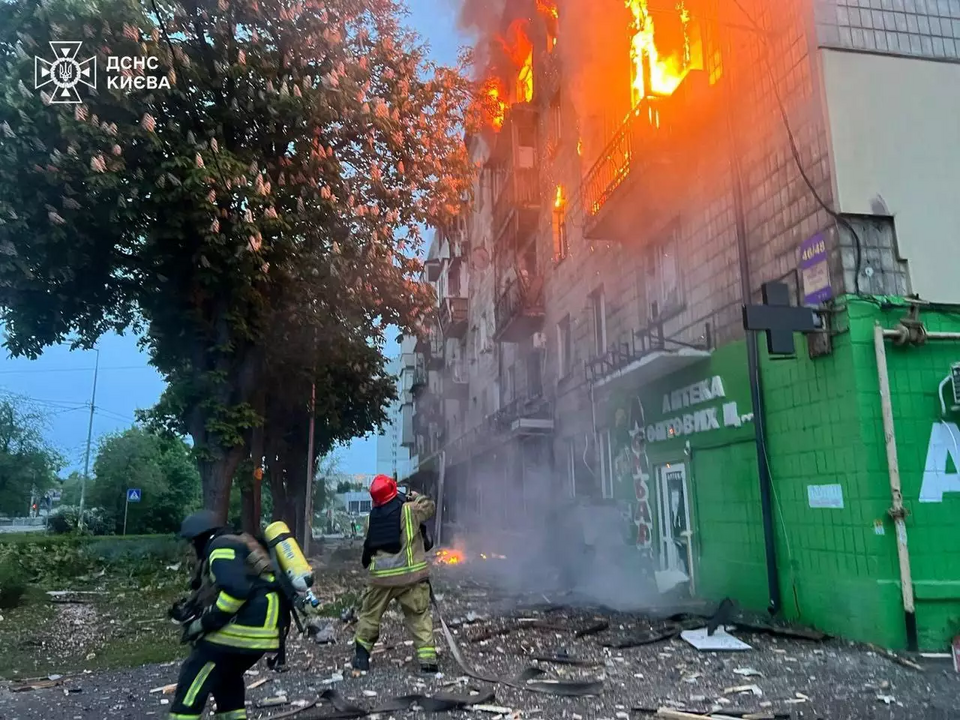
Russia’s 700‑Drone, Multi‑Missile Barrage on Ukraine Now Kills at Least 18 as Kyiv Reports Wider Damage
Russian forces on Saturday mounted one of the largest aerial assaults of 2026, launching roughly 659 drones and scores of cruise and ballistic missiles in an hours‑long barrage across multiple Ukrainian cities. Ukrainian authorities now say at least 18 people were killed — including a 12‑year‑old boy — with the dead concentrated in Odesa (9), Dnipro (5) and Kyiv (4); dozens were wounded and emergency workers were among the injured. A high‑rise residential block in Kyiv’s Podil district collapsed after a strike, windows and facades were shattered across neighborhoods, and Mykolaiv and Kherson lost power after hits to energy infrastructure. Ukraine’s Air Force reported shooting down 636 drones and 31 missiles; Russian officials framed the strikes as retaliation for Ukrainian long‑range attacks on refineries and military‑related sites inside Russia.
The strike underscored persistent gaps in Ukraine’s air defenses and the strategic pressure Kyiv faces to secure more advanced interceptors. President Volodymyr Zelenskyy has made Patriot and other systems a top diplomatic priority after a recent tour of European capitals, even as U.S. officials weigh diverting some Patriot missiles to Middle East operations tied to the U.S.–Iran conflict. Broader political and economic currents fed into the moment: a temporary U.S. Treasury waiver on certain Russian oil sales recently expired and Kyiv has criticized waivers and sanctions relief as indirectly financing Moscow’s war, while international sanctions and tight monetary conditions have nonetheless contributed to a slowdown in Russia’s war economy, with projections of reduced investment and lower oil revenues that complicate Moscow’s long‑term production capacity.
Public reaction ranged from horror to renewed calls for support. Residents described sheltering in stairwells and hallways as blasts lit up the night; analysts and social‑media commentators labeled the barrage “mass murder” or a brutal rejection of overtures for ceasefires, and some voices highlighted the attack as further evidence that easing sanctions or withholding air‑defense aid would be irresponsible. The reporting itself shifted over the day: initial coverage from outlets such as CBS and Fox emphasized the scale and civilian toll of the aerial bombardment, while later accounts from PBS and the BBC incorporated Moscow’s stated rationale and stressed the heavy use of ballistic missiles and Ukraine’s acute need for interceptors. That progression — from immediate casualty reporting to more context about claimed motives and capability gaps — changed how the attack was framed in mainstream accounts as additional details and official statements emerged.
📊 Relevant Data
In March 2026, the UN Human Rights Monitoring Mission in Ukraine reported 211 civilian deaths and 1,206 injuries, marking a 49% increase from February 2026, underscoring the escalating pattern of civilian casualties leading up to this April attack.
Protection of Civilians in Armed Conflict — March 2026 — UN Human Rights Monitoring Mission in Ukraine
Sanctions have contributed to a slowdown in Russia's war economy, with projections of a 0.9% decline in investment in 2026 due to tight monetary policy and weaker corporate credit, alongside budget deficits and reduced oil revenues, limiting its capacity to finance military operations including drone and missile production.
Russia's war economy slows as sanctions enter 5th year — Anadolu Agency
A February 2026 Chicago Council on Global Affairs survey found that 57% of Americans support providing military aid to Ukraine and 58% support economic assistance, reflecting public backing that influences policy debates on aid and sanctions.
Americans Oppose Ceding the Donbas to Russia Amid Push for Peace Deal — Chicago Council on Global Affairs
The US Department of Defense is considering diverting Patriot interceptor missiles originally intended for Ukraine to support Middle East operations amid the US-Israel conflict with Iran that began in February 2026, worsening Ukraine's existing shortages of these systems critical for intercepting ballistic missiles.
Pentagon considers diverting Ukraine military aid to the Middle East — The Washington Post
By February 2026, Russian attacks had destroyed up to two-thirds of Ukraine's power generation capacity, with near-daily strikes on energy infrastructure in January alone, leading to widespread outages and projected reductions in economic growth, as exemplified by the power losses in Mykolaiv and Kherson from this attack.
2026 Update Russia-Ukraine Energy War - Conflict Of Electricity Vs. Oil — Forbes
📌 Key Facts
- Russia carried out a massive, hourslong aerial barrage that Ukrainian and Western reports place at roughly 659–700 drones plus about 44 cruise/ballistic missiles, with direct hits recorded in at least 26 locations.
- Ukraine’s Air Force says it intercepted the bulk of the assault — reporting 636 drones and 31 missiles shot down during the attack.
- At least 18 people were killed (9 in Odesa, 5 in Dnipro, 4 in Kyiv, including a 12‑year‑old) and dozens more wounded — reports cite over 80 injured overall and 45 injured in Kyiv; four emergency medical workers were among the casualties.
- The strikes caused heavy damage to civilian infrastructure: a multi‑storey residential building in Kyiv’s Podil district collapsed or was heavily damaged after a strike, other residential buildings were hit, and Mykolaiv and Kherson lost power.
- Russian officials said the barrage was “in retaliation” for Ukrainian long‑range strikes on oil refineries and war‑related plants and was aimed at military‑associated targets; Ukrainian officials say civilians were primarily targeted.
- Ukraine warns it urgently needs more advanced air‑defence systems — officials and the air‑force spokesman emphasized Patriot interceptors as the only reliable defense against the ballistic missiles — and President Zelensky made air‑defense procurement a top diplomatic priority during a recent 48‑hour tour of Germany, Norway and Italy.
- Kyiv is pressing partners for faster military and financial support (including a rapid disbursement of a blocked €90 billion EU loan) and has criticized a recent U.S. temporary waiver on some Russian oil sanctions — now expired — as helping to finance Moscow’s war.
- Separately, Russian officials reported cross‑border casualties the same night: two people killed (including a 14‑year‑old girl) and five injured in Tuapse in Russia’s Krasnodar region in a Ukrainian drone strike.
📰 Source Timeline (5)
Follow how coverage of this story developed over time
- Updated casualty figures: at least 18 killed in Ukraine (9 in Odesa, 5 in Dnipro, 4 in Kyiv, including a 12‑year‑old boy) and 45 injured in Kyiv, plus detailed note of four emergency medical workers injured.
- More granular breakdown of the strike’s physical effects: a 16‑storey residential building in Kyiv’s Podil district collapsed; Mykolaiv and Kherson were left without power; specific injury figures in Kharkiv (a 77‑year‑old woman and a 66‑year‑old man).
- Refined weapon counts: Ukraine’s Air Force says Russia launched 659 drones and 44 cruise/ballistic missiles in the prior 24 hours, with 636 drones and 31 missiles intercepted and direct hits in 26 locations.
- New cross‑border detail: Russian officials report two killed, including a 14‑year‑old girl, and five injured in Tuapse in Russia’s Krasnodar region in a Ukrainian drone attack the same night.
- Political and economic context: Zelensky links the attack to arguments against easing sanctions and reiterates a critical shortage of Patriot interceptors, noting stocks are limited and many missiles have been diverted to the Middle East since U.S. and Israeli strikes on Iran; Ukraine is pushing for rapid release of a €90bn EU loan now that Viktor Orbán has been voted out in Hungary.
- Confirms Russian Defense Ministry’s public claim that the barrage was conducted “in retaliation” for Ukrainian long‑range strikes on oil refineries and war‑related manufacturing plants inside Russia and was aimed at military‑associated facilities, even as Ukrainian officials say civilians were primarily targeted.
- Adds that Ukrainian Air Force spokesperson Yuriy Ihnat emphasized the heavy use of ballistic missiles in this attack and said only U.S. Patriot systems can reliably intercept them, underscoring a specific capability gap.
- Reports that Ihnat said Ukraine “desperately” needs more Patriot missiles and that Zelenskyy is making Patriot and other air‑defense systems his “top diplomatic priority” after a 48‑hour tour of Germany, Norway and Italy.
- Introduces Ukraine’s concern that the U.S.–Iran war is burning through global stocks of advanced U.S. air‑defense systems Kyiv needs, and notes Kyiv’s criticism of a U.S. temporary waiver on Russian oil sanctions it says is helping finance Moscow’s war.
- Quotes Zelenskyy on X arguing that the latest overnight attack shows Russia does not deserve any easing of sanctions or “global policy” pressure.
- Ukrainian officials say Russia launched nearly 700 drones plus dozens of ballistic and cruise missiles in an hourslong barrage, killing at least 16 civilians and injuring more than 80.
- Eyewitness account from Kyiv resident Tetiana Sokol describes multiple nearby missile strikes, shattered windows, and sheltering in a hallway as blasts lit up the night.
- Zelenskyy’s 48‑hour trip this week to Germany, Norway and Italy focused on securing more air-defense systems; he also cited new agreements with those countries and ongoing talks with the Netherlands.
- Ukraine is pressing for rapid disbursement of a blocked €90 billion EU loan and warning that the Iran war is draining stockpiles of U.S. Patriot systems and that a U.S. waiver on Russian oil sanctions is helping finance Moscow’s war.
- Zelenskyy publicly instructed his air-force commander to contact partner states that had previously pledged Patriot and other interceptor missiles but have not yet delivered.
- Ukrainian officials say Russia launched its deadliest aerial assault of 2026 so far, killing at least 16 people, including a 12‑year‑old, with nearly 700 drones and 19 ballistic missiles across multiple cities.
- Kyiv Mayor Vitali Klitschko reports four dead in the capital after a drone hit an 18‑story building; nine people were killed in Odesa and two in Dnipro, with drones striking residential buildings.
- Ukraine’s southeastern cities of Mykolaiv and Kherson lost power after strikes on energy infrastructure.
- Ukraine’s Air Force claims it shot down 31 missiles and 636 drones during the Russian attack, while Russia’s Defense Ministry says it intercepted 207 Ukrainian drones in separate Ukrainian strikes.
- A U.S. Treasury Department sanctions waiver on certain Russian oil sales, introduced to stabilize markets during the U.S.–Iran war, expired Saturday; Treasury Secretary Scott Bessent said the administration will not renew the general license on Russian oil.
- Ukraine has recently stepped up long‑range attacks on Russian oil and gas infrastructure to undercut Moscow’s profits from higher Brent prices and earlier sanctions relief during the Iran war.