
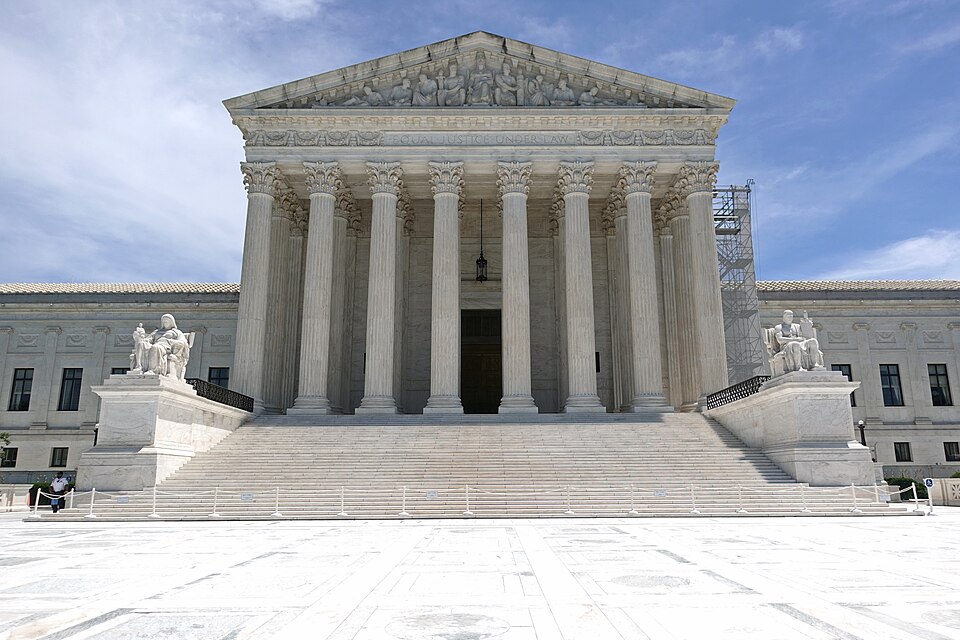
Supreme Court To Review Trump Order Suspending Asylum Between Border Crossings
The Supreme Court on Friday agreed to review former President Donald Trump's executive order that largely suspends access to asylum for migrants who cross the U.S.-Mexico border between official ports of entry, a case that could redefine presidential power over immigration enforcement at the southern border.[1]
In taking the case, the justices granted the Trump administration's appeal of lower-court rulings that found the policy unlawful but left it in effect, meaning the near-total bar on asylum applications for covered migrants remains in place while the Supreme Court considers whether a president can categorically refuse to accept such claims.[2] Immigration advocates including the American Civil Liberties Union and the National Immigrant Justice Center say the order is an attempt to "eviscerate" asylum protections by stopping people from even applying, while the administration argues it may deny asylum on a class-wide basis and need not process applications that will be rejected.[1]
The order now before the Court stems from a January 20, 2025 proclamation in which Trump declared an "invasion" at the southern border under the Constitution's Article IV, then used the same Immigration and Nationality Act provisions that Presidents Trump and Biden had previously invoked to restrict entry, this time barring migrants who cross unlawfully from invoking asylum or related protections until he determines the "invasion" has ended. Advocacy groups filed a class-action lawsuit soon after, and a federal district judge in Washington, D.C., set the policy aside, a decision that a divided D.C. Circuit panel largely affirmed in April 2026 before pausing its own ruling so the Supreme Court could have the final say. Monthly apprehensions between ports of entry have hovered around 6,000 to 10,000 this fiscal year, far below the levels that helped drive earlier border crackdowns.[2]
The legal fight over how far a president can go in conditioning or cutting off asylum at the border began in 2018, when Trump's first administration paired a presidential proclamation suspending entry between ports of entry with a rule making anyone who crossed that way categorically ineligible for asylum. Lower courts blocked that move as conflicting with the asylum statute, and in December 2018 the Supreme Court refused to lift the injunction, over dissents from four conservative justices, signaling early skepticism about using presidential entry powers to override explicit asylum rules. In June 2024, amid record crossings, President Biden took a different approach with the same statutory tools, suspending entry for unlawful crossers and sharply limiting their asylum eligibility but designing the restrictions to lift once between-port encounters fell; by December 2024, Border Patrol had recorded about 47,330 apprehensions between ports, 81% fewer than a year earlier.[3]
This term's review of Trump's current order lands on a Supreme Court docket already crowded with immigration fights: the justices are also weighing a policy that speeds some migrants' transfer to third countries and another that allows certain noncitizens to be held in detention for long stretches while their deportation cases proceed.[1] Earlier this year, the Court sided with the administration in a separate asylum-related case involving a "metering" practice that lets officials turn migrants back at official crossings, potentially allowing that policy to restart and underscoring how this conservative-majority Court has at times backed aggressive border controls even as it now confronts a more sweeping curb on the right to seek refuge.[1]
Show source details & analysis (2 sources)
📊 Relevant Data
U.S. Border Patrol recorded about 47,330 apprehensions between ports of entry on the southwest border in December 2024, 81% fewer than in December 2023, and between-port encounters fell 60% from May to December 2024 after the Biden administration's June 2024 executive action restricting asylum for unlawful crossers.
CBP Releases December 2024 Monthly Update — U.S. Customs and Border Protection
In fiscal year 2026, U.S. Border Patrol southwest border apprehensions ranged from 6,077 (January 2026) to 10,011 (May 2026) per month, with 8,936 in September 2026, about 81% below the December 2024 level; CBP put the preliminary fiscal-year total at 98,708.
Nationwide Encounters Fiscal Year 2026 — U.S. Customs and Border Protection
President Biden's June 4, 2024 proclamation also invoked INA sections 212(f) and 215(a) to suspend entry of people crossing the southern border unlawfully, paired with a rule restricting their asylum eligibility, and was designed to lift when between-port crossings fell low enough; Trump's January 20, 2025 proclamation uses the same two sections but bars covered migrants from invoking asylum until the president finds the declared 'invasion' has ceased.
FACT SHEET: President Biden Announces New Actions to Secure the Border — The White House (archived)
📌 Key Facts
- On Friday, November 13, 2026, the Supreme Court formally agreed to hear the Trump administration's appeal over its executive order banning asylum applications at the southern border, according to PBS News.
- The challenged order is framed as a ban on asylum applications for migrants it covers, with the Trump administration arguing it can categorically deny asylum and need not accept applications that would ultimately be rejected, as described in PBS News.
- Immigration advocates from the American Civil Liberties Union and the National Immigrant Justice Center are quoted as calling the executive order an unlawful attempt to "eviscerate" asylum protections by preventing people from even applying.
- The Supreme Court case over the asylum-ban order is one of three major immigration disputes on its docket this term, alongside cases on rapid removal to third countries and on indefinite detention during deportation proceedings.
- The PBS News report notes that earlier in the year the Supreme Court sided with the administration in a different asylum-related case, potentially allowing revival of a "metering" policy used to turn back migrants at the border.
📰 Source Timeline (2)
Follow how coverage of this story developed over time
- On Friday, November 13, 2026, the Supreme Court formally agreed to hear the Trump administration's appeal over its executive order banning asylum applications at the southern border.
- The article frames the order as a ban on asylum applications for migrants covered by it, with the administration arguing it can categorically deny asylum and need not accept applications that will be rejected.
- Immigration advocates from the American Civil Liberties Union and National Immigrant Justice Center are quoted as calling the order an unlawful attempt to "eviscerate" asylum protections by preventing people from even applying.
- The piece notes this is one of three major immigration cases on the Supreme Court's docket this term, alongside cases on rapid removal to third countries and on indefinite detention during deportation proceedings.
- The article recalls that earlier in the year the Court sided with the administration in a different asylum-related case, potentially allowing revival of a "metering" policy used to turn back migrants at the border.