
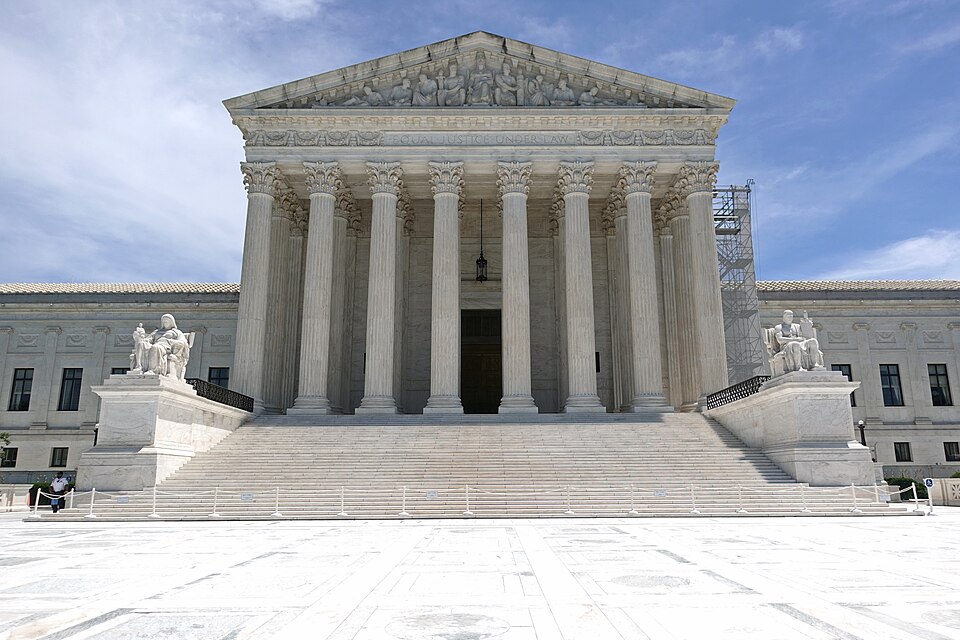
Supreme Court Hears Case On Agencies' Power To Impose Civil Fines
The Supreme Court heard arguments in Washington on Tuesday in a case that could sharply limit federal agencies' ability to impose civil fines, as justices weighed whether the Labor Department could levy roughly $500,000 in penalties on a New Jersey farm accused of mistreating migrant workers.[1]
The case centers on Sun Valley Orchards, which was cited for alleged violations involving its use of H-2A seasonal guest workers, including unsafe drinking water, overcrowded housing and failure to pay promised wages, and then fined through an in-house Labor Department process rather than in a federal court.[1] Chief Justice John Roberts and Justice Brett Kavanaugh questioned whether such administrative penalty schemes give executive-branch agencies too much quasi-judicial power, while the court's liberal justices pressed how federal courts could realistically take over the massive volume of civil enforcement cases now handled by agencies.[1] Deputy Solicitor General Sarah Harris warned that requiring every civil penalty to be pursued in an Article III court would be "catastrophic" for enforcement across programs from Medicare and Medicaid to student loans.[1]
Sun Valley's challenge arises from a long-standing system in which many federal agencies investigate violations, hold administrative hearings before agency judges, and impose civil fines without filing a traditional lawsuit in federal court, subject to later judicial review.[1] The farm argues that because the Labor Department's proceeding resulted in a large monetary penalty over contested facts, the Constitution's guarantee of a jury trial and the separation of powers require that such cases be brought in front of an independent federal judge and, if requested, a jury of citizens.[1] The Biden administration counters that Congress has long allowed agencies to resolve specialized disputes in-house and that federal courts still provide back-end oversight when regulated parties appeal.[1]
The justices' questions on Tuesday suggested a familiar ideological divide, with conservative members more open to reining in the so-called administrative state and liberals emphasizing practical consequences for government enforcement.[1] Roberts and Kavanaugh explored whether there is a principled way to distinguish between minor regulatory penalties that might remain with agencies and high-stakes monetary sanctions that must go to court, while Justice Neil Gorsuch has previously expressed deep skepticism of agency-run adjudications.[1] Justices Sonia Sotomayor, Elena Kagan and Ketanji Brown Jackson repeatedly asked how shifting every Medicare billing dispute, student loan collection action or workplace safety fine into already crowded federal dockets would work in practice, suggesting such a move could overwhelm the judiciary and impair basic enforcement of federal law.[1]
The court has not yet indicated when it will rule, but the decision could reshape how agencies across the government police misconduct and collect money from violators, or alternatively preserve the status quo system with only narrow changes.[1] Regulated businesses, worker advocates and government lawyers are watching closely, because a broad ruling against the Labor Department could invite new challenges to parallel penalty regimes at agencies such as the Securities and Exchange Commission, the Environmental Protection Agency and the Consumer Financial Protection Bureau.[1]
Show source details & analysis (1 source)
📌 Key Facts
- On Tuesday, November 10, 2026, the Supreme Court heard oral arguments in a case over Sun Valley Orchards’ challenge to a Department of Labor civil penalty.
- The Labor Department had fined Sun Valley roughly $500,000 for alleged violations in its use of H-2A migrant workers, including unsafe drinking water, overcrowded housing and unpaid promised wages.
- Chief Justice John Roberts and Justice Brett Kavanaugh signaled concern that agency penalty schemes may exceed executive power, while Justices Sonia Sotomayor, Elena Kagan and Ketanji Brown Jackson questioned how courts could absorb all such cases.
- Deputy Solicitor General Sarah Harris told the Court that requiring all civil penalties to be imposed in Article III courts would be “catastrophic” for enforcement of programs like Medicare, Medicaid and student loans.
📰 Source Timeline (1)
Follow how coverage of this story developed over time