
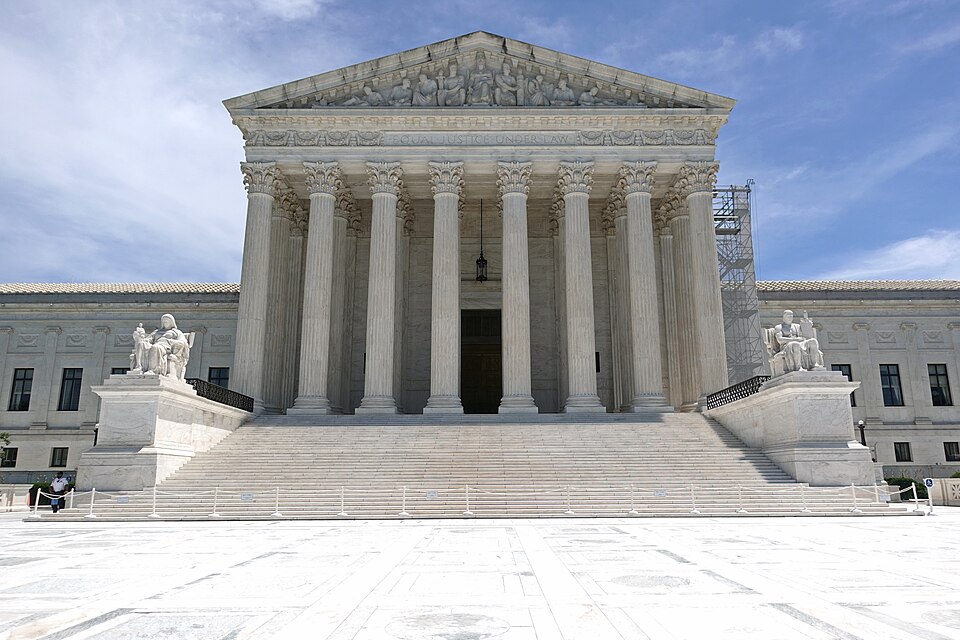
Supreme Court Conservatives Signal Support For Exempting Colorado Catholic Preschools From LGBTQ Enrollment Rule
Conservative justices on the US Supreme Court signaled Tuesday that they are likely to let two Denver-area Catholic preschools join Colorado's taxpayer-funded universal preschool program while continuing to turn away children from LGBTQ+ families.[1]
During nearly two hours of oral argument in St. Mary Catholic Parish v. Roy in Washington, several members of the court's 6-3 conservative majority pressed Colorado on why its LGBTQ nondiscrimination rule should apply to religious schools whose beliefs condemn same-sex marriage, suggesting the policy functions as a backdoor exclusion from a generally available public benefit.[2] Justice Brett Kavanaugh called the requirement that participating schools give all families an "equal opportunity" to enroll regardless of sexual orientation or gender identity a "provocation," and floated a "win-win" in which Catholic preschools receive an exemption because families could choose among roughly 2,000 other providers in the program while only 34 are Catholic.[1] Colorado's lawyer countered that the state "welcomes" religious preschools into the program as long as they follow the same rules as all other publicly funded providers and warned that preschools are not interchangeable, citing at least one child rejected under the policy and parents who need particular hours or sibling placements.[1]
Colorado's Universal Preschool program began in 2023 after voters approved dedicated funding through Proposition EE in 2020; it pays for up to 15 hours a week at a participating public or private preschool and, by statute, requires participating schools to give all families an equal shot at enrolling, including LGBTQ+ families. The Archdiocese of Denver and two parish preschools in Littleton and Lakewood sued after the state excluded them because they enroll only families who support Catholic teachings, arguing that denial of access to the funding program based on their religiously grounded admissions and conduct rules violates the First Amendment's free-exercise clause. A federal district court upheld the rule, and on Sept. 30, 2025, the Tenth Circuit affirmed, holding that the nondiscrimination condition was neutral and generally applicable under the Supreme Court's 1990 Employment Division v. Smith precedent and that the court's 2022 ruling in Carson v. Makin did not apply because Colorado's exclusion was not explicitly based on religion.[3] The Supreme Court agreed in April to review only two questions: what kind of exceptions regime makes a law no longer "generally applicable" under Smith, and whether Carson applies only when a law openly singles out religious status or use.[4]
Tuesday's argument exposed a sharp divide over how far those precedents reach and whether the state's insistence on LGBTQ inclusion actually disfavors certain faiths. Justice Amy Coney Barrett told Colorado's deputy solicitor general Helen Norton that the state could not openly ban Catholic, evangelical or Orthodox Jewish schools from its universal preschool program, then asked how that differs from attaching conditions those faiths say they cannot accept, casting the policy as a de facto exclusion.[2] Justice Neil Gorsuch asked whether the court had been "wasting our time for the last ten years" in religious-funding cases if a state can condition participation on abandoning core religious practices, a swipe at what he suggested was Colorado's resistance to decisions in cases like Carson.[1] Justice Samuel Alito pointed to Colorado's past First Amendment losses involving a baker, a website designer and a counselor, and downplayed the burden of an exemption here, saying there was "little evidence, if any" that LGBTQ couples cannot find other preschool options.[2]
The court's liberal justices focused on the flip side, pressing the Catholic schools and their allies on where a religious exemption would stop and whether the Constitution allows public money to flow to providers that categorically refuse families because of who the parents are. Justice Ketanji Brown Jackson asked whether there was any principled difference between a school excluding children of gay parents and one excluding the children of Black parents, signaling concern that a broad religious carveout could undermine race-discrimination law as well.[1] Justice Elena Kagan questioned arguments that neutral, generally applicable laws become unconstitutional whenever they disfavor certain religious views in practice, warning that such a rule would put every civil-rights law at risk when it conflicts with someone's faith doctrine.[1] Justice Sonia Sotomayor, according to one social-media account, challenged the preschools' attorney, asking, "Your Catholic schools will reject the child merely because their parents are homosexual?" That line of questioning echoed concerns from LGBTQ advocates who see the case as a test of whether public funds can support institutions that exclude their families.
Underlying the legal clash is a concrete dispute over how inclusive Colorado's publicly subsidized preschool landscape already is and who bears the cost of any exemption. Gov. Jared Polis's office has said that by the 2025-26 program year at least 79 faith-based providers were participating, serving more than 2,000 children and receiving about $9.5 million in payments, while the Department of Early Childhood reports that Universal Preschool served more than 45,000 children that year through districts, community providers and home-based care.[5] The preschools, represented by Nicholas Reaves of the Becket Fund and backed by President Donald Trump's administration, say their enrollment has dropped about 20 percent since the program began, and argue that Colorado already allows categorical and discretionary exemptions from its equal-opportunity rule for preschools serving specific populations, such as only children of color or LGBTQ families, while denying one to Catholics.[2][4] Supporters have amplified that message online, with the Becket Fund noting that Colorado promises families over $6,000 in preschool funding but leaves out those who choose a Catholic preschool, and Rep. Sheri Biggs saying "Christian discrimination has no place in America."
Media coverage of the case has evolved as Tuesday's argument unfolded, moving from a focus on the abstract legal questions to a more explicit framing that the court appears ready to prioritize religious exemptions even when they permit LGBTQ exclusion. A preview by CBS News on Monday emphasized that the justices would be testing the reach of Employment Division v. Smith and Carson v. Makin and noted that a ruling for the Catholic preschools could further narrow Smith without formally overturning it.[6] By Tuesday afternoon, CBS described the court as seeming "likely to favor Catholic schools in [the] pre-K fight," highlighting Barrett's de facto exclusion concerns and Kavanaugh's search for a "win-win."[2] Later coverage from NPR went further, stating that the conservative justices repeatedly indicated they were inclined to allow the preschools to participate "while excluding children of gay and trans parents," crystallizing a narrative that the court's majority is prepared to let religious liberty claims override nondiscrimination rules in publicly funded education.[1] A decision is expected by the end of the court's term next year and could reshape how states design civil-rights conditions on school-choice and voucher programs nationwide.
Show source details & analysis (4 sources)
📊 Relevant Data
Gov. Jared Polis's office said that as of April of the 2025-26 program year, at least 79 faith-based providers were participating in Colorado Universal Preschool, serving more than 2,000 children and receiving about $9.5 million in payments.
Amicus briefs flow in Colorado religious preschool SCOTUS case — Complete Colorado
The Colorado Department of Early Childhood says Universal Preschool served more than 45,000 children in the 2025-26 program year through a mix of school districts, community-based providers and home-based care, and that Colorado ranks third nationally in preschool access for four-year-olds, serving 70% of eligible children.
Colorado Universal Preschool Expands Access While Providing Quality Early Childhood Education Across Colorado — Colorado Department of Early Childhood
The petitioners told the Supreme Court that Colorado allows categorical and discretionary exemptions from its equal-opportunity rule, including for preschools that serve only children of color, gender-nonconforming children, the LGBTQ community, low-income families or children with disabilities, while refusing an exemption for Catholic preschools.
25-581 St. Mary Catholic Parish v. Roy, Questions Presented — Supreme Court of the United States
The case drew 30 amicus briefs supporting the Catholic preschools, filed in June and July 2026, including from the U.S. Solicitor General, 21 states and 43 members of Congress.
Amicus briefs flow in Colorado religious preschool SCOTUS case — Complete Colorado
📌 Key Facts
- On Tuesday, November 3, 2026, the Supreme Court heard oral arguments in *St. Mary Catholic Parish v. Roy*, a challenge brought by St. Mary Catholic Parish and the Archdiocese of Denver over Colorado's universal preschool program and its LGBTQ+ nondiscrimination requirements.
- Colorado contends that the Catholic preschools’ refusal to enroll children from LGBTQ+ families violates the state’s anti-discrimination law, while the schools argue that being excluded from the public funding program because of their religiously based admission and conduct policies infringes their free-exercise rights, according to PBS News.
- During the November 3 oral argument, several conservative justices repeatedly signaled they are inclined to allow Denver archdiocese preschools to participate in Colorado’s universal pre-K program while still excluding children of gay and trans parents.
- Justice Amy Coney Barrett pressed Colorado’s attorney on how the state could not explicitly bar Catholic, evangelical or Orthodox Jewish schools from the program yet can impose conditions those schools say they cannot accept, suggesting the nondiscrimination rule may operate as a de facto exclusion of certain religious schools.
- Justice Brett Kavanaugh described Colorado’s nondiscrimination condition as a “provocation” and proposed a potential “win-win” in which Catholic preschools receive an exemption because there are roughly 2,000 other participating providers but only 34 Catholic preschools.
- Justice Samuel Alito highlighted Colorado’s prior First Amendment losses involving a baker, a website designer and a counselor and said there was “little evidence, if any” that LGBTQ couples cannot find alternative placements, downplaying the practical burden of an exemption in questioning Colorado’s position.
- Justice Neil Gorsuch sharply questioned whether the Court had been “wasting our time for the last ten years” in earlier religious-funding decisions, implying that Colorado is not adequately respecting those precedents.
- Colorado Deputy Solicitor General Helen Norton argued that the state “welcomes” religious preschools into the universal program so long as they follow the same nondiscrimination rules as all publicly funded providers and noted that preschools are not interchangeable, citing at least one rejected student and parents’ needs such as early hours or sibling placement at a single school.
- Counsel for the Archdiocese, Nicholas Reaves of the Becket Fund, maintained that Colorado is denying Catholic preschools access to a public benefit because of their religiously based enrollment and conduct policies, and the schools report their enrollment has fallen about 20% since the universal preschool program began.
- Liberal justices pushed back, with Justice Ketanji Brown Jackson comparing the requested exemption to a religious school excluding children of Black parents and Justice Elena Kagan criticizing the argument that formally neutral laws are unconstitutional merely because they disfavor certain religious views, concerns reported by NPR.
📰 Source Timeline (4)
Follow how coverage of this story developed over time
- On Tuesday, November 3, 2026, during oral argument, the conservative justices repeatedly suggested they are inclined to allow Denver archdiocese preschools to participate in Colorado's universal pre-K program while excluding children of gay and trans parents.
- Justice Neil Gorsuch sharply questioned Colorado, asking whether the Court had been "wasting our time for the last ten years" in prior religious-funding cases, implying the state is defying those precedents.
- Justice Brett Kavanaugh described Colorado's nondiscrimination condition as a "provocation" and floated a "win-win" in which Catholic preschools could be exempted because there are roughly 2,000 other participating providers and only 34 Catholic schools.
- Justice Samuel Alito emphasized there was "little evidence, if any" that LGBTQ couples are unable to find alternative preschools, downplaying the practical impact of an exemption.
- Colorado Deputy Solicitor General Helen Norton cited at least one specific rejected student and argued that preschools are not interchangeable, noting that some parents need early opening hours or a single school that can take multiple siblings.
- Justice Ketanji Brown Jackson analogized the requested exemption to a religious school excluding children of Black parents, questioning whether any principled distinction exists, while Justice Elena Kagan criticized the argument that formally neutral laws are insufficient if they disfavor certain religious views.
- On Tuesday, November 3, 2026, during oral arguments in St. Mary Catholic Parish v. Roy, several conservative justices signaled they are likely to side with the Catholic preschools challenging Colorado's nondiscrimination condition.
- Justice Amy Coney Barrett told Colorado's lawyer that the state could not explicitly ban Catholic, evangelical, or Orthodox Jewish schools from the program and pressed how that differs from imposing conditions those schools cannot accept, suggesting the rule may function as a de facto exclusion.
- Justice Brett Kavanaugh emphasized that Colorado's universal preschool program includes more than 2,000 providers versus 34 Catholic preschools, and suggested the state could find a 'win-win' that both respects religious beliefs and ensures LGBTQ families can find placements.
- Justice Samuel Alito referenced Colorado's past First Amendment losses at the Court involving a baker, a website designer, and a counselor, and asked what to make of that record in assessing the state's position here.
- Colorado deputy solicitor general Helen Norton argued at argument that the state 'welcomes' religious preschools into the universal program so long as they follow the same nondiscrimination rules as all publicly funded providers, and that they remain free to teach their religious views on sex, gender, and marriage.
- Counsel for the Archdiocese, Nicholas Reaves of the Becket Fund, reiterated that Colorado was denying Catholic preschools access to public benefits because of their religiously based enrollment and conduct policies.
- The Supreme Court is holding oral arguments on Tuesday, November 3, 2026, beginning at 10 a.m. EST in the case brought by St. Mary Catholic Parish and the Archdiocese of Denver over Colorado's universal preschool program.
- Colorado argues the Catholic preschools' refusal to admit children from LGBTQ+ families violates the state's anti-discrimination law, while the schools argue exclusion from the funding program violates their free-exercise rights because their policy reflects religious teachings on same-sex marriage.
- President Donald Trump's administration is formally supporting the Catholic institutions in the case.
- The Catholic preschools say their enrollment has fallen about 20% since Colorado's universal preschool program began.
- The article notes that a ruling for the preschools could further narrow the Supreme Court's 1990 Employment Division v. Smith precedent limiting religious exemptions from generally applicable laws.