
U.S. Expands Iran Pressure As Tehran Lifts Missile-Range Limit And Blocks Nuclear Inspections
The United States has tightened its economic and military vise on Iran by pairing an expanded naval blockade with a new effort to choke off the country's overland supply routes, as Tehran responds by lifting limits on its ballistic missiles, stepping up attacks around key shipping lanes and formally blocking UN nuclear inspections until the war ends.[1]
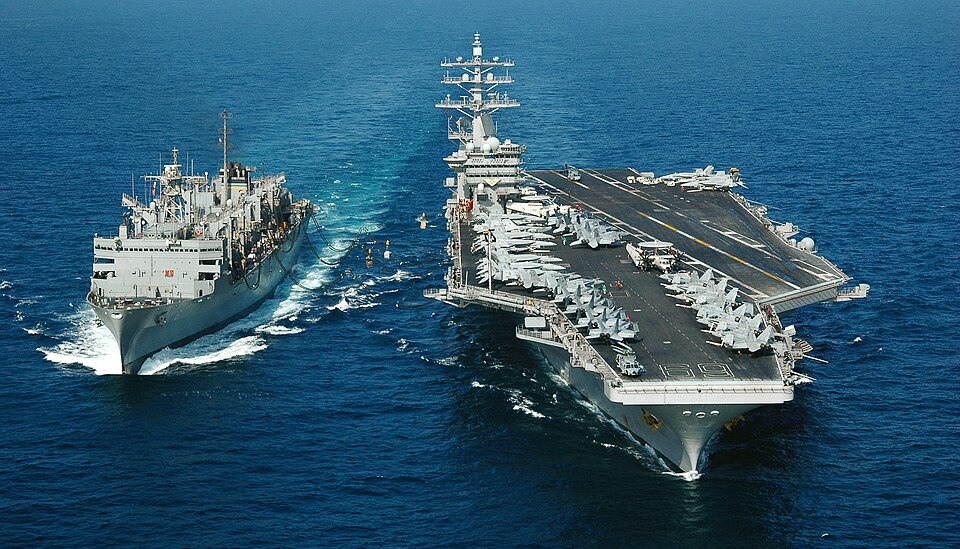
U.S. Central Command says a months-long "steel wall" blockade is already preventing nearly all non-humanitarian cargo from reaching Iranian ports, and on or about Saturday it unveiled Task Force Iron Gate, a small Tampa-based team meant to help U.S. agencies interdict advanced weapons, dual-use materials and illicit revenue moving over Iran's land borders and via the Caspian Sea.[2][3] To enforce the oil blockade, Washington now has three carrier strike groups and more than a dozen escorts operating from the Mediterranean to the Arabian Sea, even as U.S. aircraft and refueling tankers have been pulled back from British bases amid what officials describe as Iran-linked threats.[1][4] Iran has answered with a flurry of moves of its own: an Islamic Revolutionary Guard Corps spokesman announced that Tehran has scrapped its self-imposed 2,000-kilometer ceiling on ballistic-missile range and promised new "astonishing" weapons and underground facilities, while nuclear officials declared they will neither surrender "even a single particle" of enriched uranium nor allow International Atomic Energy Agency inspectors into bomb-damaged nuclear sites until the blockade ends and a permanent peace is in place.[2][5]
The latest exchange comes as Iran broadens the fight beyond its shores, launching three drone attacks since Friday on U.S. radar and helicopter facilities in Bahrain that hosts the Navy's 5th Fleet, all intercepted without American casualties according to U.S. and Bahraini officials.[6] Around the Strait of Hormuz and the nearby Bab el-Mandeb chokepoint, Iranian forces and allied Yemeni Houthis have also been blamed for missile strikes, naval mines and other attacks that UN and maritime monitors say made October one of the worst months for commercial shipping since the war's early weeks, even as U.S.-escorted tankers have pushed overall Gulf oil flows back toward prewar levels.[7][8] In one escalatory step that rattled Gulf capitals, the IRGC navy struck navigation and radar systems on Oman's tiny Didamar Island, which Iran called an "enemy navigation aid" used to help ships bypass its control, highlighting how Tehran is now willing to hit infrastructure on the territory of a neutral neighbor.[9]
The current confrontation grew out of President Donald Trump's decision on February 28 to go to war with Iran over its nuclear program, a move he still defends as necessary to stop Tehran from getting a bomb, even as Iran insists it does not seek one.[5] After early U.S.-Israeli airstrikes on nuclear-linked sites, Iran retaliated with waves of missiles and drones at bases across the Middle East and beyond, causing an estimated $3.7 billion in damage to U.S.-used facilities and destroying or damaging nearly 60 aircraft, according to Pentagon figures cited by European media.[10] Washington responded by steadily ratcheting up economic pressure, culminating this summer in a near-total naval blockade of Iranian ports that CENTCOM now credits with blocking more than $25 billion in crude exports in recent months.[3] Attempts at de-escalation repeatedly stumbled: a June deal brokered by Qatar and Pakistan to reopen the Hormuz waterway and start broader nuclear talks collapsed as both sides resumed strikes, and cease-fire drafts shuttled by Qatari mediators in October and early November never overcame Iran's demand that the U.S. first lift its oil blockade and sanctions.[11][12]
Reporting on the war's maritime dimension has shifted sharply in recent weeks. Early this fall, U.S. officials emphasized that about 97% of ships seeking to cross the Strait of Hormuz were doing so without being hit by Iranian fire and touted a "steel wall" of escorts that had helped move more than a billion barrels of oil under protection.[13] By mid-October, however, the UN's maritime chief was warning that the region faced a "severe and critical" situation, with 24 ships attacked in roughly two weeks and some 6,000 sailors effectively trapped amid what he called a "double blockade" of Iranian strikes and the U.S. port cordon.[7] Subsequent incidents, from the sinking of the container ship GFS Pride after an Iranian projectile strike to mine damage on multiple tankers reported by both UK and Iranian authorities, have reinforced the darker picture, even as U.S. commanders insist their convoys are keeping most oil moving.[13][5]
The new land-route clampdown through Task Force Iron Gate reflects Pentagon worries that Iran is adapting around the sea blockade by shifting to overland and Caspian channels, a risk flagged earlier this year by a Center for Strategic and International Studies assessment that pointed to Pakistan, Central Asia and the Caspian's five coastal states as likely conduits, with China as the main supplier of technology to rebuild Iran's military industry.[14] CENTCOM's own description of Iron Gate underscores both its ambition and its limits: the task force numbers only about 20 staff in Florida, and the command has not said how it will physically stop shipments or whether governments along Iran's borders have agreed to cooperate.[3] Iran, for its part, has dismissed the initiative as "wordplay" and claims to have quietly secured understandings with neighbors to withstand added pressure, an assertion that cannot be independently verified.[2]
Inside the United States, the grinding conflict is straining both politics and the economy. Updated Pentagon figures show 23 U.S. service members killed and 865 wounded since the war began, while the Energy Information Administration reports average gasoline at just over $4.15 a gallon and diesel above $6.29 in early November, more than a dollar and $2.50 higher than a year earlier.[15][16] Vice President JD Vance has bluntly blamed Republicans' midterm losses on the war, arguing that many 2024 Trump voters crossed over to Democrats to end the conflict and lower costs, while Treasury Secretary Scott Bessent and other senior officials have moved onto military bases after intelligence warnings that Iran has stepped up plots against American leaders.[15][17] Trump has oscillated between threatening to "destroy what is left" of Iran's infrastructure and saying there is "no reason" to escalate and that the war is "militarily ... effectively over," even as he keeps three carriers on station and empowers economic hawks who promise an "economic onslaught" until Tehran accepts U.S. terms.[18][19] For Gulf states and shippers caught in between, an Allianz Trade report estimating more than $200 billion in physical damage and nearly $790 billion in projected war-related economic costs by 2030 underscores what is at stake if Washington's expanded pressure and Iran's newly unconstrained missile posture tip the stalemate back into a broader war.[5]
Show source details & analysis (37 sources)
📊 Relevant Data
CENTCOM's November 7, 2026 release describes Task Force Iron Gate as an internal staff of about 20 civilian and military personnel based at its Tampa, Florida headquarters that will coordinate with other U.S. agencies; the release does not say how shipments would be stopped or whether governments along Iran's borders are involved, and it states that the naval blockade has kept Iran from exporting more than $25 billion in crude oil in recent months.
CENTCOM Launches Task Force to Disrupt Iranian Ground Transit Routes Supporting Illegal Shipments — U.S. Central Command
A June 2026 CSIS assessment warned that disrupted sea routes could push Iran toward supply networks through Pakistan, which reportedly authorized re-exports to Iran in April, Central Asia and the Caspian Sea, which it noted is 'a closed sea governed by its five littoral states,' and therefore harder for U.S. forces concentrated in the Gulf to disrupt; it identified China as the likely main supplier of equipment Iran needs to restore military production.
CENTCOM launches task force to disrupt Iran's weapons supply routes — Stars and Stripes
U.S. regular gasoline averaged $4.153 a gallon in the week of November 2, 2026, $1.134 above a year earlier, and on-highway diesel averaged $6.292, $2.539 above a year earlier, according to the Energy Information Administration.
Gasoline and Diesel Fuel Update — U.S. Energy Information Administration
📌 Key Facts
- The U.S. has expanded pressure on Iran by combining a months‑long naval blockade of Iranian ports—described by U.S. Central Command as a "steel wall" that largely halts non‑humanitarian imports and exports—with the creation of Task Force Iron Gate, a new effort to interdict advanced weapons, dual‑use materials and illicit revenue moving over Iran’s land borders and via the Caspian Sea.
- To reinforce this pressure, the U.S. has surged forces so that three carrier strike groups—the USS George H.W. Bush, USS George Washington and USS Theodore Roosevelt—plus more than a dozen escorts now operate in the broader region enforcing the oil blockade, while aircraft and tankers have been repositioned from British bases amid what officials describe as Iran‑linked threats.
- Iran has responded by stepping up attacks around the Strait of Hormuz and neighboring waters, including missile or projectile strikes and naval mines that Iranian state TV says have damaged multiple tankers, an IRGC strike on Omani navigation and radar systems on Didamar Island, and dozens of incidents that UN and maritime monitors say have made October and November some of the worst months for commercial shipping since the war began.
- Despite these attacks, U.S. officials say shipping under protection is largely moving, with CENTCOM reporting that roughly 97% of ships transiting the Strait of Hormuz have avoided being hit and that protected flows have recently carried well over a billion barrels of oil, even as overall traffic remains far below prewar levels.
- Iran has broadened the conflict’s geographic scope by resuming direct strikes on U.S. and partner facilities—launching drones at a U.S. radar site in Bahrain, threatening bases as far away as Britain in IRGC statements, and warning it could target undersea internet cables and other critical infrastructure in Gulf states if the U.S. and Israel escalate again.
- Amid this standoff, Iranian officials have set firm conditions for easing tensions: they demand an end to the U.S. naval blockade, sanctions relief on oil and gas, and a broader cease‑fire, and they have ruled out allowing IAEA inspections at war‑damaged nuclear sites or surrendering "even a single particle" of enriched material until the war is permanently over and a diplomatic settlement is reached.
- In a major shift to its deterrent posture, an IRGC spokesperson announced that Iran has lifted its previous self‑imposed 2,000‑kilometer limit on ballistic‑missile range, vowing to unveil new underground missile facilities and weapons that would "astonish the entire world" if a new wave of confrontation with the U.S. and Israel occurs.
- Inside the U.S., the war has killed 23 service members and wounded 865 according to updated Pentagon figures, contributed to high but recently easing fuel prices, and is widely blamed by Vice President JD Vance and many analysts for Republicans’ midterm losses—political fallout that has intensified debate over whether to keep relying on blockades and limited strikes or pursue a negotiated end to the conflict.
- Diplomacy has seesawed as Qatari mediators shuttled cease‑fire drafts between Washington and Tehran and Vice President Vance quietly proposed renewed peace talks, even as President Trump alternated between threatening to "destroy what is left" of Iran’s infrastructure and later saying there is "no reason" to escalate and that the war is "militarily … effectively over."
- The nuclear and maritime standoff has deepened international anxiety: a recent Allianz Trade report estimates more than $200 billion in physical damage across Gulf states and projects war‑related economic costs near $790 billion by 2030, while UN maritime officials warn that thousands of sailors are effectively trapped amid what they describe as a "severe and critical" double blockade of Iranian ports and threatened commercial routes.
📊 Analysis & Commentary (1)
"The author argues that the midterm results will be a decisive test both of President Trump's electoral strength and of pollsters' methods — stressing that structural polling limits, turnout-model uncertainty, and late breaking events (like strikes or last‑minute policy moves) mean poll forecasts should be interpreted probabilistically and with humility rather than as certainties."
📰 Source Timeline (37)
Follow how coverage of this story developed over time
- On Tuesday, November 17, 2026, Iran launched drones at a U.S. radar facility in Bahrain, its third attack on American military targets in Bahrain in recent days after a roughly two‑month lull in fighting.
- Bahrain said its air defenses intercepted the "treacherous Iranian aerial attacks," and U.S. officials reported no damage to U.S. equipment or injuries to American personnel from Tuesday's strike.
- Iran also attacked a U.S. early‑warning radar facility in Bahrain on Friday, November 13, and fired at a radar system at an American helicopter base there on Sunday, November 15, marking a clear resumption of direct strikes on U.S. sites in the kingdom.
- The article underscores that the U.S. naval blockade in and around the Strait of Hormuz has been in place for months and has returned Gulf oil shipments under U.S. protection to roughly prewar levels, while significantly curbing Iran's crude exports.
- The report adds that a third U.S. carrier strike group, the USS Theodore Roosevelt, has arrived in the broader region, bringing combined U.S. naval forces in the Persian Gulf, Arabian Sea, Red Sea and Mediterranean above the level at the start of the war.
- Analysts quoted in the piece state that Tehran may now see "breaking the blockade through escalation" as potentially less costly than accepting its continuation, suggesting that the risk of renewed large‑scale war no longer depends solely on whether President Trump chooses to strike Iran again.
- On Tuesday, November 17, 2026, Iran launched drones at a U.S. radar facility in Bahrain, marking its third attack in recent days on American military targets in the country after a roughly two‑month lull.
- Bahrain reported that its air defenses intercepted the 'treacherous Iranian aerial attacks,' and the U.S. military said there was no damage to U.S. equipment and no American casualties.
- Analysts quoted in the article say Iran may now be weighing whether escalating attacks to try to break the U.S. naval blockade is less costly than accepting its continuation, shifting escalation risks away from being solely dependent on U.S. decisions.
- The piece notes that oil shipments from the Gulf have returned to roughly prewar levels for tankers moving under U.S. protection, while the blockade is significantly damaging Iran's economy by limiting its crude exports.
- The article confirms that with the arrival of the USS Theodore Roosevelt, U.S. carrier presence in the wider region now exceeds levels seen at the outset of the war, further reinforcing the blockade and regional deterrence posture.
- A U.S. official confirmed on Monday, November 16, 2026, that the aircraft carrier USS Theodore Roosevelt and its strike group have arrived in the Middle East, bringing the number of U.S. carrier strike groups in the region to three.
- The Roosevelt left San Diego in September and joins the USS George H.W. Bush and USS George Washington, which have been in the region since April and August respectively to help enforce the naval blockade of Iranian shipping.
- The current U.S. flotilla in the Arabian Sea now includes three carriers, 13 destroyers, two cruisers and a littoral combat ship, with two additional destroyers operating in the Red Sea.
- The Roosevelt deployed alongside the USS Makin Island amphibious readiness group (USS John P. Murtha and USS Anchorage and about 2,000 Marines), though those amphibious ships have not yet reached the theater.
- President Trump, after midterm losses partly blamed on the Iran war, has publicly alternated between threatening additional large-scale strikes, saying the U.S. is "locked and loaded" and monitoring the Pickaxe Mountain nuclear facility, and telling reporters the war is "militarily ... effectively over" and that the U.S. no longer needs a deal with Tehran.
- Trump has told Vice President JD Vance to stop Iran cease-fire negotiations and instead focus on a domestic anti-fraud campaign targeting Democratic-controlled jurisdictions, contributing to a stall in talks as Iran insists the U.S. first lift the oil blockade.
- Iranian state TV said on Monday that naval mines have damaged six oil tankers in the Strait of Hormuz since Sunday, while the UK Maritime Trade Organization reported a separate projectile strike on a tanker that caused an engine-room fire but no casualties.
- U.S. Central Command stated it has redirected about 150 merchant vessels and disabled five since June as part of the blockade, and Lloyd's List data indicate traffic through the Strait of Hormuz remains below one-third of prewar levels.
- On Sunday, November 15, 2026, the aircraft carrier USS Theodore Roosevelt entered the U.S. Central Command area of responsibility, bringing the number of U.S. carrier strike groups in CENTCOM back to three.
- Israeli journalist Barak Ravid reported on November 15 via X that 'the U.S. military now has three aircraft carrier strike groups in CENTCOM,' citing a U.S. official; CENTCOM has not yet publicly commented.
- In comments reported by CBS News and restated here, Iranian Deputy Foreign Minister Kazem Gharibabadi reiterated that Iran will not grant the International Atomic Energy Agency access to its facilities until Iran's conditions are met and the war has 'permanently ended,' a stance that explicitly ties inspection access to a postwar diplomatic settlement.
- Gharibabadi, via Iranian state outlet irib-news.ir and a Persian-to-English translation, linked future IAEA access to resolution of the current situation, a permanent end to war, a diplomatic understanding, and changes in U.S.-Iran interactions.
- On Sunday, November 15, 2026, Iranian Deputy Foreign Minister Kazem Gharibabadi said on state television that Iran will not allow the International Atomic Energy Agency to inspect nuclear facilities damaged in the war with the U.S. until "Iran's conditions are met and the war has permanently ended."
- The article notes that IAEA inspectors last gained access only to Iran's Bushehr nuclear plant in September 2026; they have not been allowed to inspect other sites that were targeted by U.S. strikes.
- On Monday, November 16, 2026, the UK Maritime Trade Operations Center reported that a tanker transiting outbound through the Strait of Hormuz was struck by an unknown projectile, causing a fire in the engine room but no casualties, with all crew accounted for.
- Also on November 16, 2026, Iran's state broadcaster reported that a tanker east of the Strait of Hormuz caught fire after hitting a naval mine in what Tehran called a "restricted area," saying offending vessels are exposed to "serious risks"; it is unclear whether this refers to the same vessel as the UKMTO report.
- A Yemen-based group allied with the Saudi-backed, internationally recognized Yemeni government said its Southern Armed Forces have pulled back from areas along the Bab el-Mandeb Strait to focus on defending Aden and breaking the Houthi siege of Taiz, a move that has allowed Iran-backed Houthi forces to consolidate control over the strait.
- Local reporting from Yemen cited in the piece says Houthis fired two ballistic missiles at the Buraiqeh district on Aden's western coast and that fresh clashes occurred in Lahj province, which controls key supply routes near the Bab el-Mandeb waterway.
- In the days after the November 3, 2026 midterm elections, President Trump publicly said on multiple occasions that he is unlikely to order new major strikes on Iran and described the Iran war as ‘militarily … effectively over,’ while also warning the U.S. remains ‘locked and loaded’ against targets such as the Pickaxe Mountain nuclear-linked facility.
- Trump told reporters after meeting Qatar’s prime minister at the White House early in the week of November 9 that he did not expect to need additional major strikes, signaling to mediators that the U.S. might rely more on economic pressure and the naval blockade than further kinetic escalation.
- On Thursday, November 12, 2026, Trump posted on social media that the U.S. ‘doesn’t need’ a deal with Iran and directed Vice President JD Vance to focus his ‘complete and total attention’ on a domestic anti-fraud campaign, effectively sidelining his chief Iran negotiator even as Vance was weighing re-engaging Iranian officials.
- Two Middle East diplomats involved in mediation said Qatar had believed talks on restoring safe traffic through the Strait of Hormuz were on the ‘right track’ after the White House meeting, but Trump’s November 12 post created a sense of limbo and uncertainty about whether Washington still wants a negotiated agreement.
- The article reports that October 2026 saw the highest number of reported incidents against commercial ships in the Strait of Hormuz since February, according to United Nations figures, even as overall oil shipments through the strait have returned to near prewar levels.
- Iran’s deputy U.N. ambassador Gholamhossein Darzi told the U.N. Security Council on Friday, November 13, 2026, that Iran has ‘never closed the door to diplomacy’ but warned that any renewed U.S. or Israeli bombing would provoke an ‘immediate and decisive response.’
- Secretary of State Marco Rubio, speaking Friday evening, November 13, 2026, to the Federalist Society, claimed economic sanctions and the naval blockade are causing such ‘economic pain’ to Iran that ‘there’s no need for military action because we’ve weakened them so much,’ reinforcing the administration’s preference for pressure over new strikes.
- The article notes that Trump plans to discuss Iran and nuclear stockpiles at a first-ever trilateral summit with China’s Xi Jinping and Russia’s Vladimir Putin on the sidelines of the Asia-Pacific Economic Cooperation meetings in Shenzhen next week, adding a diplomatic dimension to the military and economic pressure described in earlier coverage.
- Iran’s Islamic Revolutionary Guard Corps navy struck navigation systems, radar, and communications equipment on Didamar (Little Quoin) Island, an Omani island in the Strait of Hormuz, in an attack assessed by the Institute for the Study of War as occurring on November 8, 2026.
- Three sources told Reuters that navigation and communications systems on Didamar Island were attacked; EU Copernicus Sentinel‑2 satellite imagery dated November 8 showed apparent scorch marks near radar and radio equipment.
- Iranian state media and Fars News Agency framed the strike as targeting 'enemy navigation aid systems' allegedly used to help vessels transit the strait without Tehran’s authorization and to support 'oil smuggling by the enemy.'
- Despite the strike, ISW reported that commercial vessels continued to use the southern shipping route through Omani territorial waters following the attack, and the extent of functional damage to the systems remains unclear.
- The article reiterates that CENTCOM has reinstated a naval blockade of Iranian ports and is advising commercial traffic to use the southern route in Omani waters outside Iran’s direct control, making an Iranian attack on Omani infrastructure particularly sensitive.
- Article reports that Treasury Secretary Scott Bessent has 'recently' relocated from his home to an unspecified U.S. military base for security reasons, as of reporting on November 11, 2026.
- A person familiar with the matter told the Associated Press that the move was partly prompted by media reports that exposed Bessent's home address.
- The story reiterates that recent U.S. intelligence indicates Iran has stepped up efforts to target American personnel in the Middle East and elsewhere, contributing to the State Department's decision last month to reduce staffing at four U.S. embassies in the region.
- The article recaps that Treasury in August pledged an 'economic D-Day' against Tehran and details that the United Arab Emirates and Turkey have halted Iran's top commercial bank from issuing transactions in their countries, while some major Iranian airlines have been cut off from key routes from Istanbul to Muscat, Oman.
- It notes that other top officials, including Secretary of State Marco Rubio and Defense Secretary Pete Hegseth, also live on military bases, indicating a broader security posture for senior Trump administration figures.
- On Wednesday, November 11, 2026, the secretary of Iran's Supreme National Security Council publicly vowed that Tehran would not allow the removal of "even a single particle of enriched nuclear material" from the country, directly rejecting a core U.S. demand in peace talks.
- President Donald Trump's longstanding justification for launching the war with Iran is reiterated as preventing Tehran from obtaining a nuclear weapon, a goal Iran continues to deny while now hardening its stance on retaining enriched uranium.
- Defense Secretary Pete Hegseth said on Tuesday, November 10, that "crazy Islamists in Tehran will never ever have a nuclear weapon," underscoring the U.S. position even as Iran refuses to part with its enriched stockpile.
- Iran's Islamic Revolutionary Guard Corps on Wednesday claimed two more oil tankers struck sea mines and caught fire while allegedly attempting to leave the Strait of Hormuz via an "unauthorized" route under U.S. fighter protection; the IRGC issued a similar claim on Tuesday, and the U.K. Maritime Trade Operations center reported a tanker hit by a projectile Tuesday evening.
- A new Allianz Trade report released Wednesday estimates that physical damage from the U.S.-Iran war across Gulf Cooperation Council states slightly exceeds $200 billion, with more than 80 energy facilities hit, mostly in Kuwait, Qatar and Bahrain, and projects total war-related costs for GCC economies at about $790 billion through 2030, or a cumulative 5.9% of regional GDP relative to the pre-war trend.
- The New York Times, cited by CBS News, reports Treasury Secretary Scott Bessent has relocated from his home in the Washington, D.C. area to a U.S. military base because of an Iranian threat against his life; the article does not specify the exact date of the move.
- An unclassified memo from Director of National Intelligence Jay Clayton sent last month to Secretary of State Marco Rubio warned that Iran has "substantially increased" efforts to target Americans, including current and former U.S. officials, and that Iranian plotting is at a "more advanced stage."
- A Treasury Department spokesperson told the New York Times that Bessent "will not be deterred by the Iranian regime's threats" and remains committed to an "economic onslaught" of sanctions targeting Iran.
- In response to the same threat environment, the State Department has recently adjusted staffing at U.S. diplomatic posts across the Middle East, and the U.S. military has pared back its footprint in the region and removed some aircraft from two British bases after reported Iran-linked threats.
- On Monday, November 9, 2026, two U.S. KC-135 refueling tankers and other aircraft were flown out of RAF Mildenhall in eastern England to bases in Germany, Scotland, and Spain because of a threat linked to Iran.
- This follows the early-October withdrawal of roughly a dozen U.S. Air Force bombers from RAF Fairford in southwestern England, shortly after five masked men with three white vans were arrested about 250 yards from the base fence.
- UK prosecutors charged two men on October 27 under the UK National Security Act, including one accused of assisting a foreign intelligence service and working with a handler known as Mr. Ali on behalf of Iran; Iranian officials deny involvement.
- The Pentagon has publicly estimated that Iranian missile and drone retaliation since the February 28, 2026 U.S.-Israeli attacks has caused about $3.7 billion in equipment losses, including nearly 60 aircraft and damage to hundreds of buildings at U.S.-used bases in eight countries.
- Iran’s Islamic Revolutionary Guard Corps has explicitly threatened to retaliate against countries hosting or assisting U.S. operations, and in July its statements mentioned RAF Fairford by name while warning any renewed U.S. escalation could trigger strikes beyond the Middle East.
- On Monday, November 9, 2026, the U.S. Air Force moved 10 KC-135 Stratotanker refueling aircraft from RAF Mildenhall in England to other locations in Germany, Spain and Scotland, including Spangdahlem Air Base, Ramstein Air Base, Morón Air Base and Glasgow Prestwick Airport.
- Three U.S. Osprey tiltrotor transport aircraft also departed RAF Mildenhall and were relocated to RAF Lakenheath in England on November 9–10, 2026.
- The Wall Street Journal, citing unnamed sources, reported that nine Stratotankers were repositioned due to a threat from Iran, though it is unclear whether the threat was imminent or general.
- A U.S. official told CBS News that the U.S. takes 'proactive measures to ensure our aircraft, our people, and our installations remain safe and secure,' while an Air Force spokesperson said such aircraft rotations occur routinely for training and 'real world requirements' and declined to tie movements to a specific threat.
- The article links the Mildenhall relocation to a broader security context in the U.K., noting that in late September 2026 the U.S. Air Force removed all long-range bombers from RAF Fairford after a security incident there that led to terrorism and foreign-intelligence–related charges against two men, and that U.K. Prime Minister Andy Burnham has said there are strong indications Iran 'played a part' in that incident.
- On Sunday, November 8, 2026, President Trump told CBS's 60 Minutes he sees "no reason" to escalate the war with Iran and is "not looking" to do so, while still insisting that starting the conflict will prove "historically" a good decision despite current economic pain.
- Trump said Iran's nuclear program was his main justification for launching the war in late February 2026 and argued he had done "what's right for our country."
- Trump posted on Truth Social on Sunday that Task Force Iron Gate "is in full force and effect" and, together with what he called "history's greatest Naval Blockade," means "very little gets into, or out of, Iran."
- Secretary of State Marco Rubio told reporters late Sunday, November 8, before departing for a G7 meeting in Paris, that U.S.-Iran talks are "not at the verge of a breakthrough" because Iran's demands are "simply not just unacceptable," though he reiterated that Trump prefers a diplomatic solution.
- Trump is scheduled to meet Qatari Prime Minister Sheikh Mohammed bin Abdulrahman Al Thani at the White House on Monday, November 9, 2026, with Axios reporting Al Thani will urge Trump to allow more time for diplomacy as Qatar continues to mediate indirect U.S.-Iran talks.
- On or about November 7, 2026, U.S. Central Command announced 'Task Force Iron Gate', a new initiative aimed at interdicting advanced Iranian weapons systems, dual‑use materials and illicit revenue flows across Iran's land borders and via the Caspian Sea.
- CENTCOM commander Adm. Brad Cooper said the task force is intended to constrain Iran's ability to finance terrorism, rebuild weapons factories and replenish its military, and will rely on expanded collaboration with U.S. interagency partners.
- IRGC spokesperson Brig. Gen. Hossein Mohebbi stated that Iran has lifted its previous self‑imposed 2,000‑kilometer ballistic missile range limit, saying 'that restriction has been lifted for us' in reaction to the U.S. move.
- Mohebbi warned on November 7 that Iran is developing new weapons that would 'astonish the entire world' if a 'third wave of confrontation' with the U.S. and Israel occurs, and threatened that future Iranian blows would 'leave them crippled for years to come.'
- Mohebbi also claimed Iran is preparing to unveil additional underground missile facilities and asserted that Tehran has coordinated with neighboring states to withstand added U.S. pressure, dismissing Task Force Iron Gate as mere 'wordplay.'
- On Thursday, November 5, 2026, President Trump said the world "will know very soon" his decision on whether to make a deal to end the war with Iran or order new strikes to "destroy what is left" of the country.
- On Friday, November 6, 2026, Qatar's emirate office reported that President Trump called Emir Sheikh Tamim bin Hamad Al Thani to discuss "diplomatic efforts aimed at de-escalating tensions in the region," emphasizing continued dialogue to prevent further escalation.
- Energy analyst Patrick De Haan told CBS News that the U.S. average gasoline price, at about $4.06 per gallon on November 5–6, 2026, is likely to fall below $4 next week, with diesel possibly dropping under $6 per gallon by Thanksgiving, mainly because markets expect midterm results to pressure Trump to strike a deal with Iran.
- Iran's Islamic Revolutionary Guard Corps stated on Friday, November 6, 2026, that two oil tankers hit mines and caught fire in or near the Strait of Hormuz, one day after Tehran claimed five other tankers had been similarly damaged.
- A Saudi-led coalition said on Friday, November 6, 2026, that its air defenses intercepted and destroyed two ballistic missiles launched by Yemen's Iran-backed Houthi rebels toward the Saudi city of Najran, with debris damage still being assessed.
- On November 4–5, 2026, after Democrats’ midterm sweep, Trump told reporters in the Oval Office that despite the electoral backlash he is “very much locked in” and would not have done anything differently in the Iran war.
- The article details several strategic options analysts say Trump is weighing post‑election: maintaining the current defensive‑strike posture and oil blockade, striking Iran’s deeply buried Pickaxe Mountain nuclear‑linked facility, or mounting large‑scale attacks on Iranian infrastructure.
- It reports that Israeli Prime Minister Benjamin Netanyahu pressed Trump in a weekend call before the election for renewed strikes on Iran, but Trump did not commit to new military action.
- The piece cites AP Voter Poll data from Election Day showing about 6 in 10 voters think going to war with Iran was the wrong decision and only about one‑third rated the Iran war as “crucial” to their congressional vote, compared with roughly half for cost of living and government corruption.
- Vice President JD Vance, in a lengthy social media post, explicitly blamed the GOP’s midterm losses on the Iran war, writing, “The reason we lost is the war,” while Trump initially blamed Republican candidates.
- Analysts note that Brent crude oil prices fell below $95 per barrel on Wednesday, November 4, 2026, the lowest level in about two months, signaling markets did not expect an immediate major U.S. escalation against Iran after the election.
- The article confirms that on Monday, November 2, 2026, what Iran describes as a 'limited strike' hit unspecified targets on Qeshm and Hengam islands and near Bandar Abbas, but Iranian authorities have not publicly detailed the sites or damage.
- Iranian state TV said on Wednesday, November 4, 2026, that four oil tankers caught fire after striking mines on what it called unauthorized routes in or near the Strait of Hormuz.
- Ayatollah Mojtaba Khamenei and parliament speaker Mohammad Bagher Qalibaf publicly framed the November 3, 2026 U.S. midterm results as Americans saying 'no' to the Iran war and warned of 'nightmare' consequences if Washington ignores the vote.
- The piece notes that despite ceasefire agreements and diplomacy, military confrontations have continued in southern Iran and around the Strait of Hormuz since the earlier reported pre‑election strikes.
- It adds that as of November 4, thousands of U.S. troops remain deployed offshore to enforce the naval blockade on Iranian ports, with another carrier and additional troops en route to the region.
- On Wednesday, November 4, 2026, Vice President JD Vance publicly stated on X that "the reason we lost is the war," blaming the Iran conflict for Republicans losing both chambers of Congress.
- Vance wrote that many 2024 Trump/Vance voters chose Democrats in 2026 for four reasons: to end the war with Iran, address cost of living and inflation, pursue an 'America First' focus, and change the U.S. relationship to Israel.
- He cited Florida as an example where the 2026 electorate was about nine points more Republican than Democratic, only slightly less R-leaning than 2024, and argued the main GOP problem was vote-switching, not turnout.
- Vance endorsed Fox News host Rachel Campos-Duffy's call for a 'diplomatic resolution' to the Iran conflict, calling her recommendation 'sound.'
- The article updates Pentagon figures, stating that as of early November 2026 the Iran war has killed 23 U.S. service members and wounded 865.
- It notes that on Monday, November 2, 2026, the U.S. launched limited defensive strikes on Iranian targets in the Strait of Hormuz and that President Trump said the war will end 'when I say it ends.'
- President Trump told Fox News on Election Day that the war was partially to blame for Republican losses but maintained that 'people understand the importance of what I've done.'
- Article specifies that the latest U.S. strikes were carried out Monday, November 2, 2026, hours before Tuesday’s midterm elections.
- Iranian state media reported explosions on Qeshm and Hengam islands and near Bandar Abbas, confirming the geographic focus of the strikes.
- A U.S. official, speaking on background, said the strikes targeted Iranian units using surface-to-air missiles against U.S. forces operating in the Strait of Hormuz.
- Maj. Gen. Mohsen Rezaei, head of Iran's Supreme National Security Council, said on Tuesday, November 3, that the U.S. response to Tehran’s conditions to end the war was not convincing and wrote that the strait would not reopen until those conditions are met.
- The article lays out Iran’s stated conditions for reopening the strait and resuming nuclear talks: lifting the U.S. naval blockade on Iranian ports, waiving sanctions on Iranian oil sales, and observing a ceasefire that includes Lebanon.
- Vice President JD Vance, speaking before the strikes were confirmed, publicly stated that he and President Trump "feel pretty good" about prospects for a negotiated settlement with Iran.
- The piece confirms that the Trump administration’s last previously known attacks in the theater were in early September, and that thousands of U.S. troops remain enforcing a naval blockade aimed at preventing Iranian oil exports.
- It adds sourcing that Netanyahu over the prior weekend pressed Trump by phone to launch another wave of strikes on Iran after the U.S. elections, according to two regional officials and a third person familiar with the call.
- On Monday, November 2, 2026, the U.S. conducted new, unannounced strikes on Iranian targets on Qeshm and Hengam islands and near Bandar Abbas in the Strait of Hormuz, according to a U.S. official and Iranian state media.
- A U.S. official said the latest operation targeted Iranian units that had been using surface‑to‑air missiles against U.S. forces in the strait.
- President Donald Trump had publicly said the U.S. would not strike Iran before the November 3 midterm elections, making this pre‑election action a departure from his stated position.
- U.S. Vice President JD Vance said Monday, November 2, that he and Trump "both feel pretty good" about prospects for a negotiated settlement with Iran, even as the new strikes were carried out.
- Israeli Prime Minister Benjamin Netanyahu pressed Trump in a weekend call for another wave of U.S. strikes on Iran after the U.S. elections, according to two regional officials and another person briefed on the call.
- The same regional officials said mediators are advancing a framework in which Iran would cease attacks in the Strait of Hormuz in return for the U.S. lifting its naval blockade of Iranian ports, with more talks planned this week.
- Iranian parliament speaker and chief negotiator Mohammad Bagher Qalibaf said Tuesday, November 3, that Iran had delivered a "firm and rational" response to the U.S. and warned that further U.S. miscalculations would open a "new battlefield."
- Iran on Monday opened a third Basij military training center in Tehran and announced plans to train 1 million paramilitary volunteers nationwide through about 1,500 training bases.
- Iranian authorities said the 1 million‑volunteer Basij training effort would be conducted across all cities and towns and framed it as preparation amid fears of renewed conflict.
- Residents in Tehran interviewed in the piece expressed guarded hope or skepticism that the U.S. midterm elections would change Washington's policy toward Iran.
- CBS video segment, published Tuesday, November 3, 2026, reports that U.S. officials confirmed defensive strikes on Iran's Qeshm Island after a U.S. aircraft came under fire.
- The segment reaffirms that the Qeshm operation is characterized by U.S. officials as a defensive response to fire on an American aircraft, consistent with earlier written reports but presented as an Election Day-eve update.
- At the Manama Dialogue security conference in Manama, Bahrain, held the weekend before Tuesday, November 3, 2026, Gulf Arab officials privately and publicly discussed the possibility that the U.S. could 'within days' reignite its war with Iran after the midterm elections.
- Senior Emirati official Anwar Gargash told the conference that Iranian and American positions on a potential deal remain 'far apart' and warned that if those gaps are not bridged, regional governments 'have to worry about the worst.'
- The article reports that American and Israeli military officials have drawn up an expanded target list inside Iran that includes energy infrastructure and other sites vital to the Iranian economy, going beyond the limited Qeshm Island strikes.
- Iranian officials have warned they would retaliate for any renewed attacks by striking critical infrastructure and underwater communications cables in the Gulf region, raising fears among Gulf states that host U.S. bases and energy facilities.
- President Donald Trump told Fox News on Monday, November 2, 2026, that 'there's a very good chance we make a deal' with Iran even as U.S. forces carried out limited strikes on Qeshm Island that same day, according to U.S. officials cited in the article.
- On Monday, November 2, 2026, a U.S. official said the United States conducted defensive strikes on some Iranian targets in the Strait of Hormuz after 'Iranians using surface to air missiles against U.S. assets' were identified.
- Iranian state television reported explosions heard on Qeshm Island on November 2, indicating impacts on or near the island.
- The new strikes occurred despite President Donald Trump previously saying the U.S. would not launch new strikes on Iran before Tuesday's midterm elections.
- Vice President JD Vance said Monday he and Trump "feel pretty good" about prospects for a negotiated settlement and confirmed he sent a letter last week to Iranian security chief Mohsen Rezaei focused in part on assisting Iran with medical supplies.
- The article reports that Qatari mediators held two rounds of talks with Iranian officials last week on a framework under which Iran would cease attacks in the Strait of Hormuz in exchange for the U.S. lifting its naval blockade of Iranian ports, with more talks planned this week.
- Regional officials say Israeli Prime Minister Benjamin Netanyahu pressed Trump in a weekend phone call to launch a quick but extensive post-election air campaign against Iran; Trump did not commit to new large-scale strikes during that call.
- Other unnamed Middle East allies are warning U.S. officials that expanded strikes on Iran could destabilize the region and spur more attacks by Iran-allied Houthis in Yemen and by Iran-backed militias in Iraq.
- Iran's new supreme leader, Ayatollah Mojtaba Khamenei, told Iran's military chiefs that any response to U.S. or Israeli threats should be immediate and without geographic limits, and he urged expanding the list of potential targets.
- Iranian security chief Mohsen Rezaei said on state television that the 'tone has completely changed' from the U.S. side after receiving Vance's letter, calling it a very good sign even though he had not yet responded.
- The article notes that October saw the most attacks on commercial ships in the Strait of Hormuz since March as Iran stepped up pressure to end the U.S. blockade, contributing to regional anxiety despite a same-day drop in oil prices tied to perceived diplomatic headway.
- On Monday, November 2, 2026, the U.S. military launched limited defensive strikes on Iranian targets near the Strait of Hormuz, U.S. officials told CBS News.
- A senior U.S. official said the strikes targeted sites on Iran's Qeshm Island after Iran's Islamic Revolutionary Guard Corps fired at an American aircraft.
- The strikes occurred on the eve of the November 3, 2026, U.S. midterm Election Day, as President Trump has been considering restarting broader hostilities with Iran after the elections.
- The Wall Street Journal first reported the existence of the strikes earlier on November 2, 2026.
- An Iranian delegation left Qatar on Sunday, November 1, 2026, after talks on ending the war, with a draft proposal circulated and a follow-up meeting under discussion.
- Iran’s latest public proposal would fully reopen the Strait of Hormuz to shipping within two days if the U.S. lifts its blockade of Iranian ports and meets other conditions.
- U.S. President Donald Trump said Sunday evening, November 1, 2026, that he had a 'very good' call with Israeli Prime Minister Benjamin Netanyahu on Saturday in which they discussed Iran, though he gave no details.
- New supreme leader Ayatollah Mojtaba Khamenei, meeting Iran’s military chiefs, ordered that any U.S. or Israeli threat receive an immediate response without 'geographic limits' and called for expanding the list of potential targets.
- Iranian security chief Mohsen Rezaei said 'the tone has completely changed' from the U.S., called that a 'very good sign,' and confirmed receiving but not yet answering a letter from U.S. Vice President JD Vance.
- Rezaei told state TV that Iran has made no decision to change its nuclear doctrine, despite internal debate about doing so if the country is attacked again.
- Iranian Foreign Minister Abbas Araghchi said the final outcome of negotiations depends on U.S. answers to 'Iranian questions' and was in Turkmenistan on Monday for consultations.
- At the Manama Dialogue security summit in Bahrain over the weekend of October 31–November 1, 2026, Gulf and Egyptian officials warned that current U.S.-Iran positions are far apart and a next escalation would be 'more dangerous, more destructive.'
- China announced it will send a special envoy to Iran, Oman and Saudi Arabia in early to mid‑November and that Foreign Minister Wang Yi met senior Iranian security official Ali Bagheri Kani, with Xi Jinping saying the Gulf region should not become an arena for great‑power rivalry.
- On Saturday, October 31, 2026, President Trump said the U.S. still had to 'take care of' one or two additional targets in Iran, citing a suspected nuclear complex at Pickaxe Mountain.
- On Sunday, November 1, 2026, Trump repeated that warning, saying he may have to give Tehran 'the hammer' at some unspecified time.
- Iran’s Supreme Leader Ayatollah Mojtaba Khamenei warned on Saturday, October 31, 2026, that if fighting with the U.S. resumes there would be no 'geographical limitations' and 'a vast theatre' to inflict damage.
- Iranian Foreign Minister Abbas Araghchi said in Qatar that Iranian negotiators are reviewing a proposal that could reopen the Strait of Hormuz soon and that the outcome depends on answers from the United States.
- President Trump told reporters on Sunday, November 1, 2026, that he had a 'very good talk' with Israeli Prime Minister Benjamin Netanyahu on Saturday about the war in Iran; Axios-sourced accounts say Netanyahu urged new U.S. strikes while Trump prefers to let negotiations proceed.
- United Arab Emirates presidential adviser Anwar Gargash said on Sunday, November 1, 2026, that the UAE hopes for a diplomatic solution but is preparing for 'the worst' and described 2026 as a 'watershed year' after Iranian attacks on Gulf states.
- The article reiterates that Qatari mediators held a third straight day of indirect talks on Sunday, November 1, 2026, in an effort to reach a deal before a possible resumption of U.S.-Iran hostilities.
- Over the 72 hours preceding Sunday, November 1, 2026, Qatari mediators shuttled between Tehran and Doha to try to avert possible new U.S. attacks on Iran expected after the November 3 midterm elections.
- Iranian Foreign Minister Abbas Araghchi told Iranian state media on November 1 that mediation has produced no definitive conclusion but that discussions include a potential two-day plan under which Iran would refrain from attacking ships in the Strait of Hormuz to enable direct U.S.-Iran talks.
- At a Halloween event at Mar-a-Lago in late October 2026, President Donald Trump said the U.S. and Israel had 'knocked out' almost all of Iran's military equipment and nuclear capabilities and could strike one or two remaining nuclear sites 'in 10 minutes,' but he did not specify what he would do after the midterms.
- Reporting from Bahrain notes that senior European diplomats and Arab military officials in the Gulf say they do not know what Trump will decide, and that tens of millions of people in the region are directly exposed to the consequences.
- On Friday, October 30, 2026, a Qatari delegation led by a senior adviser to Qatar's prime minister and foreign minister returned to Tehran to push a peace deal between Iran and the U.S., according to IRNA, Reuters, AFP and a U.S.-briefed official.
- An official confirmed to CBS News on Wednesday, October 28, 2026, that Qatari mediators had already presented Iran with a new draft deal to end the war.
- A senior Iranian official told Reuters that Qatar's latest proposals were 'unacceptable' and that Tehran would not change its stance on the nuclear issue, insisting the U.S. first lift its blockade of Iranian ports and drop oil and gas sanctions.
- Iranian Foreign Minister Abbas Araghchi wrote on X on Wednesday, October 28, 2026, that Tehran 'continues to give diplomacy a chance to succeed' and is reviewing mediator ideas based on an Iranian proposal floated last month that President Trump rejected but Iran still backs as the basis for a cease-fire.
- President Trump said on Thursday, October 29, 2026, that Vice President JD Vance's recent letter to Iranian security chief Mohsen Rezaei was aimed only at facilitating medical supplies into Iran, denying that it was intended to rekindle broader peace talks; Iranian media report Tehran has not yet replied to the letter.
- A British navy monitor reported Thursday evening, October 29, 2026, that a tanker was struck by a projectile in the Strait of Hormuz, following Iran's claim that four ships using U.S.-promoted shipping lanes had hit sea mines.
- As of late October 2026, the Pentagon's Defense Casualty Analysis System lists 23 U.S. service members killed since the start of the Iran war, including 11 deaths from enemy fire and 12 nonhostile deaths; the two most recent additions were airmen, one who died of illness and another whose cause is under investigation.
- Vice President JD Vance sent a letter last week via Qatari mediators proposing a renewal of comprehensive peace negotiations with Iran, which was delivered Sunday, October 25, 2026, to Gen. Mohsen Rezaei, secretary of Iran's Supreme National Security Council.
- Vance's letter suggested that American and Iranian officials meet soon for talks and stated that he would personally lead the negotiations for the United States.
- A senior Iranian official said Iran's leaders received the proposal positively and that Gen. Rezaei was expected to formally reply by Thursday, October 29, 2026.
- A senior U.S. official said President Donald Trump read and approved Vance's letter before it was sent to Tehran.
- The article reports that President Trump has been weighing a possible renewal of active strikes against Iran after next Tuesday's midterm elections, and that the U.S. military has drawn up an expanded target list including Iranian energy infrastructure and other key economic sites.
- U.S. officials reiterated that Iran has warned it would retaliate fiercely, including by targeting infrastructure and underwater cables in the region, and that U.S. intelligence last week assessed Iran as being in advanced stages of planning attacks against Americans in the Middle East and other regions.
- On Monday, October 26, 2026, high-level delegations from Saudi Arabia, Pakistan and Turkey met Iranian leaders in Tehran to try to avert renewed fighting in the Iran war.
- Iranian President Masoud Pezeshkian told the visiting delegations that Tehran supports any agreement that deepens regional cooperation and resolves differences among Islamic countries.
- Qatari mediators also traveled to Tehran on Sunday, October 25, 2026, working in coordination with the United States to help de-escalate regional tensions.
- The article reports that a June agreement brokered by Pakistan and Qatar, aimed at fully reopening the Strait of Hormuz, ending the U.S. blockade of Iranian ports and launching broader nuclear talks, unraveled as both sides resumed attacks.
- Israeli Prime Minister Benjamin Netanyahu warned again on Sunday, October 25, 2026, that Iran or its proxies might attack before Israel's election and said Israel's military is ready 'to defend and to strike' with 'disproportionate blows.'
- Israel's Channel 12 reported a clash between Netanyahu and the military chief of staff over an instruction by Netanyahu to carry out an 'action' that the army believed could rapidly restart conflict with Iran; Netanyahu's office and Defense Minister Israel Katz publicly denied any pre-election strike plans.
- The piece details intensified Yemen fighting: early Monday, October 26, 2026, Houthi spokesman Yahya Saree claimed ballistic-missile attacks on Saudi-backed forces in Aden and Lahj, while residents reported explosions in Sanaa and along the Red Sea coast and Houthi media alleged coalition strikes on a solar system and water well.
- Saudi-led coalition spokespeople said an operation in Houthi-controlled areas destroyed five tunnels used for ballistic missiles, four missile launchers and other missile storage infrastructure.
- On Monday, October 26, 2026, Egypt's parliament approved President Abdel-Fattah el-Sissi's request to provide military support to Saudi Arabia to help defend against Houthi attacks.
- On Sunday, October 25, 2026, President Trump told Fox News he was deciding whether to "finish" Iran militarily or "make a deal," saying either option would be "very easy to do."
- As of early Monday, October 26, 2026, Brent crude oil was trading around $115 per barrel after a surge late the previous week tied to supply concerns from wars in the Middle East and Ukraine and rising winter demand.
- The article reports that additional U.S. forces, including a third aircraft carrier group, have been sent to the Middle East while overall U.S. troop presence in the region is quietly being reduced and diplomatic staffing has been cut.
- Iran's foreign ministry said on Monday, October 26, 2026, that the outcome of Israel's October 27 elections "makes no difference" to Tehran, after Prime Minister Benjamin Netanyahu warned of possible Iranian attempts to disrupt the vote.
- Iranian and Saudi officials confirmed that on Monday, October 26, 2026, senior officials from Saudi Arabia, Turkey and Pakistan would meet Iranian counterparts in Tehran to discuss regional security and de-escalation.
- Ali Bagheri Kani said on state television that Saudi Defense Minister Khalid bin Salman, Pakistani army chief Gen. Asim Munir and Turkish intelligence chief Ibrahim Kalin would attend the Tehran meeting alongside Iran's security chief Mohsen Rezaei, and Saudi Deputy Minister for Public Diplomacy Rayed Krimly said the talks support de-escalation and mediation efforts by Qatar and Pakistan.
- On Wednesday, October 21, 2026, Iranian Foreign Minister Abbas Araghchi said indirect negotiations with the U.S. are continuing over a seven‑day ceasefire proposal that President Trump initially rejected last month, with Washington seeking new clauses.
- On October 21, 2026, Brig. Gen. Yadollah Javani, the Islamic Revolutionary Guard Corps deputy for political affairs, warned that if the U.S. and its allies launch new attacks on Iranian infrastructure, Iran could retaliate against "investments and assets," explicitly including undersea internet cables running through the Strait of Hormuz.
- Analysts cited in the report said cutting those cables would most likely disrupt internet connectivity in Persian Gulf countries, underscoring potential regional infrastructure impacts beyond shipping.
- On Wednesday, October 21, 2026, Yemen's Houthi movement claimed it struck a Saudi military operations room at Badr Camp in Aden with a ballistic missile, calling it an accurate, direct hit and marking the third claimed Houthi attack on Aden in a week.
- A Qatari aircraft briefly landed in Tehran on Tuesday, October 20, 2026, and departed about 30 minutes later, with Iranian media noting the unusually short visit amid ongoing U.S.–Iran indirect ceasefire talks and Qatar's role as a mediator.
- Despite elevated global oil prices near five‑month highs, President Trump said on Tuesday, October 20, 2026, that the U.S. was "doing very well" with Iran and that he had yet to "make a final decision of which way do we want to win" the war "the nice way or the not nice way."
- On Monday, October 19, 2026, Russian Foreign Minister Sergey Lavrov was due in Tehran for his first visit since the U.S. launched its war with Iran on February 28, 2026, saying talks are aimed at preventing a return to large-scale war.
- Iran's foreign minister says Tehran's proposal from late September for a seven-day ceasefire with the U.S., a phased reopening of the Strait of Hormuz, and lifting of the U.S. naval blockade and oil sanctions remains on the table despite President Trump's rejection last month.
- The U.K. navy's Maritime Trade Operations center reported that last week saw 10 attacks on commercial vessels in and near the Strait of Hormuz, making October the worst month for shipping attacks there since the war's early weeks in March.
- A tugboat traveling southbound off the coast of the United Arab Emirates near the Strait of Hormuz reported on Sunday, October 18, 2026 that it was struck by two unknown projectiles, sustaining damage and one minor casualty but continuing its route.
- Crude oil prices remain above $105 per barrel and recently reached a five-month high near $110, levels tied to the war and intensified shipping attacks.
- On Monday, October 19, 2026, the U.S. government issued a security alert urging Americans in the Middle East to exercise heightened vigilance, citing Iranian-supported Houthi attacks on Saudi civilian airports and infrastructure and warning that Iran-backed groups could target U.S. interests or locations associated with Americans worldwide.
- On Sunday, October 18, 2026, International Maritime Organization Secretary-General Arsenio Dominguez told Fox News Digital that the Strait of Hormuz region now faces a 'severe and critical' situation for international shipping.
- Dominguez said around 6,000 seafarers have been trapped near the Strait of Hormuz since the beginning of the conflict and warned shipowners not to transit the strait or put crews at risk 'until we have guarantees.'
- He cited reports that 24 ships have been attacked in or near the waterway over roughly two weeks, significantly updating the tally of recent incidents.
- Dominguez described the situation as a 'double blockade,' referring to both Iranian attacks on commercial shipping and the U.S. naval blockade of Iranian ports.
- Iran sent a letter dated October 9, 2026, to the International Maritime Organization accusing U.S. forces of misusing VHF Channel 16, the international maritime distress and safety frequency, to intimidate Iranian civilian crews, and that letter was circulated to IMO member states.
- The Iranian complaint, filed by Ambassador Seyed Ali Mousavi, alleges U.S. military forces in the Persian Gulf repeatedly occupied Channel 16 for prolonged periods, used Persian-language 'threatening, abusive and provocative' language, and in some cases urged Iranian seafarers to abandon their vessels, though it provided no recordings or detailed transcripts.
- In a statement to Fox News Digital, U.S. Central Command defended its conduct, saying the months-long naval blockade of Iranian ports is 'professionally communicated' to all mariners, that noncompliant ships receive multiple warnings and 'ample opportunity to comply,' and that U.S. forces remain 'highly vigilant, focused, and professional' while enforcing the blockade.
- CENTCOM spokesperson Capt. Tim Hawkins said this week that roughly 97% of ships that sought to transit the Strait of Hormuz have done so successfully without being hit by an Iranian projectile.
- CENTCOM confirmed that the Singapore-flagged, Cyprus-owned container ship GFS Pride was struck by an Iranian projectile in the Strait of Hormuz on Wednesday, October 14, 2026, and later sank while being towed ashore because of a fire onboard.
- Adm. Brad Cooper said Friday, October 16, 2026, that more than 20 civilian mariners have been killed by Iranian attacks on commercial shipping since February, citing International Maritime Organization figures.
- Cooper added that over the last seven days about 400 merchant ships sailed through the Strait of Hormuz and that U.S. forces helped Gulf partners move over 100 million barrels of crude oil during that period, contributing to more than 1.3 billion barrels shipped through the Strait in recent months under U.S.-assisted protection.
- CENTCOM states that the USS Rafael Peralta is enforcing a 'steel wall' military blockade of Iranian ports, allowing no exports or imports to Iran except humanitarian shipments permitted by the U.S.