
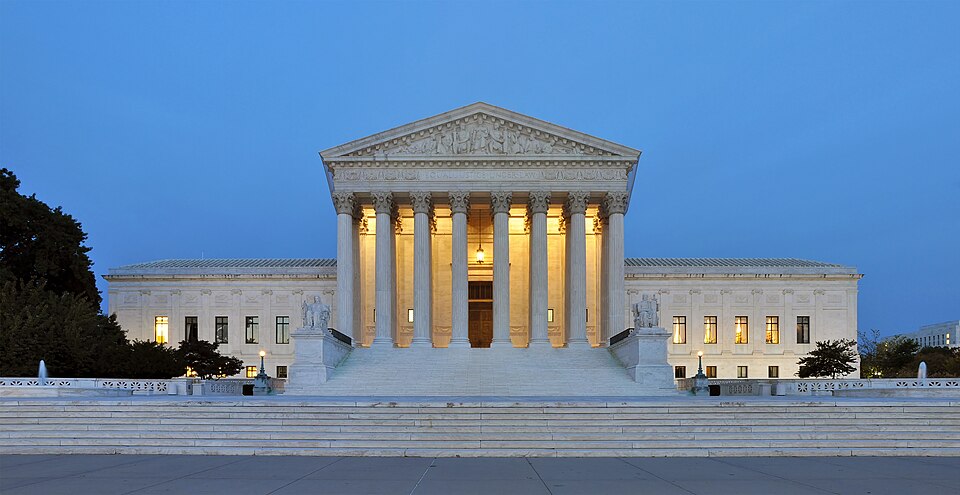
Supreme Court Allows Trump Third-Country Deportations To Resume And Sets December Hearing
On September 29, 2026 the U.S. Supreme Court allowed the Trump administration to resume deportations to third countries while it agreed to grant full review and hear oral argument in December.[1]
The court stayed a February 2026 district-court injunction that had required migrants be given notice and a chance to challenge third-country removals.[2] The justices asked parties to brief whether lower courts had authority to intervene and whether the policy violates due-process and anti-torture protections.[1]
Late on September 23 the 1st U.S. Circuit Court of Appeals issued a near-midnight clarification saying its prior order allowing third-country flights to continue was no longer in effect.[3] That clarification forced cancellation of a charter flight from Alexandria, Louisiana carrying about 70 people bound for Burundi, Rwanda and the Central African Republic.[3] In emergency filings Solicitor General John Sauer told the court the third-country removal policy is an "essential tool" used to deport tens of thousands when home countries refuse to accept them.[1] Advocates told the justices class members removed without meaningful notice faced prolonged detention, beatings, sexual assault, disappearance and onward refoulement.[1] Reporting shows the administration has used often-secret agreements to transfer people to more than two dozen countries, with most removals to Mexico and advocates estimating roughly 500 sent to non-native African countries.[4]
Early mainstream coverage framed the court's action as a temporary stay that preserved an enforcement tool while flagging the need for due-process answers.[1] Subsequent reporting by PBS and court filings has shifted the focus to individual harms, naming allegations that two men deported to Equatorial Guinea were beaten and held at gunpoint and documenting a Laotian man who spent more than a year in an Eswatini prison after being sent there with no notice.[5]
The December arguments will decide whether the administration can continue these transfers and how much notice or hearing migrants must receive before removal.[1] The question is already playing out in lower courts, where judges are weighing individual battles such as the government's bid this week to vacate a 2019 injunction and deport Kilmar Ábrego Garcia to Liberia.[6]
The mainstream summary emphasizes the procedural aspects of the Supreme Court's decision, framing it primarily as a temporary stay that allows the Trump administration to continue deportations while addressing due-process concerns. However, the Wall Street Journal's analysis highlights a more significant ideological battle over the balance of power between the executive branch and the judiciary, arguing that the Court should defer to executive decisions on national security and immigration matters. This perspective suggests a broader context of judicial activism versus executive authority that the mainstream coverage does not fully explore, potentially downplaying the implications of the Court's composition on future rulings regarding immigration policy.
Moreover, while the mainstream summary notes the individual harms faced by deportees, it does not delve into the systemic issues surrounding the use of third-country deportations. The WSJ commentary points out that the upcoming term presents high-stakes questions that could reshape national policy, indicating that the implications of this case extend beyond immediate legal outcomes to broader questions of governance and executive power. This framing invites a critical examination of how such policies may affect the rights and safety of migrants, an aspect that the mainstream coverage only touches upon superficially.
Show source details & analysis (10 sources)
📌 Key Facts
- On September 29, 2026 the U.S. Supreme Court issued a brief order allowing the Trump administration to resume third‑country deportations and granted full review, scheduling oral argument for December 2026.
- The Court’s order stayed a February 2026 district court order that had required migrants be given notice and an opportunity to challenge third‑country removals, and the justices asked parties to address lower courts’ authority and whether the policy violates due‑process and anti‑torture protections.
- Late on September 23, 2026 the 1st U.S. Circuit Court of Appeals issued a near‑midnight clarification saying its prior order allowing third‑country deportation flights to continue was no longer in effect, forcing cancellation of a deportation flight from Alexandria, Louisiana carrying about 70 people bound for Burundi, Rwanda and the Central African Republic.
- In emergency filings Solicitor General John Sauer argued the third‑country removal policy is an “essential tool” used to deport tens of thousands of people when home countries refused to accept them, while DHS told the Court the lower‑court injunction had caused canceled flights, diplomatic clashes and delays removing people with assault and drug convictions.
- Immigration advocates, represented by the National Immigration Litigation Alliance, told the Court that class members removed without meaningful notice have suffered prolonged and arbitrary detention, beatings, sexual assault, disappearance and chain refoulement; lawyers also allege at least two men deported to Equatorial Guinea were beaten and held at gunpoint.
- Reporting indicates the administration has used often‑secret agreements to transfer people to more than two dozen countries (with reporting suggesting roughly 25,000 removals overall, mostly to Mexico), while advocacy groups estimate about 500 people were sent to non‑native African countries since the program began in 2025; for example, Eswatini accepted deportees in exchange for a $5.1 million payment and has received roughly 30 people.
- High‑profile individual fights continue: on October 6, 2026 federal proceedings returned Kilmar Ábrego Garcia to Judge Paula Xinis as the government sought to vacate a 2019 preliminary injunction blocking his transfer to Liberia; his lawyers asked the judge to convert that injunction into a permanent bar after he was mistakenly deported to El Salvador in March 2025 and later returned to the U.S.
📊 Analysis & Commentary (1)
"The WSJ opinion segment uses an interview with John Yoo to argue that the Supreme Court’s new term will decide consequential separation‑of‑powers and national‑security questions—urging deference to executive judgments (illustrated by the Court’s action on the administration’s third‑country deportation policy) rather than expansive judicial policymaking."
📰 Source Timeline (10)
Follow how coverage of this story developed over time
- On Tuesday, October 6, 2026, Kilmar Ábrego Garcia returned to federal court as the government sought to vacate a preliminary injunction that blocks ICE from detaining and deporting him to Liberia.
- Ábrego Garcia's legal team asked Judge Paula Xinis to convert the existing preliminary injunction into a permanent injunction, which would bar his third-country removal to Liberia.
- A March 2026 memo by then-acting ICE director Todd Lyons argued that deporting Ábrego Garcia to Costa Rica would be 'prejudicial to the United States' because the U.S. had invested resources and political capital negotiating with Liberia to accept third-country nationals.
- The government continued to pursue removal to Liberia even after the U.S. signed an agreement with Costa Rica to accept deportees who cannot legally be returned to their home countries.
- The article reiterates that ICE acknowledged in court filings that Ábrego Garcia's earlier deportation to El Salvador and transfer to the CECOT mega-prison was an 'administrative error' and notes Judge Xinis ordered his release from custody in December 2025 while leaving prior protective orders in place.
- Advocacy group We Are CASA described the Liberia plan as punishing Ábrego Garcia for asserting his constitutional rights and said it will rally at the courthouse, portraying him as a symbol of due process in the immigration debate.
- The article restates that Ábrego Garcia, a Salvadoran national who entered the U.S. illegally as a teenager, has an American wife and child in Maryland and that a 2019 immigration judge found he could not be deported to El Salvador due to gang threats.
- On Tuesday, October 6, 2026, U.S. District Judge Paula Xinis is set to hear arguments on whether to dissolve her 2019 order blocking the deportation of Kilmar Abrego Garcia and allow the Trump administration to remove him to Liberia.
- Abrego Garcia, a Salvadoran man who had been living in Maryland, was mistakenly deported to El Salvador in March 2025 despite Xinis's 2019 order barring removal there due to gang-danger findings; he was held at El Salvador's CECOT mega-prison before being returned to the U.S. in June 2025 to face human-smuggling charges.
- In March 2026, the Trump administration told the court that Liberia had agreed to accept Abrego Garcia and said ICE could charter a plane to deport him there within days if Xinis lifts her bar on removing him.
- Liberia is one of the non-native countries that has agreed to receive U.S. deportees under the third-country removal policy, and the administration began sending Latin American deportees there in August 2026.
- Costa Rica has indicated it would grant Abrego Garcia refugee status or residency, and he designated Costa Rica as his preferred country of removal in August 2025, but DOJ has not pursued that option.
- A federal judge in Tennessee has already thrown out Abrego Garcia's criminal human-smuggling indictment as vindictive prosecution, and DOJ appealed that ruling in August 2026.
- DOJ has also attempted to remove Abrego Garcia to Uganda, Eswatini and Ghana, but those governments declined to accept him; he remains free from ICE custody while his case proceeds.
- A Laotian national, Phone Chomsavanh, who was deported by the U.S. to Eswatini in July 2025 under the third-country removal program, was released from Matsapha Correctional Complex, a maximum-security prison near Mbabane, on Sunday, October 4, 2026, after more than a year in custody.
- Chomsavanh was informed he was being deported to Eswatini only shortly before a U.S. military cargo plane landed there with him and four other deportees, according to his U.S.-based lawyer Tin Thanh Nguyen.
- Nguyen says Chomsavanh had already completed his U.S. criminal sentence before deportation, was never charged with any crime in Eswatini, and had no notice, hearing, or opportunity to object to being left in a foreign prison.
- Nguyen reports that after his release from Eswatini, Chomsavanh transited through Johannesburg and is now being deported onward to Laos, where he was not raised and has no recent ties.
- Advocacy groups Human Rights First and Refugees International estimate around 500 immigrants have been deported from the U.S. to African countries that are not their home nations since the third-country program began in 2025.
- Eswatini agreed to accept U.S. third-country deportees in exchange for a $5.1 million payment from the Trump administration and has received roughly 30 deportees so far under that agreement.
- The article reiterates that about a dozen African countries have accepted U.S. third-country deportees, in some cases in exchange for millions of dollars, and that deportees are often held in countries where they have no ties and face no local charges.
- In the week of September 28–October 2, 2026, the EU adopted bloc-wide rules explicitly allowing member states to send rejected asylum seekers to third countries that meet human-rights and non-refoulement standards.
- On Thursday, October 1, 2026 (per article timing), interior and migration ministers from Greece, Germany, Austria, Denmark, and the Netherlands agreed on a common framework to create 'return hubs' outside the EU for migrants who have exhausted legal remedies and cannot be returned to their home countries.
- Danish Interior Minister Morten Bødskov said Denmark expects to be ready to transfer the first irregular migrants to a partner country outside the EU within 2027.
- Greek Migration Minister Thanos Plevris said Greece aims to have a pilot return-hub project operating in the first half of 2027.
- A Greek government statement said the hubs are expected to be located in safe third countries, particularly on the African continent, with Rwanda mentioned in reporting as a possible partner though no destination has been finalized.
- An October 2025 EU Council discussion paper previously described return hubs as a deterrent to irregular migration that could 'incentivize voluntary returns' by making transfer to a hub an alternative consequence for failing to comply with deportation orders.
- The article documents that the EU explicitly requires any third-country arrangements to comply with international human-rights standards and the principle of non-refoulement.
- The story pairs the EU shift with concrete recent U.S. practice, noting that more than 100 deportees were transferred from the U.S. to eight African countries over 10 days in August 2026, including Liberia, Rwanda, Eswatini and Sierra Leone.
- The September 30, 2026 Up First item briefly recaps the Supreme Court’s September 29 emergency order allowing the Trump administration to resume third-country deportations while the Court hears arguments in December.
- It underscores that the Court asked parties to address lower courts’ authority to intervene and whether the policy violates due process or anti-torture protections.
- The segment reiterates that immigration advocates warn the policy could cause 'irreparable damage,' highlighting at least one immigrant who fears being sent to a country where he would not receive treatment for severe mental illness.
- On Tuesday, September 29, 2026, the Supreme Court expressly framed its action as temporarily allowing the Trump administration to resume its March 2025 third-country removal policy while it hears arguments.
- The CBS report specifies that the district court order the Supreme Court stayed was issued in February 2026 and required that migrants receive notice and an opportunity to challenge third-country removals before being sent out of the U.S.
- The article reiterates that under the policy, deportees can be sent without advance notice of destination to countries that give the U.S. blanket assurances against persecution or torture, and notes that several dozen mainly African and Latin American countries have accepted such transfers over the past 18 months.
- CBS details that some deportees have been sent to high-risk destinations such as the Central African Republic and South Sudan, and recounts testimonies from deported migrants in Liberia who said they only learned they were being sent to Africa hours before departure or mid-flight.
- DHS General Counsel James Percival publicly celebrated the ruling on September 29, 2026 in an X post calling it "our second Supreme Court victory in less than a week" and urging people in the U.S. illegally to self-deport, saying "It's not too late to get $3,000 and a flight home."
- The Justice Department told the Court last week that the lower-court injunction had forced DHS to cancel a removal flight carrying 70 migrants to three countries, some of whom had criminal records, and that the policy has already been used to deport "thousands" with "thousands more" eligible.
- On Tuesday, September 29, 2026, the Supreme Court again allowed the Trump administration to continue deporting people to third countries while it considers the policy's legality, issuing an order that halts a lower appeals-court ruling for now.
- The Court said it will hear arguments on whether migrants must have a meaningful chance to object before being sent to countries where they have no ties.
- Federal attorneys told the Court that the lower-court decision had forced cancellation of a deportation flight carrying about 70 people bound for three countries.
- The article reiterates that under a series of often-secret agreements the administration has deported some 25,000 people to more than two dozen countries, with the vast majority sent to Mexico and others to countries including Liberia and Guyana.
- The administration describes the policy as applying to people with final deportation orders who cannot be returned to their homelands or whose native countries refuse to accept them, including some with criminal convictions, and says receiving governments give assurances against persecution or torture.
- On Tuesday, September 29, 2026, the U.S. Supreme Court issued a brief order allowing the Trump administration to resume, for now, deportations of migrants to third countries not listed in their removal orders.
- The same September 29 order granted full review and scheduled oral argument in the case for December 2026, asking parties to address both lower courts' jurisdiction and the legality of the policy under due process and anti-torture conventions.
- The order noted that the three liberal justices dissented from staying the lower-court ruling, but did not provide a detailed rationale for the majority's decision.
- Solicitor General John Sauer argued in a September 24, 2026 emergency application that the third-country deportation policy is an "essential tool" for removing certain noncitizens, including some with serious criminal records, and said it has been used to deport tens of thousands of people after their home countries refused to accept them.
- The Department of Homeland Security told the Court that U.S. District Judge Brian Murphy's injunction had caused canceled flights, potential diplomatic clashes and delays in removing people convicted of assault and drug crimes.
- Advocates for migrants, represented by the National Immigration Litigation Alliance, told the Court that class members removed without meaningful notice have faced prolonged and arbitrary detention, beatings, sexual assault, disappearance and chain refoulement after third-country deportations.
- Late on Wednesday, September 23, 2026, the 1st U.S. Circuit Court of Appeals issued a near-midnight clarification saying its prior order allowing third-country deportation flights to continue was no longer in effect.
- The 1st Circuit action forced the cancellation of a deportation flight scheduled from Alexandria, Louisiana, that was to carry 70 people to three countries, which plaintiffs said were Burundi, Rwanda and the Central African Republic.
- Attorney General Todd Blanche publicly condemned the 1st Circuit order as issued "in the dark of night" and said it removed an "entirely legal and valuable tool" to curb illegal immigration.
- The article details that, beyond removals to Mexico, the Trump administration has used secret or little-known agreements to deport thousands of people to more than two dozen other countries, including Liberia and Guyana.
- Lawyers for two men deported to Equatorial Guinea this month alleged the men were beaten and held at gunpoint in a hotel-turned-detention center by local police who covered their heads with bags.
- The piece reiterates that the appeals court's underlying ruling does not ban third-country deportations but requires that migrants have a meaningful chance to object if they fear persecution or torture, a process the administration says will cause cascading delays.