
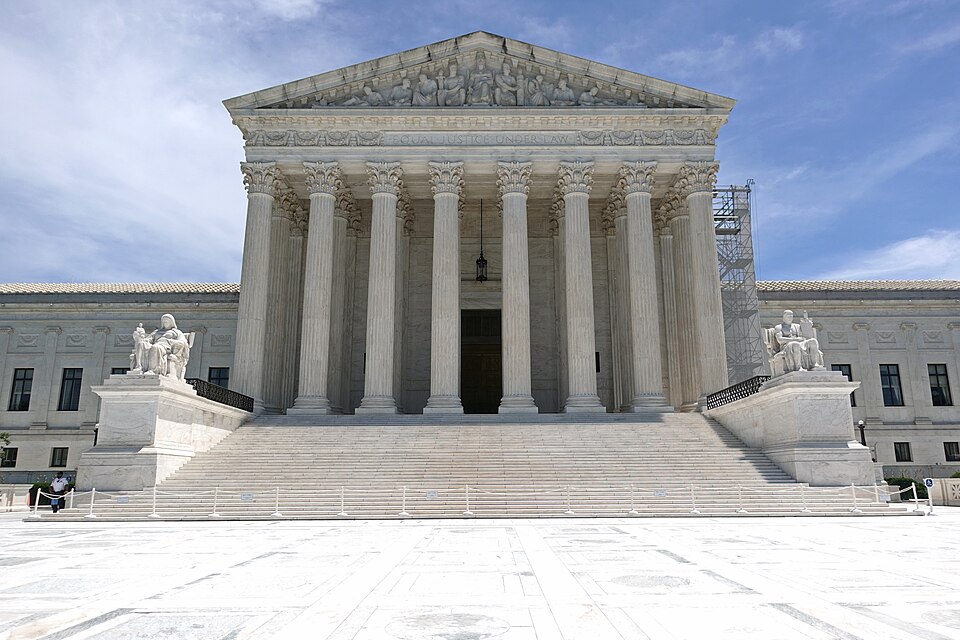
Supreme Court Order And Missouri Rulings Lock In 2022 House Map For November
The U.S. Supreme Court on September 10 blocked Missouri from using a new Republican-drawn congressional map, leaving the 2022 districts in place for the November general election.[1]
Justice Brett Kavanaugh first denied Missouri's emergency request on September 8, leaving the state court's order intact, and the full Court followed with an unexplained order on September 10.[1] U.S. District Judge Stephen R. Clark had issued a 14-day federal order directing use of the Republican-drawn map, producing conflicting federal and state instructions that confused election officials.[2] Secretary of State Denny Hoskins initially rejected the citizen referendum on primary day but later certified Proposition A for the ballot; the Missouri Supreme Court found the December 2025 petition froze the new map.[3]
In December 2025, voters filed a referendum petition challenging the Republican-drawn congressional map enacted after the 2020 census.[4] The Missouri Supreme Court ruled the petition was legal, sufficient and timely and said the filing retroactively suspended the new lines before they took effect.[3]
Initial coverage framed the rulings mainly as a political defeat for Republicans seeking to flip Emanuel Cleaver's 5th District and gain a 7-1 House split.[5] Subsequent reporting shifted tone, highlighting how competing state and federal orders could affect more than 1 million voters and leave many general-election voters in different districts than where they voted in the August primary.[6]
Secretary Hoskins on September 10 directed local officials to use the 2022 map and the Missouri Supreme Court deemed his earlier contempt cured once he issued that guidance.[6] Republican plaintiffs, including Rep. Bob Onder, said they will continue litigating the map's merits in the Eighth Circuit even as the 2022 lines govern November voting.[6]
Show source details & analysis (16 sources)
📌 Key Facts
- The U.S. Supreme Court first declined Missouri’s emergency request on Tuesday, September 8, 2026 (via Justice Brett Kavanaugh) and then the full Court issued an unexplained order on Thursday, September 10, 2026, blocking a federal judge’s direction to use the new Republican-drawn map and effectively requiring use of the 2022 congressional districts for the November election instead (Supreme Court).
- The Missouri Supreme Court found that a citizen referendum petition filed in December 2025 retroactively suspended the Trump-backed map — meaning the new map legally never took effect unless voters approve it — and ordered that the measure appear on the November ballot as Proposition A (Missouri Supreme Court).
- Missouri Secretary of State Denny Hoskins initially rejected the referendum on primary day but later placed the redistricting question on the November ballot as Proposition A; after conflicting court orders he was held in contempt by the Missouri Supreme Court on September 10, 2026 but the violation was deemed cured once he issued guidance reverting to the 2022 map (Secretary of State Denny Hoskins).
- U.S. District Judge Stephen R. Clark issued a 14‑day temporary restraining order on Wednesday, September 9, 2026, directing Missouri to use the Trump-backed map for the November election and warned that switching maps after the primary would “wreak havoc,” creating competing federal and state court orders that produced confusion for election officials (U.S. District Judge Stephen Clark).
- Because the August 2026 primary was conducted under the Republican-drawn map, certified candidates will remain on the November ballot under their district numbers even though the underlying lines will likely revert to the 2022 plan, a shift AP estimates could affect more than 1 million Missouri voters (about one-quarter of the electorate) and would make large parts of some districts new to their candidates (more than 1 million Missouri voters).
- The Trump-backed plan specifically targeted Emanuel Cleaver’s Kansas City-based 5th District by slicing parts into neighboring Republican-held districts and extending the remainder into rural GOP areas, part of a redesign that could have changed Missouri’s U.S. House delegation from 6–2 to 7–1 for Republicans (Emanuel Cleaver's 5th District).
- On September 5, 2026, Missouri Attorney General Catherine Hanaway filed an emergency appeal to the U.S. Supreme Court seeking to revive the GOP-backed map, arguing courts had never ordered a post-primary congressional map change and warning of “unprecedented chaos”; Justice Kavanaugh gave opponents until Monday, September 7, 2026, to respond (Missouri Attorney General Catherine Hanaway).
- Republican plaintiffs, including Rep. Bob Onder, signaled they will continue litigating the merits in the 8th U.S. Circuit Court of Appeals even as the 2022 map is used for the 2026 general election (Rep. Bob Onder).
📰 Source Timeline (16)
Follow how coverage of this story developed over time
- Fox News reiterates that the U.S. Supreme Court's brief, unsigned order issued in early September 2026 blocks Missouri from using the new GOP-backed congressional map in November and requires use of the 2022 map instead.
- The article emphasizes that the blocked map was designed in part to shift parts of Democratic Rep. Emanuel Cleaver's Kansas City-based 5th District into more Republican-leaning areas to make the seat more competitive and potentially give Republicans a 7–1 delegation.
- It notes explicitly that under the Supreme Court's order Missouri will revert to the 2022 map after having already conducted its August 2026 primary on the new map, so some voters will cast general-election ballots in a different district than the one where they voted in the primary.
- Fox cites an Associated Press estimate that the map switch could affect more than 1 million Missouri voters, roughly one-quarter of the state's electorate.
- The piece underscores that candidates and election officials must now adjust to the 2022 boundaries with the November 2026 election only weeks away, describing the situation as adding to 'confusion' from conflicting earlier court orders.
- On Thursday, September 10, 2026, after the U.S. Supreme Court again rejected Missouri's bid to use the Trump-backed map, Secretary of State Denny Hoskins formally directed local election authorities to use the 2022 congressional districts for the November election.
- The Missouri Supreme Court held a contempt hearing for Hoskins on September 10, 2026, found him in contempt for previously instructing use of the new map, but immediately deemed the violation cured once he issued guidance reverting to the 2022 map and imposed no penalties.
- The article reports that Missouri will likely run the November general election under different U.S. House districts than those used in the August 2026 primary, a highly unusual situation that AP estimates could change candidate choices for more than 1 million potential voters, nearly one in four statewide.
- The story details that candidates certified from the August primary will remain on the November ballot under their district numbers, even though the underlying district lines and voter composition will shift under the 2022 map.
- AP notes that the 5th Congressional District under the Trump-backed map would have been dramatically reconfigured, with about 59% of potential voters new to the district compared with the 2022 map, underscoring the political stakes.
- The article clarifies that the Missouri Supreme Court has ordered the referendum on the Trump-backed map to appear on the November ballot as Proposition A and that no court has suggested re-running the August primary despite the map change.
- Republican plaintiffs, including Rep. Bob Onder, said "this isn't over" and plan to continue litigating in the 8th U.S. Circuit Court of Appeals on the merits, even as the 2022 map is used for 2026.
- The piece reiterates that the Missouri Supreme Court held that the citizen referendum petition, filed in December 2025, retroactively suspended the Trump-backed map before it ever took effect, meaning it never legally replaced the 2022 plan absent voter approval.
- On Thursday, September 10, 2026, CBS reported that the U.S. Supreme Court blocked a Missouri federal judge's order that would have allowed the state to use a newly drawn congressional map favoring Republicans in the November 2026 elections.
- CBS emphasized that the blocked map was expected to give Republicans roughly one additional U.S. House seat compared with the currently in-force districts.
- On Thursday, September 10, 2026, the U.S. Supreme Court again rejected Missouri's emergency bid to use the Trump-backed congressional map, with no justices noted as dissenting.
- The order "appears to clear the way" for Missouri to use the congressional map passed in 2022, as previously ordered by the Missouri Supreme Court, meaning the November 2026 general election will likely use different districts than the August primary.
- Also on September 10, 2026, the Missouri Supreme Court held a hearing on whether to hold Secretary of State Denny Hoskins in contempt for directing local officials to use the new Trump-backed map despite the court's earlier order.
- During the hearing, Missouri Supreme Court judges repeatedly pressed Hoskins' counsel to have him issue fresh guidance that same day instructing use of the 2022 map, and Chief Justice W. Brent Powell warned, "We're in a precarious situation."
- The Missouri Supreme Court did not immediately decide on contempt but urged Hoskins not to stray far from Jefferson City while he evaluates next steps, according to Deputy Solicitor General William Seidleck.
- The article reiterates that the 2022 map was passed by Republican lawmakers after the last census and that the Trump-backed plan was designed to shift Missouri's U.S. House delegation from 6-2 to 7-1 by reconfiguring Democratic Rep. Emanuel Cleaver's Kansas City-based district.
- On Thursday, September 10, 2026, the Supreme Court issued an unsigned order with no noted dissents directing Missouri Secretary of State Denny Hoskins to use the 2022 congressional map in the November elections instead of the new Republican-drawn plan.
- The article specifies that the new map targeted the district of longtime Democratic Rep. Emanuel Cleaver and could have shifted Missouri's U.S. House delegation from 6-2 to 7-1 in favor of Republicans.
- The piece notes that minutes before the Supreme Court's order, lawyers for Hoskins and Missouri filed a brief warning it would be "extraordinarily burdensome" to change maps after the August primary and claiming a switch risked disenfranchising "hundreds of thousands of voters."
- The CBS account reiterates that Judge Stephen Clark on Tuesday, September 8, 2026, ordered use of the new map, refused to stay his order late Thursday, and that an Eighth Circuit panel is handling an appeal of his decision.
- The story adds national context that the Missouri map was part of a broader redistricting effort led by President Trump and Republicans to preserve the GOP House majority, with parallel efforts in Texas and North Carolina and a voter-approved but blocked initiative in Virginia.
- On Thursday, September 10, 2026, the full U.S. Supreme Court granted an emergency application from opponents of Missouri's GOP-friendly congressional map to stop the state from using that map for the November midterm elections, issuing an unexplained order with no noted dissents.
- The article details that the new emergency application was filed by Richard von Glahn and the group People Not Politicians, seeking to halt a federal district court order that required use of the new Republican-drawn map.
- The challengers' application accused the federal district judge of "charging forward with federal court interference" into Missouri's election process minutes after Justice Brett Kavanaugh had separately denied Missouri's earlier request to stay the Missouri Supreme Court's ruling.
- Missouri state officials argued to the justices that following the district judge's order to use the new map for November was the only way to avoid "disenfranchisement of hundreds of thousands of voters" who had already voted in the August primary under that map.
- The piece clarifies procedural sequencing: Kavanaugh, as circuit justice, first rejected Missouri's bid to halt the state Supreme Court's instruction to revert to the 2022 map; a federal district judge then ordered the new map used; the latest Supreme Court order from the full Court blocks that federal order and restores the state court's directive.
- On Thursday, September 10, 2026, the full Supreme Court issued a second brief order again preventing Missouri from using the newly redrawn Republican-backed congressional map in the November election.
- The order came in response to an appeal of Chief U.S. District Judge Stephen R. Clark's September 8, 2026 ruling that had directed the state to use the Trump-backed map despite the Missouri Supreme Court's contrary order.
- The Court issued the September 10 order without noted dissents and without a written explanation, effectively siding again with the Missouri Supreme Court's instruction to revert to the 2022 map.
- The article reiterates that Judge Clark's federal ruling was brought by a Republican incumbent congressman seeking reelection and a GOP candidate who had won a primary under the new map.
- The New York Times characterizes Thursday's order as the second intervention by the justices in this Missouri redistricting dispute during the same week, just two months before the general election.
- NPR’s Up First newsletter reports that on Thursday, September 10, 2026, Missouri Secretary of State Denny Hoskins is scheduled to appear before the Missouri Supreme Court to explain why he should not be held in contempt over his handling of the Trump-backed congressional map.
- The article emphasizes that Hoskins has chosen to follow the federal district court order he prefers while ignoring the Missouri Supreme Court’s earlier ruling that rejected the Republican map and required voter approval before it can take effect.
- NPR highlights that because the August primaries already took place under the Republican map, local election officials are now uncertain which congressional districts voters will belong to for the November midterms.
- On Tuesday, September 9, 2026, U.S. District Judge Stephen Clark issued a 14-day temporary restraining order prohibiting Missouri from using anything other than the new Trump-backed congressional districts for the November election.
- Clark’s order came moments after the U.S. Supreme Court declined Missouri Attorney General Catherine Hanaway’s emergency appeal and left in place the Missouri Supreme Court’s injunction requiring use of the old 2022 post‑census districts.
- Missouri Secretary of State Denny Hoskins told local election officials on September 9 they are required to use the new Trump-backed map in light of Clark’s order, while People Not Politicians asked the Missouri Supreme Court to hold Hoskins in contempt for attempting to implement that map.
- The Missouri Supreme Court scheduled arguments for Thursday, September 10, 2026, on the contempt request against Secretary Hoskins.
- Clark’s order applies for 14 days from September 9, 2026, and he wrote that switching from the primary’s new map to the old map for the general election would violate federal rights and “wreak havoc” on fairness and orderly elections.
- On Tuesday, September 8, 2026, the Supreme Court denied an emergency application seeking to block the Missouri Supreme Court ruling that bars use of the new, Republican-favoring congressional map.
- The CBS report frames the decision as the Court "rebuffing" Missouri's request to use the new House map, confirming that the Trump-backed plan cannot be used unless and until voters approve it via the existing referendum process.
- On Tuesday, September 8, 2026, Justice Brett Kavanaugh, acting for the U.S. Supreme Court, denied Missouri Attorney General Catherine Hanaway's emergency request to use a Trump-backed congressional map in the November elections.
- The article details that Hanaway argued switching maps between the August primary and November general election would violate voters' federal rights and create an "election-administration disaster," causing "unprecedented chaos" and making the primary "utterly pointless."
- The story adds that Democratic Rep. Emanuel Cleaver was unopposed in the primary for the redrawn 5th District, while Republican Rick Brattin won the GOP primary under the now-blocked map.
- It specifies that on the day of the August primary, Secretary of State Denny Hoskins rejected the referendum petition as unconstitutional, a decision later reversed by the Missouri Supreme Court, which held that the petition filing in December 2025 froze the Trump-backed map before it could take legal effect.
- The piece explains that Missouri's Supreme Court interpreted a constitutional reference to a referendum on "any act" of the Legislature as encompassing congressional redistricting, thereby requiring the map to go to voters.
- The article reiterates that Hoskins has now placed the referendum on the November ballot as Proposition A in compliance with the state court's ruling.
- On Tuesday, September 8, 2026, the U.S. Supreme Court rejected Missouri Attorney General Catherine Hanaway's emergency appeal seeking to use the new Trump-backed congressional map in the November election.
- The article specifies that the U.S. Supreme Court's action 'rebuffed' Missouri's appeal and left in place the Missouri Supreme Court ruling that a citizen referendum petition automatically suspended the new map.
- PBS/AP reporting explains that the Missouri Supreme Court held the new districts were retroactively frozen as of December 2025, when petition signatures were submitted, meaning the Trump-backed map legally never took effect.
- Missouri Secretary of State Denny Hoskins on Tuesday, September 8, 2026, formally placed the redistricting referendum on the November ballot as Proposition A in compliance with the state Supreme Court order.
- The story details that the Trump-backed map targeted Democratic Rep. Emanuel Cleaver's 5th District by redistributing parts of Kansas City into two neighboring Republican-held districts and extending the rest of the district far into rural GOP areas.
- The article notes that Missouri is currently represented by six Republicans and two Democrats under the 2022 map and that those post‑2020 census districts will govern the November 2026 elections unless Proposition A passes.
- It recounts that on primary day, Secretary of State Hoskins rejected the referendum petition on the ground that the Missouri Constitution does not allow a referendum on congressional redistricting, a position later reversed by the Missouri Supreme Court.
- The article quotes the Missouri Supreme Court's reasoning that the constitutional authorization of a referendum on 'any act' of the Legislature encompasses congressional redistricting legislation, thereby allowing the Proposition A vote.
- Contextual AP reporting adds that Missouri was the second Republican-led state after Texas to respond to President Trump's call to redraw U.S. House districts and that Republicans had hoped to gain up to 16 additional seats nationwide from new maps in eight states.
- Fox News reports on Tuesday, September 8, 2026, that the U.S. Supreme Court rejected Missouri Republicans' emergency request to use the revised, Trump-backed congressional map in the 2026 midterm elections.
- The Fox article frames the denial as a setback for Missouri GOP efforts to implement the new map, emphasizing that the state must continue using its existing post-2020 congressional districts unless voters approve the revised map in the referendum ordered by the Missouri Supreme Court.
- Article publication time is given as 4:49 p.m. Central on Tuesday, September 8, 2026, providing a more precise indication of when the Supreme Court's single-justice order became public.
- On Tuesday, September 8, 2026, Justice Brett Kavanaugh, acting as the circuit justice, denied Missouri's emergency request to use the new GOP-backed congressional map for the 2026 midterms.
- Kavanaugh handled the application alone and did not refer it to the full Court, issuing a standard unexplained denial.
- The denial leaves the Missouri Supreme Court's order in place: the 2022 post‑census congressional map will govern the November election unless voters approve the new map via referendum.
- Missouri's application argued a "federal-election-administration disaster" was unfolding and claimed about 1.2 million Missourians had already voted in the August 2026 primary under the new map.
- Opponents of the state, including referendum backer Richard von Glahn, told the Court there was no real emergency and accused Secretary of State Denny Hoskins of intentionally waiting until the last possible day to reject the referendum petition after implementing the new map for the primary.
- On Friday, September 4, 2026, Missouri Attorney General Catherine Hanaway filed an emergency appeal asking the U.S. Supreme Court to halt the Missouri Supreme Court's ruling that blocked the new congressional map and ordered a referendum.
- U.S. Supreme Court Justice Brett Kavanaugh requested that opponents of the new map file a response to Missouri's emergency appeal by Monday, September 7, 2026.
- Missouri law sets a Tuesday, September 8, 2026, deadline to make changes to the November ballot, and Hanaway's filing argues the state is unsure it can switch its governing congressional map in time without Supreme Court intervention.
- Hanaway's appeal asserts that no court in American history has previously ordered a change of congressional maps after a primary but before a general election, calling the Missouri ruling an 'extraordinary remedy' that creates 'unprecedented chaos.'
- The article reiterates that the Missouri Supreme Court held the referendum petition filed in December 2025 was legal, sufficient, and timely and that the post-2020 census map remains in effect for the November 2026 general election unless voters approve the new map.