
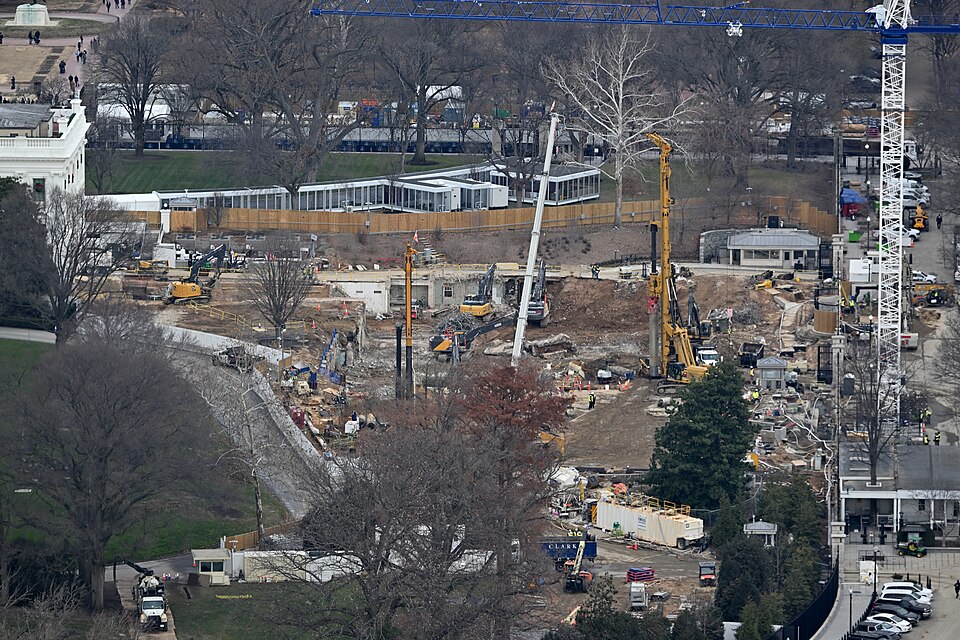
Supreme Court Chief Justice Temporarily Allows White House Ballroom Construction To Proceed
Chief Justice John Roberts issued a one-page administrative order on Friday, August 21, 2026, allowing above-ground construction of President Trump's planned White House ballroom to proceed while the Supreme Court reviews an emergency application.[1]
Roberts' order temporarily put on hold a district-court injunction that had blocked above-ground work and lets construction continue while the Justice Department seeks relief from the full Court.[2] The administration says the 90,000-square-foot project is about 65% complete, crews are working roughly 20 hours a day, seven days a week, and about $200 million in private donations has been spent or committed.[1] Estimates of the project's overall cost vary; NPR reports at least $300 million while other outlets cite roughly $400 million.[3]
Judge Richard Leon's April 16, 2026 order blocked above-ground construction but permitted below-ground bunker and military work, and a D.C. Circuit panel on August 7, 2026 upheld that injunction on grounds the administration lacked congressional authorization.[4] The National Trust for Historic Preservation, which sued to block the project, warns that allowing the stay would let the administration "outrun judicial review." NPR
Early coverage framed Roberts' action as an administrative move to preserve the status quo while appellate review continues.[2] Reporting later shifted to the broader implications, with outlets warning that rapid construction could undercut the courts' ability to lawfully review the project.[3]
Construction began in July 2025 and has closed public access to the north side of the White House and Lafayette Park.[3] An April poll found 56% of Americans opposed tearing down the East Wing to build the ballroom.[3]
Show source details & analysis (8 sources)
📌 Key Facts
- On Friday, August 21, 2026, Chief Justice John Roberts issued a one‑page administrative order placing the district‑court injunction on hold and allowing above‑ground work on President Trump's planned White House ballroom to continue while the Supreme Court considers the administration's emergency application (Chief Justice John Roberts).
- The original U.S. District Court order from April 16, 2026 blocked above‑ground ballroom construction but permitted below‑ground bunker and military work, and a D.C. Circuit panel on August 7, 2026 had upheld that injunction on the ground the administration lacked the required congressional authorization (D.C. Circuit panel).
- The Justice Department sought emergency relief from the Supreme Court after the lower‑court injunction threatened to halt the project, prompting the temporary stay while the full Court considers the government’s request (DOJ).
- The D.C. Circuit majority held the National Trust for Historic Preservation had standing through member Alison Hoagland—rejecting that she could avoid harm by “averting her gaze”—while a dissent argued the asserted aesthetic injury was speculative; the National Trust warned a stay would let the administration “outrun judicial review” (National Trust for Historic Preservation).
- The administration told the courts the 90,000‑square‑foot project is about 65% complete, that crews are working roughly 20 hours a day, seven days a week (about a 250‑person crew), and that roughly $200 million in private donations has been spent or committed so far (the administration).
- Construction, which began in July 2025, has closed public access to the north side of the White House and Lafayette Park, and an April poll found 56% of Americans opposed tearing down the East Wing to build the ballroom (construction).
- Reported cost estimates differ: NPR reports the project is now estimated to cost taxpayers at least $300 million, while other outlets cite roughly $400 million, despite prior presidential assurances taxpayers would not pay (NPR).
- Media accounts varied in characterizing the action: several outlets described Roberts' move as an administrative order preserving the status quo, while CBS framed it as a temporary stay by the full Court that permits construction to continue “for now” (CBS News).
📰 Source Timeline (8)
Follow how coverage of this story developed over time
- On Friday, August 21, 2026, CBS News reported that the Supreme Court "temporarily allowed" President Trump's White House ballroom construction to continue, characterizing the step as a Court action rather than solely a chief justice administrative move.
- The CBS segment, anchored by chief legal correspondent Jan Crawford, reiterated that the order permits construction on the White House ballroom project to go forward "for now" while the justices consider the administration's emergency request.
- On Friday, August 21, 2026, Chief Justice John Roberts issued an administrative stay of an April 16, 2026 preliminary injunction by the U.S. District Court for the District of Columbia that had blocked above‑ground construction of President Trump's White House ballroom.
- Roberts' order explicitly places the district court injunction on hold "pending further order" from himself or the full Supreme Court, allowing above‑ground construction to continue while the Court considers the administration's emergency application.
- The article details that the administration's emergency filing characterized the project as an "integrated military complex" and cited past assassination attempts against President Trump as part of its national‑security rationale.
- The piece reiterates that a federal appeals court had already ruled Congress had not authorized the ballroom and that its mandate blocking above‑ground work was scheduled to take effect on Friday, August 21, 2026, just before Roberts' stay.
- Fox specifies that the National Trust for Historic Preservation, which is suing to block the project, argued in its filing that a 250‑person crew has been working roughly 20 hours a day, seven days a week, and accused the administration of trying to "outrun judicial review" by accelerating construction.
- CBS segment on August 21, 2026 reports the Supreme Court has issued a temporary stay in the White House ballroom case, allowing construction to continue while the legal challenge proceeds.
- The video piece characterizes the action as a temporary stay by the full Court rather than only as an administrative move by the Chief Justice, emphasizing that construction may continue during ongoing litigation.
- On Friday, August 21, 2026, the Supreme Court issued a brief order, signed by Chief Justice John Roberts, allowing President Trump's planned White House ballroom construction to proceed without prior congressional approval while litigation continues.
- NPR reports the project is now estimated to cost taxpayers at least $300 million, higher than the previously cited $250 million estimate, despite prior presidential assurances that taxpayers would not pay for it.
- The National Trust for Historic Preservation’s latest filing argued that granting the stay would effectively end the case by allowing the administration to "outrun judicial review" through accelerated construction.
- The article recounts that Judge Richard Leon initially ordered construction halted in March 2026 except for safety and security additions, the D.C. Circuit then allowed temporary continuation, and Leon later clarified that only below‑ground work could continue while above‑ground construction was barred.
- NPR notes that construction, which began in July 2025, has closed public access to the north side of the White House and Lafayette Park, and cites an April Washington Post‑ABC News‑Ipsos poll finding 56% of Americans opposed tearing down the East Wing to build the ballroom.
- On Friday, August 21, 2026, Chief Justice John Roberts issued a one-page temporary order allowing the White House to continue aboveground construction on President Donald Trump's planned $400 million ballroom while the Supreme Court considers the administration's emergency request.
- The order arrived just hours before lower-court rulings would have forced a halt to aboveground work, and does not set a timetable for a fuller decision by the full Court.
- The administration told the courts that about 65% of the 90,000-square-foot ballroom project has been completed, that crews are working roughly 20 hours a day, seven days a week, and that about $200 million in private donations has been spent or committed so far.
- The administration continues to argue that the president has total authority to renovate the White House and that completing the ballroom is 'vitally required' for national security, while the National Trust for Historic Preservation maintains Trump lacks unilateral authority, especially after demolishing the East Wing.
- A D.C. district court order from April 2026 halted aboveground ballroom construction but allowed belowground bunker and military work to continue, and a D.C. Circuit panel later upheld that injunction, with two Democratic-appointed judges saying the project is for Congress to decide and a Trump-appointed judge dissenting on standing.
- The article reiterates that the National Trust accuses the White House of trying to 'outrun the courts' by accelerating construction before appellate review is complete.
- Axios reports on August 21, 2026, that the Supreme Court allowed President Trump's 90,000-square-foot White House ballroom construction to proceed while litigation continues, consistent with a stay issued by Chief Justice John Roberts.
- The article reiterates that the DOJ sought emergency relief from the Supreme Court after a district court injunction threatened to halt the project, and that the stay is temporary while the Court considers the government's request in full.
- Axios characterizes the order as an administrative move by the Chief Justice that preserves the status quo for the Trump administration's ballroom project pending further Supreme Court action.
- On Friday, August 21, 2026, Chief Justice John Roberts, acting as the Circuit Justice for D.C., issued an administrative order allowing above‑ground construction of President Trump's planned White House ballroom to continue while the full Supreme Court considers the government's emergency request.
- The underlying D.C. Circuit panel decision on August 7, 2026, upheld U.S. District Judge Richard Leon's preliminary injunction on the ground that the administration lacked legally required congressional authorization for the 90,000‑square‑foot ballroom, with Judges Patricia Millett and Bradley Garcia in the majority and Judge Neomi Rao dissenting.
- The D.C. Circuit majority held that the National Trust for Historic Preservation had standing through member and architectural historian Alison Hoagland, rejecting the administration's argument that her alleged aesthetic injury could be avoided by “averting her gaze,” and warning that such a standing theory would bar challenges even to razing major national monuments.
- In dissent, Judge Rao framed the dispute as weighing asserted aesthetic harm to a single passerby against the safety and security interests of the president, family, staff and guests, and argued that Hoagland's claimed injury was either speculative or too generalized to confer standing.
- Judge Leon's injunction, which has been stayed throughout the appeal, would not bar all work and explicitly permits below‑ground construction, including national‑security facilities, and above‑ground work short of building the proposed above‑ground ballroom structure.