
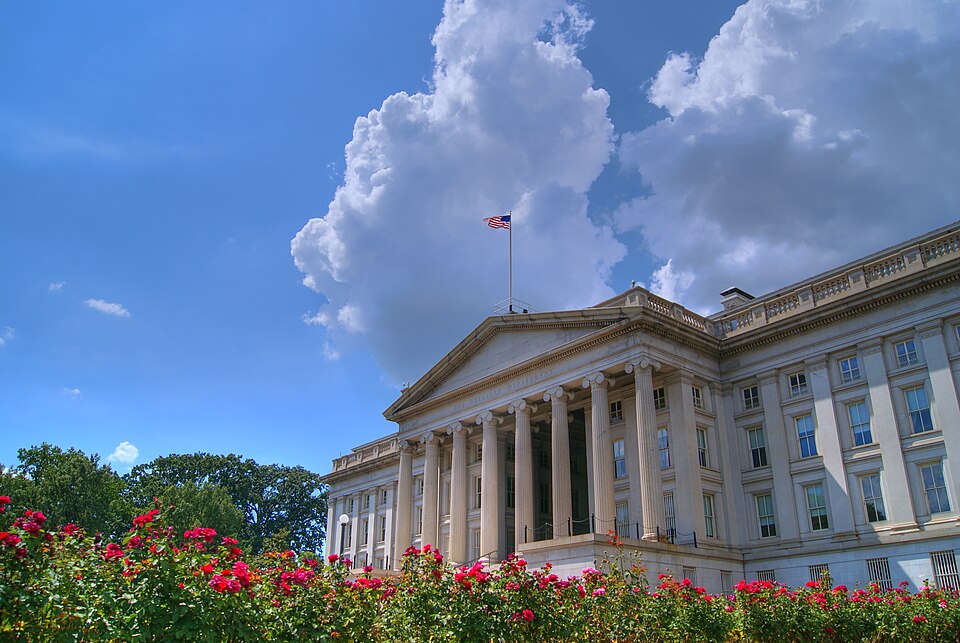
Treasury Launches 'Economic D-Day' Iran Sanctions, Expands Secondary Targets
Treasury Secretary Scott Bessent unveiled an "economic D-Day" sanctions campaign against Iran at a Washington news conference on Monday, Aug. 24, 2026, aimed at severing Tehran's remaining economic lifelines.[1]
Bessent said the initiative, internally called Operation Economic Outcast, broadens U.S. secondary sanctions beyond oil to five sectors — digital assets, technology, gold, aviation and shipping — and included nearly 60 new OFAC designations.[2] Treasury officials warned the campaign can reach countries and governments that facilitate Iran's cashflow and said they would give targeted partners time to wind down Iran business rather than immediately blacklisting them.[3]
On Aug. 7 the Treasury had already designated Dubai-based HMS Trading FZE for helping Iran move oil revenue, part of earlier steps meant to close the financial "gray spaces" that let Tehran retrieve proceeds from overseas oil sales.[4] President Trump had previewed the move on Truth Social and Bessent detailed the plan in a Financial Times op-ed before the press conference.[5] Iran showed acute economic strain as the rial tumbled to roughly 2.02 million per U.S. dollar on the open market and the IMF now forecasts a GDP contraction of more than 5%.[6] Iran's cryptocurrency ecosystem recorded $7.78 billion in transaction volume in 2025, with IRGC-linked wallets receiving over $3 billion that year. Chinese crude imports through the Strait of Hormuz averaged about 530,000 barrels per day in July-August 2026, roughly half of pre-war levels.
Early coverage presented the rollout as a decisive pivot from military pressure to an unprecedented economic assault, but later reporting emphasized Washington's reluctance to immediately punish major partners such as China and framed parts of the announcement as a "warning shot." New York Times That shift in tone — from maximalist rhetoric to targeted timelines and diplomatic caveats — was highlighted by outlets tracking market reactions and Gulf allies weighing whether to comply.[3]
The mainstream summary emphasizes the sanctions as a decisive pivot in U.S. policy, framing them as an unprecedented economic assault on Iran. However, it downplays significant concerns raised by analysts and social media commentators regarding the potential ineffectiveness of these measures. For instance, former ambassador Anil Trigunayat cautions that the sanctions may disrupt global supply chains without effectively pressuring Tehran, suggesting a more complex outcome than the mainstream narrative implies. Additionally, while the summary mentions the broadening of sanctions, it does not highlight the hesitance to immediately punish key partners like China, which is critical in understanding the nuanced approach of the U.S. administration. This reluctance is further underscored by the observation that Bessent's announcement serves more as a warning than an outright declaration of total economic warfare, with targeted timelines and diplomatic caveats being a significant part of the strategy.
Moreover, the mainstream account overlooks the humanitarian implications of such sanctions, which have historically impoverished civilian populations in Iran without achieving desired political outcomes. Research from experts indicates that comprehensive sanctions have often strengthened the repressive capacities of the Iranian state while exacerbating economic suffering among ordinary citizens, a perspective that adds depth to the understanding of the sanctions' potential consequences. This critical context is essential for grasping the broader ramifications of the U.S. sanctions beyond mere economic metrics.
Show source details & analysis (19 sources)
📊 Relevant Data
Iran’s cryptocurrency ecosystem reached $7.78 billion in transaction volume in 2025, with IRGC-linked wallets receiving more than $3 billion that year.
U.S. widens Iran crackdown to encompass crypto, gold, shipping and technology — CoinDesk
Chinese imports of Iranian crude through the Strait of Hormuz averaged about 530,000 barrels per day in July and August 2026, 48 percent below pre-war levels.
Chart of the Week: China’s Iranian oil imports nearly halve since war — The National
📌 Key Facts
- On Monday, August 24, 2026, Treasury Secretary Scott Bessent held a Washington news conference (1 p.m. ET) to unveil what he called an 'economic D‑Day' — internally named Operation Economic Outcast — a campaign Bessent described as "the single greatest financial offensive ever marshaled against an adversary" aimed at severing Iran's economic lifelines and forcing it back to negotiations (Treasury Secretary Scott Bessent).
- The new sanctions framework broadened U.S. secondary‑sanctions exposure beyond oil to five explicitly named sectors — including digital assets, technology, gold, aviation and shipping — and OFAC concurrently designated nearly 60 additional individuals and entities accused of supporting Iran's revenue streams (digital assets).
- Treasury officials said the campaign will reach not only private firms but also countries and governments that facilitate Iran's cashflow; officials stressed they would give targeted countries a wind‑down timeline rather than immediately blacklisting entire trading partners, characterizing the announcement as a 'warning shot' while reserving the option of harsher secondary penalties later (secondary sanctions).
- Earlier enforcement steps this month included an August 7 designation of Dubai‑based HMS Trading FZE and related findings that Iran's Shahr Bank and several Dubai currency‑exchange firms helped move oil revenue abroad; U.S. designations since April 2025 have already targeted some Chinese refiners and financial intermediaries as part of sanctions enforcement (HMS Trading FZE).
- Iranian leaders and officials sharply condemned the U.S. move: Foreign Minister Abbas Araghchi called it 'economic terrorism,' Parliament Speaker Mohammad Bagher Qalibaf dismissed the threats as ineffectual, and new Supreme National Security Council head Mohsen Rezaei warned of 'seismic' retaliation and of possible targeting of Gulf states that participate in the restrictions (Mohsen Rezaei).
- The sanctions rollout came amid acute economic pain inside Iran: on Monday, August 24, 2026, Iran's rial plunged to a record market rate near 2.02 million per U.S. dollar, staple prices have surged (rice ≈ +60%, beef ≈ +150%) and the IMF now forecasts Iran's GDP will contract by more than 5% as war, a naval blockade and sanctions squeeze the economy (Iran's rial).
- Regional and international reverberations followed: the United Arab Emirates announced suspension of trade with Iran, Pakistan sent a high‑level delegation to press for talks, Oman and Iran continued talks about joint management of the Strait of Hormuz (Oman's foreign minister scheduled to visit Tehran on August 25, 2026), and U.S. officials singled out China as the most consequential external actor because of its role as Iran's largest oil buyer (United Arab Emirates).
- U.S. officials and analysts acknowledged an unresolved question over how aggressively Washington will penalize major Iranian trading partners — particularly China — because broader moves against large Chinese banks or sectors could complicate high‑level U.S.‑China diplomacy even as the administration signals it may target non‑oil revenue channels such as gold and cryptocurrency (China).
📰 Source Timeline (19)
Follow how coverage of this story developed over time
- The New York Times article published Wednesday, August 26, 2026, specifies that Treasury's "Economic D-Day" threat explicitly targets Iran's gold, digital assets (cryptocurrency) and aviation industries, in addition to previously described sectors.
- Treasury's Monday, August 24, 2026 statement warned it would "punish any country or entity" that does business with Tehran in these key industries, but stopped short of immediately blacklisting all involved individuals and companies, effectively creating a wind-down negotiation window.
- The article highlights that a central unresolved question is how aggressively the United States will move against major Iranian trading partners such as China, noting that Iran has historically circumvented sanctions through trade with Russia and regional neighbors.
- The report notes that the new Treasury threat came less than a week after the United Arab Emirates announced plans to halt all trade and financial transactions with Iran, linking the U.S. move to a tightening economic squeeze that now extends beyond oil.
- Iran's parliamentary speaker Mohammad Bagher Ghalibaf publicly dismissed the Trump administration's August 24 "Economic D-Day" announcement on social media, claiming that Iran's trading partners were not taking the new U.S. threats seriously.
- Economist Mahdi Ghodsi of the Vienna Institute for International Economic Studies is quoted warning that the broader, generalized sanctions will likely hit ordinary Iranians hardest, saying that as in war "civilians are the casualties" in economic conflict.
- On Tuesday, August 25, 2026, long lines formed at gas stations in Tehran after the U.S. announced the new Iran sanctions campaign, with residents expressing fears of fresh economic pain despite official efforts to downplay the measures.
- Iran's national police chief said Monday, August 24, 2026, that the United States is 'seeking to create unrest in a part of the country or throughout the country' by imposing the additional sanctions.
- Local interviews cited by Agence France-Presse describe Iranians expecting the war to be 'more economic,' anticipating pressure and potential new protests tied to the sanctions-driven squeeze.
- CBS segment on August 25, 2026, characterizes Treasury Secretary Scott Bessent's package as a plan to sever Iran's economy until it "stands alone," underscoring the administration's stated end-goal.
- The segment emphasizes that Bessent publicly threatened countries that continue to trade with Tehran under the new sanctions framework.
- Article publication timestamp (Tuesday, August 25, 2026, 7:50 a.m. Central) helps anchor the public rollout timing of Bessent's announcement and media framing as a new "economic plot" against Iran.
- On Monday, August 24, 2026, NPR reports that Bessent is explicitly telling other governments they must choose between 'economic isolation or return to normalcy' with Iran and warning that 'no entity is beyond the reach of U.S. sanctions.'
- NPR adds that Bessent issued a direct message to Iranian soldiers, asking them to consider whether their commanding officers are leading the country to 'triumph or ruin.'
- The article reports that the United Arab Emirates was among the first countries to publicly announce it would cut off commercial trade ties with Iran after the new U.S. sanctions push.
- NPR details that reactions from other Gulf allies have been muted so far, and that U.S. officials see China as the most consequential player because it is the largest importer of Iranian oil.
- China’s Foreign Ministry is quoted condemning the latest U.S. measures as 'illicit unilateral sanctions without international legal basis.'
- Iran’s Economy Minister Ali Madanizadeh is quoted saying on the night of August 24, 2026, that Iran has been preparing for the sanctions and has a two-year plan to manage the consequences.
- NPR analysis says the Trump administration appears to be counting on regime change in Iran as the path to prevent Tehran from developing nuclear weapons.
- At a Washington news conference on Monday, August 24, 2026, Treasury Secretary Scott Bessent formally announced Operation Economic Outcast as a 'zero leakage' crackdown on Iranian oil smuggling and sanctions evasion.
- Bessent said the administration would not immediately impose secondary sanctions on countries doing business with Iran, instead giving each country a specific timeline to wind down Iran-related activity and characterizing the campaign as a 'warning shot.'
- The announcement did not identify any specific penalties against China, Iran's largest oil buyer; Bessent declined to name targeted countries or answer questions about possible measures against Chinese banks.
- President Trump had previewed the effort on Truth Social the prior week, calling it 'Economic D-Day' and 'the most crushing economic operation ever taken against any country.'
- Iranian Foreign Minister Abbas Araghchi responded on Sunday, August 23, 2026, saying in a Telegram video that prior U.S. military and blockade actions had failed and that the new economic measures would also fail.
- On Monday, August 24, 2026, Treasury Secretary Scott Bessent formally announced the sanctions initiative under the internal name Operation Economic Outcast.
- The new framework specifies five sectors now explicitly exposed to secondary sanctions related to Iran: digital assets, technology, gold, aviation and shipping.
- The Office of Foreign Assets Control concurrently designated nearly 60 additional individuals and entities it accuses of supporting Iran.
- Bessent's prepared remarks invoked a 'D-Day' analogy and pledged to 'sever every economic lifeline that sustains this tyrannical regime until Tehran stands alone.'
- The announcement did not specify a concrete compliance deadline for foreign countries and entities to adjust in order to avoid potential secondary sanctions.
- On Monday, August 24, 2026, as markets opened in Tehran, Iran's rial fell to a record 2.02 million per U.S. dollar on the open market while the Central Bank's official rate stood around 1.5 million per dollar.
- The article reports that since the war began on February 28, 2026, prices of rice in Iran have risen about 60% and beef prices have increased by more than 150%.
- The International Monetary Fund is cited forecasting that Iran's GDP will contract by more than 5%, explicitly tying this to the nearly six months of war and sanctions pressure.
- The piece says traffic through the Strait of Hormuz has fallen to 'near halt' levels and frames the war as having devolved into a contest over control of the strait, with Iran refusing to fully reopen it unless it can charge ships.
- It reports that Iran and Oman are in the final stages of agreeing on a joint management plan for the Strait of Hormuz, with Oman's foreign minister scheduled to visit Iran on Tuesday, August 25, 2026.
- President Donald Trump posted on social media ahead of the sanctions rollout that 'IRAN IS COMPLETELY COLLAPSING!!!'.
- Treasury Secretary Scott Bessent wrote in a Sunday, August 23, 2026 Financial Times opinion piece that 'President Trump decimated Iran's economy to a point where the rial has never been weaker and inflation has rarely been higher' and that Iran's leaders rely on 'the self-deception of fearful nations' that still try to accommodate Tehran.
- The story reiterates that Treasury Secretary Scott Bessent is scheduled to announce 'even stronger' sanctions, including secondary sanctions on countries continuing to do business with Iran, at a 1 p.m. EDT news conference on Monday, August 24, 2026.
- It notes that last week the United Arab Emirates announced a suspension of all trade with Iran and that the UAE has historically been among Iran's largest trading partners and its biggest source of imports.
- The article adds that Pakistan sent a high-level delegation to Iran on Monday, August 24, 2026 to discuss options for ending the war after previously brokering a 60-day ceasefire in June.
- On Monday, August 24, 2026, Treasury Secretary Scott Bessent said the new U.S. sanctions aim to block all potential revenue sources for Iran and warned that any economic engagement with Iran will expose those involved to the 'full reach of American power.'
- Bessent stated at the Washington news conference that it is 'no longer acceptable to operate in the gray spaces' of the conflict and explicitly framed the campaign as including secondary sanctions on countries that continue doing business with Iran, though he did not name them; the article notes China, Turkey and the United Arab Emirates are Iran's largest trade partners.
- The article reports that Iran's rial fell to a record low market rate of about 2.02 million per U.S. dollar as trading opened Monday, August 24, 2026, while the official Central Bank rate stood around 1.5 million per dollar.
- Since the U.S.-Israel attacks on Iran on February 28, 2026, staple prices have surged, with rice up roughly 60% and beef more than 150%, and the International Monetary Fund now forecasts Iran's GDP will contract by more than 5%.
- The piece says the war has effectively become a contest over control of the Strait of Hormuz, with Iran refusing to fully reopen the waterway unless it can charge ships, and notes that Iran and Oman are reportedly nearing a joint-management plan; Oman's foreign minister is scheduled to visit Tehran on Tuesday, August 25, 2026.
- The article adds that Pakistan sent a high-level delegation to Iran on Monday, August 24, 2026, led by army chief Field Marshal Asim Munir and Interior Minister Mohsin Naqvi, to encourage a return to negotiations; Munir is expected to meet Iran's president and other senior officials after previously helping pave the way for the June memorandum of understanding with the U.S.
- President Trump, ahead of the announcement, posted on social media that 'IRAN IS COMPLETELY COLLAPSING!!!' and Bessent wrote in a Financial Times op-ed Sunday that the regime's 'final refuge now lies in the self-deception of fearful nations' that still trade with Iran.
- The article confirms that the United Arab Emirates, one of Iran's top trading partners, announced last week that it was suspending all trade with Iran, and quotes Iranian Foreign Ministry spokesperson Esmail Baghaei warning that 'any escalation of this situation will undoubtedly bring about consequences' and that 'our hands are not tied.'
- On Monday, August 24, 2026, Treasury Secretary Scott Bessent is holding a 1 p.m. ET press conference at the Treasury Department to announce details of the administration's 'economic D-Day' sanctions campaign against Iran.
- Bessent is expected to broaden the existing sanctions regime with stronger secondary sanctions targeting entities and countries that transact with Tehran, as part of a strategy to pressure Iran to reopen the Strait of Hormuz and end the six‑month‑old war.
- In a Financial Times op‑ed published Sunday, August 23, 2026, Bessent called the effort 'the single greatest financial offensive ever marshaled against an adversary' and said the objective is to 'sever every economic lifeline that sustains the tyrannical regime until Tehran stands alone.'
- The article reiterates that on August 7, 2026, Treasury designated Iran's Shahr Bank, Dubai-based Titan Exchange and Alps International, several Iranian nationals including Shahr Bank employee Saeed Ghasempour, Farab Soroush Afagh Qeshm staff, and shell companies in Hong Kong, Singapore and Dubai for allegedly laundering hundreds of millions of dollars in oil revenue.
- The report notes that OFAC sanctioned former Fly Baghdad CEO Basheer Abdulkadhim Alwan al‑Shabbani for allegedly assisting the Islamic Revolutionary Guard Corps-Qods Force, and that OFAC has since removed Fly Baghdad itself from the sanctions list.
- President Trump posted on Truth Social on the morning of August 24, 2026, that 'IRAN IS COMPLETELY COLLAPSING!!!', continuing a pattern of asserting Iran is on the verge of collapse.
- On Monday, August 24, 2026, the Trump administration is set to unveil what it calls its most comprehensive assault to date on Iran's economy, described as a package intended to isolate Iran from the rest of the world.
- Treasury Secretary Scott Bessent will announce the new sanctions campaign at a news conference Monday afternoon, framing it as part of Operation Economic Fury and emphasizing greater coordination with U.S. allies.
- In a Sunday, August 23, 2026 social media post, Bessent called the plan an 'economic D-Day' and 'the single greatest financial offensive ever marshaled against an adversary,' saying the goal is to 'sever every economic lifeline that sustains the tyrannical regime until Tehran stands alone.'
- The article details that potential secondary sanctions could target countries continuing oil and financial dealings with Iran, and notes that the administration has so far avoided large-scale sanctions on major Chinese financial institutions that facilitate Iranian oil sales.
- The piece highlights that more sweeping measures against Chinese banks would risk complicating President Trump's meeting with Xi Jinping in Washington next month, and quotes Bessent suggesting China is aligned with U.S. goals to reopen the Strait of Hormuz and lower energy prices.
- CBS segment on August 24, 2026 reiterates that Treasury Secretary Scott Bessent is set to announce a new sanctions package against Iran later that day.
- The same segment ties the Iran sanctions rollout directly to the newly imposed 50% tariffs on Canadian goods, highlighting Prime Minister Mark Carney's on-camera response that Canada will match the fees "dollar for dollar."
- The article confirms that Mark Carney publicly framed Canada's retaliation in those terms following the U.S. move.
- On Monday, August 24, 2026, Treasury Secretary Scott Bessent is expected to unveil a new round of economic sanctions on Iran that he has described as the 'single greatest financial offensive ever.'
- The forthcoming measures are described as shifting focus toward pressuring countries and governments, not just private entities, that host networks providing Iran with cashflow; Bessent warned that such countries should 'consider the consequences' of continuing to trade with Tehran.
- In a Financial Times editorial published overnight before August 24, Bessent wrote that the objective is to 'sever every economic lifeline that sustains the tyrannical regime until Tehran stands alone,' and he highlighted China for historically buying about 90% of Iran's oil.
- The article notes there has been a months-long U.S. naval blockade of Iran that has cut off most goods from the outside world, framing the new sanctions as an escalation atop existing measures.
- Iran's new Supreme National Security Council head Mohsen Rezaei said over the weekend in a state-TV interview that Iran would retaliate in a 'seismic manner' to the new sanctions, warning Gulf states that countries partnering in the U.S. economic restrictions would be treated as enemies and potential targets.
- Rezaei threatened that Iran could further target oil tankers transiting the Persian Gulf on the Omani side of the Strait of Hormuz, declaring that 'not even a single drop of oil will leave the region,' and the piece notes Iran is not yet interfering with those particular routes.
- The article reiterates that since the U.S. and Israel launched their war on Iran nearly six months earlier, Iran has attacked U.S. bases in Jordan and Gulf countries including the UAE, Kuwait, and Saudi Arabia, causing deaths and serious injuries, and ties the new sanctions to that ongoing conflict.
- On Monday, August 24, 2026, NPR reports Treasury Secretary Scott Bessent is set to announce a new round of economic pressure on Iran explicitly framed as an effort to force Tehran back into negotiations.
- NPR quotes Iran's new Supreme National Security Council head Mohsen Rezaei warning that Iran would retaliate against Trump's economic plan in a 'seismic manner' and could target Gulf states that implement the new economic restrictions.
- NPR highlights on-the-ground economic strain inside Iran, citing a 30‑year‑old woman who says many people are buying food on credit and lifesaving medicines like insulin have become increasingly unaffordable.
- On Monday, August 24, 2026, Iran's market rial rate fell to a record low of about 2.02 million per U.S. dollar, while the official Central Bank rate was around 1.5 million per dollar.
- Since the U.S.-Israeli attacks on Iran began on February 28, 2026, prices of key staples have surged, with rice up roughly 60% and beef prices more than 150% higher, according to local reporting cited in the article.
- The International Monetary Fund now forecasts that Iran's GDP will contract by more than 5%, reflecting the combined impact of war, sanctions and a U.S. naval blockade.
- The article reports that traffic through the Strait of Hormuz has fallen to a near halt as a result of Iranian attacks and threats against shipping, underscoring how Iran is using control of the strait as a strategic lever.
- It adds that Iran and Oman are reportedly in the final stages of agreeing on a joint management plan for the Strait of Hormuz, with Oman's foreign minister scheduled to visit Iran on Tuesday, August 25, 2026.
- U.S. Treasury Secretary Scott Bessent reiterated in a Financial Times op-ed and social media posts on August 23–24, 2026, that an 'economic D-Day' against Iran would begin Monday and called it 'the single greatest financial offensive ever marshaled against an adversary.'
- The piece notes a high-level Pakistani delegation arrived in Iran on Monday, August 24, 2026, to discuss ending the war, and quotes Iranian Foreign Ministry spokesperson Esmail Baghaei warning that 'any escalation' of sanctions 'will undoubtedly bring about consequences' and that Iran's 'hands are not tied.'
- The article includes on-the-ground color from Tehran on August 24, 2026, describing residents queueing to buy U.S. dollars as a hedge against further currency declines and quoting a 73-year-old man expressing pessimism about prospects for peace.
- On Monday, August 24, 2026, Treasury Secretary Scott Bessent is scheduled to unveil new Iran sanctions he calls 'the single greatest financial offensive ever marshalled against an adversary' at a news conference.
- In an op-ed in the Financial Times published shortly before August 24, 2026, Bessent labeled the upcoming sanctions push an 'economic D-Day' and urged Iran's allies to sever ties to gain better access to global capital and bolster market confidence.
- The article reports that President Donald Trump in recent weeks signaled a strategic shift from primarily military pressure toward an intensified economic-pressure campaign to break the stalemate in the Iran war.
- Iran and Oman will continue talks in Tehran on Tuesday, August 25, 2026, on managing ship traffic through the Strait of Hormuz, including possible transit fees and defined routes.
- Iranian Foreign Ministry spokesperson Esmail Baghaei said Monday, August 24, 2026, that Oman's foreign minister will travel to Tehran for the next round of Strait of Hormuz discussions.
- Iranian President Masoud Pezeshkian said in a speech published Sunday, August 23, 2026, by state-run IRNA that the June 2026 memorandum of understanding with the U.S. remains, in his view, the best path to move beyond a 'neither war nor peace' stalemate, despite both sides previously declaring the deal defunct.
- On August 7, 2026, the U.S. Treasury issued a statement naming Dubai-based HMS Trading FZE as playing "a critical role in helping the Iranian regime retrieve revenue from its oil sales overseas," and imposed sanctions that bar U.S. nationals from doing business with it and trigger secondary sanctions for foreign banks that knowingly do so.
- The same August 7 Treasury statement said Iran's Shahr Bank, linked to the Islamic Revolutionary Guard Corps, had relied heavily on two unnamed Dubai-based currency exchange firms to launder money.
- Former U.S. Treasury official Miad Maleki told CBS News on August 21, 2026, that about 80% of Iran's foreign currency exchange is conducted in Dubai, and that Iran uses oil sales to China to fund imports and to move some proceeds into the UAE through exchange houses.
- A UAE Ministry of Foreign Affairs spokesperson, Afra Al Hameli, stated in a social media post earlier in the week of August 17, 2026, that "all trade, commercial exchanges, and financial transactions with Iran have been halted until further notice," framing the move as protecting the integrity of the international financial system.
- Emirati officials said before the halt announcement that on or shortly before Tuesday, August 18, 2026, Iran launched two ballistic missiles toward the UAE that triggered air defenses but splashed into the sea, and that Iran had recently attacked an Abu Dhabi National Oil Company vessel transiting the Strait of Hormuz.
- On Thursday, August 20, 2026, Treasury Secretary Scott Bessent told CNBC the coming Iran measures will 'squash' Iran's ability to fund its military and will be 'the toughest sanctions in history.'
- Bessent warned that any country or entity transferring money to Iran or buying its oil will face 'the full might and force' of the U.S. government and said 'It would do [China] a big service to get with the program.'
- The Treasury Department is scheduled to unveil specific plans to ramp up economic pressure on Iran on Monday, August 24, 2026.
- Analysts in the article say the White House is likely to consider additional secondary sanctions or penalties on Chinese entities that trade with Iran, highlighting the risk of disruption to global oil markets and strain on U.S.-China trade talks ahead of President Xi Jinping's expected Washington visit in September.
- The piece notes that prior U.S. sanctions since April 2025 have targeted at least four Chinese independent oil refiners and several financial intermediaries, but the administration has so far avoided broad penalties on China's major oil and finance sectors.
- On Friday, August 21, 2026, Iranian Parliament Speaker Mohammad Baqer Qalibaf, identified as Iran's main negotiator with the U.S., said Trump's threat of an 'economic D-Day' shows Washington cannot prevail militarily and is resorting to economic and 'cognitive' warfare.
- Iranian Foreign Minister Abbas Araghchi publicly labeled the new U.S. economic push 'economic terrorism,' saying it is meant to divert attention from U.S. economic problems and will fuel anti‑American sentiment.
- Earlier in the week, President Trump wrote on Truth Social promising 'the most crushing economic operation ever taken against any country' and warning that 'ANY country' providing 'any type of lifeline to Iran' would face 'TREMENDOUS Economic Consequences.'
- Treasury Secretary Scott Bessent told CNBC on Thursday, August 20, 2026, that the U.S. plans 'the greatest coordinated economic isolation in the history of the world,' said 'we are going to collapse this regime,' and explicitly noted China had been buying about 90% of Iran's oil but declined to say if it would be sanctioned.
- A Chinese Foreign Ministry spokesperson on Friday, August 21, 2026, responded by calling for negotiations instead of sanctions, saying 'sanctions and pressure tactics are not the solution.'
- The article notes that a 60‑day memorandum of understanding to negotiate an end to the war has just expired, that formal peace talks are 'completely stalled,' and that a U.S. blockade and Iranian restrictions on traffic through the Strait of Hormuz remain in place.
- NPR quotes analyst Sina Toossi of the Center for International Policy saying Iranian hardliners prioritize regime survival over the economy and are prepared to bear greater economic costs in response to perceived existential threats.