
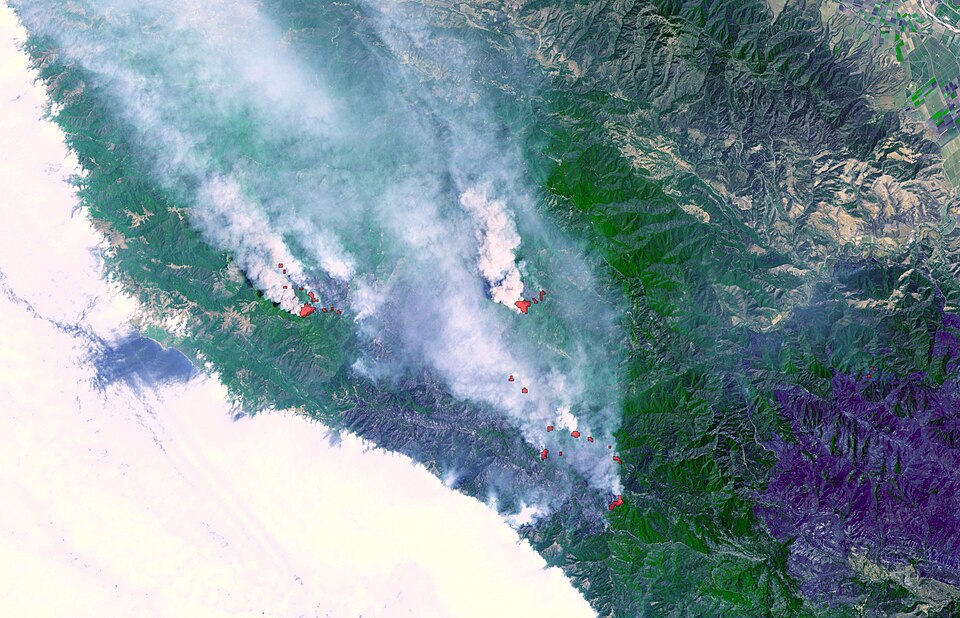
British Columbia Premier Warns Bald Range Wildfire May Signal Faster-Spreading 'New Normal'
British Columbia Premier David Eby warned Wednesday that the rapidly spreading Bald Range wildfire along Okanagan Lake may represent a faster-spreading "new normal" for wildfire behavior.[1]
The blaze forced orders for roughly 12,000 residents of Summerland and about 8,000 people in and around Peachland to evacuate and prompted a provincial state of emergency on Saturday, August 8.[2] Officials said the Bald Range had expanded to about 184 square kilometers by Wednesday, up from earlier estimates near 50 square kilometers.[1] Aerial teams were reassigned to rescues, and authorities used 18 aircraft to evacuate and rescue more than 50 people as the fire remained out of control.[3] The Royal Canadian Mounted Police reported an 80-year-old woman died while trying to escape the fire.[4] Highway 97 through the Okanagan remained closed, and Emergency Management Minister Kelly Greene said officials are withholding property-damage details until residents can be notified directly.[1]
On Saturday, August 8, officials declared a provincial state of emergency after the fast-moving Bald Range fire destroyed homes and trapped residents along Okanagan Lake.[2] The BC Wildfire Service said more than 100 wildfires were active across the province amid hot, windy weather and prolonged drought and warned of a high potential for dry lightning ignitions that could spark new blazes.[5]
Early mainstream reporting emphasized the mass evacuations, rescues and the immediate danger to communities.[2] By midweek coverage shifted to Premier Eby's warning that the fire outpaced provincial wildfire models and may force a review of response planning, building standards and vegetation management near communities.[1]
Canada's minister of emergency management approved British Columbia's request for federal assistance to provide shelter and accommodations for evacuees.[4] Officials cautioned that damage assessments cannot begin while the burned area remains unsafe and provided no timeline for when evacuees could return home.[1]
Show source details & analysis (6 sources)
📌 Key Facts
- On Saturday, August 8, 2026, British Columbia declared a provincial state of emergency as a fast-moving wildfire along Okanagan Lake destroyed homes and trapped residents (provincial state of emergency).
- Roughly 12,000 residents of Summerland and about 8,000 people in and around Peachland were ordered to evacuate — more than 20,000 people in total (Summerland).
- Aerial firefighting crews were reassigned to emergency rescues; 18 aircraft were used to rescue more than 50 people from the Bald Range Fire area (18 aircraft).
- By Wednesday, August 12, 2026, the Bald Range wildfire had expanded to about 184 square kilometers (71 square miles), up from earlier estimates of roughly 50 square kilometers within hours (Bald Range wildfire).
- Officials reported more than 100 active wildfires across British Columbia amid hot, windy weather and prolonged drought, and the BC Wildfire Service warned on Sunday, August 9, 2026 of a high potential for new, lightning-caused ignitions that can spread quickly (BC Wildfire Service).
- The Royal Canadian Mounted Police reported that an 80-year-old woman died while trying to escape the Bald Range wildfire in the Okanagan Lake region (Royal Canadian Mounted Police).
- Premier David Eby said the Bald Range fire's speed may represent a 'new normal,' that it outpaced provincial wildfire modelling, and that the province will review response planning, building standards and vegetation management (Premier David Eby).
- Emergency Management Minister Kelly Greene said the state of emergency grants powers to restrict travel and secure accommodations for evacuees, and authorities are withholding detailed information about destroyed properties until residents can be notified directly (Kelly Greene).
- Canada's minister of emergency management and community resilience, Eleanor Olszewski, approved British Columbia's request for federal assistance to provide shelter and accommodations for evacuees (Eleanor Olszewski).
📰 Source Timeline (6)
Follow how coverage of this story developed over time
- By Wednesday, August 12, 2026, officials said the Bald Range wildfire had grown to about 184 square kilometers (71 square miles), up from earlier estimates around 50 square kilometers.
- British Columbia Premier David Eby said Wednesday that the Bald Range fire's speed may represent a 'new normal' for wildfire behavior and that it outpaced provincial wildfire modeling, leaving some residents little time to evacuate.
- Eby said the province will review the response to consider potential changes to wildfire planning, building standards, and vegetation management near communities.
- Highway 97, a major corridor through the Okanagan region, remained closed as of Wednesday due to the fire and unsafe conditions.
- Officials have begun damage assessments but said the burned area remained unsafe and provided no timeline for when evacuees would be allowed to return home.
- Emergency Management Minister Kelly Greene said authorities are withholding detailed information about destroyed properties until residents can be notified directly to avoid them learning about losses from media or social networks.
- Premier Eby warned that, given ongoing drought and summer heat, the Bald Range wildfire is 'very unlikely to be the last significant fire we see this summer.'
- Local pharmacist Jonathan Kiesman described concerns about maintaining medications for displaced patients and said watching the fire approach Summerland 'almost brought tears to my eyes.'
- The Bald Range Fire along Okanagan Lake forced evacuations of about 12,000 residents from Summerland and roughly 8,000 people in and around Peachland by early Saturday, August 8, 2026, totaling more than 20,000 evacuees.
- On Sunday, August 9, 2026, the Royal Canadian Mounted Police reported that an 80-year-old woman died while trying to escape the Bald Range wildfire in the Okanagan Lake region.
- Eleanor Olszewski, Canada's minister of emergency management and community resilience, said Sunday that she had approved British Columbia's request for federal assistance to provide shelter and accommodations for evacuees.
- Evacuees described fleeing Summerland around 4:30 a.m. Saturday, August 8, through heavy smoke with a visible 'ridge of fire' approaching their homes.
- The Bald Range Fire in British Columbia "nearly doubled overnight" as of late Sunday, August 9, 2026, and remained out of control.
- British Columbia officials said aerial firefighting teams were reassigned to emergency evacuations, with 18 aircraft used to rescue more than 50 individuals from the Bald Range Fire area.
- The article reiterates that more than 20,000 people were ordered to evacuate around Summerland, about 150 miles east of Vancouver, due to the Bald Range Fire.
- By Sunday, August 9, 2026, British Columbia had more than 100 active wildfires provincewide, according to the BC Wildfire Service, amid continued high temperatures and gusty winds in the southeastern and Okanagan regions.
- The BC Wildfire Service warned on Sunday of a high potential for new lightning-caused wildfire ignitions, particularly in the central Interior and Okanagan, where storms are expected to bring dry lightning and little precipitation.
- Officials reiterated Sunday that new ignitions during the current hot, dry weather can establish and spread quickly, underscoring the ongoing risk even after the initial wave of Bald Range evacuations affecting more than 20,000 people.
- On Saturday, August 8, 2026, British Columbia declared a provincial state of emergency as a fast-moving wildfire along Okanagan Lake destroyed homes and trapped residents.
- Authorities said roughly 12,000 residents of Summerland and about 8,000 people in and around Peachland were ordered to evacuate overnight, with additional damage in the smaller community of Faulder.
- BC Wildfire Service official Cliff Chapman said firefighting helicopters were diverted to rescue people who could no longer escape by road as the Bald Range fire grew to about 50 square kilometers (19 square miles) within hours.
- Emergency Management Minister Kelly Greene said the state of emergency grants powers to restrict travel and secure accommodations for evacuees that would otherwise be unavailable.
- Officials reported more than 100 wildfires burning across British Columbia, nearly half of them out of control amid hot, windy weather and prolonged drought.