
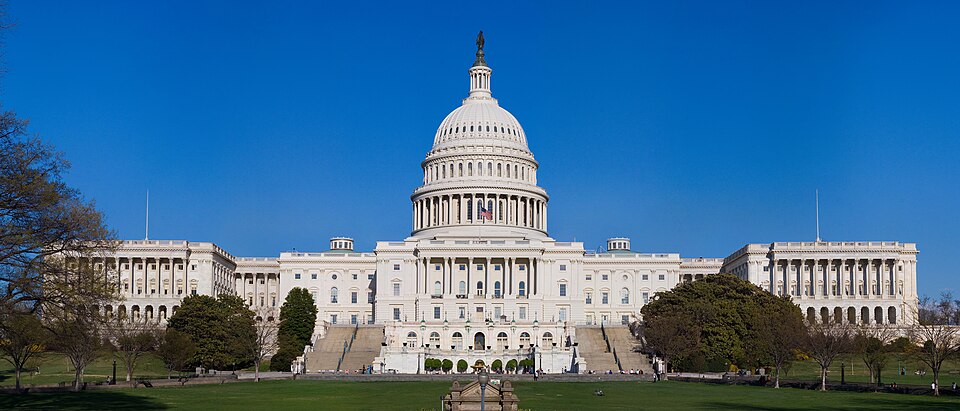
Congress Again Splits Over Limiting Trump's Iran War Powers As House Backs, Senate Blocks Resolution
On Thursday, July 23, 2026, the House approved Rep. Pramila Jayapal's concurrent war powers resolution directing U.S. forces be removed from hostilities with Iran absent explicit congressional authorization, passing 214-208.[1] The Senate blocked a companion measure the same day, failing 47-49 to advance Sen. Chris Van Hollen's resolution.[2]
Four House Republicans — Tom Barrett, Brian Fitzpatrick, Warren Davidson and Thomas Massie — joined all Democrats in supporting the Jayapal measure.[3] Sen. Susan Collins crossed party lines to back the Van Hollen measure in the Senate.[2] Sen. John Fetterman opposed, and Sens. Lisa Murkowski and Rand Paul did not vote.[2] The votes came as the Iran war has killed 18 U.S. service members and wounded roughly 482.[4] At a July 21 Senate hearing, Defense Secretary Pete Hegseth said the campaign has cost about $37.5 billion so far.[5] He has also requested roughly $67 billion in supplemental Pentagon funding.[6] GOP leaders are debating competing packages that range from about $70 billion to $95 billion and include proposals for farm aid and voting-law changes.[7]
At a July 21 Senate Appropriations Committee hearing, senators pressed Hegseth and Joint Chiefs Chair Gen. Dan Caine on strategy, costs and troop casualties.[8] Lawmakers accused the administration of trying to sidestep normal appropriations channels while seeking emergency war funds.[9] President Trump notified Congress in July that military action against Iran had restarted.[1] Administration lawyers argue an April 7 cease-fire had terminated hostilities and that the 60-day War Powers clock therefore did not apply.[2]
Early coverage framed U.S. strikes as a necessary response and emphasized military needs. NPR later highlighted increasing public disapproval and the House's second rebuke as signs the campaign was losing political support.[3] CBS coverage emphasized sharp Senate questioning of Pentagon leaders and the mounting casualty and cost figures driving lawmakers' anger.[2] A classified Aug. 4 briefing for Republican senators showed the administration pressing for large, broad defense increases and excluded Democrats, signaling plans for post-election budget maneuvers.[10]
The mainstream summary frames the congressional votes primarily as a split along party lines, but it misses the nuance of public sentiment regarding the Iran war. Nate Silver argues that while there may appear to be support for the military campaign, it is shallow and highly conditional, with public disapproval likely to grow as casualties and costs mount. This suggests that the House's passage of the war powers resolution reflects not just a partisan divide but also electoral pressure from constituents who are increasingly uneasy about prolonged military engagement. The summary does not account for this critical context, which highlights the potential for shifting political dynamics as public opinion evolves.
Additionally, while the mainstream account notes the failure of the Senate resolution, it overlooks the implications of the filibuster in this context. Matthew Yglesias emphasizes that the filibuster serves as an undemocratic barrier to urgent action, particularly when the Senate blocks measures like Sen. Van Hollen's resolution. This perspective suggests that the ongoing gridlock may not only reflect partisan disagreements but also a structural issue in the Senate that hinders effective governance, a point that is absent from the mainstream coverage.
Show source details & analysis (26 sources)
📌 Key Facts
- On Thursday, July 23, 2026, the House approved Rep. Pramila Jayapal's concurrent war powers resolution directing U.S. forces be removed from hostilities with Iran absent explicit congressional authorization, passing 214–208 (Rep. Pramila Jayapal's concurrent war powers resolution).
- On Thursday, July 23, 2026, the Senate failed 47–49 to advance Sen. Chris Van Hollen’s Iran war powers resolution that would have directed the president to remove U.S. forces from hostilities with or against Iran without explicit authorization (Sen. Chris Van Hollen’s Iran war powers resolution).
- As of July 22–23, 2026 reporting, the Iran war has killed 18 U.S. service members and wounded roughly 482–about 500 service members (Pentagon figures cited in hearings and reporting), with four U.S. deaths reported since July 17, 2026 (18 U.S. service members).
- On Wednesday, July 22, 2026, President Trump and Defense Secretary Pete Hegseth attended a dignified transfer at Dover Air Force Base for 1st Lt. Tyler James Feehan, Pvt. Isabella Gonzales, Sgt. Angel S. Rampersad and Sgt. Michael Emmanuel Swinton (dignified transfer at Dover Air Force Base).
- The Army identified Sgt. Michael Emmanuel Swinton, 30, as the soldier killed Sunday, July 19, 2026, in Iraq during a controlled detonation of an Iranian drone; Swinton was assigned to the 55th Air Defense Artillery Regiment and will receive posthumous awards and a promotion (Sgt. Michael Emmanuel Swinton).
- The Pentagon updated the status of Sgt. Angel S. Rampersad, 28, of Ozone Park, New York, to 'Duty Status–Whereabouts Unknown' and 'believed to be deceased' after the July 17, 2026 Iranian missile and drone attack at Muwaffaq Salti Air Base in Jordan, a change that contributed to the official U.S. death toll rising to 18 (Sgt. Angel S. Rampersad).
- At a July 21, 2026 Senate Appropriations Committee hearing, Defense Secretary Pete Hegseth and Joint Chiefs Chair Gen. Dan Caine were grilled on the Iran campaign; Hegseth said the war has cost about $37.5 billion so far and he requested roughly $67 billion in supplemental Pentagon funding while GOP discussions also referenced an $87.6 billion supplemental package (Defense Secretary Pete Hegseth).
- On Tuesday, August 4, 2026, Hegseth and senior Pentagon officials held a closed‑door classified briefing for Republican members of key Senate committees to press for large defense funding increases — highlighting munitions shortfalls tied to the Iran war and broader threats including China — and Democrats were not invited (closed-door classified briefing).
- Republicans advanced competing funding plans as Congress debated the war: a GOP budget package under review totaled about $95 billion (including roughly $70 billion for Iran operations, $10 billion for farmers and $10 billion for voting-law changes with no offsets), while House Republicans also moved a reconciliation blueprint that would provide tens of billions more for the Pentagon and farm aid (GOP budget package).
📊 Analysis & Commentary (3)
"The piece critiques simple readings that the Iran campaign is "popular," arguing (with polling‑method caution and political context) that support is conditional, fragile, and likely to shrink as costs and casualties grow — analysis prompted by recent congressional votes and the expanding U.S. campaign in Iran."
"The author argues Democrats should seize the present moment of Senate gridlock (exemplified by the Senate blocking a House-backed Iran war‑powers measure) to end or radically reform the filibuster — rejecting the usual arguments for preserving it as insufficient given the urgent policy paralysis it creates."
"The author argues that although Democrats lead in public-opinion polls on issues like limiting the Iran war, their current tactics — symbolic resolutions, poor cross‑chamber coordination, and weak messaging — mean they are failing to turn popular support into real policy wins; the piece is a critique urging more pragmatic, strategically coordinated action."
📰 Source Timeline (26)
Follow how coverage of this story developed over time
- On Tuesday, August 4, 2026, Defense Secretary Pete Hegseth and several undersecretaries held a closed-door, classified briefing for Republican members of key Senate committees to press for a large defense funding increase.
- The officials outlined an 'around-the-world' threat assessment with a particular emphasis on China and used the Iran war to highlight concerns about U.S. munitions stockpiles, providing more detail than prior briefings, according to sources in the room.
- Trump officials are already informally planning a post-election 'reconciliation 4.0' package for the lame-duck session that would include significant new Pentagon funding and a necessary federal debt-ceiling increase expected sometime in 2027.
- Emil Michael, the undersecretary for research and engineering, argued in the briefing that major near-term investment in artificial intelligence is needed to maintain U.S. military advantage over China.
- Democrats were not invited to the August 4 classified session and, according to a source cited by Axios, have also been excluded from other recent Iran-related briefings.
- On Thursday, July 30, 2026, the Commerce Department reported that U.S. real GDP grew at a 1.5% annual rate in Q2 2026, below the 2.1% rate expected by economists.
- The article attributes part of the slowdown to the U.S.-Iran war, noting that conflict-linked disruptions in the Strait of Hormuz and higher global energy costs are weighing on growth.
- The Bureau of Economic Analysis said consumer spending remained “healthy” in the April–June quarter despite war-related energy and shipping pressures.
- NPR notes in its July 24, 2026 Up First newsletter that the House's July 23 war powers resolution was the second such rebuke the chamber has passed since the Iran war began.
- The article emphasizes that over the past two weeks U.S. strikes on Iran and Iranian attacks on U.S. bases in the Gulf and Jordan have contributed to turbulence in global energy markets.
- On Thursday, July 23, 2026, the House approved Rep. Pramila Jayapal’s new resolution to remove U.S. forces from hostilities with Iran on a 214-208 vote.
- Four Republicans — Tom Barrett of Michigan, Brian Fitzpatrick of Pennsylvania, Warren Davidson of Ohio and Thomas Massie of Kentucky — joined Democrats in supporting the House resolution.
- Shortly after the House action on July 23, Senate Democrats attempted to advance a separate war powers resolution, which failed on a 47-49 vote.
- The article updates casualty figures, reporting that 18 U.S. troops have died since fighting began in February, including 4 deaths since July 17, and that U.S. forces have suffered nearly 500 injuries, about 100 of them in the past two weeks, according to the Pentagon.
- Rep. Pramila Jayapal characterized the Iran campaign on July 23 as an "illegal war" lacking a clear mission, strategy or end goal and said Congress "has not been consulted."
- House Foreign Affairs Committee Chair Brian Mast argued on the floor that voting to limit the mission would belittle the service of personnel killed in the war and said the operation is bringing "reckoning" for Iranian attacks on Americans.
- On Thursday, July 23, 2026, the Senate failed 47-49 to advance Sen. Chris Van Hollen’s Iran war powers resolution that would direct President Trump to remove U.S. forces from hostilities with or against Iran absent explicit authorization.
- Republican Sen. Susan Collins of Maine joined Democrats in support, while Democratic Sen. John Fetterman of Pennsylvania opposed; Sens. Lisa Murkowski and Rand Paul, who previously backed similar efforts, did not vote.
- Earlier the same day, the House adopted Rep. Pramila Jayapal’s separate war powers resolution on Iran in a 214-208 vote, with four Republicans voting in favor.
- The article notes this was the first Senate war-powers vote on Iran since the U.S.-Iran cease-fire collapsed earlier in July 2026.
- It updates that U.S. forces have now carried out a 12th consecutive night of airstrikes on Iranian military infrastructure and that the U.S. death toll in the conflict has reached 18 service members, including three killed in an Iranian attack in Jordan and one killed in Iraq while destroying an Iranian drone.
- The piece details the administration’s War Powers Resolution argument: officials said the 60-day clock did not apply because "hostilities" were deemed terminated with the April 7 cease-fire, and President Trump formally notified Congress on July 7 that military action had restarted.
- Senate Minority Leader Chuck Schumer publicly urged Republicans before the vote to "end this war" and "get our troops out of harm’s way," characterizing the conflict as a catastrophe.
- GOP Sen. Tim Sheehy of Montana, a former Navy SEAL, delivered a floor speech defending the Iran campaign and framing Trump as the first president to "stand up to Iran and hit back."
- On Thursday, July 23, 2026, the House again passed a war powers resolution on Iran, 214-208, directing that U.S. forces be removed from hostilities absent congressional authorization.
- A handful of Republicans joined all Democrats to approve the second resolution, while most Republicans backed continuing the war and effectively ceded war powers to President Trump.
- The article reports that continued U.S. airstrikes in and around the Strait of Hormuz have brought total U.S. spending on the Iran war to $37.5 billion and left 18 U.S. service members dead.
- Sen. Chris Van Hollen is leading a similar war powers effort in the Senate scheduled for consideration Thursday, July 23, 2026, framing the conflict as a 'very unpopular war.'
- The piece details reported political pressure from President Trump on Republicans who voted for earlier war powers measures, including calling them 'grandstanders' and 'losers,' and recounts Sen. Bill Cassidy’s reversal after a one-on-one White House briefing.
- Polling cited from a July Washington Post/Ipsos survey shows most Americans disapprove of Trump's handling of the Iran war and few believe it has been worth fighting, with only about two-thirds of Republicans approving his handling.
- CBS News video piece published at 10:15 a.m. Central on Thursday, July 23, 2026, reiterates that the House passed a resolution to limit President Trump's war powers and direct him to end military operations in Iran.
- The segment notes that four Republicans joined Democrats on the vote, aligning with previously reported individual names but restating the partisan breakdown as "four Republicans" rather than listing them.
- On Thursday, July 23, 2026, the House voted 214-208 to adopt Rep. Pramila Jayapal's concurrent war powers resolution directing President Trump to remove U.S. forces from hostilities against Iran without express congressional authorization.
- Four Republicans — Tom Barrett of Michigan, Brian Fitzpatrick of Pennsylvania, Warren Davidson of Ohio and Thomas Massie of Kentucky — joined Democrats in supporting the resolution.
- The article reiterates that Mr. Trump formally notified Congress on July 10, 2026, that military action against Iran had restarted and that the administration claims an April ceasefire 'terminated' hostilities, resetting the War Powers Resolution's 60-day clock.
- The piece notes that both the House and Senate already passed a separate war powers resolution last month and that Democrats are exploring legal options and appropriations leverage to force compliance.
- It adds that on Wednesday, July 22, 2026, House Republicans advanced a reconciliation blueprint to provide up to $73 billion in Iran war funding and up to $12 billion in farm aid, over the opposition of two Republicans and one independent.
- On Thursday, July 23, 2026, the House adopted a new concurrent war powers resolution directing the U.S. to cease hostilities with Iran, passing 214-208.
- Four Republicans — Reps. Warren Davidson of Ohio, Brian Fitzpatrick of Pennsylvania, Tom Barrett of Michigan, and Thomas Massie of Kentucky — joined all Democrats in supporting the July 23 resolution.
- The July 23 measure is the fifth House vote on curbing the Trump administration’s Iran military actions and the second successful adoption of such a war powers resolution in this conflict.
- Rep. Pramila Jayapal sponsored the latest House resolution and described the vote as Congress reasserting its authority over war and demanding an end to the Iran war.
- Rep. Gregory Meeks said he is exploring 'all legal avenues' to enforce the earlier June war powers resolution that both chambers adopted, insisting it is binding under the War Powers Resolution.
- The article reaffirms that as of this week the Iran war has reached 145 days and that four additional U.S. soldiers were killed in recent days, bringing total U.S. casualties to 18 dead.
- President Trump warned on Truth Social on Wednesday, July 22, 2026, that if Iran fires on any ships in the Strait of Hormuz, the U.S. will 'bomb and destroy one bridge or power plant,' including in or near Tehran.
- On Wednesday, July 22, 2026, President Donald Trump attended a dignified transfer ceremony at Dover Air Force Base for four U.S. service members killed in recent Iran war-related operations in Jordan and Iraq.
- The four service members honored were 1st Lt. Tyler James Feehan, 25, of Ewa Beach, Hawaii; Sgt. Angel Rampersad, 28, of Ozone Park, New York; Pvt. Isabella Gonzales, 19, of Carrollton, Texas; and Sgt. Michael Emmanuel Swinton, 30, of Fayetteville, North Carolina.
- U.S. Central Command previously said Feehan, Rampersad and Gonzales were killed at Muwaffaq Salti Air Base in Jordan as U.S. and partner forces defended against Iranian ballistic missile and drone attacks, while Swinton was killed at an air base in Iraq while troops attempted to destroy a downed Iranian attack drone.
- Trump told reporters before the Dover ceremony on July 22 that the fallen troops were "great heroes" and described dignified transfers as one of the hardest duties of the presidency, adding a public message of love and sympathy to their families.
- Feehan's parents, Stephen and Shari, said in a separate interview that they are creating a scholarship in his name using his death gratuity to support people who serve or hope to serve, and invited additional contributions.
- On Wednesday, July 22, 2026, President Donald Trump attended and oversaw a dignified transfer at Dover Air Force Base for the remains of four U.S. soldiers killed in the Iran war.
- The article states that on the night of July 22, 2026, the U.S. launched another round of airstrikes on Iran, marking the 12th consecutive night of strikes in the current campaign.
- On Wednesday, July 22, 2026, U.S. Ambassador to the U.N. Mike Waltz testified before the House Foreign Affairs Committee and was sharply questioned by Rep. Ted Lieu over Iran war casualties.
- During the hearing Waltz initially said he believed more than 100 U.S. troops had been wounded in the Iran conflict; Rep. Lieu corrected him, stating the actual figure is 482 wounded.
- Lieu said the U.S. military death toll in the Iran war has reached 18 service members, reflecting three killed in an Iranian attack on a U.S. base in Jordan on Friday, July 17, 2026, and a fourth killed over the weekend at a base in northern Iraq.
- Waltz acknowledged that U.S. troops are stationed in Jordan after initially deflecting Lieu's questioning, saying, "Of course they are, with a great ally."
- The article notes President Trump, in a July 21, 2026 Oval Office meeting with Lebanese President Joseph Aoun, criticized Jordan's defenses and said an Iranian strike "would not have happened if American forces or personnel had been in charge."
- On Wednesday, July 22, 2026, President Donald Trump and Defense Secretary Pete Hegseth attended a dignified transfer for four U.S. Army soldiers killed in recent days in the Middle East during the Iran war.
- Family members of the four fallen soldiers were present for the July 22 dignified transfer ceremony.
- CBS News' coverage of the July 22 dignified transfer was anchored by Mugo Odigwe.
- On Wednesday, July 22, 2026, President Trump and Defense Secretary Pete Hegseth attended a dignified transfer at Dover Air Force Base in Delaware for four U.S. Army soldiers killed in recent Iran war-related attacks.
- The dignified transfer honored Lt. Tyler James Feehan, 25, of Hawaii; Pvt. Isabella Gonzales, 19, of Texas; Sgt. Angel Rampersad, 28, of New York; and Sgt. Michael Emmanuel Swinton, 30, of North Carolina.
- The administration is investigating attacks at Muwaffaq Salti Air Base in Jordan that killed Feehan and Gonzales and led to the presumed death of Rampersad, whose status was updated from missing in action to whereabouts unknown and believed killed.
- Sgt. Michael Emmanuel Swinton was killed at Erbil Air Base in northern Iraq during a controlled detonation of an Iranian drone.
- Trump told reporters before the transfer that the administration will share results of the probe into the Jordan attacks and reiterated that the U.S. "cannot let Iran have a nuclear weapon."
- On Wednesday, July 22, 2026, Secretary of State Marco Rubio told reporters the United States remains open to negotiations with Iran but said Tehran 'doesn't seem serious about a solution.'
- The CBS segment reiterates that Defense Secretary Pete Hegseth testified Tuesday, July 21, 2026, that the Iran war has cost $37.5 billion so far, tying the cost figure directly to his Senate testimony.
- CBS frames Rubio's and Hegseth's comments together as the latest public depiction of both the financial toll of the conflict and current U.S. skepticism about Iran's willingness to negotiate.
- On Wednesday, July 22, 2026, President Donald Trump plans to attend a dignified transfer at Dover Air Force Base for four U.S. service members killed in the Middle East.
- The remains to be returned include two soldiers killed in Iranian missile and drone attacks in Jordan, the remains of a third soldier previously listed as missing and now believed deceased from the same July 17 Jordan attacks, and a soldier killed in Iraq during a detonation of an Iranian drone.
- The Defense Department identified the soldiers as 1st Lt. Tyler James Feehan, 25, of Ewa Beach, Hawaii; Pvt. Isabella Gonzales, 19, of Carrollton, Texas; Sgt. Angel S. Rampersad, 28, of Ozone Park, New York; and Sgt. Michael Emmanuel Swinton, 30, of Spring Lake, North Carolina.
- Feehan, killed Saturday, July 18, 2026, will be posthumously promoted to captain and awarded the Bronze Star, Purple Heart and Combat Action Badge; he was assigned to the 32nd Army Air and Missile Defense Command out of Fort Bragg, North Carolina.
- Swinton, killed Sunday, July 19, 2026, in Iraq during a controlled detonation of an Iranian drone, will be posthumously promoted to staff sergeant and receive a Bronze Star, Purple Heart and Combat Action Badge; he was assigned to the 55th Air Defense Artillery Regiment, 108th Air Defense Artillery Brigade out of Fort Bragg.
- Gonzales, killed Friday, July 17, 2026, served with the 10th Army Air and Missile Defense Command in Ansbach, Germany and graduated from Hebron High School in Carrollton, Texas in 2025.
- Rampersad, believed killed in the July 17 Jordan attacks, was a sergeant assigned to the 57th Air Defense Artillery Regiment, 52nd Air Defense Artillery Brigade, 10th Army Air and Missile Defense Command in Ansbach, Germany.
- Trump said on July 19 that the fallen were 'out there fighting so that Iran cannot have a nuclear weapon' and that U.S. strikes on Iran are being carried out 'in honor' of the troops killed.
- Trump reiterated on July 20 that each time Iran kills an American soldier, 'they will pay for that killing many times over,' and said that in the Jordan attack 'they did slip something through in Jordan' despite most incoming fire being stopped.
- The article reiterates that since the Iran war began on Feb. 28, 2026, a total of 18 U.S. service members have been killed.
- On Wednesday, July 22, 2026, President Trump was scheduled to travel to Dover Air Force Base for the dignified transfer of U.S. service members killed in recent Iranian strikes.
- On Tuesday, July 21, 2026, the Pentagon identified the third soldier killed in the July 17 Jordan attack as Sgt. Angel S. Rampersad, 28, of Ozone Park, New York, alongside previously named 1st Lt. Tyler James Feehan, 25, of Ewa Beach, Hawaii, and Pvt. Isabella Gonzales, 19, of Carrollton, Texas.
- NPR now places the cumulative U.S. death toll in the Iran war at 18 and emphasizes rising public disapproval of casualties in what many perceive as an unnecessary war.
- In Senate testimony, Defense Secretary Pete Hegseth requested $67 billion in supplemental Pentagon funding, warning that without it, pay for service members could face shortfalls.
- On Tuesday, July 21, 2026, the Pentagon said Sgt. Angel S. Rampersad, 28, of New York is believed to be the third U.S. service member killed in the July 17 Iranian missile and drone attack on a U.S. base in Jordan, changing her status to 'Duty Status–Whereabouts Unknown' and 'believed to be deceased'.
- Rampersad served in the 10th Army Air & Missile Defense Command based in Ansbach, Germany, the same unit as Pvt. Isabella Gonzales, one of the two previously identified soldiers killed in the Jordan attack.
- The confirmation that Rampersad is believed dead raises the official U.S. death toll in the Iran war to 18 service members.
- The article reiterates that the three soldiers killed in Jordan were supporting a U.S. mission against the Islamic State group when they were struck by Iranian ballistic missiles and drones, marking the first U.S. troop deaths from direct Iranian fire since the opening days of the war.
- Separately, the Army on Tuesday formally identified Sgt. Michael Emmanuel Swinton, 30, of North Carolina, as the soldier killed Sunday, July 19, 2026, during a controlled detonation of an Iranian drone at an air base in Irbil, Iraq, and said he will posthumously receive a Bronze Star, Purple Heart and Combat Action Badge and be promoted to staff sergeant.
- Swinton enlisted in 2017, was assigned to the 55th Air Defense Artillery Regiment, 108th Air Defense Artillery Brigade at Fort Bragg, North Carolina, and the Army said it is investigating the circumstances of his death in Irbil.
- On Tuesday, July 21, 2026, officials identified Sgt. Michael Emmanuel Swinton, 30, as the U.S. soldier killed in Iraq during a controlled explosion of an Iranian drone.
- Swinton is the 17th U.S. service member reported killed in the Iran war.
- CBS reports that Sgt. Swinton is scheduled to be buried with military honors, though the segment does not specify the funeral date or location.
- During the Senate Appropriations Committee hearing on Tuesday, July 21, 2026, Sen. Gary Peters told Defense Secretary Pete Hegseth, 'You, sir, are the failure,' accusing him of failing U.S. troops by lacking a winning strategy in the Iran war.
- Peters argued that the Strait of Hormuz 'is still closed,' that 'prices were lower for everybody until the war,' and that U.S. service members 'are still dying,' asking Hegseth 'what's different' as the conflict continues.
- Hegseth responded that characterizing the war 'as a failure is reckless,' said Peters' comments 'smear the sacrifice' of troops serving to prevent Iran from getting a nuclear weapon, and urged Peters to 'show some leadership' by supporting the Pentagon's $87.6 billion supplemental funding request.
- Peters countered that 'it's not a question of money. It's a question of leadership and understanding what it takes to actually win,' framing his criticism as directed at leadership rather than frontline troops.
- The article notes the exchange came after the U.S. rolled out its 10th consecutive night of strikes against Iran, with at least three American service members killed in recent days and the Strait of Hormuz still closed, contributing to another jump in U.S. gasoline prices.
- Article confirms that during the July 21, 2026 Senate Appropriations hearing, Defense Secretary Pete Hegseth framed the $87.6 billion supplemental as an 'urgent, necessary injection of resources' without explicitly mentioning the Iran war in his opening statement.
- It details an exchange in which Sen. John Kennedy, R-La., pressed Gen. Dan Caine and Hegseth for hypotheticals about what would happen if the U.S. ceased military action against Iran, including whether Iran would 'put tolls' on the Strait of Hormuz, and notes both officials declined to answer directly, calling the scenarios political or hypothetical.
- It reports a heated back-and-forth where Sen. Gary Peters, D-Mich., told Hegseth the administration's efforts are 'an utter and complete failure to win this war,' adding 'You, sir, are the failure,' while Hegseth accused Peters of 'Trump Derangement Syndrome' and Democrats of not funding the troops.
- It adds that Sen. Kirsten Gillibrand, D-N.Y., accused military officials of 'asking for unlimited money for bombs' and highlighted conflicting administration statements about whether Iran's nuclear sites were destroyed, saying Americans do not know 'who to believe or what to believe.'
- On Tuesday, July 21, 2026, Defense Secretary Pete Hegseth told senators that the Iran war has cost $37.5 billion so far.
- The $37.5 billion figure was disclosed during the same Senate session where Hegseth and Joint Chiefs Chairman Gen. Dan Caine were grilled over the state of the war with Iran.
- On Tuesday, July 21, 2026, Sen. Patty Murray directly challenged Defense Secretary Pete Hegseth during the Senate Appropriations Committee hearing, saying she viewed the administration's Iran war funding request as an 'attempt to skirt the normal appropriations process.'
- Murray accused the Trump administration of 'poor planning' as it seeks an additional $67 billion in war-related funding beyond previously discussed figures.
- The CBS segment frames the exchange as a pointed, on-the-record clash between the committee's top Democrat on appropriations and the defense secretary over both process and scale of the Iran war request.
- On Tuesday, July 21, 2026, the Senate Appropriations Committee scheduled a 2:30 p.m. EDT hearing where Defense Secretary Pete Hegseth, Joint Chiefs Chairman Gen. Dan Caine and Agriculture Secretary Brooke Rollins will testify on President Trump’s funding request for the Iran war.
- The GOP budget package under review totals $95 billion, including about $70 billion in war funding for operations against Iran, $10 billion in aid for farmers affected by Trump’s tariffs and $10 billion for voting law changes likely to include new voter ID requirements, with no spending offsets.
- The Pentagon recently announced that three more American service members have died in the conflict with Iran, bringing the U.S. death toll to 17, and that more than 100 have been injured since early July.
- Senate Democratic Appropriations leader Patty Murray’s prepared remarks warn the Iran conflict 'could be another forever war' and note that President Trump has said 'over 40 times' that a deal is near while now requesting $70 billion more.
- Senate Democratic Leader Chuck Schumer criticized Hegseth for promoting his testosterone screening initiative for troops while not promptly disclosing updated Iran war casualty numbers, and said nearly 450 service members have been injured since the start of the war.
- The article identifies Sgt. Michael Emmanuel Swinton as another U.S. soldier killed in the Iran war, this time in Iraq, during a controlled detonation of an Iranian drone at an air base in Irbil on Sunday, July 19, 2026.
- It confirms that Swinton served in the 55th Air Defense Artillery Regiment, 108th Air Defense Artillery Brigade, based at Fort Bragg, North Carolina, and that he will receive a Bronze Star, Purple Heart and Combat Action Badge with a posthumous promotion.
- It reiterates that two U.S. Army soldiers were killed in Jordan last week by Iranian ballistic missile and drone attacks, identifying them and noting a third service member missing, with "unidentified remains" now found and being analyzed by U.S. Central Command.