
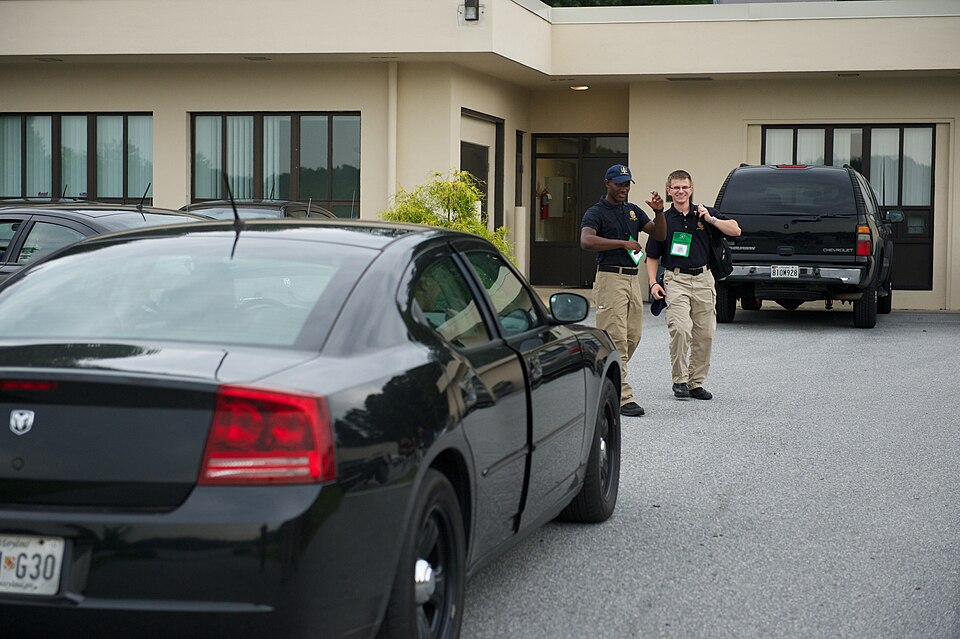
DHS Orders ICE Body Cameras As Agency Sets August Deadline And Defends Release Policy
The Department of Homeland Security ordered that every ICE arrest team must include at least one agent wearing a body-worn camera and said it expects all field officers to be equipped by the end of August.[1]
Acting ICE Director David J. Venturella defended the agency's body-camera policy, saying limits on releases protect investigations and privacy.[1] The policy, first issued in February 2025, requires a senior review and recommends expedited release within 72 hours after a death or serious injury but lets the director block footage if release is not in the agency's "best interests," a point critics say weakens accountability.[2] Federal procurement records show ICE spent $30.9 million in July on Axon body-camera equipment, and the agency says cameras have already gone to more than half of its field offices.[2]
President Trump ordered a major expansion of interior immigration enforcement in January 2025, a push that quickly increased arrests and staffing. DHS says it added about 12,000 new ICE officers during the surge, a hiring drive that critics say shortened training and strained vetting.[3] ICE detentions hit record monthly highs in June and July 2026 as enforcement ramped up, even as two recent on-the-street fatalities in Houston and Biddeford, Maine, prompted the agency to accelerate camera deployment.[4]
DHS initially described the Biddeford, Maine, shooting as an officer firing while "fearing for public safety" after a driver allegedly tried to flee.[5] But security and home-surveillance video and a New York Times frame-by-frame analysis show the white sedan moving slowly and being pinned by an ICE SUV before agents pulled the wounded driver from the car, raising new doubts about whether lethal force was necessary.[6] The DHS Office of Inspector General and the Maine attorney general are leading the probe; the FBI initially assisted at the scene but, as of August 4, was not conducting a separate civil-rights investigation.[7]
The mainstream summary does not address the significant concerns surrounding the accountability of ICE officers in light of recent fatalities. Critics, including civil rights advocates like Ben Crump, argue that these incidents illustrate systemic failures within ICE, calling for immediate reforms and transparency. However, Steve Sailer critiques such claims as exaggerated and politically motivated, suggesting that they may lead to hasty policy changes rather than evidence-based solutions. This perspective highlights a tension between calls for accountability and the framing of such calls as politically expedient rather than grounded in a comprehensive understanding of the facts.
Additionally, while the mainstream account notes the deployment of body cameras, it omits the troubling reality that officers involved in recent fatal incidents lacked functioning cameras due to budgetary oversights, as pointed out by social media commentators. For instance, @RepCDMenefee emphasized at a congressional hearing that ICE received substantial funding for body cameras, yet officers involved in critical situations were still not equipped, raising serious questions about the agency's commitment to accountability. This gap between funding and operational readiness underscores a deeper issue that the mainstream summary fails to capture.
Show source details & analysis (39 sources)
📌 Key Facts
- During an attempted ICE vehicle stop in Biddeford, Maine, on July 13, 2026, 25‑year‑old Johan Sebastián Durán Guerrero was shot and killed; home‑security and surveillance video and witness accounts show agents approaching and pinning his car before he was pulled from the vehicle, and DHS said the officer fired "fearing for public safety" while surveilling an address tied to another person with a final removal order (Johan Sebastián Durán Guerrero).
- DHS and local officials have said Guerrero was not the intended target of the operation, the ICE officer who fired has been placed on leave, and the death prompted immediate calls for investigation from community members and immigrant‑rights groups (DHS).
- Relatives and public records identified the officer who fired as 37‑year‑old David Brouillette and, citing family‑court filings and an Associated Press review, described a history of alleged domestic violence, mental‑health episodes and violent statements; ICE declined to confirm his identity while saying the officer has nearly a decade of federal law‑enforcement experience (David Brouillette).
- Federal investigative posture: the DHS Office of Inspector General and the Maine attorney general’s office are leading the probe into the Biddeford shooting, the FBI initially assisted at the scene, and as of August 4, 2026 the FBI was not conducting a separate civil‑rights investigation though DOJ said it would act if evidence of civil‑rights violations emerges (DHS Office of Inspector General).
- In reaction to the Maine and earlier Houston shootings, DHS ordered that every ICE arrest team include at least one officer wearing a body‑worn camera and temporarily paused most non‑urgent vehicle stops during enforcement operations — a moratorium President Trump publicly overturned about 24 hours later, restoring ICE authority to resume traffic stops (President Trump).
- ICE procurement and deployment: federal records show ICE spent $30.9 million in July 2026 on body‑camera equipment, the agency said cameras have already been sent to more than half of field offices, and ICE announced it expects every field officer to be equipped with a body camera by the end of August 2026 (best interests of the agency).
- ICE's release policy and transparency concerns: a February 2025 ICE body‑worn camera policy requires a senior‑staff review committee to recommend expedited release of footage within 72 hours after serious injury or death but gives the ICE director discretion to block or indefinitely delay release if doing so is not in the agency's "best interests," and experts warn that language and mandated redactions could limit public accountability (best interests of the agency).
- Context and congressional oversight: the Biddeford and Houston incidents are part of a broader pattern of deadly encounters during recent ICE operations, ICE detentions reached Trump‑era highs in June–July 2026, and Democratic lawmakers including Rep. Robert Garcia and Sen. Richard Blumenthal have demanded detailed training and vetting records for the officer involved as part of increased oversight (Rep. Robert Garcia and Sen. Richard Blumenthal).
📊 Analysis & Commentary (1)
"This is a critical opinion piece attacking Ben Crump for what the author calls inflammatory, politically motivated accusations about recent deaths (likely those tied to ICE and the Maine/Houston shootings), arguing activists and the media rush to a simplistic, weaponized narrative that pushes reactive policy changes before facts are established."
📰 Source Timeline (39)
Follow how coverage of this story developed over time
- On Saturday, August 8, 2026, ICE said it expects every officer and agent in the field to be equipped with a body-worn camera by the end of August 2026.
- Acting ICE Director David J. Venturella issued a public statement defending the agency's body-camera policy and said restrictions on releasing footage are meant to protect investigations and privacy and are consistent with federal law and other federal agencies.
- Venturella specifically disputed an Associated Press report as having 'mischaracterized' the policy, arguing AP conflated a provision about expedited release after serious injury or death with ICE's broader authority to release footage.
- ICE confirmed that its policy includes a provision for expedited release of footage after serious injury or death in custody when doing so is determined to be in the 'best interests of the agency.'
- The article notes that neither of two recent fatal ICE shootings, including a July 2026 killing of a 25-year-old motorist in Maine and an earlier Houston shooting, was captured on body-camera video because cameras were not yet deployed.
- The story reiterates outside expert criticism that ICE's explicit 'best interests of the agency' standard for release is unusually clear compared with other agencies' more informal selective-release practices.
- ICE's February 2025 body-worn camera policy states that video of shootings or other incidents causing death or serious injury will be released promptly only if ICE determines doing so is "in the best interests of the agency," giving the director broad discretion to withhold or delay footage.
- Under the policy, after a serious confrontation a committee of senior ICE officials and lawyers reviews footage and recommends release within 72 hours, but the director may block or indefinitely delay disclosure if "specific and compelling circumstances" are found, without further definition.
- The policy requires redaction of all officers' identifying features, including faces, names and badge numbers, before any public release to protect officer privacy.
- ICE said on August 7, 2026 that body cameras have already been sent to more than half of its field officers and that all will have them by the end of September 2026, with at least one camera required on every arrest team.
- Federal procurement records show ICE spent $30.9 million in July 2026 to purchase body-camera equipment from Axon, one day after an ICE officer fatally shot a 25-year-old motorist in Maine, adding to congressional pressure following a separate fatal ICE shooting in Houston.
- ICE previously failed to purchase body cameras even after receiving a $75 billion funding increase in 2025 and expanding arrests, and only accelerated deployment after multiple shootings and a $20 million congressional earmark tied to ending a partial government shutdown.
- White House border czar Tom Homan said on July 19, 2026 that body cameras tend to exonerate agents more often than they provide evidence of wrongdoing, and ICE asserts cameras are being deployed nationwide to all field officers.
- Experts quoted in the article, including Christopher Schneider and Katherine Hawkins, warn that ICE's "best interests" standard and lack of a clear public-access mechanism risk turning cameras into public-relations tools rather than accountability mechanisms.
- As of Tuesday, August 4, 2026, several sources told CBS News that the FBI is not conducting a federal civil rights investigation into the July 13, 2026 ICE shooting of Johan Sebastián Durán Guerrero in Biddeford, Maine.
- A Justice Department official said in a statement that the DHS Office of Inspector General and the Maine attorney general’s office are leading the investigation and that DOJ will evaluate and act if evidence of a civil rights violation emerges.
- The FBI Boston field office, which has jurisdiction over Maine, said questions should be directed to DHS OIG and the Maine attorney general, and confirmed that the FBI initially responded to the scene to investigate a possible assault-on-a-federal-officer case.
- Earlier public statements from lawmakers, including Sens. Susan Collins and Angus King, indicated they understood the FBI to be investigating, but DOJ’s new clarification shows the bureau is currently only in an assisting posture, not running a civil rights probe.
- The attorney for Guerrero’s partner, Karolina Rojas Alvarez, said the Maine attorney general’s office interviewed her about a week after the July 13 shooting, but that neither he nor his client has been contacted by the FBI, DHS, or any other federal agency so far.
- Internal DHS data obtained by CBS show ICE detained more than 46,000 people in July 2026, setting a new monthly high for Trump's second term and surpassing roughly 43,000 detentions in June.
- As of the weekend of August 1-2, 2026, ICE was holding about 68,000 detainees nationwide, nearing a record of more than 70,000 set in January 2026.
- The White House has pressed DHS and ICE to reach 2,000 immigration arrests per day this summer, while July averages were about 1,500 new detainees entering ICE custody daily.
- Despite a brief internal pause on most vehicle stops after recent fatal shootings, President Trump intervened to overturn the moratorium roughly 24 hours after it was instituted, allowing ICE traffic stops to resume.
- The article details growing use of plainclothes ICE agents making arrests near departure gates and check-in counters at U.S. airports, enabled by expanded data sharing between TSA and ICE about noncitizen travelers and lapsed statuses.
- The Trump administration recently terminated Temporary Protected Status for more than 300,000 Haitian migrants, and some Haitians in Ohio have begun receiving notices to report to local ICE offices, prompting community fear.
- Homeland Security Secretary Markwayne Mullin replaced Kristi Noem earlier in 2026 with the stated aim of keeping ICE out of the headlines while still advancing Trump's pledge of the 'largest deportation operation in American history.'
- On Friday, July 31, 2026, CBS reported that Democratic Rep. Robert Garcia of California and Sen. Richard Blumenthal of Connecticut are demanding detailed information on the training and vetting of the ICE officer who killed Colombian immigrant Johan Sebastián Durán Guerrero in Biddeford, Maine.
- Garcia and Blumenthal directed their inquiries specifically at the agent involved in the Biddeford shooting, seeking records about his preparation and screening as part of broader oversight of ICE use-of-force incidents.
- On Thursday, July 30, 2026, Rep. Robert Garcia and Sen. Richard Blumenthal sent a formal letter to DHS and Federal Law Enforcement Training Centers leaders demanding details and records about the training and vetting of the ICE officer who shot and killed 25-year-old Colombian immigrant Johan Sebastián Durán Guerrero in Biddeford, Maine, on July 13, 2026.
- The letter asks whether Officer David Brouillette, identified earlier in Associated Press reporting, went through a condensed training process or a four-week online course created under the Trump administration’s rapid ICE hiring push, and whether a background check was conducted before or during that training.
- Garcia and Blumenthal cite whistleblower testimony from a former ICE instructor who described Trump-era ICE training as 'deficient, defective, and broken,' and they request Brouillette’s training and testing records as well as investigative records on the July 13 shooting.
- Tom Homan, President Trump’s border czar, told CNN that if reports about Brouillette’s long history of abusive and violent behavior are accurate, 'I don’t think he should ever have cleared vetting.'
- The article reiterates that DHS has not formally named Brouillette as the shooter and that its public account says Durán Guerrero attempted to flee in his vehicle and that the officer fired fearing for public safety.
- On Wednesday, July 22, 2026, ICE officers in plain clothes arrested Ukrainian national Iryna Gorb inside San Francisco International Airport's Harvey Milk Terminal near gate B7.
- Video recorded by Richmond, California city council member Doria Robinson shows two apparent plainclothes ICE officers pinning Gorb to the floor of a terminal shop area as she shouts that she is being choked and asks for help.
- A Department of Homeland Security spokesperson confirmed Gorb lawfully entered the U.S. in 2010 on a visa that expired at the end of May 2011 and that she overstayed roughly 15 years; DHS says she attempted to flee and resisted arrest and will remain in ICE custody pending removal proceedings.
- Robinson and other bystanders said the arresting men did not display visible identification and refused to answer crowd questions about what agency they worked for before handcuffing Gorb and removing her in a wheelchair.
- Bay Area immigration attorney Ghassan Shamieh, who does not represent Gorb, told NBC Bay Area he and peers have seen a spike in ICE detentions at airports since June and said four of his clients, none with criminal records, have recently been detained at airports, including one at SFO.
- ICE internal data show that in June 2026, more than 43,000 people were booked into detention, the highest monthly total since President Trump took office for his second term.
- Average daily arrests in June were 1,438, rising to 1,593 during the first 11 days of July 2026, indicating that enforcement activity remained high even after the Houston and Biddeford shootings.
- The detained population, which had declined after Operation Metro Surge in Minnesota wound down in February 2026, increased to an average of about 59,400 people in June and more than 65,600 in early July.
- The article clarifies that both men killed in the Texas and Maine incidents were collateral arrests, reflecting a broader pattern of ICE detaining people who were not the initial targets and who often lack criminal records.
- DHS Secretary Markwayne Mullin publicly stated on Friday, July 17, 2026, that ICE arrests are 'hitting single-day records every single day,' signaling continued escalation despite the fatal shootings and new body-camera requirements.
- On Tuesday, July 14, 2026, 28-year-old Mexican national Juan Jairo Coronilla Durán was struck and killed by a tractor trailer on State Road 16 in St. Augustine, Florida, after fleeing an encounter with ICE and Homeland Security Investigations agents.
- Coronilla Durán was visiting the United States from San Luis de la Paz, Guanajuato, and had arrived in Atlanta on a trip to visit family and then vacation at Florida beaches, according to advocacy group Colectivo Arbol.
- His wife told advocates and a Guanajuato state migration official that he was in the U.S. on a tourist visa and had been in the country only a short time; DHS has not confirmed his immigration status.
- Florida Highway Patrol said four people were in the vehicle that stopped at a gas station before 7 a.m. on July 14, and all fled on foot when approached by ICE and HSI agents, with Coronilla Durán running into the path of the truck.
- The Mexican consulate and Guanajuato state officials are assisting his widow, Yezzika Alamilla, with viewing his body at a Florida funeral home and repatriating his remains for burial in San Luis de la Paz.
- Coronilla Durán left behind two children, ages 7 months and 7 years, and his death is at least the 10th involving encounters with immigration agents since President Trump launched his mass deportation campaign last year.
- Advocacy group Colectivo Arbol provided immediate assistance to the widow, including purchasing a plane ticket to Florida and temporary lodging, before the Mexican consulate took over support.
- Ashley Brouillette told NPR that her ex‑husband, ICE officer David Brouillette, was the officer who fatally shot Johan Sebastián Durán Guerrero four times during an attempted traffic stop in Biddeford, Maine, on Monday, July 13, 2026.
- She said David Brouillette called her on Wednesday, July 15, 2026, asking her to vouch for his character and not to talk about alleged abuse in their marriage, and she told him she would not lie for him.
- Ashley Brouillette alleged multiple past incidents of domestic violence between 2007 and 2009, including an episode where she says he pointed a gun at her in the shower and threatened to kill her; she said she later recanted to police, so there are no corroborating reports.
- High‑school friend Scott Collins told NPR that Brouillette "had a bad tendency of going out and looking for fights" and that he used anti‑Black slurs in high school; Collins previously testified on Ashley Brouillette's behalf in their divorce.
- An ICE spokesperson declined to confirm or deny that Brouillette was the officer involved, but said the officer who fired has nearly a decade of federal law‑enforcement experience with required training.
- Relatives and acquaintances quoted in the article said Brouillette displayed racist beliefs, and Ashley Brouillette noted his high-school nickname was "White Boy David."
- Identifies the ICE officer involved in the July 13, 2026 Biddeford, Maine killing of Johan Sebastián Durán Guerrero as 37-year-old David Brouillette, an Army veteran.
- Reports that multiple close relatives, including ex-wife Ashley Brouillette and daughter Madison, describe a long history of terrifying and violent behavior, including alleged attacks on women and an audio message in which he said someone should slit a relative's throat.
- Says Brouillette told at least three relatives in calls after the shooting that he shot Durán Guerrero and claims he acted in self-defense.
- Details that family-court records from Augusta District Court contain years of allegations of physical and verbal abuse, stalking and harassment by a second ex-wife on behalf of herself and Brouillette's daughters.
- Notes that Brouillette has no apparent criminal record in Maine despite the abuse allegations and that DHS and ICE have not officially released his name; an ICE spokesperson declined to confirm his identity, citing doxxing concerns.
- States that ICE says the officer has nearly a decade of federal law-enforcement service and required use-of-force training, raising further questions about DHS vetting during Trump-era hiring surges.
- The article reports that, in the FBI affidavit supporting the July 14, 2026 search warrant for Lorenzo Salgado Araujo's van, agents said they observed several plastic bags containing a 'white crystal-like substance' and claimed probable cause for 'possession with intent to distribute' controlled substances.
- Family attorney Ruby Powers asserts the bags contained a homemade electrolyte mixture of granulated salt, lemon and water used by outdoor workers, directly disputing the FBI's characterization of suspected drugs.
- Harris County District Attorney Sean Teare told MS NOW that the new drug-suspicion narrative is 'inconsistent' with what he has been told by the van's passengers, reinforcing his call for independent review of all evidence in the Houston ICE shooting.
- The story notes that DHS’s initial public statement about the July 7, 2026 stop did not mention drug suspicion, instead stating that Salgado Araujo 'weaponized his vehicle' and that the officer acted in self-defense.
- Powers links the post hoc drug suspicion to a broader pattern in recent ICE shootings under the Trump administration, arguing such claims may be used to discredit victims and those seeking accountability.
- Article identifies the ICE officer who shot and killed Johan Sebastián Durán Guerrero in Biddeford, Maine, as 37‑year‑old David Brouillette, an Army veteran with nearly a decade of federal law‑enforcement experience.
- Close relatives, including ex‑wife Ashley Brouillette and his 18‑year‑old daughter, say Brouillette has a long history of violent and abusive behavior, including alleged physical abuse of partners and a teenage daughter, and stalking and harassment documented in family‑court records in Augusta, Maine.
- Relatives shared with the Associated Press a voicemail from winter 2025‑26 in which Brouillette said he thought someone should slit a female relative’s throat.
- Ashley Brouillette says Brouillette acknowledged during a November 2025 Facebook audio call that he had been hired by ICE, and after the July 13, 2026 shooting he told her and their daughter in separate calls that he shot and killed Durán Guerrero, which they describe as him claiming self‑defense.
- Maine Department of Public Safety records show no criminal record for Brouillette, but hundreds of family‑court filings from Augusta District Court detail years of alleged physical and verbal abuse raised by his second ex‑wife on behalf of herself and his daughters, including an incident in which he allegedly tackled his teenage daughter and smashed spaghetti into her hair.
- ICE spokesperson Lauren Bis declined to confirm the officer’s identity, saying the agency will never confirm or deny attempts to dox its officers, and stated that the officer has nearly a decade of federal law‑enforcement experience and required use‑of‑force training.
- On Thursday, July 16, 2026, the Associated Press reported that ICE officer David Brouillette, who fatally shot a Colombian man during a vehicle stop in Biddeford, Maine earlier that week, is an Army veteran with a long history of serious mental health issues and violent behavior, according to close relatives and records.
- In response to the AP report, Rep. Bennie Thompson, the top Democrat on the House Homeland Security Committee, said Brouillette's history and the Maine death 'directly call into question the supposed vetting and training ICE does of its recruits' and urged that the officer be removed from the streets and face justice.
- Senate Democratic Leader Chuck Schumer issued a statement blaming the Trump administration's rapid hiring of roughly 12,000 ICE agents without adequate fitness checks and said Republicans had given ICE 'vast power and no accountability,' calling for new guardrails to prevent further killings.
- Sen. Susan Collins of Maine reiterated her call for an impartial investigation into the Biddeford shooting and highlighted that she secured $20 million for body-worn cameras and $2 million for de-escalation training in the Homeland Security funding bill used to end the recent DHS shutdown, adding that the 'Democratic government shutdown' delayed implementation.
- The article underscores that the AP's revelations about Brouillette's past have intensified congressional scrutiny of DHS's hiring spree and raised fresh questions about how quickly new agents were vetted, trained and deployed.
- In January 2026, DHS said it had hired 12,000 new ICE officers and agents since the hiring surge began and that thousands were already in the field.
- An internal ICE memo, reported in February 2026, instructed supervisors to refer "derogatory information" about newly hired employees’ conduct, such as prior terminations or forced resignations, to internal affairs.
- ICE’s hiring surge included signing bonuses up to $50,000, removal of a college-degree requirement, and lowering the minimum recruit age to 18.
- A DHS inspector general audit of ICE’s hiring and training processes was opened in August 2025, though findings have not yet been released.
- Former ICE training lawyer Ryan Schwank says the agency reduced the total training time and testing requirements for new deportation officers during the surge.
- On June 2026, Secretary Markwayne Mullin said ICE would increase academy training time; DHS now says all academy classes beginning July 1, 2026 will last 71 days and that officers who graduated under the shorter curriculum will receive additional field training.
- DHS says new training being added includes crowd control, high-risk vehicle stops, live-fire exercises and medical training in response to what it calls coordinated attacks on ICE officers and facilities.
- The ICE officer who fatally shot 25-year-old Johan Sebastián Durán Guerrero in Biddeford, Maine, on Monday, July 13, 2026, is identified by relatives as 37-year-old Army veteran David Brouillette.
- Relatives and court records describe Brouillette as having severe, long-standing mental health issues, including childhood diagnoses of bipolar disorder and ADHD, two suicide attempts at age 12, and multiple psychiatric hospitalizations.
- Family court filings from Augusta District Court show years of alleged physical and verbal abuse by Brouillette toward his partners and daughters, including incidents where he allegedly threw boiling water at his then-wife holding their child and later tackled and dragged his teenage daughter.
- An immediate relative says military recruiters initially rejected Brouillette over his mental health, then encouraged him to come off medication for a year to enlist; he later served in the Maine Army National Guard and in the regular Army, deploying to Afghanistan from May 2012 to February 2013 as a human intelligence collector.
- After leaving the Army in December 2015, Brouillette worked briefly at the Maine Correctional Center, at the state Department of Health and Human Services, and as a Veterans Affairs police officer near Augusta before later doing gig work, truck driving, and real estate.
- A lawsuit shows he suffered a head injury during firefighter training at Southern Maine Community College, resulting in a concussion and post-concussive syndrome that impaired memory and cognition; the case was settled out of court.
- In late 2025, around the time he joined ICE, he left a three-minute voicemail for an ex-wife in which he repeatedly wished for her and other female relatives to have their throats slit, while insisting this was not a direct threat he would carry out.
- Brouillette’s ex-wife and 18-year-old daughter say he called them after the shooting and admitted killing Durán Guerrero, telling them he acted in self-defense and that the driver tried to run him over with a car.
- An ICE spokesperson responded to questions about Brouillette by refusing to confirm his identity, citing doxxing concerns, but said the unnamed officer has nearly a decade of federal law enforcement experience and required use-of-force training.
- The NPR article specifies that on July 16, 2026, Leavitt said ICE vehicle stops are continuing and that DHS has issued verbal guidance to all field offices to that effect.
- It clarifies that the widely reported plan earlier in the week for DHS to pause most vehicle stops came from communications shared with Sen. Angus King's office but was overtaken by President Trump's public order to keep stops in place.
- The new piece emphasizes that DHS declined to independently describe the current policy to NPR and pointed reporters back to the White House, underscoring White House control over the decision.
- The NPR report clarifies that despite DHS's directive that every ICE arrest team include at least one officer with a body camera, as of mid-July 2026 only about half of ICE field offices actually have body cameras in place.
- DHS attributes delays in purchasing and issuing cameras to "multiple government shutdowns" and says the acquisition and deployment process was interrupted, but states that the remaining field offices are on a deployment schedule.
- Tom Homan said at a July 2026 briefing that hundreds of cameras were purchased and sent specifically to Minnesota after the January Minneapolis shootings, but acknowledged there were not enough devices to outfit every ICE agent and said he was waiting on more funding.
- The article notes Congress most recently appropriated $31 billion for technology that can include body cameras but did not enact a statutory mandate for ICE to purchase or use them, leaving implementation to DHS.
- DHS declined to answer NPR's detailed questions on how many cameras it currently owns or plans to buy, and outside experts contend the slow rollout reflects a lack of prioritization rather than a lack of available funds.
- Article reiterates that the July 7, 2026 Houston shooting of Lorenzo Salgado Araujo and a subsequent July 13, 2026 fatal ICE traffic-stop shooting in Maine were central drivers of DHS’s decision to review and briefly pause most ICE vehicle stops before President Trump ordered them reinstated.
- It adds specificity that Salgado Araujo was not the target of the July 7 operation and that DHS has not disputed relatives’ claims that he had no criminal record, reinforcing the context for new DHS body-camera and tactics reviews.
- Harris County District Attorney Sean Teare’s public readiness to file state charges against ICE agents if evidence supports it underscores the legal stakes for agents operating under the reinstated vehicle-stop authority.
- On Wednesday, July 15, 2026, DHS said every ICE arrest team going forward must include at least one officer wearing a body camera.
- Also on July 15, 2026, President Trump overturned DHS's earlier order that paused most ICE traffic stops, reinstating ICE authority to conduct those vehicle stops.
- CBS framed both moves explicitly as policy changes following two fatal ICE shootings earlier in July.
- The article reports a separate July 14, 2026 incident near St. Augustine, Florida, in which a 28-year-old Mexican national fleeing an encounter with ICE and Homeland Security Investigations agents was struck and killed by a tractor trailer while running across a busy highway.
- Florida Highway Patrol identified that four individuals fled the vehicle on foot during the encounter and that only one was hit; the status of the other three occupants remains unclear, as DHS did not answer questions about them.
- DHS acknowledged conducting an operation in the area and said Florida Highway Patrol and Homeland Security Investigations are investigating the death as an incident involving a Mexican national.
- The piece notes that this Florida case is the third death in a week involving ICE encounters, adding to the previously reported shootings in Houston and Biddeford, and that it is at least the 10th such death since Trump’s mass deportation push began.
- The article also cites previous cases in California and Virginia where migrants died after running from immigration officers and being hit by vehicles, framing the Maine and Florida incidents within a multi-year pattern.
- On July 15, 2026, President Trump publicly stated that ICE should continue vehicle stops and warned that abandoning traffic stops would 'play right into the criminal's hands,' signaling opposition to the suspension adopted after the Maine and Houston shootings.
- The article confirms DHS communicated to Sen. Angus King's office that ICE was suspending traffic stops, providing additional corroboration of the scope of the pause.
- It adds that Sen. Susan Collins directly urged DHS Secretary Markwayne Mullin on July 14, 2026, to cease all non-urgent vehicle stops in light of the shootings.
- It reports a new fatal incident in Florida on Tuesday, July 14, 2026, where a 28-year-old man was killed after being hit by a tractor trailer while fleeing immigration and other federal officers, broadening the pattern beyond the Maine and Houston shootings.
- The article states there have been at least 10 deaths tied to encounters with immigration agents since Trump's deportation campaign began, with at least four involving people in vehicles, and cites an estimate of about 18 traffic-stop shootings from former acting ICE director John Sandweg.
- CBS reports on July 15, 2026, that President Trump defended ICE's traffic-stop efforts on social media after the fatal shootings in Biddeford, Maine, and Houston, Texas.
- The segment underscores that DHS's new requirement for at least one body-camera-equipped officer on every ICE arrest team was announced in direct response to those two shootings.
- DHS announced by July 15, 2026, that every ICE arrest team nationwide must include at least one officer equipped with a body camera.
- The new body-camera mandate was explicitly framed as a response to the Maine and Texas shootings, where none of the ICE agents involved were wearing body cameras.
- On July 15, 2026, President Trump publicly criticized the nationwide pause on most ICE vehicle stops that followed Johan Sebastián Durán Guerrero’s killing and called for a return to traffic-stop operations.
- Trump’s statement characterizes traffic stops as 'one of I.C.E.’s most important and effective crime fighting tools' and warns that suspending them is 'playing right into the criminal’s hands.'
- MS NOW’s reporting underscores that Guerrero’s death is one of at least 18 shootings at people in cars by federal officers in the last year, according to the outlet’s database.
- On Wednesday, July 15, 2026, ICE agents were directed to suspend most vehicle stops during enforcement operations nationwide.
- CBS framed the new directive explicitly as a response coming "following the latest fatal shooting" of Johan Sebastián Durán Guerrero in Maine on Monday, July 13, 2026.
- The CBS piece reiterates that Durán Guerrero was shot and killed while in his car in Maine, tying the operational pause directly to that vehicle-stop shooting.
- DHS stated July 14, 2026 that every ICE arrest team will now have at least one officer with a body-worn camera, citing the Houston and Biddeford shootings as catalysts.
- The article confirms that the Colombian man killed in Biddeford, Maine on Monday, July 13, 2026 was not the original target of the ICE operation and that involved agents lacked body cameras.
- ICE has temporarily ordered agents nationwide to suspend most vehicle stops during enforcement operations except when targeting serious criminal suspects, while officers receive additional training.
- Home security cameras in Biddeford recorded the incident on Monday, July 13, 2026, with five gunshots heard at 7:17 a.m. ET and subsequent footage at 7:18 and 7:19 a.m.
- Video shows ICE agents approaching the white sedan on both sides as it slowly moves in circles for about a minute, followed by an ICE SUV pinning the vehicle before agents pull the wounded driver onto the pavement.
- Witness Daniel Boucher told CBS News he heard the victim say "I tried to stop" and described the shooter ICE officer as appearing in shock.
- The article identifies the victim as a 25‑year‑old married father who worked as a delivery driver and died at the scene despite first responders' efforts.
- CBS, citing law enforcement sources, reports that Johan Sebastián Durán Guerrero was not the target of ICE’s surveillance operation, aligning with Rep. Chellie Pingree’s statement that agents may have "shot the wrong person."
- Multiple law enforcement sources told CBS that federal officials are suspending most vehicle stops during immigration enforcement operations nationwide for ICE Enforcement and Removal Operations, with White House border czar Tom Homan characterizing it as a short-term pause rather than a formal policy change.
- Sen. Susan Collins publicly said it would be wise for DHS to halt non-urgent traffic stops until the facts of the Maine shooting investigation are known.
- Article provides frame-by-frame analysis of multiple surveillance and/or home-security camera videos of the July 13, 2026 ICE vehicle stop and shooting of Johan Sebastián Durán Guerrero in Biddeford, Maine.
- The New York Times analysis reconstructs the relative positions and movements of Guerrero’s white sedan and the ICE SUV immediately before and during the gunfire, offering a more precise timeline than earlier descriptions.
- Video evidence in the article appears to diverge from key elements of DHS’s initial public statement that the driver attempted to flee and posed an immediate public-safety threat, raising new questions about whether lethal force was necessary at the moment shots were fired.
- The article identifies additional physical details at the scene (such as angles of approach, blocking maneuvers and when the sedan was effectively pinned) that had not been publicly documented in prior coverage.
- Investigators and officials are likely to review the newly surfaced videos as part of the ongoing DHS Office of Inspector General and FBI investigations into the shooting.
- CBS’s July 14, 2026 piece notes that the ICE directive to suspend most vehicle stops came after federal agents killed two men in less than a week, tying the Maine and Houston shootings together as the trigger.
- The report reinforces that the Maine killing is one of two closely spaced fatalities that prompted a nationwide pause on most ICE vehicle stops.
- The PBS article confirms that the July 13, 2026 ICE shooting in Maine was the second time in a week that ICE used deadly force on U.S. soil and at least the ninth death since President Trump's expanded immigration crackdown began.
- It adds that Maine has a relatively large immigrant population and that Trump had previously targeted the state for ICE operations after two high-profile shootings in Minnesota earlier in the year.
- The story reports that multiple Maine Democratic hopefuls for the U.S. Senate, including former Maine CDC director Nirav Shah, quickly visited the scene and Collins' office to tie the shooting to Sen. Susan Collins' role as chair of the Senate Appropriations Committee overseeing ICE's budget.
- Nirav Shah is quoted accusing Collins of giving ICE a "blank check to kill" and calling for abolishing the agency and firing its leadership.
- Sen. Susan Collins issued a new public statement on Tuesday, July 14, 2026, saying she spoke with DHS Secretary Mullin the prior night and urged him to cease all non-urgent ICE vehicle stops, signaling direct senatorial pressure on DHS in response to the shooting.
- On Tuesday, July 14, 2026, Sen. Angus King's office said DHS confirmed that ICE will pause non-urgent vehicle stops nationwide following the recent deadly shootings.
- Sen. Susan Collins wrote on X on July 14, 2026, that she had urged DHS Secretary Markwayne Mullin to cease all non-urgent ICE vehicle stops.
- DHS provided NPR with a statement saying it will not "disclose or discuss law enforcement tactics," leaving the exact contours of the pause unclear.
- The Maine shooting victim is identified by NPR as 26-year-old Colombian national Joan Durán Guerrero, and DHS says agents were attempting to pull over his car on Monday, July 13, 2026, in Biddeford when an officer fired.
- NPR reports that ICE agents involved in the Biddeford shooting were not wearing body cameras, and notes there is currently no video evidence supporting DHS claims that Guerrero posed a public safety threat.
- Former DHS/ICE officials Paul Hunker and Sarah Saldaña told NPR that deadly force is permitted only when an officer perceives an imminent threat and that pausing most traffic stops is a practical step while training is improved.
- The CBS article confirms that, following the July 13, 2026 shooting of Colombian national Joan Sebastian Guerrero in Biddeford, Maine, ICE has instructed agents to immediately suspend most vehicle stops nationwide except when pursuing serious criminal targets.
- It restates DHS's prior public account that on Monday, July 13, 2026, around 7 a.m. Eastern in Biddeford, Maine, ICE attempted to pull over Guerrero's car while conducting surveillance on the address of another person with a final removal order, and that DHS says Guerrero attempted to flee before an officer fired fearing for public safety.
- The report adds that independent Maine Sen. Angus King said Guerrero had previously received an order to leave the country, aligning with but slightly expanding prior descriptions of his immigration history.
- Article confirms the Maine attorney general's office is treating the July 13, 2026 Biddeford shooting as involving a motorist who was "trying to flee in the direction of the agent" and that the ICE officer who fired has been placed on leave.
- Sen. Angus King said on July 14 that DHS Secretary Markwayne Mullin told him the officer opened fire after the man "tried to use his vehicle as a weapon" and that officers were serving an arrest warrant not for the person who was shot.
- Immigrant-rights groups are planning additional protests on Tuesday, July 14, 2026, demanding answers about the shooting.
- The Colombian Embassy confirmed it is in contact with U.S. authorities about the death and is assisting the family of the 26-year-old Colombian victim.
- Security-camera video obtained by the Associated Press shows the white vehicle moving at modest speed, circling an intersection, and then being blocked by a law-enforcement SUV before two officers open the driver’s door and pull out a limp body, though the footage does not show when shots were fired.
- Eyewitness Daniel Boucher said he heard "pop, pop, pop" on July 13, saw the SUV moving until it hit another vehicle, and heard the wounded driver say "I tried to stop" as his face and head appeared bloody.
- The article confirms the victim's name and spelling as Johan Sebastián Guerrero, age 26, and notes he was the father of a 3-year-old daughter.
- Sen. Angus King said on July 14, 2026, that DHS Secretary Markwayne Mullin later clarified Guerrero was not the intended target of the ICE operation, contradicting King's initial understanding.
- The Colombian embassy in the U.S. has asked DHS to clarify the circumstances of Guerrero's death.
- Neighbor Nelson Elias Marcos told MS NOW that he saw Guerrero's wife and daughter crying at the scene and described Guerrero as a food delivery driver.
- MS NOW reports that Guerrero's killing is at least the 18th instance in the past year in which federal officers fired at people in cars and later said it was in self-defense.
- The story directly links Guerrero's death with the July 7, 2026 Houston ICE shooting of Lorenzo Salgado Araujo, noting both men were not the original targets of the operations and that neither set of ICE officers was wearing body cameras.
- The article adds that in February 2026 DHS Secretary Kristi Noem pledged body cameras for all federal immigration officers after prior Minnesota killings, and that Congress appropriated $20 million, but DHS now says acquisition has been delayed by "multiple government shutdowns."
- The article confirms the fatal shooting occurred on Monday, July 13, 2026, in Biddeford, Maine, when an ICE agent fired on a motorist during an attempted vehicle stop.
- DHS posted on X that agents were surveilling an address tied to a person with a final removal order, that a vehicle leaving the address 'attempted to flee the scene,' and that an officer discharged his weapon 'fearing for public safety.'
- Sen. Angus King said Homeland Security Secretary Markwayne Mullin told him the officer opened fire after the driver allegedly tried to use his vehicle as a weapon against agents, but Mullin later clarified the man who was shot was not the subject of the arrest warrant.
- Sen. Susan Collins said Mullin told her the DHS Office of Inspector General is investigating the shooting in cooperation with the FBI, and the Maine attorney general’s office said initial statements indicate the motorist was trying to flee in the direction of the agent.
- The Maine attorney general’s office confirmed the ICE agent who fired has been placed on leave pending investigation.
- Witness Daniel Boucher told reporters he heard a 'pop, pop, pop' and then heard the wounded driver say 'I tried to stop' as his car, with a bloody-faced driver, moved before being struck by an SUV behind it.
- The article reiterates that ICE agents involved in the Biddeford operation were not wearing body cameras, according to Sen. King’s account of his conversation with Secretary Mullin.
- CBS identifies the Maine shooting victim by name as Joan Sebastian Guerrero.
- The report states that Guerrero's death is the second time in a week that ICE agents have shot and killed a civilian.
- The Department of Homeland Security has alleged that a man 'attempted to flee the scene' when stopped by ICE in connection with this incident.
- Guerrero's killing has already prompted public calls for an investigation into the shooting.
- A CBS News segment on Tuesday, July 14, 2026, reported that a public official said the Colombian man killed in the Biddeford, Maine shooting was not the target of the ICE operation.
- The piece highlights growing community pressure in Biddeford, with residents and local leaders demanding more information and accountability from ICE about the circumstances of the July 13, 2026 shooting.
- The clip reinforces that the man was shot and killed by ICE agents in Biddeford, Maine, and frames the status of the investigation as a central concern for the local community.