
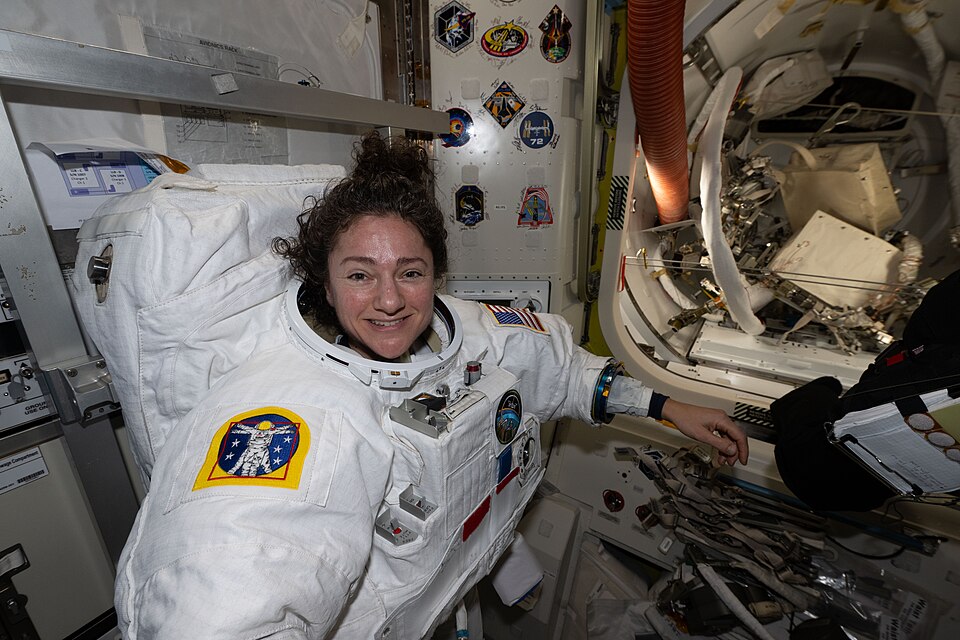
NASA Astronauts Replace Failed Wrist Joint On ISS Robot Arm
NASA astronauts Jessica Meir and Chris Williams replaced a failed wrist joint on the ISS's Canadarm2 during a spacewalk on Tuesday, June 30, 2026, restoring the robotic arm's full function.[1]
The spacewalk began at 7:20 a.m. Central.[1] They removed the arm's latching end effector, extracted failed joint No. 5 and installed a 200-pound spare wrist joint staged on an external stowage platform.[1] Flight controllers later confirmed two good strings of power and data through the new joint, restoring Canadarm2 to full operational status.[1] The failed joint was returned inside the station for eventual refurbishment and reuse.[1]
On May 27, 2026, one of Canadarm2's wrist joints drew elevated motor current and failed to move as commanded, triggering an engineering analysis.[1] NASA and the Canadian Space Agency determined a spacewalk was required and used a spare already aboard the station, keeping the arm in a safe parked configuration until the repair.[1]
The walk lasted about 7 hours and 20 minutes and drew live public coverage and praise for the tight coordination between the crew and flight controllers. Canadarm2 has been a workhorse since its installation in 2001, and the repair helps preserve critical cargo and maintenance capabilities through the station's planned retirement in 2030.
The mainstream summary does not mention that Canadarm2 has been operational since April 26, 2001, and has previously undergone similar repairs, including a wrist roll joint replacement in June 2002 and new latching end effectors in 2017-2018. This historical context highlights the robotic arm's longevity and the ongoing need for maintenance as it approaches the ISS's planned retirement in 2030, which is critical for sustaining its cargo and maintenance capabilities. The summary also overlooks the significant operational challenges associated with aging hardware, as a 2021 NASA audit indicated a 35% increase in systems maintenance and upgrade costs due to factors like ionizing radiation and micrometeoroids, which could further complicate future repairs and operations.
Furthermore, while the mainstream account emphasizes the successful repair, it does not address the broader implications of international cooperation in maintaining the ISS. Analysis from the Baker Institute underscores that countries collaborate in space exploration to share costs and expertise, making the ISS a prime example of how joint efforts can sustain complex projects that no single nation could manage alone. This aspect of the mission reflects not just a technical achievement but also a significant geopolitical collaboration in the realm of space exploration.
Show source details & analysis (1 source)
📊 Relevant Data
Canadarm2 has operated continuously since its installation on April 26, 2001, and has undergone prior in-orbit component replacements via spacewalk, including a wrist roll joint in June 2002 and new latching end effectors in 2017-2018.
About Canadarm2 — Canadian Space Agency
📌 Key Facts
- On Tuesday, June 30, 2026, astronauts Jessica Meir and Chris Williams began a spacewalk at 8:20 a.m. ET to repair Canadarm2.
- They removed the arm’s latching end effector assembly, extracted failed joint No. 5, and installed a 200-pound spare wrist joint from an external stowage platform.
- Flight controllers later confirmed two good strings of power and data through the new joint, fully restoring the arm’s operational status.
- The failed joint was returned inside the station for eventual refurbishment and future reuse, as Canadarm2 remains critical to ISS operations.
📰 Source Timeline (1)
Follow how coverage of this story developed over time