
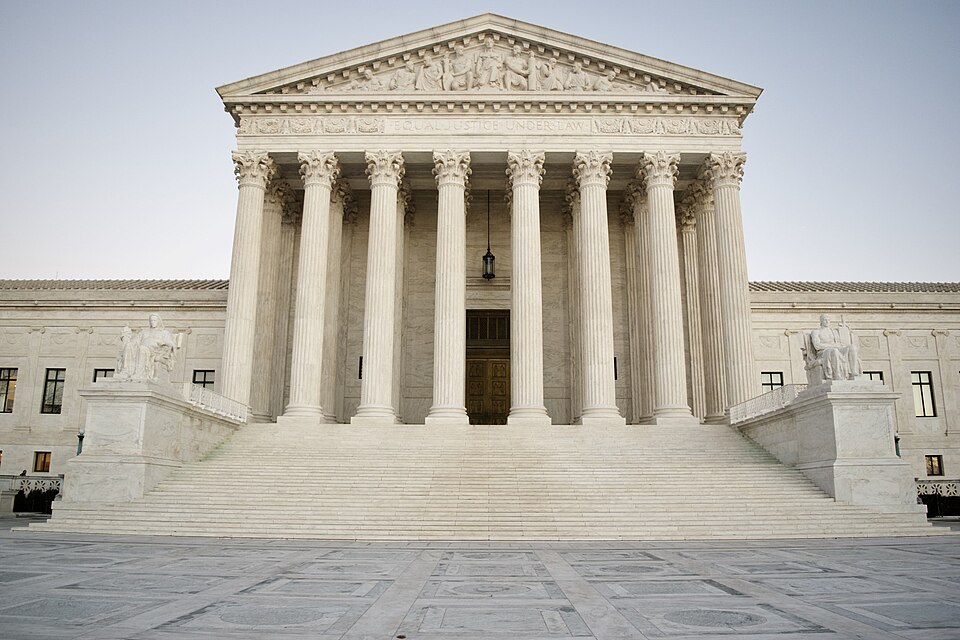
Supreme Court Strikes Down Federal Limits On Political Party Spending With Candidates
The Supreme Court on Tuesday, June 30, 2026, struck down federal limits on coordinated party spending in National Republican Senatorial Committee v. Federal Election Commission in a 6-3 decision.[1]
Justice Brett Kavanaugh wrote the majority opinion saying the ruling "treats all political parties equally" and lets national and state party committees coordinate more closely with their candidates.[1] Under the 2026-cycle Federal Election Campaign Act limits now invalidated, parties could coordinate between $65,300 and $130,600 with House campaigns and roughly $130,600 to $4 million with Senate campaigns.[1] The decision also allows parties to spend unlimited amounts in coordination with their nominees, removing the barrier that once separated party committees from super PACs.[2]
In November 2022, the National Republican Senatorial Committee, the National Republican Congressional Committee, then-Sen. J.D. Vance and then-Rep. Steve Chabot sued the FEC, arguing the coordinated-spending caps were unconstitutional.[3] A district court later certified the constitutional question to the en banc Sixth Circuit, which in September 2024 upheld the limits under a 2001 precedent. After President Trump's second term began, the Justice Department declined to defend the statute and the Supreme Court appointed outside counsel Roman Martinez to argue in its favor.[1]
The court tied the ruling to earlier campaign-finance decisions such as Citizens United and a 2014 aggregate-contribution case, placing it in a line of recent rulings that have loosened federal spending restrictions.[4] Justice Elena Kagan dissented, warning the decision would let parties act as an "alternative checking account" for campaigns and enable circumvention of contribution limits.[5]
The ruling comes weeks before the 2026 midterm campaigns and is widely viewed as a major win for national party committees that could reshape how parties fund and run coordinated advertising.[6] For context, individuals may contribute up to $44,300 per year to a national party committee's main account in the 2025-2026 cycle, a limit that remains even as coordinated spending is now unlimited.
The mainstream summary does not mention the broader implications of the ruling on political dynamics and campaign finance. While it highlights the Supreme Court's decision to invalidate spending limits, it overlooks the analysis suggesting that this ruling could exacerbate issues of elite influence in politics. For instance, social media commentators like @shoeluvvr argue that the decision effectively increases the control of the wealthy over political processes, framing donations as disguised bribes. This perspective aligns with concerns raised in academic analyses, which indicate that deregulation in campaign finance contributes to a decline in voter trust and a perception of elite capture in politics, as evidenced by the work of economist C. Cox.
Additionally, the summary does not capture the historical context provided by commentators who argue that the ruling restores a more traditional understanding of political party rights under the First Amendment. The City Journal emphasizes that the decision corrects a regulatory approach that had weakened political parties and their ability to engage in democratic functions. This aspect underscores a tension between the ruling's potential to empower political parties and the critiques suggesting it could facilitate circumvention of contribution limits, as noted in Justice Kagan's dissent and echoed in various media analyses.
Show source details & analysis (11 sources)
📊 Relevant Data
In the 2020 election cycle, total spending on federal elections reached $14.4 billion.
2020 cycle shatters records — OpenSecrets
For the 2025-2026 cycle, individuals may contribute up to $44,300 per year to a national party committee's main account.
Contribution limits for 2025-2026 federal elections — Federal Election Commission
📌 Key Facts
- On Tuesday, June 30, 2026, the Supreme Court ruled 6–3 in National Republican Senatorial Committee v. Federal Election Commission that statutory caps on coordinated party expenditures violate the First Amendment (National Republican Senatorial Committee v. Federal Election Commission).
- Justice Brett Kavanaugh’s majority opinion said the decision "treats all political parties equally" and allows national and state party committees to coordinate more closely with their candidates (Justice Brett Kavanaugh’s majority opinion).
- The ruling lets national and state party committees spend unlimited amounts in coordination with their candidates—removing the coordination ban that previously separated party committees from super PACs (super PACs).
- Under the now-invalidated 2026-cycle limits set by the Federal Election Campaign Act, party committees could coordinate between $65,300 and $130,600 with House campaigns and between $130,600 and roughly $4 million with Senate campaigns (Federal Election Campaign Act).
- The Court placed the decision in a broader line of campaign-finance rulings that weakened federal restrictions, citing earlier cases including Citizens United (2010) and a 2014 aggregate-contribution decision (Citizens United (2010)).
- The challenge was brought in 2022 by GOP national campaign committees and figures including then-Sen. J.D. Vance and then-Rep. Steve Chabot; after President Trump’s second term began the Federal Election Commission declined to defend the law and the Court appointed outside counsel Roman Martinez to defend the statute (GOP national campaign committees).
- Justice Elena Kagan dissented, warning the ruling allows circumvention of contribution limits and lets a party act as an "alternative checking account" for a campaign (Justice Elena Kagan dissented).
- News outlets and analysts characterized the June 30 ruling as an immediate, potentially transformative development ahead of the 2026 midterm elections and a major win for national party committees (2026 midterm elections).
📊 Analysis & Commentary (2)
"Paul Gigot's podcast commentary briefly summarizes three recent Supreme Court decisions — on birthright citizenship, transgender participation in girls' sports, and limits on coordinated party spending — presenting them as consequential rulings and tying them together in a short, descriptive commentary rather than mounting an extended argument for or against any single decision."
"The City Journal piece comments on the Supreme Court’s decision striking down limits on coordinated party spending, arguing that the Court rightly "restores an old idea" about parties’ First‑Amendment rights — endorsing the ruling as a correction of flawed campaign‑finance constraints while acknowledging critics’ warnings about possible circumvention of contribution limits."
📰 Source Timeline (11)
Follow how coverage of this story developed over time
- CBS segment reiterates that in a 6-3 ruling the Supreme Court held the Federal Election Campaign Act's coordinated party-expenditure caps unconstitutional under the First Amendment.
- The piece emphasizes that the practical effect is to remove limits on how much money political parties can spend on congressional campaigns in coordination with candidates ahead of the 2026 midterms.
- CBS News legal contributor Jessica Levinson provides on-air explanation of the decision's implications, but the article text itself does not add new factual details beyond those already reported in prior write‑ups of the ruling.
- The PBS segment, aired June 30, 2026, frames the National Republican Senatorial Committee v. FEC ruling as "transforming" campaign finance rules by lifting limits on coordinated party spending, underscoring its systemic impact.
- PBS anchors Geoff Bennett and Amna Nawaz hosted an expert discussion with UCLA law and political science professor Rick Hasen (spelled "Gasen" in the text) to analyze how the decision changes party advertising and expense coordination with candidates.
- The article emphasizes that the Court's conservative majority specifically opened the door for parties to spend unlimited amounts on advertising and other coordinated expenses with their nominees.
- The CBS piece states that the Court 'struck down limits on coordinated campaign spending,' aligning with the June 30, 2026 ruling in National Republican Senatorial Committee v. FEC.
- No new numbers, vote counts, or doctrinal nuances are provided beyond what the existing story already contains.
- Article (via Axios headline and timing) confirms the Supreme Court's June 30, 2026 decision striking down federal coordinated spending limits remains the central development; no materially different holding or scope is indicated beyond what is already captured.
- The Axios piece primarily reiterates that the Court struck down party spending caps and frames the ruling as a major win for national party committees, consistent with existing reporting.
- CBS video segment, published Tuesday, June 30, 2026, at 9:59 a.m. Central, reiterates that the Supreme Court struck down federal coordinated campaign spending caps in a major move before the 2026 midterms.
- The segment frames the ruling specifically as affecting "coordinated campaign spending" in the run-up to the 2026 midterm elections, emphasizing its immediate electoral timing and significance.
- Fox News confirms the Court decided National Republican Senatorial Committee v. Federal Election Commission in a 6-3 vote on Tuesday, June 30, 2026.
- The article quotes directly from Justice Brett Kavanaugh's majority opinion that coordinated-expenditure limits violate the First Amendment and that the decision "treats all political parties equally."
- The story quotes Justice Elena Kagan's dissent warning that the ruling allows circumvention of contribution limits and lets a party act as an "alternative checking account" for a campaign.
- Fox identifies then-Sen. J.D. Vance as one of the original 2022 plaintiffs along with the National Republican Senatorial Committee and National Republican Congressional Committee.
- Article confirms the Supreme Court ruling on coordinated party spending was handed down on Tuesday, June 30, 2026, in a case reported as lifting spending limits on political parties and candidates.
- It characterizes the effect as allowing national and state party committees to spend unlimited amounts in coordination with their candidates, subject to other campaign-finance rules.
- The report frames the decision as the latest in a series of Supreme Court rulings weakening federal campaign-finance restrictions and underscores its potential impact on both major parties in upcoming elections.
- The PBS/AP piece reiterates that on Tuesday, June 30, 2026, the Supreme Court struck down federal limits on how much political parties can spend in coordination with congressional and presidential candidates.
- The article emphasizes that the caps the Court invalidated were originally enacted more than 50 years ago and had previously been upheld by the Court in 2001.
- It restates that the challenge was brought in 2022 by the GOP House and Senate campaign committees, joined by then-Sen. JD Vance and then-Rep. Steve Chabot, and notes that after President Trump’s second term began, the Federal Election Commission abandoned defense of the law and sided with the Republican challengers.
- The story highlights that Democrats urged the Court to retain the limits even while acknowledging that, in an era of unlimited outside spending, the caps have often disadvantaged parties.
- It provides fresh color from December’s oral argument, quoting Justice Sonia Sotomayor warning that each time the Court overrides Congress on campaign finance it "makes matters worse," and Justice Samuel Alito defending Citizens United as having "leveled the playing field" by expanding spending rights beyond media companies.
- On Tuesday, June 30, 2026, the Supreme Court ruled 6-3 in National Republican Senatorial Committee v. Federal Election Commission that statutory caps on coordinated party expenditures violate the First Amendment.
- Justice Brett Kavanaugh’s majority opinion emphasized the ruling "treats all political parties equally" and allows national and state party committees of any party to "coordinate more closely" with their candidates.
- The article reiterates that, under the now-invalidated 2026 cycle limits, party committees could coordinate between $65,300 and $130,600 with House campaigns and between $130,600 and roughly $4 million with Senate campaigns, figures set under the Federal Election Campaign Act.
- The piece situates the decision within the Court’s broader campaign-finance jurisprudence, linking it to Citizens United (2010), the 2014 aggregate-contribution ruling, and the 2022 Ted Cruz loan-repayment case as part of a line of deregulating decisions.
- It notes that when the case reached the Supreme Court, the FEC under the Trump administration sided with the Republican challengers, and the Court appointed outside counsel Roman Martinez to defend the law after Democratic campaign committees urged the justices to uphold the caps.
- On Tuesday, June 30, 2026, the Supreme Court ruled 6-3 that federal limits on how much political parties may raise and spend on their candidates violate the First Amendment.
- Justice Brett Kavanaugh’s majority opinion holds that parties may now both coordinate with candidates and raise unlimited funds, effectively giving them "the best of both worlds" compared with super PACs.
- The decision explicitly overturns a 2001 Supreme Court precedent that had upheld party spending limits and places the new ruling in a line of earlier campaign-finance cases including Citizens United and a 2014 aggregate-contribution decision.
- The article emphasizes that other entities like PACs and super PACs already faced no limits on fundraising and spending but were prohibited from coordinating with candidates, a contrast the ruling eliminates for parties.
- Democratic Party lawyers defending the law argued in briefs that authorizing unlimited coordinated expenditures could "fundamentally reshape the campaign finance regime" and increase quid pro quo corruption risks, while GOP challengers argued parties by definition seek to influence their own candidates and thus do not "corrupt" them.