
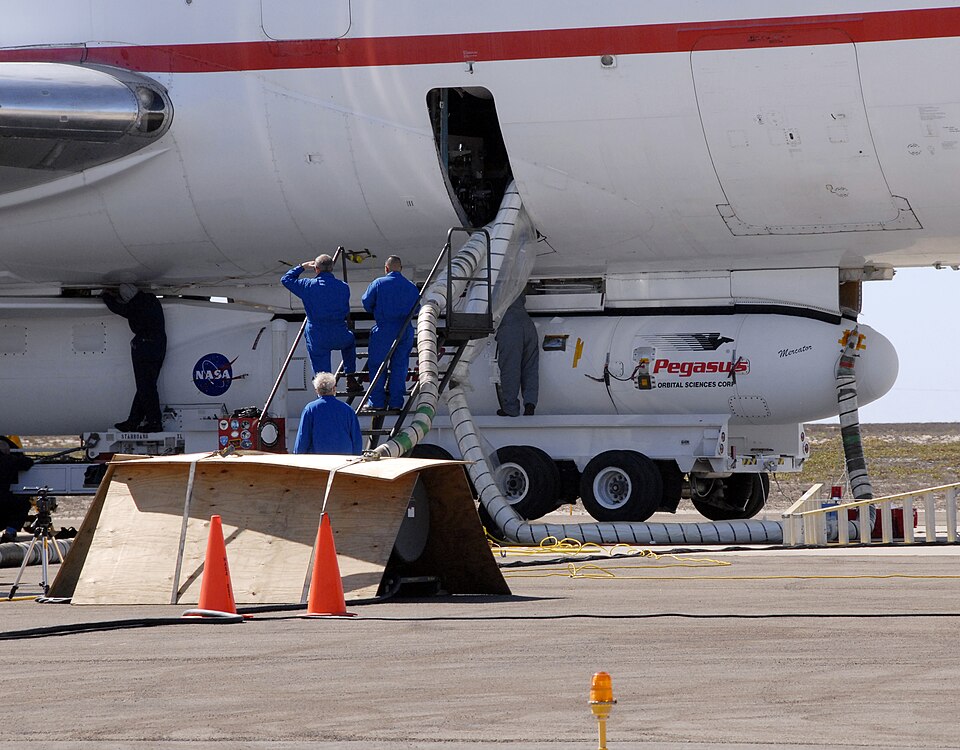
NASA Tries First U.S. Robotic Rescue To Save Swift Telescope
NASA is attempting the first U.S. robotic rescue of the Neil Gehrels Swift Observatory, with contractor Katalyst's Link spacecraft set to launch on a Pegasus from Marshall Islands as early as Wednesday, July 1, 2026.[1]
NASA awarded Katalyst a $30 million contract to build and fly Link on an emergency reboost mission aimed at lifting Swift's orbit and preserving its gamma-ray observations.[1] Link will try to rendezvous with Swift, now about 224 miles up, and raise it to roughly 373 miles over several months before the telescope risks dipping below about 185 miles and re-entering in October.[1] NASA powered down Swift's science instruments on February 11, 2026, to reduce drag and buy time for the robotic servicer.[1]
Solar maximum activity in 2024 expanded Earth's upper atmosphere and increased drag on Swift, accelerating its orbital decay. By January 2025, NASA forecasts showed most models projecting Swift's uncontrolled re-entry by summer 2026, prompting an emergency plan. Launched in 2004 for about $250 million, Swift has detected more than 2,000 gamma-ray bursts since 2004, making it a high-value target for preservation.
A successful reboost would serve as a pathfinder for robotic servicing of larger assets like Hubble and follows international precedent such as China's SJ-21 capture and relocation of a defunct satellite in January 2022. Agency and industry posts noted Katalyst moved Link from concept to launch readiness in under a year, underscoring the mission's tight schedule and technical risk.
The mainstream summary does not mention that Swift's mission has been extended multiple times due to its scientific success, highlighting its value to the scientific community beyond its initial launch cost of $250 million in 2004. This context underscores the importance of the current rescue mission, as Swift has detected over 2,000 gamma-ray bursts, enabling rapid follow-up observations of cosmic events, which could be lost if the telescope were to re-enter the atmosphere.[2]
Additionally, while the summary mentions Katalyst's rapid development of the Link spacecraft, it does not fully explore the implications of this mission for future autonomous servicing technology. The $30 million contract is framed as a high-stakes test that could pave the way for similar efforts with larger assets like the Hubble Space Telescope. This perspective highlights a broader trend in NASA's approach to space infrastructure maintenance and commercialization, driven by policy incentives and the need to extend the life of aging satellites at a lower cost than replacement.[3]
Show source details & analysis (1 source)
📊 Relevant Data
Swift was originally developed and launched by NASA at a cost of $250 million in 2004, with its mission repeatedly extended due to scientific success.
NASA is paying $30 million for a 1st-of-its-kind rescue mission to the aging Swift telescope — Space.com
Swift has detected more than 2,000 gamma-ray bursts since its 2004 launch, enabling rapid follow-up observations of the universe's most energetic explosions.
Scanning the cosmos since its launch in 2004, Swift has been sinking faster — NBC10 Boston / Associated Press
China's SJ-21 spacecraft in January 2022 successfully captured a defunct BeiDou navigation satellite in geosynchronous orbit and moved it to a higher graveyard orbit, marking the first active debris removal operation in that regime.
China tops US in defense-related satellites orbited in 2022 — Breaking Defense
📌 Key Facts
- NASA has contracted Katalyst Space Technologies for a $30 million mission to reboost the Swift Observatory.
- Launch of Katalyst’s Link spacecraft on a Pegasus rocket from the Marshall Islands could occur as early as Wednesday, July 1, 2026.
- Link will attempt to rendezvous with Swift, now at about 224 miles altitude, and raise it to roughly 373 miles over several months before the telescope dips below about 185 miles in October 2026.
- Swift’s scientific instruments were shut down in February 2026 to slow its orbital decay, and NASA sees the mission as a pathfinder for possible future servicing of Hubble.
📰 Source Timeline (1)
Follow how coverage of this story developed over time