
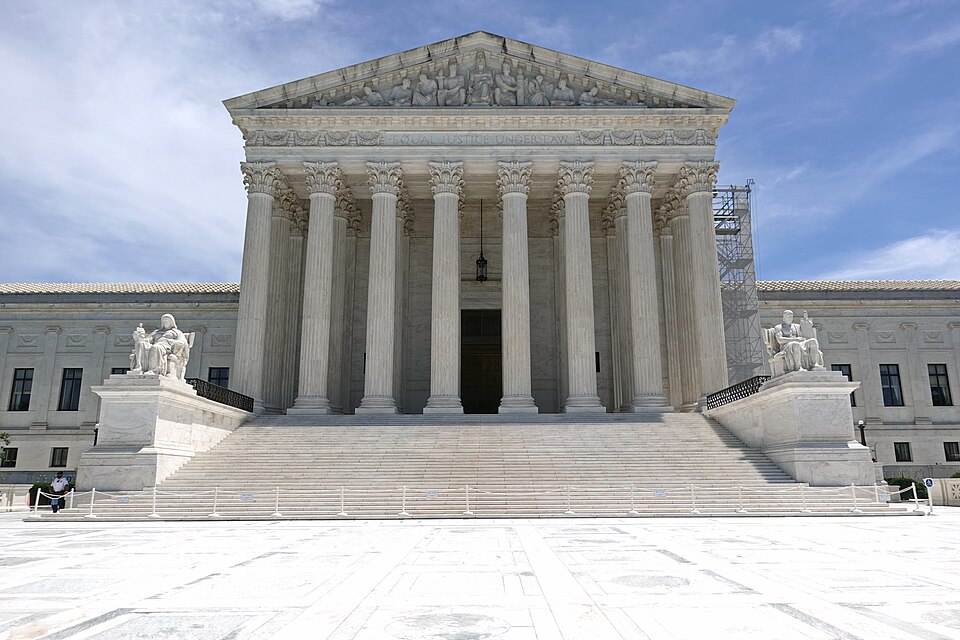
Supreme Court Narrows Asylum Access For Migrants Turned Back At Border
The Supreme Court ruled 6-3 on Thursday, June 25, 2026, that the United States may turn away asylum-seekers who are stopped on the Mexican side of the southern border, narrowing who can seek asylum at ports of entry.[1]
Justice Samuel Alito wrote the majority opinion, saying people stopped before stepping onto U.S. soil have not "arrive[d] in" the United States and so are not entitled to an asylum inspection.[1] Justice Sonia Sotomayor, joined by Justices Elena Kagan and Ketanji Brown Jackson, dissented from the bench, warning the ruling would "regrettably and tragically extinguish the light of the torch of the Statue of Liberty." MS NOW
Customs and Border Protection began the so-called "metering" or turn-back practice at the San Ysidro port of entry in 2016 during a surge of Haitian asylum seekers.[2] A federal judge in California ruled metering unlawful in 2021, a divided Ninth Circuit largely affirmed that view, and the decision now clears the way for the policy to be revived.[1]
Initial coverage framed the ruling as a clear legal victory for the Trump administration and a win for tighter asylum controls.[3] Later reports and Sotomayor's dissent emphasized practical risks, saying the decision could create a "perverse incentive" for migrants to attempt dangerous crossings between ports of entry.[4] U.S. Customs and Border Protection recorded 237,538 southwest land border encounters in fiscal year 2025, a fraction of the 2022 peak, a fact that some analysts say shapes how the ruling might play out at the border. Fox News noted the Department of Homeland Security celebrated the ruling while the plaintiff group Al Otro Lado warned it would encourage illegal crossings.[5]
The mainstream summary frames the Supreme Court's ruling as a straightforward legal victory for the Trump administration, but Jonathan Turley argues that the decision reflects a necessary interpretation of asylum law that prioritizes physical presence. He contends that the ruling is not just a win for stricter border controls but also a correction to what he sees as the previous administration's failures in managing asylum claims, which he claims are often unsupported or invalid. This perspective contrasts with the mainstream account, which emphasizes the dissenting justices' humanitarian concerns without addressing the broader implications of the ruling for the asylum system itself.
Additionally, the summary does not mention the significant drop in border encounters, from over 2 million in fiscal years 2022 and 2023 to 237,538 in 2025, which some analysts suggest may influence how the ruling is implemented. This context is crucial as it highlights the changing dynamics at the border that could affect the practical outcomes of the Supreme Court's decision. The implications of the ruling could lead to increased illegal crossings, as noted in Sotomayor's dissent, which the mainstream coverage only lightly touches upon without delving into the potential consequences for migrants seeking asylum.[6][7]
Show source details & analysis (7 sources)
📊 Relevant Data
U.S. Customs and Border Protection recorded 237,538 southwest land border encounters in fiscal year 2025, down from more than 2.2 million in fiscal year 2022 and more than 2 million in fiscal year 2023.
Southwest Land Border Encounters — U.S. Customs and Border Protection
There were 872,000 defensive asylum applications in fiscal year 2025.
State of Immigration in Numbers — USAFacts
📌 Key Facts
- On Thursday, June 25, 2026, the Supreme Court ruling decided 6–3 to overturn a lower-court order that had blocked the border “metering” policy.
- Justice Samuel Alito’s majority held that people stopped on the Mexican side of the border have not “arrive[d] in” the United States for asylum purposes and that federal law does not entitle someone standing in Mexico to apply for asylum or require an inspection by an immigration officer (MS NOW).
- Alito framed the legal issue with the analogy that “a guest does not arrive in a house when he knocks on the front door,” stressing that in ordinary speech a person does not “arrive in” a place before entering it (PBS News).
- Justice Sonia Sotomayor, joined by Justices Elena Kagan and Ketanji Brown Jackson, dissented from the bench, saying the decision “regrettably and tragically extinguishes the light of the torch of the Statue of Liberty” and warning it could create a perverse incentive for migrants to cross between ports of entry (PBS News).
- The ruling clears the way to revive the Department of Homeland Security’s “metering” or “turn-back” practice — first used at San Ysidro in 2016 during a surge of Haitian asylum seekers, later expanded under President Trump, ended in 2020, and formally rescinded by President Biden in 2021 (Los Angeles Times).
- The case’s procedural history includes a 2021 California federal judge finding metering unlawful, a divided Ninth Circuit panel decision that attracted criticism and a vote by nearly half of the full Ninth Circuit to rehear, which helped prompt Supreme Court review (PBS News).
- Reactions and practical implications: the Department of Homeland Security celebrated the June 25, 2026 decision, plaintiff group Al Otro Lado warned the rule would encourage illegal crossings, and the majority said such concerns are “overstated” because metering delays rather than permanently bars asylum while illegal entry carries legal risks.
📊 Analysis & Commentary (1)
"Jonathan Turley's column defends the Supreme Court's asylum ruling (that asylum seekers stopped outside U.S. territory have not 'arrived') and the TPS decision as lawful wins for stronger border control, arguing that textual limits on 'constructive entry' and curtailed TPS relief are needed because most recent asylum claims are invalid or abused and liberal analogies (like the St. Louis case) are inapt."
📰 Source Timeline (7)
Follow how coverage of this story developed over time
- On Thursday, June 25, 2026, Fox News highlighted dissenting Justice Sonia Sotomayor's warning that the Mullin v. Al Otro Lado ruling could create a "perverse incentive" for migrants to cross the border illegally rather than wait lawfully at ports of entry.
- The article quotes plaintiff organization Al Otro Lado's court filings arguing that restricting asylum to those who physically enter the U.S. would encourage crossings between ports of entry because such entrants receive greater rights than those stopped at ports.
- Fox reports that the Department of Homeland Security publicly celebrated the June 25, 2026 decision but did not respond to a Fox request for comment on whether it has prepared for a potential uptick in illegal crossings.
- Justice Samuel Alito's majority opinion is quoted further, asserting that concerns about increased illegal crossings are "overstated" and emphasizing that metering does not permanently bar asylum, whereas illegal entry is dangerous, criminal, and can carry adverse legal effects.
- Alito adds that an asylum seeker whose admission is delayed by metering would need a "powerful reason" to prefer immediate asylum via illegal entry given the risks and penalties described.
- Article restates that on Thursday, June 25, 2026, the Supreme Court ruled 6-3 in Mullin v. Al Otro Lado to uphold the metering policy that lets U.S. border agents block asylum seekers who remain on the Mexican side of the border.
- It quotes Justice Samuel Alito’s majority opinion emphasizing a "straightforward" statutory reading of the phrase "arrives in the United States," saying that in ordinary speech a person does not "arrive in" a place before entering it.
- It highlights Justice Sonia Sotomayor’s dissent describing the majority’s interpretation as "illogical" and asserting it is natural to say asylum seekers are arriving when they reach the threshold of a port of entry.
- The piece notes that the Court’s ruling fits within a broader pattern of deference to presidential authority on immigration and national security and frames the decision as part of an effort to "meter" asylum seekers when overall arrivals are currently relatively low.
- Article confirms the Supreme Court's June 25, 2026 decision allows asylum seekers approaching ports of entry on the southern border to be turned back without a hearing if they have not physically entered U.S. territory, reaffirming that the statutory right applies only to those who "arrive in the United States."
- It details that the case arose from DHS's "turn-back" or metering practice that began at San Ysidro in 2016 during a surge of Haitian asylum seekers and was later extended to other crossings, requiring migrants to remain in Mexico until called for interviews.
- The report quotes Justice Alito's majority reasoning that no one "arrives in" a place before entering it, and Justice Sotomayor's dissent linking the Refugee Act of 1980 to the moral lessons of the MS St. Louis and the post-Holocaust refugee regime.
- The article recounts the prior 9th Circuit ruling by Judge Michelle Friedland, who held that a person presenting herself to an official at the border has "arrived" and warned that the government's interpretation would give the executive vast discretion to bar asylum applications simply by physically blocking migrants at the border.
- Fox News confirms that in Mullin v. Al Otro Lado, decided Thursday, June 25, 2026, the Supreme Court held that migrants turned back at the southern border before entering the United States are not entitled to apply for asylum because they have not legally "arrive[d] in" the country.
- The article quotes Justice Samuel Alito’s majority reasoning that, in ordinary speech, a person does not "arrive in" a place before entering it, directly rejecting the Ninth Circuit’s broader interpretation.
- Fox characterizes the decision as a major victory for President Trump’s efforts to reduce asylum claims and notes that conservatives had viewed prior rulings recognizing asylum-processing rights for migrants just outside ports of entry as facilitating abuse.
- The article confirms the Supreme Court ruling was issued Thursday, June 25, 2026, in a 6-3 decision overturning a lower court order that had blocked the border 'metering' policy.
- It reiterates that the challenged policy limited the number of people who could apply for asylum each day at U.S.-Mexico border ports of entry and had first been used under President Obama before expansion under President Trump.
- Justice Samuel Alito's majority opinion framed the legal issue with the analogy that 'a guest does not arrive in a house when he knocks on the front door,' underscoring that migrants stopped before physical entry are not considered to have 'arrived' for asylum purposes.
- Justice Sonia Sotomayor delivered a dissent from the bench, saying the decision 'regrettably and tragically extinguishes the light of the torch of the Statue of Liberty,' and Justice Alito unusually responded aloud, noting that both Obama and Trump administrations had used the policy.
- The article notes that the metering policy itself is not currently in effect, having ended in 2020 and been formally rescinded by President Biden in 2021, but that the Supreme Court ruling clears the way for the Trump administration to potentially revive it.
- It recounts that a California federal judge in 2021 found metering unlawful and a divided appeals court panel affirmed, with nearly half of the full Ninth Circuit voting to rehear, a backdrop that likely contributed to Supreme Court review.
- Article confirms on Thursday, June 25, 2026, that the Supreme Court ruled 6-3 that people standing on the Mexican side of the border have not 'arrived in' the United States for asylum purposes.
- Justice Samuel Alito's majority opinion holds that federal law does not entitle someone standing in Mexico to apply for asylum and does not require an immigration officer to inspect them.
- Justice Sonia Sotomayor's dissent, joined by Justices Elena Kagan and Ketanji Brown Jackson, states that the decision 'blesses the Executive Branch's decision to slam the door shut on all who are fleeing persecution.'
- The article reiterates that the case centers on the statutory phrases 'physically present in the United States' and 'arrives in the United States' and that attempting, but failing, to step onto U.S. soil does not qualify as arrival.
- It recounts that the Ninth Circuit panel majority had previously ruled against the government, finding the administration's reading would radically contract asylum rights, while Trump-appointed Judge Ryan Nelson dissented and Judge David Bress later criticized that panel decision.