
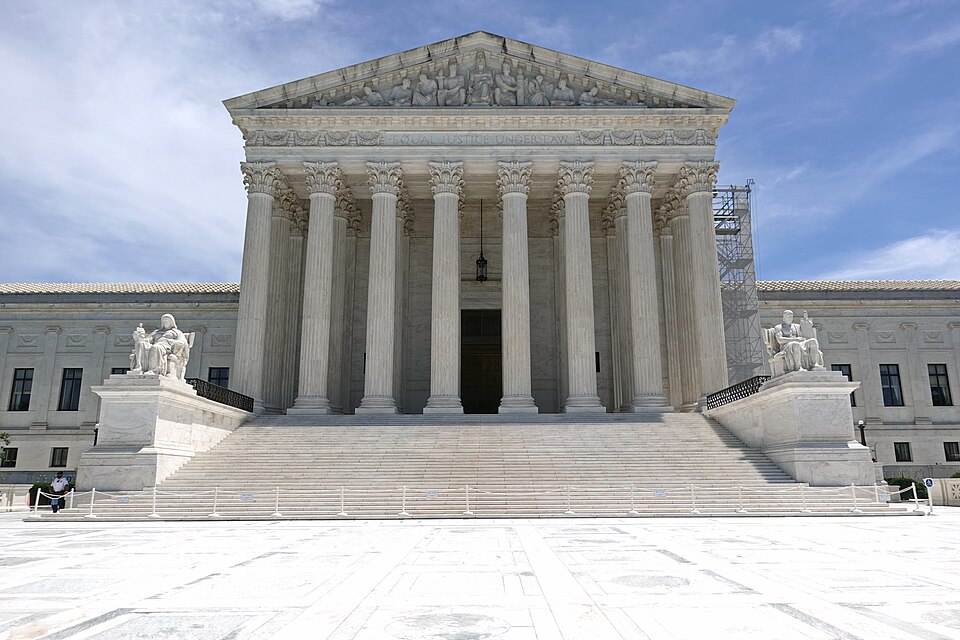
Supreme Court Strikes Down Five-State Gun Carry Permission Laws On Private Property Open To Public
On Thursday, June 25, 2026, the Supreme Court ruled 6-3 in Wolford v. Lopez to invalidate Hawaii's law that forced concealed-carry permit holders to get property owners' prior permission to carry on most open private property.[1]
Justice Samuel Alito wrote that advance-permission or "vampire" requirements impose an undue burden and "hobble" what the Second Amendment protects.[2] The ruling targets similar laws in California, Maryland, New York and New Jersey as well as Hawaii.[2] Practically, people may now carry into stores, hotels, shopping malls and gas stations until an owner explicitly posts a ban.[3] Justice Elena Kagan wrote a solo dissent and Justice Ketanji Brown Jackson, joined by Sonia Sotomayor, authored a longer dissent defending property owners' right to exclude.[4]
In June 2022, the Court's Bruen decision ended states' ability to require a special need for concealed-carry permits. Hawaii responded in June 2023 with Act 52, which barred carry on most private property open to the public unless an owner gave express permission. A district judge initially blocked parts of the law, the Ninth Circuit upheld the private-property provision in 2024, and the Supreme Court took the case in October 2025.
Early coverage framed the decision as another expansion of gun rights after Bruen and described "vampire" permission rules as undue burdens.[2] Later reporting stressed the ruling's wider reach and noted that similar laws in other states are now seen as vulnerable to challenge.[4]
As a near-term follow-up, the Justice Department filed lawsuits on Wednesday, July 1, 2026 challenging new gun restrictions in Virginia and California.[5]
The mainstream summary emphasizes the Supreme Court's decision as a straightforward expansion of gun rights, framing the ruling primarily through the lens of the Second Amendment. However, analysis from Politico highlights the underlying implications of this decision, arguing that the conservative majority, particularly Justice Alito, is reshaping major policy areas through a specific doctrinal approach that could have far-reaching consequences for state laws and public safety. This perspective suggests that the ruling is not merely about individual rights but also about how judicial interpretations are influencing broader governance issues, which the mainstream account downplays.
Moreover, the mainstream summary does not mention the significant context surrounding the ruling, such as the staggering number of modern sporting rifles in circulation—approximately 32 million since 1990—which underscores the scale of gun ownership in the U.S. and the potential impact of such rulings on public safety. This omission leaves readers without a full understanding of the broader landscape of gun rights and regulations that the court's decision interacts with, as highlighted by Pew Research, which shows a stark partisan divide on gun control measures, reflecting deeper cultural polarization on this issue.
Show source details & analysis (9 sources)
📊 Relevant Data
Approximately 32 million modern sporting rifles (including AR-15 style rifles) have been produced and are in circulation in the United States since 1990.
Is Media Purposefully Underreporting How Many Americans Own Modern Sporting Rifles? — National Shooting Sports Foundation
📌 Key Facts
- On Thursday, June 25, 2026 the Supreme Court ruled 6-3 in Wolford v. Lopez to invalidate Hawaii’s Act 52 provision that required licensed concealed‑carry holders to obtain property owners’ advance permission before bringing firearms onto most private property open to the public (Wolford v. Lopez).
- Justice Samuel Alito’s majority opinion said advance‑permission or “vampire” requirements impose an undue burden that “hobbles what the Second Amendment protects,” framing the law as inconsistent with the right to carry for self‑defense as people go about daily life (Justice Samuel Alito’s majority opinion).
- The three dissenting justices were Sonia Sotomayor, Elena Kagan and Ketanji Brown Jackson: Justice Elena Kagan wrote a separate solo dissent calling the statute a modern analogue of historical restrictions, while Justice Ketanji Brown Jackson (joined by Justice Sotomayor) authored a longer dissent emphasizing the property right to exclude (Justice Elena Kagan).
- The decision targeted so‑called “vampire laws” in five states — Hawaii, California, Maryland, New York, and New Jersey — that required prior consent from property owners, contrasting with most other states where carriers may enter private property until an owner affirmatively objects (five states – Hawaii, California, Maryland, New York, and New Jersey).
- Practically, the ruling means people may carry firearms onto privately owned places open to the public — for example shopping malls and gas stations, hotels and stores — unless the owner explicitly posts that guns are banned (shopping malls and gas stations).
- The high‑court decision is situated in the post‑2022 Bruen landscape, where lower courts have struck down many restrictions and wrestled with Bruen’s historical‑analogy test and its application to modern gun laws (post-2022 Bruen landscape).
- The ruling did not address other Hawaii gun restrictions (for example limits the state has applied to parks, beaches and restaurants serving alcohol), which remain subject to separate legal challenges in lower courts (parks, beaches and restaurants serving alcohol).
- As a near‑term follow‑up, on Wednesday, July 1, 2026 the Justice Department filed separate federal lawsuits challenging recently enacted state laws in Virginia (targeting Senate Bill 749 and an assault‑weapons/import‑sale ban on AR‑15‑style semiautomatic rifles and >15‑round magazines) and California (challenging a new restriction on certain Glock‑style pistols and enforcement of the Unsafe Handgun Act and handgun roster) and said it was seeking permanent relief (Justice Department).
📊 Analysis & Commentary (1)
"The Politico Playbook commentary urges readers to watch individual Supreme Court justices — especially Justice Alito and the conservative majority — because their recent authorship and doctrinal choices (illustrated by the Court’s June rulings on concealed carry) are reshaping major areas of law; the piece is a commentary that warns about the practical consequences and highlights the importance of tracking who writes and why."
📰 Source Timeline (9)
Follow how coverage of this story developed over time
- On Wednesday, July 1, 2026, the Justice Department filed separate federal lawsuits against California and Virginia challenging recently enacted state gun restrictions.
- The California suit targets new restrictions on the sale of Glock-style semiautomatic pistols that took effect earlier on July 1 under the state's Unsafe Handgun Act and Penal Code section 27595.
- The Virginia lawsuit challenges Senate Bill 749, signed by Gov. Abigail Spanberger in May 2026, which as of July 1 makes it a misdemeanor to import, sell, manufacture, purchase or transfer certain semiautomatic firearms classified as assault weapons.
- Assistant Attorney General for Civil Rights Harmeet Dhillon is leading the litigation effort and publicly framed the cases as the DOJ enforcing the Second Amendment against unconstitutional state regulations.
- California Attorney General Rob Bonta disclosed that DOJ sent a notice of intent to sue, rejected DOJ's constitutional arguments in a written response, and declined to negotiate, prompting the filing.
- Gov. Gavin Newsom's office responded that California would continue enforcing its gun safety laws and characterized the DOJ actions as politically motivated.
- On Wednesday, July 1, 2026, the Justice Department filed a lawsuit against Virginia challenging a new law banning the sale and purchase of assault weapons and magazines holding more than 15 rounds, seeking a permanent injunction.
- The Virginia complaint argues that AR-15-style rifles are 'not commonly used by criminals' and cites survey data on their use for self-defense and hunting while omitting discussion of their role in mass shootings.
- A separate DOJ lawsuit filed the same day targets California's 'Glock Ban' on semiautomatic pistols that can be converted into machine guns with switches, as well as enforcement of the state's 2007 Unsafe Handgun Act and its handgun roster.
- The DOJ suits follow Gov. Abigail Spanberger's signing of the Virginia assault-weapons ban in May 2026 and Gov. Gavin Newsom's signing of the California Glock law in fall 2025; both governors' offices issued statements vowing to defend the laws.
- The article notes that the Supreme Court is already expected to consider the constitutionality of assault-weapons bans in its next term, meaning the new DOJ challenges will unfold alongside pending high-court review.
- On Wednesday, July 1, 2026, the Justice Department filed separate lawsuits against Virginia and California claiming their new gun restrictions are unconstitutional.
- The Virginia suit targets a law that, according to DOJ, bans the commercial purchase and sale of AR-15-style semiautomatic rifles, which it describes as ordinary semi-automatic rifles owned by millions of Americans.
- The California suit challenges a new law effective July 1, 2026, restricting sales of certain Glock pistols that state law treats as 'machinegun-convertible' and also seeks to block enforcement of California's Handgun Roster.
- Acting Attorney General Todd Blanche said in a statement that 'the Second Amendment is a sacred right belonging to all Americans,' including residents of Virginia and California.
- DOJ characterizes Virginia's enforcement of the AR-15-style rifle ban as a 'pattern or practice' by state law enforcement that deprives residents of constitutional rights to buy and sell protected arms.
- PBS/AP article confirms the Supreme Court ruled 6-3 on Thursday, June 25, 2026, to strike down Hawaii's 2023 law requiring advance permission to carry guns into stores, hotels and other private businesses open to the public.
- The article clarifies practical impact: people may now carry guns onto privately owned property such as shopping malls and gas stations unless owners explicitly post that guns are banned.
- It notes the law was sometimes called a "vampire rule" because it required carriers to obtain an invitation-like permission from property owners.
- The story specifies that about four other states have enacted similar presumptive private-property gun bans, and that comparable restrictions have already been blocked in some jurisdictions.
- PBS reiterates that Hawaii's separate restrictions on guns in places such as parks, beaches and restaurants serving alcohol were not before the Court in this case and remain under challenge in lower courts.
- The article states that the lawsuit was brought by a gun-rights group and three Maui residents, and that a district judge initially blocked the law before an appeals court allowed enforcement prior to the Supreme Court ruling.
- It underscores that the Trump administration supported the challengers and argued the law violated the Second Amendment.
- On Thursday, June 25, 2026, the Court ruled 6-3 that Hawaii cannot require concealed-carry permit holders to obtain property owners' permission before bringing guns onto private property open to the public.
- Justice Samuel Alito's majority opinion explicitly held that Hawaii's regime "hobbles what the Second Amendment protects" and violates both the Second and Fourteenth Amendments.
- Justice Elena Kagan wrote a separate solo dissent arguing the law is a modern analogue of colonial and founding-era laws restricting firearms on private property without affirmative consent.
- Justice Ketanji Brown Jackson, joined by Justice Sonia Sotomayor, authored a longer dissent stating that the statute "fairly applies a first principle of property law — the right to exclude — and does no harm to the Second Amendment."
- The article emphasizes that challengers framed the law as inconsistent with the 2022 Bruen historical-tradition test, while Hawaii argued it reflected a longstanding property right to exclude firearms even on premises open to the public.
- The piece notes this Wolford v. Lopez ruling comes after another Second Amendment decision this term, United States v. Hemani, in which the Court unanimously sided with a Texas man prosecuted under the federal gun ban for drug users.
- Article confirms the Supreme Court's June 25, 2026 decision invalidating Hawaii’s Act 52 requirement that licensed gun carriers obtain advance permission before carrying on most private property open to the public.
- It supplies additional on-the-ground detail about how Hawaii officials had applied the law in practice, including examples of businesses posting default "no guns" policies and the impact on permit holders’ ability to carry in common commercial settings.
- It includes reaction quotes from Hawaii officials and gun-control advocates describing the ruling as a significant rollback of post-Bruen gun restrictions and outlining potential legislative responses.
- Fox News article confirms that in Wolford v. Lopez, decided Thursday, June 25, 2026, the Supreme Court ruled 6-3 against Hawaii's attorney general and in favor of the plaintiffs.
- The piece reiterates that the specific Hawaii provision at issue required explicit permission from property owners before licensed carriers could bring firearms into public businesses.
- It identifies the lineup of dissenting justices in this case as Sonia Sotomayor, Elena Kagan, and Ketanji Brown Jackson, consistent with earlier reporting.
- On Thursday, June 25, 2026, the Supreme Court’s 6-3 decision was framed as barring state laws that require gun owners to obtain advance permission from property owners before carrying firearms on their land.
- NPR reports that five states – Hawaii, California, Maryland, New York, and New Jersey – have such so-called “vampire laws” that require prior consent.
- Justice Samuel Alito’s majority opinion characterizes advance-permission requirements as an undue burden that ‘hobbles what the Second Amendment protects: the right of Americans to carry arms for self-defense as they go about their daily lives.’
- The article notes that in most other states, gun owners may carry onto private property unless and until the owner affirmatively objects, contrasting that baseline with the five vampire-law states.
- NPR situates the ruling in the broader post-2022 Bruen landscape, citing an analysis that nearly 100 gun laws were struck down in the year after Bruen and describing lower courts’ confusion over its historical-analogy test.