
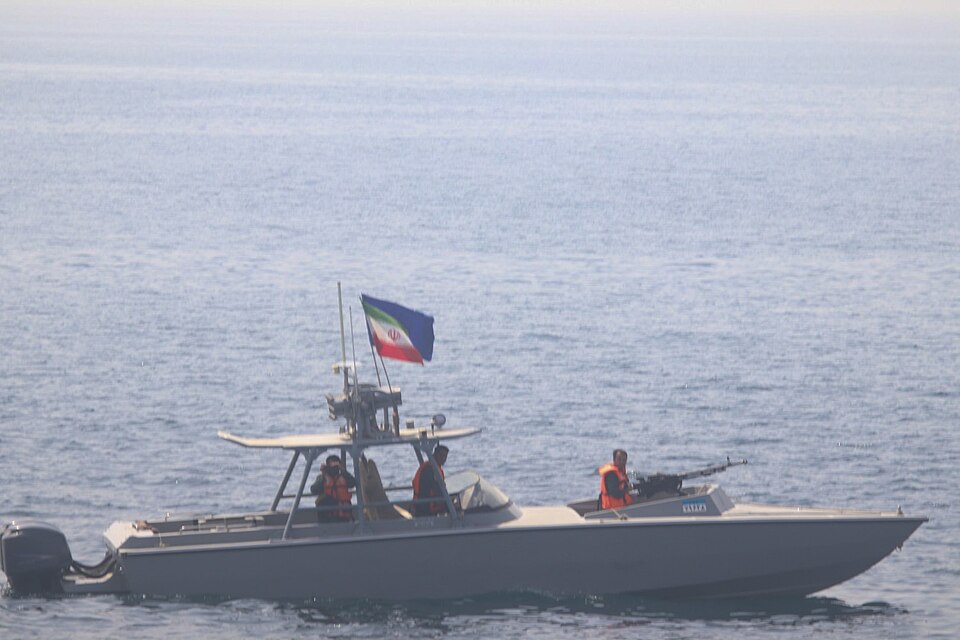
Iranian Officials Reaffirm Sweeping Conditions To Reopen Strait Of Hormuz
Iranian officials on Sunday said they will not reopen the Strait of Hormuz unless the United States ends the war, lifts its naval blockade, withdraws forces, compensates Iran for wartime damage and removes sanctions and frozen assets.[1]
Foreign Ministry spokesman Abbas Araghchi said Tehran is holding only indirect exchanges with Washington and that formal talks now center on finalizing new maritime routes with Oman, not on direct U.S.-Iran negotiations.[2] Two regional officials and Iranian state media say the draft Oman-Iran plan would use separate inbound and outbound lanes — inbound near Iran, outbound near Oman — and that technical details are in their final stages.[3]
On June 25, a Revolutionary Guard drone struck the Singapore-flagged merchant vessel Ever Lovely and the U.N. International Maritime Organization paused a U.N.-backed evacuation and routing plan while safety guarantees were rechecked.[4] U.S. forces began repeated retaliatory strikes the next day to degrade Iran's missile, drone and radar sites after attacks on commercial shipping, and Washington reimposed a naval blockade of Iranian ports on July 14 to enforce maritime controls.[5][6] The cycle of attacks pushed Brent crude above $100 per barrel in late July before prices eased on renewed diplomacy, even as U.S. officials acknowledged growing costs: roughly 18 U.S. service members killed and concerns that long-range missile inventories have been heavily drawn down.[7][8][9]
Early coverage of the June mediation cast the June memorandum as a U.S.-brokered, toll-free route to reopen Hormuz, driven by Pakistani and Qatari mediators.[10] More recent reporting has highlighted a shift: Iranian officials now insist on controlling routing and have publicly floated service fees and bans on ships from "hostile" countries, a stance that clashes with U.S. demands for toll-free, non-Iranian-controlled lanes.[11]
The mainstream summary primarily focuses on Iran's conditions for reopening the Strait of Hormuz, but it overlooks the significant role that Pakistan has played as a mediator in the ongoing negotiations. Rashmee Roshan Lall argues that Pakistan's strategic importance has increased due to its involvement in brokering the ceasefire and facilitating maritime arrangements, suggesting that its influence should not be underestimated by the U.S. and other powers. This perspective highlights a broader geopolitical context that the mainstream account does not address, particularly the implications of Pakistan's involvement for regional security dynamics and U.S. negotiations.
Additionally, the mainstream narrative does not engage with the emotional dimensions of the conflict, which Saeid Golkar emphasizes as politically consequential. The concept of 'the politics of tears' illustrates how public displays of grief and emotional rhetoric in Iran can affect domestic politics and international diplomacy, potentially complicating efforts for de-escalation. This nuanced understanding of emotional politics adds a layer of complexity to the situation that is absent from the more transactional framing in the mainstream coverage.[12][13]
Show source details & analysis (243 sources)
📌 Key Facts
- On Thursday, June 25, 2026 Iran’s Revolutionary Guard fired a drone that struck the Singapore‑flagged merchant vessel Ever Lovely, damaging its bridge and helping trigger a pause by the International Maritime Organization in its U.N.‑backed evacuations of ships through the Strait of Hormuz.
- In direct response to Iranian attacks on commercial shipping, U.S. forces carried out repeated retaliatory strikes beginning Friday, June 26, 2026; U.S. Central Command said the strikes hit missile and drone storage sites, coastal radars and other Revolutionary Guard facilities to degrade Iran’s ability to threaten navigation.
- Following renewed tanker attacks on July 7, 2026 the administration revoked a key export waiver for Iran, formally rescinding General License X, replaced it with a narrower license, and coupled sanctions and military strikes as leverage while markets and insurers reeled.
- Mediators report Iran and Oman have been negotiating a temporary corridor plan to reopen Hormuz — with inbound traffic using a lane close to Iran and outbound traffic via an Oman‑hugging lane — but Tehran and Washington publicly disagree about whether the draft would grant Iran control or permit fees; officials say final sign‑off and linkage to lifting the U.S. naval blockade remain unresolved (PBS News).
- The U.S. reimposed a naval blockade on Iranian ports starting July 14, 2026, disabling or redirecting multiple commercial vessels that attempted to reach Iranian terminals and escalating maritime enforcement in the Strait of Hormuz.
- Regional escalation broadened: Iran and its proxies struck Gulf states and commercial ships (including attacks U.S. officials attribute to Iran), while Yemen’s Houthi rebels began attacking tankers in the Red Sea and declared a blockade of Saudi‑linked shipping through Bab el‑Mandeb, creating a two‑chokepoint energy shock.
- Markets reacted sharply to the fighting and negotiation signals: benchmark Brent crude spiked above $100 per barrel in late July on renewed attacks and then swung back on August 4 as talks about Hormuz resurfaced, while U.S. equities and bond yields moved on both risk and earnings news.
- U.S. military and public tallies show mounting human and material costs: by late July/August officials cited about 18 U.S. service members killed and hundreds wounded, repeated multi‑night U.S. strike campaigns inside Iran, and growing concerns about depletion of advanced munitions — notably near‑exhaustion of certain long‑range missiles and drawdowns of Patriot/THAAD interceptors — even as diplomacy and last‑chance dealmaking continued.
📊 Analysis & Commentary (11)
"The piece argues that Pakistan's standing has risen — citing its role alongside Qatar in mediating the Iran‑Strait of Hormuz agreement — and contends Islamabad now matters geopolitically in ways Western policymakers should recognize and engage with, though the author likely also notes Pakistan's limits."
"The author uses recent U.S.–Iran exchanges (and Trump's declaration that the ceasefire is 'over') as the news hook to argue that public grief and emotional rhetoric — 'the politics of tears' — are politically powerful signals that shape Iran’s domestic trajectory and international responses, and that policymakers who ignore how grief is weaponized risk hardening conflict rather than resolving it."
"Paul Gigot critiques the White House’s reimposition of a naval blockade and Trump’s vow to ‘guard’ the Strait of Hormuz, arguing that the earlier talk of a 20% transit fee muddled the administration’s message and could make it politically costly if oil prices rise."
"The WSJ columnist argues that while the U.S. Navy could militarily 'force open' the Strait of Hormuz, doing so would require ground troops and be costly and open‑ended; by contrast, the blockade President Trump ordered is a more feasible way to pressure Iran (enforceable by long‑range air and open‑sea interceptions), and policymakers should weigh those practical costs against the limited additional gains from escalation."
"The Fox News opinion argues that U.S. support for Israel is a strategic, reciprocal partnership — not charity — and urges preserving robust ties (especially amid regional escalation), rebutting critics who frame aid as one‑sided handouts or who call for conditioning/withdrawing support."
"The Fox News opinion argues that Iran's attacks are a deliberate asymmetric strategy to 'widen the board' (target shipping, energy chokepoints and proxies) rather than match U.S. firepower directly, and warns that President Trump must craft a coherent endgame — not just strike back — while avoiding tactical and rhetorical mistakes that hand Tehran political advantage."
"The submitted analysis piece's body is corrupted/unreadable; based on its title alone it most likely comments on the news story 'U.S. Intensifies Iran Strikes, Hits Iranian Bridges, Power Sites And Chabahar Port Tower,' but I cannot extract the author's actual arguments or stance from the damaged text."
"Politico’s Playbook argues that President Trump’s public threats and the administration’s stepped‑up strikes on Iran risk trapping the U.S. — politically and militarily — by inflating expectations, narrowing prudent options, driving a push for supplemental war funding, and increasing the chance of dangerous escalation rather than delivering clear, sustainable security gains."
"The NYT opinion critiques the Trump administration’s Iran campaign and related transactional diplomacy (including its handling of the Saudi nuclear pact), arguing the idea of a contained, ‘perfect’ war is illusory: military coercion and deal‑conditioning risk widening the war, spurring retaliation, damaging alliances and the economy, and foreclosing the multilateral diplomacy needed to stabilize the region."
"Matthew Yglesias argues that Trump’s war with Iran, abrasive diplomacy, and tariff-heavy trade posture have damaged U.S. global standing (as shown by recent Pew polling) and made China look comparatively more constructive — a strategic failure that undermines America’s ability to forge international coalitions."
📰 Source Timeline (243)
Follow how coverage of this story developed over time
- On Sunday, August 9, 2026, two people familiar with the talks said Iran and Oman are working to finalize a temporary deal to reopen the Strait of Hormuz using separate inbound and outbound lanes near Iran and Oman, with ships transiting without paying fees or tolls during the interim period.
- Those sources said the draft deal is endorsed by Gulf Cooperation Council members and is expected to be jointly announced by Iran, Oman, the United States and the U.N. International Maritime Organization, though terms could still change.
- Iranian state media reported that Parliament’s National Security Committee has approved the "general outlines" of a plan for managing Hormuz, and a lawmaker said ships from "hostile countries" that have caused damage to Iran, including the U.S. and Israel, would be barred until they compensate Iran.
- Foreign Minister Abbas Araghchi stated that negotiations with Oman on "new maritime routes" are in their final stages but said this does not mean the strait will reopen, reiterating that reopening is contingent on extensive conditions set by the Supreme National Security Council, including an end to the war and U.S. withdrawal.
- U.S. Central Command figures cited in the article say that as of Saturday, August 8, 2026, the U.S. naval blockade has redirected 53 commercial vessels, disabled two and boarded two trying to reach Iranian ports.
- On Sunday, August 9, 2026, Iranian Foreign Minister Abbas Araghchi told reporters in Tehran that only 'exchange of messages through intermediaries' with the U.S. is ongoing and that this does not amount to negotiations.
- Araghchi said negotiations with Oman over 'new maritime routes' through the Strait of Hormuz are in their final stages but stressed that agreement on routes would not by itself mean reopening the strait.
- Araghchi stated that talks with the U.S. cannot resume until Washington ends what Iran views as violations of the June memorandum of understanding and remedies the provisions it allegedly breached.
- Iran’s Supreme National Security Council, via secretary Mohammad Bagher Zolghadr, issued a new public statement saying the Strait of Hormuz will not reopen until the U.S. permanently ends the war with Iran and its regional allies, lifts the naval blockade, withdraws its military from the area, fully compensates Iran for war damage, ends sanctions, and unconditionally releases frozen assets.
- The statement reiterated that the U.S. must 'never threaten Iran again' and that the American side wants an acceptable deal on Hormuz before ending the blockade, while Washington had no immediate public comment.
- On Saturday, August 8, 2026, Iran's Supreme National Security Council, via secretary Mohammad Bagher Zolghadr, declared the Strait of Hormuz will not reopen until the U.S. 'corrects its behavior' and listed conditions including a permanent end to the war with Iran and its allies, lifting the naval blockade, U.S. military withdrawal from the region, full war-damage compensation, lifting sanctions and unconditional release of frozen assets.
- The UAE Foreign Ministry said on August 8, 2026, that a vessel owned by Abu Dhabi state-owned ADNOC was targeted by an Iranian missile while transiting the Strait of Hormuz; ADNOC reported no casualties from the early-Saturday attack but said more than a dozen of its ships have been hit by missiles and drones in the strait since the U.S. and Israel launched the war in February, resulting in one death and 20 injuries.
- The United Kingdom Maritime Trade Operations Center reported that a vessel east of Khasab, Oman, was struck by a projectile that started a fire later extinguished, with the vessel and crew safe; it is unclear whether this was the same ADNOC ship cited by the UAE.
- Iranian Foreign Minister Abbas Araghchi said on August 8, 2026, that Iran and Oman are close to an agreement on navigation in the strait, including determination of a transit route, but reiterated that reopening remains contingent on broader political conditions and accused the U.S. of violating the June interim deal.
- Oman issued a statement on August 8, 2026, saying talks on managing the strait continue 'in a positive and constructive atmosphere' and condemning attacks on ships in the waterway.
- On Saturday, August 8, 2026, Iran's Supreme National Security Council declared the Strait of Hormuz will not reopen until the United States "corrects its behavior," including permanently ending the war with Iran and its armed allies, lifting the U.S. naval blockade of Iranian ports, withdrawing U.S. forces from the region, fully compensating Iran for war damage, lifting sanctions, and unconditionally releasing frozen assets.
- The council's statement, published by Iran's state broadcaster and attributed to secretary Mohammad Bagher Zolghadr, asserts these conditions as prerequisites for reopening the strait and accuses the U.S. of violating an interim June deal on Hormuz.
- Iranian Foreign Minister Abbas Araghchi said on August 8 that Iran and Oman are close to an agreement on navigation and a specific transit route in the Strait of Hormuz, but stressed that reopening remains contingent on broader conditions, which he linked to U.S. behavior under the interim deal.
- Oman issued a statement on August 8 saying talks with Iran on managing the Strait of Hormuz were ongoing "in a positive and constructive atmosphere" and condemning attacks on ships transiting the waterway.
- The article notes that the 60-day window from the June interim agreement to negotiate a final Hormuz deal will expire in just over a week, though it could be extended, highlighting a near-term deadline for decisions on reopening.
- The United Arab Emirates reported that a vessel owned by Abu Dhabi state-owned company ADNOC was attacked by an Iranian missile while transiting the Strait of Hormuz early on Saturday, August 8, 2026; ADNOC said no crew were killed in that incident but that over a dozen of its vessels have been attacked by missiles and drones in the strait since the U.S. and Israel launched the war on Iran in February, causing one death and 20 injuries.
- The United Kingdom Maritime Trade Operations Center separately said a vessel east of Khasab, Oman, was struck by a projectile that caused a fire which was extinguished, with the ship and crew reported safe; it is not yet clear whether this report refers to the same ADNOC vessel mentioned by the UAE.
- On Saturday, August 8, 2026, CBS reported that Iran again stated it is finalizing a deal with Oman to co-manage the Strait of Hormuz, indicating continued diplomatic movement alongside the parliamentary bill previously described.
- The same CBS report says Saudi Arabia, Pakistan and Turkey have signed a "historic" joint defense pact establishing mutual support in case of an attack, signaling a new formal security arrangement among three major Muslim-majority powers.
- The article characterizes the pact as a mutual-defense commitment, though it does not provide the formal treaty name, text, or specific triggering conditions.
- On Friday, August 7, 2026, the Trump administration announced its eighth round of Iran-related sanctions, targeting Iran's banking system and multi-country companies Treasury says launder hundreds of millions of dollars.
- Treasury designated Iran's Shahr Bank and two Dubai-based exchange houses, Titan Exchange and Alps International, alleging they helped retrieve oil revenue for the National Iranian Oil Company and Naftiran Intertrade Co.
- Titan Exchange allegedly held tens of millions of dollars on Shahr Bank's behalf and is linked to a financier previously sanctioned for a separate shipping and sanctions-evasion network.
- Treasury also designated several Iranian nationals, including Shahr Bank employee Saeed Ghasempour, who purportedly coordinated currency conversions with Russia's VTB Bank, and staff of Farab Soroush Afagh Qeshm who handled invoices and payments.
- A cluster of shell companies in Hong Kong, Singapore and Dubai used as intermediary accounts for the laundering network was designated in this package.
- OFAC separately sanctioned former Fly Baghdad CEO Basheer Abdulkadhim Alwan al-Shabbani for allegedly helping the Islamic Revolutionary Guard Corps-Qods Force move fighters, weapons and money, while removing Fly Baghdad itself from the sanctions list earlier in the week.
- State Department spokesperson Tommy Pigott said the new measures are meant to cut financial lifelines for Iran's ruling elite by disrupting networks that let Tehran access oil revenue and evade earlier sanctions.
- The administration explicitly framed these sanctions as part of its economic pressure campaign to push Iran to reopen the Strait of Hormuz and end a six-month-old war that the White House initially projected would last four to six weeks.
- A recent CBS News poll cited in the article found 63% of Americans think the Iran conflict is not going well, 67% say it should be ended now, and 69% say they are not getting a clear day-to-day understanding of events.
- President Trump said on Thursday, August 6, 2026, that negotiations over the Strait of Hormuz are "doing fine" and that a deal could be announced "soon."
- NPR reports that Iran’s parliament is currently considering an agreement with Oman under which ships connected to the U.S., Israel and other 'hostile countries' would be banned from the Strait of Hormuz until Iran receives compensation for war damages.
- The article specifies that, under the proposal, commercial vessels using the strait would face fees of up to 7% of cargo value, with a 20% fine imposed for noncompliance with the fee rules.
- It notes that on Wednesday, August 5, 2026, Iran publicly said it was finalizing a shipping‑route agreement with Oman, while the Trump administration disputes Iran’s characterization and maintains that the U.S. currently controls the strait via its naval blockade; Oman has not publicly commented.
- NPR adds that observers fear the U.S. may be forced into an arrangement worse than the prior status quo of free transit, because current negotiations are focused almost entirely on reopening the waterway rather than on issues such as uranium enrichment that Trump originally cited to justify the Iran war.
- On Thursday, August 6, 2026, Houthi spokesman Yahya Saree said the group carried out a 'large-scale and special military operation' targeting Saudi military build-ups in Marib and Hadramawt, claiming hundreds of Yemeni soldiers were killed or wounded and camps and depots destroyed in the Al-Wadiah area.
- Yemen’s state-run Saba news agency reported on Friday, August 7, 2026, that Houthis launched fresh missile and drone attacks on Saudi-backed government positions in the eastern city of Marib; Yemeni forces said they shot down several drones.
- The Saudi-backed Yemeni Joint Operations Command confirmed 17 soldiers and officers were killed in the earlier Houthi attacks around Marib and Hadramawt, while AFP put the death toll for government troops at at least 58.
- The Saudi-led coalition said on Friday, August 7, 2026, that 11 civilians were wounded in Najran, Saudi Arabia, including seven Saudis (among them a woman and a four-year-old child), one Yemeni, two Egyptians and one Pakistani, in what it called Houthi 'terrorist attacks' using indiscriminate projectiles.
- Coalition spokesman Turki al-Maliki said some Najran victims suffered second-degree burns and called the strikes a 'flagrant violation of international humanitarian law' involving deliberate targeting of civilians and civilian infrastructure.
- Sen. Ted Cruz told the 'School of War' podcast that in the sixth month of the Iran war the United States should pursue 'regime collapse' in Iran, including by arming Iranian opponents of the government, and reiterated his opposition to the current U.S.-Iran memorandum of understanding.
- On Thursday, August 6, 2026, Iranian state media reported that Iran's parliament is reviewing a plan to ban ships linked to the U.S., Israel and other 'hostile countries' from transiting the Strait of Hormuz until Tehran is compensated for war damage.
- The draft plan would impose fees of up to 7% of cargo value on commercial vessels using the strait and would fine ships 20% of cargo value if they violate Iran's conditions.
- On Wednesday, August 5, 2026, Iran said it was finalizing an agreement on shipping routes with Oman in which ships would enter through a northern corridor near Iran's coast and exit via a southern corridor near Oman's coast.
- A U.S. official, speaking on condition of anonymity, told NPR that any temporary routes will involve no approvals, permissions, tolls or charges and asserted that "no party controls the lanes or the ability to transit" the Strait of Hormuz.
- Oman has not publicly commented on the details of the shipping-routes arrangement as of the August 6, 2026 report.
- On Thursday, August 6, 2026, Oman agreed to the framework of a temporary deal with Iran to reopen the Strait of Hormuz, according to two Middle East diplomats cited by MS NOW.
- An Iranian official linked to the talks said the framework would route inbound commercial vessels into the Persian Gulf through an Iranian-controlled lane and outbound traffic through an Oman-controlled lane.
- The same Iranian official said the temporary agreement does not include collection of tolls from commercial vessels seeking safe passage.
- The official said the deal is intended as a temporary arrangement that could lay the groundwork for Washington and Tehran to call a new cease-fire and resume stalled nuclear negotiations.
- The United Nations’ International Maritime Organization and the U.S. government are expected to be involved in the official announcement of the agreement, though no announcement date has been set.
- A Gulf government official told MS NOW that the framework has been endorsed by members of the Gulf Cooperation Council.
- A U.S. official, speaking on condition of anonymity, said any temporary routes must involve no approvals, permissions, tolls or charges and reiterated that the Strait of Hormuz is an international waterway that no party controls.
- President Donald Trump has publicly opposed any arrangement that would give Iran greater control over the strait, and U.S. backing for the framework will depend on final details.
- On Thursday, August 6, 2026, Iranian state media reported that Iran and Oman are close to agreeing on new arrangements for the Strait of Hormuz, but not yet for a full reopening of the waterway.
- The CBS report specifies that the emerging Iran‑Oman understanding is framed as "new arrangements" for traffic management rather than a finalized, full reopening deal.
- On the same day, President Donald Trump publicly denied reports of significant U.S. munitions shortages caused by the Iran war, pushing back on concerns about U.S. stockpile levels.
- On Thursday, August 6, 2026, Iranian officials said they are nearing finalization of a deal with Oman to co-manage traffic through the Strait of Hormuz.
- In the same period, President Donald Trump said "a lot of progress has been made" on the waterway but did not acknowledge that the U.S. is not part of the talks.
- Iran explicitly stated that the emerging co-management agreement with Oman is being pursued without U.S. involvement.
- On Wednesday, August 5, 2026, Iranian Foreign Ministry spokesperson Esmail Baghaei said an agreement with Oman on the Strait of Hormuz is in the 'final stage' of drafting and that a joint statement will be issued if 'certain parties' (apparently the U.S.) do not obstruct the process.
- The prospective Hormuz deal is described as likely contingent on the U.S. lifting its naval blockade on Iran's ports.
- Lloyd's List Intelligence reported that at least two ships were hit in the Strait of Hormuz in the week before August 6, 2026, with several others reporting near misses or warnings from entities claiming to represent Iran's Revolutionary Guard.
- According to Lloyd's List Intelligence, vessel traffic through Hormuz increased to 84 transits during the week of July 27–August 2, 2026, up from 45 the previous week but still far below the more than 700 weekly transits seen before the crisis.
- Yemen's Houthi rebels carried out attacks in two provinces that killed at least 30 government troops and wounded 50 others, in what officials described as a major escalation since a 2022 truce.
- The Israeli military said that on Thursday, August 6, 2026, two Israeli soldiers were killed and four seriously wounded in an explosion in southern Lebanon, the first Israeli deaths since a June truce with Hezbollah.
- Israeli prosecutors charged settler Yinon Levi with reckless manslaughter, armed trespassing, and malicious property damage in the July 2025 killing of Palestinian activist Awdah Hathaleen in the West Bank, in what Israeli rights group B’Tselem called the first such settler-violence indictment since Hamas’ October 7, 2023 attack.
- On Thursday, August 6, 2026, Iran's foreign minister said Oman and Iran are hammering out final details of a deal to reopen and jointly manage traffic through the Strait of Hormuz.
- The CBS segment frames the arrangement explicitly as joint management of the strait with Oman and says Iran believes the deal is 'getting close' to completion.
- The report cites BBC correspondent Jon Donnison relaying Tehran's characterization of the status of the negotiations.
- On Thursday, August 6, 2026, Iran's Foreign Ministry said it has reached an agreement with Oman to co-manage traffic in the Strait of Hormuz and that final details are being worked out.
- The same day, President Donald Trump publicly denied that the U.S. munitions stockpile is running low, rejecting reports of missile shortages.
- CBS correspondent Kathryn Watson reported that Iran portrays the Hormuz arrangement with Oman as effectively settled pending technical details, rather than merely a draft awaiting sign-off.
- In an early-morning Truth Social post on Thursday, August 6, 2026, President Trump denied reports of significant U.S. munitions shortages, saying the U.S. has 'massive amounts of munitions' and that large amounts are being manufactured and shipped.
- Trump claimed 'defense companies are building the largest number of plants and factories in our country's history' and said 'leakers' of reports about shortages are 'being hunted down' and that 'long term jail sentences will be sought.'
- CBS News reiterates that, according to two sources with direct knowledge, the U.S. has used nearly all of its global stockpile of long-range precision missiles in the Iran war, including virtually all Army Tactical Missile Systems (ATACMS) and Precision Strike Missiles.
- A Center for Strategic and International Studies report cited in the article estimates U.S. Patriot interceptor inventories fell from about 2,330 prewar to between 759 and 827 by the end of July 2026, and THAAD interceptors from 452 to between 234 and 278 as of July 27, 2026, with prewar levels unlikely to be restored before at least mid-2029.
- Chief Pentagon spokesperson Sean Parnell issued a statement asserting that America's military 'has everything it needs' and 'a deep arsenal of capabilities,' while Defense Secretary Pete Hegseth previously called stockpile concerns a 'manufactured story' on June 14.
- In the August 5, 2026 wrap, PBS reports that Iran says it is in the final stage of drafting a deal with Oman that would reopen the Strait of Hormuz.
- This wording reflects Iran’s public characterization of the status of the draft but does not supply additional terms or U.S. reactions beyond what earlier Axios, PBS, and NPR coverage on the prospective Hormuz corridor already detail.
- On Wednesday, August 5, 2026, President Trump told reporters that 'a lot of progress had been made' on reopening the Strait of Hormuz.
- In the same remarks, Trump said a deal to reopen the Strait of Hormuz could be announced as early as Wednesday, August 5, 2026.
- CBS framed the update as coming while Iran and Oman continue talks on a potential Hormuz reopening arrangement.
- On Tuesday evening, August 4, 2026 (California time), President Donald Trump told reporters that a deal to reopen the Strait of Hormuz "could happen" on Wednesday, August 5, or the next day and said "a lot of progress has been made."
- Two regional officials briefed on the talks told the Associated Press that Iranian and Omani negotiators have finalized a draft agreement to reopen the Strait of Hormuz and are awaiting final approval from Iran’s supreme leader as of Wednesday, August 5, 2026.
- Those officials characterized the prospective Hormuz agreement as a temporary arrangement tied to the collapsed June U.S.-Iran deal and said it is intended to pave the way for renewed negotiations on Iran’s nuclear program.
- The draft plan described by regional officials would route inbound traffic to the Persian Gulf through an Iranian-controlled lane and outbound traffic through an Oman-controlled lane, with service fees charged for security and environmental protection services.
- Brent crude oil prices initially eased on August 5 on hopes of a Hormuz deal but later edged higher, trading around $80 per barrel, still below peak war levels.
- On Tuesday evening, August 4, 2026 (California time), President Trump told reporters that a deal to reopen the Strait of Hormuz could be announced 'tomorrow or the next day,' specifying Wednesday or Thursday as likely dates.
- Trump reiterated his opposition to any tolls in the strait, saying of Iran, 'I'm not going to let them charge. Anybody's going to charge, we'll charge.'
- An Iranian source familiar with the direct Iran‑Oman talks told CBS News that discussions are now focused largely on the mechanics of reopening the Strait of Hormuz, with broad outlines already agreed and remaining issues centered on implementation and timing.
- Under the current proposal described by that source, inbound ships would use the channel closest to Iran with Tehran coordinating inbound traffic, while outbound vessels would use the Omani side with Muscat managing outbound traffic.
- The same proposal includes a 'service fee' on traffic through the Strait of Hormuz, with revenue to be split between Iran and Oman.
- CBS News reports that the United States has used nearly all of its global stockpile of long‑range precision missiles during the war with Iran, according to two sources with direct knowledge of the matter.
- On Wednesday, August 5, 2026, Yemen's Iran‑backed Houthi movement said it attacked the Saudi oil tanker Wafa off Yanbu in the northern Red Sea with multiple ballistic missiles and claimed this was the eighth Saudi oil tanker targeted since the start of their declared maritime blockade on July 22.
- On Tuesday evening, August 4, 2026 (California time), President Donald Trump told reporters a deal to reopen the Strait of Hormuz "could happen" on Wednesday, August 5, 2026, or "the next day," saying "a lot of progress has been made."
- Early Wednesday, August 5, 2026, Brent crude oil prices fell about 1.2% to $78.43 per barrel on hopes that a Strait of Hormuz deal will allow shipping to resume.
- The article states that Israel and the United States initially framed war objectives as including toppling Iran’s government and ending its nuclear program, but that the conflict has effectively devolved into a fight over control and closure of the Strait of Hormuz.
- The emerging Iran-Oman deal, as described by two regional officials to the Associated Press, would route inbound ships into the Persian Gulf via an Iranian-controlled lane and outbound ships through an Oman-controlled lane, with "service fees" charged for security and environmental protection.
- On Wednesday, August 5, 2026, Yemen’s Iranian-backed Houthi rebels claimed they fired ballistic missiles at the Saudi oil tanker Wafa in the northern Red Sea off Yanbu, though they provided no evidence and Saudi Arabia did not immediately comment.
- On Tuesday, August 4, 2026, an Indian-flagged commercial ship sank in the Red Sea off Yemen after being struck by an explosive-laden boat, with Yemen’s coast guard rescuing a crew of 13 Indians and one Yemeni; no group immediately claimed responsibility.
- Also early Tuesday, August 4, 2026, a cargo ship transiting the Strait of Hormuz reported being hit by an "unknown projectile" about 37 kilometers northeast of Al Khasab, Oman, according to the UK Maritime Trade Operations Center; security firm Ambrey said the vessel was damaged.
- The piece notes that the U.S. and Iran previously reached a deal to open the strait in June 2026, but attacks later resumed, undermining that arrangement.
- The article reports that Trump faces mounting political pressure to end an increasingly unpopular war ahead of U.S. midterm congressional elections later in 2026.
- As of Tuesday, August 4, 2026, U.S., Iranian and Omani negotiators are closing in on an interim agreement to reopen the Strait of Hormuz, with the U.S. aiming for a Wednesday, August 5 announcement.
- According to two regional sources, the emerging deal would establish a 60-day temporary arrangement in which all inbound ship traffic into the Gulf would use a northern lane through Iranian waters and all outbound traffic would use a southern lane through Omani waters in coordination with Iran, with no tolls or fees charged during this period.
- The parties would work to clear naval mines from the median lane within 30 days; once cleared, that median channel would be used for inbound and outbound traffic under a permanent arrangement to be negotiated between Oman and Iran.
- Regional sources said Iranian Foreign Minister Abbas Araghchi agreed in principle to the arrangement over the weekend of August 1–2 but still required approval from Supreme Leader Mojtaba Khamenei and the Supreme National Security Council; a U.S. official and a regional source now say Iranian leadership completed that approval process on Tuesday, August 4.
- President Donald Trump decided on Saturday, August 1, 2026 not to follow through on earlier threats to launch a massive bombing campaign against Iran in order to give more time for the Hormuz diplomacy, though U.S. officials signal he could still authorize major strikes if a deal is not finalized.
- The article details recent mediation and communication channels, including calls in recent days between Trump envoy Steve Witkoff, Iranian Foreign Minister Araghchi and Omani Foreign Minister Badr al-Busaidi, and notes that Qatari, Pakistani and Saudi officials have also been involved in the mediation.
- The report notes that White House, Omani and regional mediators believed they had a deal with Iran roughly three weeks earlier, but Iran then resumed attacks on ships, prompting two weeks of renewed fighting and bringing the parties close to an all-out war.
- On Tuesday, August 4, 2026, regional officials told the Associated Press that Iran and Oman have made progress toward a deal to reopen the Strait of Hormuz using separate inbound and outbound routes.
- Under the emerging arrangement, ships would enter the Persian Gulf via an Iranian-controlled inbound lane and exit through an Omani-controlled outbound route, with Iran and Oman charging "service fees" for security and environmental protection, according to two regional officials.
- The regional officials said any final agreement could differ from the current draft and would be linked to lifting the U.S. naval blockade on Iranian ports; they spoke on condition of anonymity because the talks are secret.
- A U.S. official familiar with the talks said any "temporary" routes the United States would back would not include Iranian approvals or tolls and that Washington remains committed to restoring a status quo in which no single party controls the transit lanes.
- Iranian Foreign Ministry spokesman Esmail Baghaei confirmed talks with Oman focused on establishing safe inbound and outbound shipping lanes that address both countries' sovereign and security concerns but did not mention fees.
- U.S. Secretary of State Marco Rubio said at the State Department on August 4 that "there's been progress" in the talks but "not finality yet" and reiterated U.S. opposition to a deal giving Iran control over the strait.
- Treasury Secretary Scott Bessent told CNBC there is a chance of a deal "today or tomorrow" to reopen the strait and said he expected "freedom of movement" rather than tolls.
- On Monday, August 3, President Donald Trump told reporters he opposed any tolling in the strait, saying, "I'm not going to let them charge. Anybody's going to charge, we'll charge."
- The article notes that any agreement formalizing Iran's control of the Strait of Hormuz would be a strategic victory for Tehran and that the United States could try to block it by refusing to lift its port blockade.
- The piece reports that on Tuesday, August 4, a cargo ship transiting the Strait of Hormuz off Oman reported being "hit by an unknown projectile," according to the UK Maritime Trade Operations Center, with British firm Ambrey saying the vessel sustained damage.
- The article reiterates that the strait was an open international waterway before U.S. and Israeli forces attacked Iran on February 28, 2026, after which Iranian ship attacks largely shut the corridor and drove up global fuel and fertilizer prices.
- The story recalls that Iran and the United States reached an interim agreement in June 2026 to reopen the strait and hold 60 days of talks on ending the war and addressing Iran's nuclear program, but that arrangement later collapsed amid renewed hostilities centered on Hormuz.
- On Tuesday, August 4, 2026, a senior Middle East diplomat with direct knowledge of the talks told MS NOW that the U.S. and European governments are placing heavy pressure on Oman to accept a temporary agreement with Iran to reopen the Strait of Hormuz.
- The diplomat said the current draft would route the inward shipping lane entirely through Iranian territorial waters and an outward lane largely through Omani waters but partly through Iranian waters, with temporary control over both routes effectively resting with Iran for the duration of the deal.
- The diplomat characterized the arrangement as giving Iran greater control over Hormuz than before the war, despite prior Trump administration statements that Tehran must not gain additional control over the strait.
- Secretary of State Marco Rubio said at the State Department on August 4 that there has been "progress made" but "not finality yet" on Hormuz talks and that reopening the strait would create a pathway toward subsequent U.S.-Iran nuclear negotiations.
- In a CNBC interview on August 4, Treasury Secretary Scott Bessent said the U.S. is "in talks with the Iranians" and predicted a temporary Oman-Iran agreement to reopen the strait could be reached "today or tomorrow" and move the conflict toward a "more normalized position."
- A senior Iranian official, speaking anonymously to MS NOW, rejected Bessent's characterization, saying "His claim is false" and asserting that Iran is negotiating only with Oman on a joint monitoring mechanism for Hormuz, while insisting Tehran has been assured that the U.S. will not have a direct role in that mechanism.
- As of early August 2026, two sources with direct knowledge told CBS News the U.S. has used nearly all of its global stockpile of long-range precision missiles in the Iran war, specifically Army Tactical Missile Systems (ATACMS) and Precision Strike Missiles.
- CSIS estimated that before the war the U.S. had about 2,330 Patriot interceptors and that by the end of July 2026 that number had fallen to between 759 and 827, while THAAD interceptors dropped from a pre-war 452 to between 234 and 278 as of July 27, 2026.
- A recent CSIS analysis cited in the article estimates it could take until at least mid-2029 for the U.S. to rebuild Patriot and THAAD inventories back to pre-war levels at current production rates.
- Chief Pentagon spokesperson Sean Parnell provided an on-the-record statement asserting that the U.S. military "has everything it needs" and "a deep arsenal of capabilities," despite the reported drawdowns.
- Defense Secretary Pete Hegseth had previously dismissed concerns about munitions levels on July 14, 2026, calling reports of stockpile problems "a manufactured story" and saying stockpiles are "great" and "only getting stronger."
- On August 3, 2026, President Trump said U.S. strikes on Iran are paused again for diplomacy over the Strait of Hormuz but threatened to resume large-scale attacks and used the phrase, "I want to give them every last chance before decapitation."
- On Tuesday, August 4, 2026, Treasury Secretary Scott Bessent told CNBC he believes 'there is a chance we may have a deal today or tomorrow to open the Strait' of Hormuz and move toward a more normalized position in the U.S.-Iran conflict.
- Following Bessent's comments and strong corporate earnings, the Dow Jones Industrial Average jumped 1,007 points (1.9%), the S&P 500 rose 1.9% to 7,731 in afternoon trading, and the Nasdaq Composite gained 2.6%, putting the S&P 500 on track to surpass its June 2 record high.
- Brent crude oil prices fell 4.9% on August 4 to $79.64 per barrel after having swung between $72 and $102 through July amid uncertainty over Hormuz shipping.
- Second-quarter earnings for S&P 500 companies were on track for nearly 50% year-over-year growth in earnings per share, the strongest increase since spring 2021, according to FactSet.
- Palantir Technologies shares surged 29.3% after the company reported a 93% year-over-year revenue increase and raised its full-year 2026 revenue forecast, while Caterpillar shares rose 6.5% after reporting its first-ever quarter with more than $20 billion in sales and revenue.
- The latest Job Openings and Labor Turnover Survey released August 4 showed U.S. hiring remains solid, with layoffs at modest levels, contributing to investor confidence.
- In the early hours of Tuesday, August 4, 2026, a cargo ship reported being hit by an unknown projectile at about 2 a.m. local time while 37 kilometers (23 miles) northeast of Al Khasab, Oman, in the Strait of Hormuz, according to the UK Maritime Trade Operations Center.
- The UKMTO did not identify the vessel’s flag or cargo and said only that the ship reported being hit by an unknown projectile off Oman’s coast.
- The article reiterates that the Strait of Hormuz has been effectively shut to commercial traffic by Iranian attacks on shipping since the war began in February 2026 and by a U.S. blockade on Iranian ports in the waterway.
- On Monday, August 3, 2026, President Donald Trump said the U.S. and Iran are resuming talks to wind down the war and claimed that, whether Iran admits it or not, 'we are, in fact, talking.'
- Iranian Foreign Ministry spokesperson Esmail Baghaei on Monday, August 3, 2026, publicly denied any negotiations with the United States, stating that Tehran is only talking with Oman about establishing a safe navigation route through the Strait of Hormuz.
- Trump wrote on Truth Social that 'Iranian Leadership is unbelievably duplicitous!' and accused Tehran of asking for and 'begging' for meetings while then publicly denying talks and saying they are only dealing with Oman.
- As of Monday, August 3, 2026, Iranian and American officials say Iran and Oman are closing in on an agreement to reopen shipping traffic through the Strait of Hormuz.
- Officials familiar with the emerging accord say inbound vessels to the Persian Gulf would use a channel controlled by Iran near its coast, while outbound ships would use a channel closer to Oman.
- Two Iranian officials told the New York Times the draft includes a "service fee" for environmental, security and staffing costs, with revenues split equally between Iran and Oman, though a U.S. official disputes that description.
- A U.S. official said any "temporary" routes through the strait would not involve Iranian approvals or permissions and would not include tolls.
- Iranian officials say the strait would remain closed, even with an agreement on routes, until the U.S. lifts its naval blockade against Iranian ports in the Persian Gulf and both sides return to the 14-point Islamabad memorandum of understanding.
- Some officials say the U.S. could further ease market pressure by issuing sanctions exemptions to allow Iran to legally sell and deliver oil, an option being discussed in connection with the talks.
- CBS segment published at 5:42 p.m. Central on Monday, August 3, 2026, reiterates that President Trump said he was giving Iran a 'last chance' to make a diplomatic deal to end the war.
- The clip is framed as a same-day report by CBS correspondent Natalie Brand, confirming that the 'last chance' language was part of Trump's Monday public remarks.
- On Monday, August 3, 2026, in Oval Office remarks, President Trump said newly planned talks with Iran are the 'last chance' for Tehran to reach a deal and avoid further escalation of U.S. strikes.
- Trump said he expects negotiations aimed at reopening the Strait of Hormuz and creating a pathway to address U.S. concerns about Iran's nuclear program to begin 'in the next day or two' after August 3, 2026.
- Trump stated that 'the first phase is the opening of the straits' and 'the second phase will be the denuclearization,' indicating a phased framework he is publicly tying to the prospective talks.
- Trump said he had approved and then canceled on Sunday, August 2, 2026, what he called 'the biggest attack since World War II' against Iran, and that he pulled back after appeals from Gulf allies Qatar, Saudi Arabia and the United Arab Emirates and unnamed Iranian officials.
- Trump said he wants to give Iran 'every last chance before decapitation,' framing his restraint as concern for Iranian lives while warning of possible future severe escalation.
- The article reports Trump was angered by Iran publicly insisting it was only talking to Oman about a temporary shipping lane while he claims U.S.-Iran discussions are occurring about preventing nuclear weapons development.
- New political context includes Associated Press-NORC polling showing about two-thirds of U.S. adults say the war with Iran has not been worthwhile, including roughly 37% of Republicans, and quotes from GOP Sen. John Kennedy urging a more calibrated approach focused on sanctions and Iran's nuclear program.
- The story details a phone call on Saturday, August 1, 2026, between Trump and Saudi Crown Prince Mohammed bin Salman, in which the crown prince warned escalation could severely impact the global economy and highlighted Kuwait's vulnerability to Iranian-backed militias, influencing Trump's decision to halt the planned strikes.
- On Sunday, August 2, 2026, President Donald Trump said he had planned 'the biggest attack since World War II' against Iran but decided not to proceed after appeals from leaders of Qatar, Saudi Arabia and the United Arab Emirates, as well as unnamed Iranian officials.
- Trump stated that new negotiations to 'wind down the war in Iran' and revive cargo traffic through the Strait of Hormuz will begin on Monday afternoon, August 3, 2026, although he did not specify participants or venue.
- On Monday, August 3, 2026, Iranian Foreign Ministry spokesperson Esmail Baghaei said Tehran is not currently holding negotiations with the United States and that its ongoing talks are with Oman about a temporary safe-navigation route through the Strait of Hormuz.
- Trade data from Kpler cited in the article show that nine vessels transited the Strait of Hormuz on Sunday, August 2, 2026, most using an Iranian-controlled route.
- The article reiterates that the stated goal of the potential talks is to end the conflict and to revive stalled cargo traffic through the Strait of Hormuz, through which about one-fifth of traded oil and natural gas passed before the war.
- On Monday, August 3, 2026, President Donald Trump said talks with Iran were expected to begin again that day and would initially focus on reopening the Strait of Hormuz.
- The same day, Iranian officials publicly disputed Trump's characterization, saying there were no planned direct talks with the White House and that only discussions with Oman were scheduled.
- Over the weekend before Monday, August 3, 2026, President Trump posted on social media that the U.S. was canceling planned attacks on Iran and that “the perimeters of a deal” had been reached.
- NPR reports that U.S. and Israeli forces had been poised to strike Iranian energy infrastructure before Trump called the operation off.
- NPR analyst Hadeel Al-Shalchi notes a recurring pattern since an initial April deal in which Trump threatens strikes, then backs off and declares that a diplomatic resolution or new agreement has been reached.
- Following Trump’s latest announcement, Brent crude oil prices fell about 8%, dropping to roughly $83 per barrel.
- On Monday, August 3, 2026, Iranian Foreign Ministry spokesperson Esmail Baghaei said Tehran has no plans for direct negotiations with the United States, despite President Trump’s claim they would start that day.
- Baghaei said Iran’s only current talks are with Oman and are focused on agreeing a new, likely temporary, shipping route through the Strait of Hormuz to ensure safe passage.
- He specified that Iran and Oman have held "constructive discussions" over the past eight days on a middle route with both inbound and outbound lanes, intended for temporary use until a permanent route is agreed.
- Iran has insisted that ships navigating the strait should use a route it designates after requesting permission and paying service fees, and Baghaei said the pre-war status of Hormuz "will in no way return" to what it was before February 28, 2026, when the war began.
- President Trump told reporters Sunday, August 2, 2026, aboard Air Force One that a deal with Iran was "imminent" covering the Strait of Hormuz and "ultimately, the denuclearization of Iran," and reiterated that the called-off strikes would have been "the biggest attacks since World War II."
- In a CBS News segment aired Sunday, August 2, 2026, President Trump reiterated that he has "called off" new attacks on Iran "for the time being" and asserted that an end to the war is "close."
- Trump again publicly demanded the "immediate" reopening of the Strait of Hormuz in that August 2, 2026 appearance.
- The CBS piece contrasts Trump's insistence that an outline of an Iran deal has been agreed with mediators' statements that such a framework is not yet finalized, underscoring ongoing disagreement over the status of negotiations.
- On Saturday evening, August 1, 2026, President Trump posted that he would 'cancel the attack' and halt new U.S. strikes on Iran, saying mediators had outlined a deal to end the five‑month‑old war.
- Trump’s post specified that the emerging framework 'would include the Immediate, Complete, and Total OPENING OF THE HORMUZ STRAIT, and an end to Iran’s nuclear threat,' and said his decision was 'subject to being able to rapidly make a DEAL.'
- On Sunday, August 2, 2026, Iranian Foreign Ministry spokesperson Esmail Baghaei told state TV that the Strait of Hormuz 'will in no way return to the status it was before February 28th' and that there is 'no current talk about reopening' the waterway, though discussions with Oman on shipping continue.
- An unnamed regional mediation official said the latest proposal calls for reopening the Strait of Hormuz, halting regional attacks by Iranian‑backed militias, and ending the U.S. naval blockade so Iran can resume oil exports, while U.S. and Iran return to negotiations to work through unresolved issues.
- The same mediation source said no final deal has been reached and described talks as ongoing; the official spoke on condition of anonymity because he was not authorized to brief the media.
- Trump stated that Israel is joining his commitment to end the war by implementing the ceasefire deal, though Israel has not publicly commented on his announcement.
- Saudi Crown Prince Mohammed bin Salman spoke by phone with Trump on Saturday, August 1, 2026, before Trump’s post, warning that further U.S. escalation could severely harm the global economy if Iran retaliated against Gulf allies, according to a person briefed on the call.
- The Saudi call was described by that source as 'candid and constructive' and was aimed at seeking clarity on U.S. plans for additional bombardment of Iran.
- The article lists a timeline of at least eight instances from April 7 through August 1, 2026 in which President Trump publicly announced a halt or pause to U.S. strikes on Iran, followed by renewed attacks days or even hours later.
- On April 7, 2026, the U.S. and Iran agreed to a two-week ceasefire; Trump announced it less than two hours before his own deadline to attack Iranian bridges and power plants.
- On April 21, 2026, Trump said the U.S. would indefinitely extend the ceasefire one day before it was set to expire; the pause held until May 8, when U.S. forces struck Iranian tankers.
- On May 18, 2026, Trump said he was holding off on a major strike because “serious negotiations” were underway; U.S. strikes resumed by May 27 after talks faltered.
- On June 11, 2026, Trump publicly threatened to hit Iran “VERY HARD TONIGHT” and take “total control” of its oil and gas industries, then a few hours later posted that there had been a negotiation breakthrough and called off the strikes.
- On June 17, 2026, Trump and Iran signed a memorandum of understanding calling for a permanent end to hostilities and reopening of the Strait of Hormuz, starting a 60‑day negotiating clock; Trump stressed he could abandon it and “go back to shooting at them, dropping bombs.”
- On July 7, 2026, after new Iranian attacks on commercial ships, Trump launched fresh strikes on Iran while at the NATO summit in Ankara and later said he believed the ceasefire was over and threatened to “just finish the job.”
- On July 27, 2026, Trump said he had paused two weeks of intense daily U.S. strikes on Iran to allow negotiations another chance, after 13 days of U.S. attacks on key military and commercial sites and Iranian missile and drone responses across the region.
- On August 1, 2026, after telling reporters the U.S. would hit Iran “very hard,” Trump announced via social media that he had canceled planned strikes, claiming Middle East allies had reached parameters of a deal to end the war and reopen the Strait, and said the cancellation was “subject to being able to rapidly make a DEAL.”
- In response to the August 1, 2026 announcement, Iran’s defense minister said Iran was “neither surprised nor passive” and remained on alert in the face of U.S. threats.
- As of early August 2026, more than 50,000 American troops remain deployed in the Middle East for the Iran war, according to CBS News.
- The article reports at least 18 U.S. service members killed and hundreds injured or wounded in the Iran conflict to date, figures attributed to current administration and congressional discussions.
- The Trump administration has asked Congress to approve an additional $67 billion to cover ongoing costs of the campaign, beyond previously reported tens of billions.
- The Pentagon has effectively halted regular on-camera press briefings on the war, with the last such briefing occurring in early May 2026, instead relying on curated strike videos and presidential statements.
- On Friday, July 31, 2026, at Camp David, President Trump repeated that the Iranian Navy and Air Force have been 'obliterated' and claimed Iran has far fewer missiles than four or five months ago, without providing detailed assessments.
- Pentagon chief spokesperson Sean Parnell told CBS News that the 'Department of War and U.S. Central Command' have 'consistently provided comprehensive updates' and cited Trump and Hegseth's online communications as evidence of transparency.
- The article notes that there are no U.S. ground troops in Iran for journalists to embed with and that Iran is under a media blackout, leaving almost no independent footage from inside the country.
- On Saturday night, August 1, 2026, President Trump posted on Truth Social that Iran and unspecified 'other Middle Eastern countries' asked the U.S. 'to hold off any attack' on Iran because 'the perimeters of a deal has been agreed to.'
- Trump said the U.S. was 'locked and loaded and ready to go against the Islamic Republic of Iran' but claimed he agreed to 'cancel the attack, subject to being able to rapidly make a DEAL,' and said Israel was part of that commitment.
- Trump described the potential deal as including 'the Immediate, Complete, and Total OPENING OF THE HORMUZ STRAIT, and an end to Iran's nuclear threat.'
- The semi-official Iranian Mehr news agency, citing unnamed Iranian military officials, dismissed Trump's assertions as 'simply a new lie'; as of publication Iran had not issued an official government comment on the alleged framework.
- The article notes an AP poll released this week finding that almost two-thirds of Americans say the war with Iran is not worth the fight.
- The piece characterizes the announcement as 'the latest abrupt U-turn' since the U.S. and Israel launched the war on Iran in February, underscoring continued volatility in U.S. decision-making.
- On Saturday, August 1, 2026, President Trump posted on social media that Mideast allies have reached the parameters of a deal to end the Iran war and said he would hold off on ordering new strikes.
- Trump said the emerging framework would include the 'Immediate, Complete, and Total' opening of the Strait of Hormuz and 'an end to Iran’s nuclear threat,' and he claimed Israel agreed to join the U.S. commitment to try to complete the agreement.
- Trump stated he had agreed 'to cancel the attack' on Iran 'subject to being able to rapidly make a DEAL,' indicating specific planned strikes were called off.
- The article reports that earlier on August 1, 2026, Trump spoke by phone with Saudi Crown Prince Mohammed bin Salman, who raised concerns about U.S. escalation and possible Iranian retaliation against Gulf energy infrastructure.
- A person familiar with the Saudi call said the crown prince sought clarity on potential new U.S. actions against Iran and that Saudi Arabia has been urging both Washington and Tehran to return to negotiations, even as it recently joined U.S. strikes on militia targets.
- The article notes Trump met Israeli Prime Minister Benjamin Netanyahu at the White House on Tuesday, July 28, 2026, with Netanyahu urging him to continue prosecuting the war against Iran.
- On Saturday, August 1, 2026, President Trump said on Truth Social that the United States has agreed to "cancel the attack" on Iran after being asked by Iran and unspecified other Middle Eastern countries to hold off because "the perimeters of a deal has been agreed to."
- Trump said the emerging deal parameters include the "Immediate, Complete, and Total" opening of the Strait of Hormuz and "an end to Iran's nuclear threat," and he wrote that Israel "joins" him in the commitment to cancel the attack, contingent on rapidly making a deal.
- Multiple sources told CBS News that the U.S. and Israel had planned one of their harshest bombing campaigns to date against energy infrastructure targets inside Iran, with strikes possible throughout the weekend before the cancellation.
- Earlier on August 1, 2026, Saudi Crown Prince Mohammed bin Salman spoke with Trump and cautioned him against launching a new round of strikes on Iran, CBS News reported.
- On Friday, July 31, 2026, at Camp David, President Trump told reporters the U.S. will hit Iran 'very hard' and said 'we just want to win' in Iran, signaling he expects military action to continue for some time.
- On Friday evening, July 31, 2026, White House Press Secretary Karoline Leavitt said Iran 'broke' last month’s memorandum of understanding on a truce, 'shot at commercial ships, and killed American soldiers,' and warned that 'Iran will continue to pay until they come to the table' in what Mr. Trump deems a meaningful way.
- On Saturday, August 1, 2026, the State Department issued new security warnings for U.S. citizens in 10 countries — Bahrain, Israel, Iraq, Jordan, Kuwait, Lebanon, Oman, Qatar, Saudi Arabia, and the United Arab Emirates — urging preparation for possible flight cancellations, temporary airspace closures, and other travel disruptions.
- Kuwait’s Defense Ministry said on Saturday, August 1, 2026, that its forces were responding to Iranian drone attacks that struck 'a number of vital facilities,' including a government structure in northern Kuwait, reporting no casualties.
- The United Kingdom Maritime Trade Organization reported that on Friday, July 31, 2026, an unknown projectile hit a tanker 11 nautical miles northeast of Lima, Oman, damaging its engine room, and that on Saturday, August 1, a large splash and explosion occurred near another tanker 21 nautical miles northwest of Khasab, Oman, in the Strait of Hormuz.
- Satellite imagery reviewed by the Associated Press shows crude oil appears to be leaking and spreading from a sanctioned tanker grounded off Oman near a marine protected area in recent days.
- The article reports that on Friday night and Saturday, July 31–August 1, 2026, Israel carried out heavy strikes across the Gaza Strip, killing at least four people and wounding dozens, after Hamas agreed to disarm; the Israeli military said it struck Hamas targets and dismantled five storage facilities following evacuation warnings.
- On Friday, July 31, 2026, during a Cabinet meeting at Camp David, President Trump said the U.S. would be 'hitting [Iran] very hard' in the coming weeks and voiced frustration with Iranian negotiators, saying he was 'losing faith in them.'
- The Wall Street Journal, citing unnamed U.S. officials, reported Friday, July 31, 2026, that Trump has ordered the Pentagon to launch fresh strikes on Iran as soon as this weekend.
- A senior Gulf government official and a foreign diplomat based in the Gulf told MS NOW on Saturday, August 1, 2026, that Gulf states have been briefed on potential U.S.-Israeli attacks targeting Iranian energy infrastructure and warned of 'significant disruptions' across the region if those attacks occur.
- The same Gulf-region officials said Iran is expected to retaliate by targeting energy sites in U.S.-allied Gulf states if its own energy infrastructure is struck.
- On Saturday, August 1, 2026, U.S. embassies in Jordan, Iraq and the United Arab Emirates issued security alerts advising American citizens to 'consider departing, or be prepared to depart' those countries if hostilities escalate.
- The article reiterates that the Strait of Hormuz remains closed more than a month after the U.S. and Iran remotely signed an interim memorandum of understanding that was intended to end hostilities, underscoring that the MOU has effectively broken down.
- MS NOW reports that Israel carried out lethal strikes in Gaza on Saturday, August 1, 2026, despite Trump’s July 30 announcement that Hamas had agreed to disarm under negotiations with the U.S.-backed Board of Peace.
- On Friday, July 31, 2026, during a Cabinet meeting at Camp David, President Trump told reporters the U.S. will hit Iran "very hard" and said "we just want to win" in Iran, signaling he expects U.S. military action to continue for some time.
- White House press secretary Karoline Leavitt said Friday evening that Iran had signed but then "broke" a memorandum of understanding on a truce, accusing Tehran of subsequently shooting at commercial ships and killing American soldiers, and warned that Iran "will continue to pay until they come to the table" in what Trump deems a meaningful way.
- On Saturday, August 1, 2026, the U.S. State Department issued new security alerts for Americans in 10 countries — Bahrain, Israel, Iraq, Jordan, Kuwait, Lebanon, Oman, Qatar, Saudi Arabia and the United Arab Emirates — advising heightened caution and preparation for potential flight cancellations, temporary airspace closures and other travel disruptions due to escalating tensions with Iran.
- Kuwait's Defense Ministry said Saturday that Iranian drones struck "a number of vital facilities," including a government structure in northern Kuwait, and that Kuwaiti forces were responding; the spokesperson reported no casualties.
- The United Kingdom Maritime Trade Organization reported that on Friday, a tanker was hit by an unknown projectile 11 nautical miles northeast of Lima, Oman, in the Strait of Hormuz, damaging its engine room, and that on Saturday another tanker reported a large splash and explosion nearby while sailing 21 nautical miles northwest of Khasab, Oman, with no casualties in either incident.
- Israeli forces carried out heavy strikes on central and northern Gaza on Friday night into Saturday, August 1, 2026, killing at least four people and wounding dozens after issuing evacuation warnings and following Hamas' announcement that it had agreed to disarm.
- During an Oval Office meeting earlier in the week of July 27, 2026, Israeli Prime Minister Benjamin Netanyahu proposed to President Donald Trump that the U.S. and its partners implement a land blockade to cut off Iran's cross-border trade and supplies.
- A senior Israeli official told MS NOW on July 31, 2026, that Netanyahu urged combining a fully enforced land and sea blockade to isolate Iran economically and argued that "complete isolation and complete financial deprivation" can drive regime change.
- A White House official said on July 31, 2026, that "the Commander-in-Chief has all options at his disposal" when asked specifically about the land-blockade concept.
- Retired U.S. Central Command deputy commander Adm. Robert Harward told MS NOW that a synchronized land blockade, sea blockade, and economic pressure could be more effective than military action alone but would require cooperation from Iran's seven land neighbors or the use of force to enforce border "kill zones."
- The article details that enforcing such a land blockade would require Iraq, Turkey, Pakistan, Afghanistan, Turkmenistan, Armenia, and Azerbaijan to close their borders to Iran, and notes Iran's total land border is about 3,662 miles.
- On Friday, July 31, 2026, CBS reported that President Trump is considering a coordinated strike with Israel on Iranian energy-related targets.
- Sources familiar with the planning told CBS that the joint U.S.-Israeli operation could occur as soon as the upcoming weekend, though Trump has not made a final decision.
- The contemplated targets are specifically described as Iranian energy infrastructure, indicating a potential shift toward hitting economic and energy-production assets.
- On Friday, July 31, 2026, sources told CBS News that the U.S. and Israel are preparing one of their harshest bombing campaigns to date against energy infrastructure targets in Iran, with strikes possible over the coming weekend.
- The strike package under consideration includes power plants and oil refineries, and senior officials discussed trying to complete the operation before financial markets open on Monday due to concerns about U.S. and global economic effects.
- The plan was discussed at President Trump's July 31 cabinet meeting at Camp David, but he has not yet issued final execution orders; the Pentagon says it is 'locked and loaded' to act once directed.
- A senior Israeli official said Netanyahu briefed Trump earlier in the week on three war options, including strikes on land resupply routes, and noted that a joint operation would mark Israel's return to combat after halting strikes during a U.S.-brokered truce.
- U.S. officials held high-level discussions on July 31 about potentially cutting electricity across Tehran as part of the campaign, and Trump had previously posted that he would bomb an Iranian bridge or power plant for every attack on a ship in the Strait of Hormuz.
- On Friday, July 31, 2026, Iran's Revolutionary Guard said it struck two "non-compliant" oil tankers attempting to pass through the Strait of Hormuz under a U.S. military aerial escort and forced four other tankers to turn back.
- U.S. Central Command said on Thursday, July 30, 2026, it had redirected 24 commercial vessels since reimposing a blockade on Iranian ports earlier in July, up from 20 vessels the previous day.
- Iranian state media reported that the bodies of five Islamic Revolutionary Guard Corps members killed in joint U.S.-Saudi strikes on Hashed al-Shaabi positions in Iraq earlier in the week were returned to Iran, with funerals held in Najaf on July 30, 2026.
- Iran's military said on Friday, July 31, 2026, that it launched drone strikes against U.S. facilities at Ahmad al-Jaber Air Base in southern Kuwait, claiming it targeted fighter aircraft shelters, satellite communications systems and equipment storage areas.
- Kuwait's Defense Ministry stated it detected hostile drones in Kuwaiti airspace since dawn on July 31, 2026, intercepted and destroyed them, and reported debris-caused material damage but no casualties at unspecified "vital and military facilities."
- Iran framed the Kuwait drone action as retaliation for recent U.S. strikes on a residential home on Qeshm Island; local media had reported three civilians killed in those U.S. strikes in the Strait of Hormuz area.
- On Wednesday, July 29, 2026, Saudi Defense Minister Prince Khalid bin Salman met President Trump and Vice President JD Vance in Washington and conveyed Riyadh's view that Iran is seeking leverage through escalation via Houthi and Iraqi proxy forces.
- Saudi Arabia publicly joined the U.S. in airstrikes on Iran-backed militias in Iraq on Wednesday, July 29, 2026, after bombing Houthi targets days earlier, marking the first publicly acknowledged combat involvement by a Persian Gulf state in the war; Iran-backed groups say at least 20 people, including some Iranian advisers, were killed.
- Saudi leaders, including Crown Prince Mohammed bin Salman, are described as trying to avoid further regional escalation and are concerned Israeli Prime Minister Benjamin Netanyahu is pushing for a more escalatory approach.
- In an Oval Office meeting on Tuesday, July 28, 2026, Netanyahu outlined three strategic options for President Trump: a deal focused on removal of Iran's nuclear material, a blockade with added economic pressure, or intensified military strikes on overland supply routes, according to a senior Israeli official.
- The senior Israeli official defended Netanyahu's early prediction that the war would last four to six weeks by saying only the "tense part" of the conflict was that length, even as the war now enters its sixth month.
- Israeli officials assessed that economic sanctions and blockades could influence more pragmatic Iranian figures, naming Foreign Minister Abbas Aragchi as a "realist" but not a moderate, while also stating Netanyahu still believes lasting change requires regime change in Tehran.
- The article states that current U.S. intelligence assessments do not support the idea that renewed strikes would topple Iran's government, even as Netanyahu hopes to lay groundwork for an uprising.
- The United Arab Emirates carried out dozens of airstrikes in Iran earlier in the spring as part of the conflict but has not publicly highlighted its role, according to the report.
- CBS reports that on or just before Thursday, July 30, 2026, American fighter jets launched airstrikes on Iran after attempted missile attacks on U.S. forces in Jordan.
- The CBS segment links the new strikes explicitly to attempted Iranian missile attacks against U.S. forces stationed in Jordan.
- The report notes the strikes follow President Trump's vow to hit back and describes them as part of a widening Middle East war.
- On July 30, 2026, U.S. officials said Saudi Arabia publicly joined the conflict by conducting joint strikes with the United States against logistics and weapons sites used by Iranian-backed militias in Iraq.
- Iran said it fired ballistic missiles at Jordan's Muwaffaq Salti Air Base, a key U.S. hub, in the 24 hours before July 30, 2026; President Trump said the missiles were intercepted.
- Trump told reporters in the Oval Office on July 29, 2026, that Iran had 'already apologized' for a thwarted attack on the U.S. base in Jordan and that 'we got to smack them a little bit,' adding, 'we're going to hit them very hard.'
- A U.S. official, speaking on condition of anonymity, said the Iranian missile attack on Muwaffaq Salti Air Base and the subsequent joint U.S.-Saudi strikes in Iraq were not operationally connected.
- The article characterizes the diplomatic track as having 'faltered once again,' noting Iran's deputy foreign minister said on July 28, 2026, that Tehran had made no requests to restart talks in more than two weeks despite U.S. claims it was eager to negotiate.
- On Thursday, July 30, 2026, both the U.S. and Iran fired new missile barrages, ending a brief pause and resuming a pattern of back-and-forth strikes after five months of war.
- U.S. Central Command said its latest "heavy wave of strikes" hit dozens of Revolutionary Guard targets in Iran, including military command centers, missile and drone facilities, and coastal surveillance and defense sites.
- Iran’s IRNA news agency reported that a U.S. strike on Qeshm Island in the Strait of Hormuz killed three people and wounded two others.
- Jordan said on Thursday, July 30, that its air defenses intercepted five missiles launched from Iran for the second consecutive day with no reported injuries.
- Kuwait’s military reported that an Iranian strike hit a Chinese firm’s building in northern Kuwait on July 30, killing one worker and severely damaging the structure.
- On Wednesday, July 29, the U.S. and Saudi Arabia jointly struck Iran-backed militias in Iraq, killing at least 20 fighters and six Iranian advisers, marking continued Saudi participation in combat operations.
- Also on Wednesday, July 29, drone strikes ignited fires on two natural-gas vessels — a U.S.-owned floating storage unit and a Greek-owned tanker — at Egypt’s Damietta port; Egypt’s prime minister’s office said initial probes found the fires were caused by a drone, with no injuries and the port later fully operational.
- On Monday, July 27, 2026, Planet Labs satellite imagery showed damage at Saudi Aramco’s Abqaiq oil-processing facility, which can process about 7 million barrels of crude per day, after Houthi-announced drone attacks on Saudi oil-transport facilities.
- The article states the Strait of Hormuz remains effectively closed for energy shipments and that fighting and Houthi actions are now squeezing supplies along the alternative Bab el-Mandeb route as well.
- Saudi Defense Minister Khalid bin Salman met President Trump and Vice President JD Vance in Washington on Wednesday, July 29, and, according to people familiar with the talks, said Riyadh joined U.S. strikes on Iraqi militias to signal it will not tolerate attacks on its oil industry while also pressing for de-escalation and renewed U.S.-Iran negotiations.
- Article specifies that U.S. Central Command said the Islamic Revolutionary Guard Corps launched multiple ballistic missiles from inside Iran at U.S. forces in the region at approximately 5:45 p.m. Eastern on Tuesday, July 28, 2026.
- CENTCOM reported that all Iranian missiles in the July 28 attack were intercepted, with no immediate U.S. casualties or damage reported.
- The Fox News piece quotes President Trump telling Fox News that the United States would be 'hitting them hard' and 'going to beat the f---ing s--- out of them,' providing his most explicit public language on the scale of retaliation.
- The article notes that the July 29 U.S. strikes were the first inside Iran since Trump paused the bombing campaign Friday, July 24, 2026, after 13 consecutive nights of strikes to allow diplomacy another chance.
- It reports that Iran said it also targeted commercial tankers in the Strait of Hormuz around the time of the missile attack and that the U.S. and Saudi Arabia jointly struck Iran-backed armed groups in Iraq in response to drone attacks on Saudi oil facilities, with Riyadh publicly acknowledging participating in strikes alongside Washington for the first time.
- On Thursday, July 30, 2026, U.S. Central Command said it had completed “a heavy wave of strikes against Iran,” hitting “dozens” of Revolutionary Guard targets including command centers, missile and drone facilities, and coastal surveillance and defense sites.
- The latest U.S. strikes were carried out in retaliation for an earlier Iranian missile attack on a U.S. base in Jordan, and President Donald Trump said from the Oval Office the U.S. would be “hitting them very hard because it’s our turn to hit them.”
- Iran’s IRNA news agency reported three people killed and two wounded in a U.S. strike on Qeshm Island in the Strait of Hormuz on July 30, 2026.
- Kuwait’s military said an Iranian strike Thursday morning, July 30, 2026, hit a Chinese firm’s building in northern Kuwait, killing one worker and severely damaging the structure.
- Jordan’s military said its air defenses intercepted five missiles launched from Iran hours before the Kuwait strike, with no casualties reported, according to the Petra news agency.
- British security firm Ambrey and Egypt’s prime minister’s office said drone strikes on Wednesday, July 29, 2026, ignited fires on two natural gas vessels — a U.S.-owned floating storage unit and a Greek-owned tanker — in Egypt’s port of Damietta; no injuries were reported.
- Ambrey and Egyptian officials said initial investigations indicate a drone caused the Damietta fires, but responsibility for the attack has not yet been attributed.
- The article notes strategic concern that the renewed fighting is drawing down already diminished U.S. stockpiles of sophisticated munitions needed to defend its bases and allies.
- CENTCOM said U.S. forces began launching strikes against Iran at about 8 p.m. Eastern on Wednesday, July 29, 2026.
- CENTCOM described the operation as a powerful response to multiple ballistic missiles Iran’s Islamic Revolutionary Guard Corps launched on Tuesday, July 28, 2026, in what the U.S. called an attempted surprise attack on U.S. forces in the Middle East.
- CENTCOM said all of Iran’s missiles in the Tuesday attack were intercepted and that no casualties were immediately reported.
- President Donald Trump told reporters earlier on Wednesday, July 29, that Iran should expect a forceful response, saying, "We’re going to be hitting them very hard because it’s our turn to hit them" and that "They know it’s coming."
- CENTCOM’s announcement did not immediately identify specific targets or locations inside Iran struck in the retaliatory operation.
- Late Tuesday, July 28, 2026, Iran formally rejected an Oman-brokered proposal, backed by Arab states and Pakistan, for joint Iran-Oman management of the Strait of Hormuz with multiple shipping routes and voluntary fees for Tehran.
- Iranian deputy foreign minister Kazem Gharibabadi told state TV that the inbound Hormuz shipping lane must be entirely under Iran’s control and only part of the outbound lane could remain under Oman’s control.
- A second unnamed Iranian official told Reuters that a 50-50 joint-control plan with Oman would not serve Iran’s interests and that Tehran is offering a counterproposal centered on Iranian management of the strait.
- Early Wednesday, July 29, 2026, Iran intercepted three oil tankers attempting to transit the Strait of Hormuz, further constricting traffic through the waterway.
- Early Wednesday, July 29, 2026, Iran launched several ballistic missiles at American forces based in Jordan; U.S. Central Command reported all missiles were intercepted and described it as the fifth Iranian attack on Jordan in less than two weeks, following a July 17 strike that killed three U.S. soldiers.
- President Donald Trump told Fox News after the July 29 Jordan attack that U.S. strikes against Iran would resume and said, "We’ll be hitting them hard."
- The article specifies that Wednesday’s U.S.-Saudi airstrikes on Iran-backed militias in Iraq were described by Central Command and Saudi authorities as the first coordinated U.S.-Saudi combat operation in more than a decade, following Iraqi militia attacks on Saudi energy infrastructure.
- The story details an Oman proposal under which ships could choose from at least two Hormuz routes, one along Oman’s coast and another closer to Iran’s shoreline, and notes Iran had earlier demanded a $1 million transit fee per ship.
- In the early hours of Wednesday, July 29, 2026, Iran's Revolutionary Guard said it fired ballistic missiles at Muwaffaq Salti Air Base in Jordan, a key U.S. hub, while Jordan's military reported intercepting and destroying five missiles with no casualties reported.
- U.S. and Saudi fighter jets conducted joint airstrikes overnight July 28-29, 2026, on logistics and weapons sites used by Iran-backed militias in eastern Iraq, with Iraq's Popular Mobilization Forces reporting at least 20 fighters killed and 32 wounded and saying six Iranian advisers also died.
- Iraqi President Nizar Amidi's office condemned the U.S.-Saudi strikes as an "unacceptable attack" and "blatant violation" of Iraqi sovereignty, and Iraq's National Security Council said the raids occurred while Baghdad was in talks with U.S. and Saudi officials about alleged militia drone attacks.
- Saudi Arabia publicly accused Iraqi militias of launching drone attacks on its oil facilities over the two days preceding July 29, 2026, while the Houthi movement in Yemen separately claimed responsibility for attacks on Saudi energy targets in a related front of the conflict.
- The renewed cross-border hostilities and collapsed interim agreement over the Strait of Hormuz drove Brent crude up 3.1% on July 29, 2026, to $84.58 a barrel, as mediators privately said they are still trying to restore a cease-fire but offered no sign of concrete progress.
- A Fox News reporter said on air that he spoke with President Donald Trump on July 29, 2026, and that Trump, using vulgar language, pledged the U.S. would hit back hard in response to the Iranian strikes.
- CBS reports on July 29, 2026, that the U.S. and Saudi Arabia "launched strikes against Iranian-backed forces in Iraq," confirming Saudi participation in active operations.
- U.S. Central Command said U.S. forces also stopped what it called a surprise attack on U.S. forces in the Middle East, indicating at least one newly thwarted operation against U.S. troops.
- The CBS segment, aired at 11:16 a.m. Central on July 29, 2026, characterizes Saudi participation as a major escalation in the Iran war.
- CBS segment reports that four days of relative calm in the Iran war ended when U.S. and Saudi forces jointly struck Iran-backed groups in Iraq, as of Wednesday, July 29, 2026.
- The report says the U.S. stopped what officials described as a Iranian 'surprise attack' on a U.S. base in Jordan; the timing is not specified beyond occurring in the current escalation window.
- CBS correspondent Charlie D'Agata characterizes Saudi participation in the Iraq strikes as opening a 'new chapter' in the Iran war, underscoring an expanded Saudi operational role alongside the U.S.
- In the early hours of Wednesday, July 29, 2026, Iran's Revolutionary Guard launched ballistic missiles at Jordan's Muwaffaq Salti Air Base, a key U.S. hub, while U.S. and Saudi fighter jets struck multiple logistics and weapons sites in eastern Iraq.
- Iraq's Popular Mobilization Forces said at least 20 fighters were killed and 32 wounded in the overnight U.S.-Saudi strikes; two Iraqi militia officials told the AP that six Iranian advisers were among the dead, though it was unclear if they were included in the PMF tally.
- Jordan's military reported intercepting and destroying five Iranian missiles targeting Muwaffaq Salti Air Base with no immediate casualties or damage reported.
- Iraqi President Nizar Amidi's office and Iraq's National Security Council publicly condemned the U.S.-Saudi strikes as an "unacceptable attack" and a violation of Iraqi sovereignty, saying they hit official security institutions and killed "a number of innocent people."
- A planned July 30, 2026 visit by Iraqi Prime Minister Ali al-Zaidi to Saudi Arabia was postponed indefinitely following the strikes, according to two Iraqi officials.
- Brent crude oil rose 3.1% to $84.58 a barrel on July 29, 2026, after the renewed hostilities, including attacks on Saudi oil infrastructure and the effective closure of the Strait of Hormuz.
- Planet Labs satellite imagery from Monday, July 27, 2026, showed damage at Saudi Aramco's Abqaiq processing facility, and a regional official said Saudi Arabia's 400,000-barrel-per-day Jazan refinery on the Red Sea coast was temporarily shut after a Houthi drone attack, with repairs expected to last several days and a tentative restart date of August 15.
- Iran's deputy foreign minister Kazem Gharibabadi said in a state TV interview aired Tuesday night that Tehran rejected an Omani proposal to jointly manage shipping in the Strait of Hormuz and stated Iran's policy is for the strait "never to return to its prewar situation."
- CBS segment published 8:31 a.m. Central on Wednesday, July 29, 2026, reports that after several days of relative calm, fighting in the Middle East resumed overnight.
- U.S. Central Command says it thwarted a 'surprise attack' by Iran overnight before July 29, 2026.
- CENTCOM states that U.S. forces joined Saudi Arabia in conducting new strikes on Iran-backed groups in Iraq during that overnight period.
- CBS reports that American and Saudi forces "launched precision strikes" against Iran-backed militias in Iraq, with the piece framed as the latest wave of this campaign as of Wednesday, July 29, 2026.
- The same CBS segment reports that Tehran fired ballistic missiles toward American forces, which U.S. commanders characterized as an attempted surprise attack.
- The article reinforces that these are coordinated U.S.-Saudi operations explicitly targeting Iranian proxy militias in Iraq, confirming continued joint strike activity.
- On Tuesday night, July 28, 2026, U.S. and Saudi forces conducted joint airstrikes on 'terrorist logistics and weapons sites' used by Iranian proxies across eastern Iraq, according to U.S. Central Command.
- The Popular Mobilization Forces said on Wednesday, July 29, 2026, that at least 20 of its fighters were killed and 32 wounded, and that its Baghdad headquarters and six other locations were hit.
- CENTCOM said the strikes responded to more than 30 attempted drone attacks over the prior three days targeting U.S. forces and Saudi energy facilities, and Saudi officials said they had intercepted drones launched from Iraq at petroleum sites in Riyadh and the east.
- Jordan’s military reported that its air defenses intercepted and destroyed five missiles launched from Iran early Wednesday, July 29, 2026, while CENTCOM said all Iranian missiles aimed at U.S. forces in the region were intercepted.
- Iran’s Tasnim News Agency, linked to the Revolutionary Guards, reported that IRGC forces struck and halted three 'violating' oil tankers in the Strait of Hormuz after they allegedly ignored warnings and continued on an unsafe route.
- Earlier Tuesday, Yemen-based Houthi forces said they fired several ballistic missiles at a Saudi-flagged tanker in the Red Sea, further extending Iran-linked attacks on commercial shipping.
- In the early hours of Wednesday, July 29, 2026, Jordan's military said its air defenses intercepted and destroyed five missiles launched from Iran.
- Iran's Revolutionary Guard stated that its Aerospace Force fired ballistic missiles at Muwaffaq Salti Air Base and at the headquarters of U.S. Central Command in Jordan.
- U.S. Central Command said U.S. and Saudi fighter aircraft conducted joint strikes on multiple logistics and weapons sites used by Iran-backed militias in eastern Iraq in the previous hours.
- CENTCOM described the Iraq strikes as a response to more than 30 IRGC-directed aerial drone attacks on U.S. and Saudi targets over the prior 72 hours.
- The Popular Mobilization Forces, an officially recognized Iraqi security formation dominated by Iran-backed militias, reported at least 20 fighters killed and 32 wounded in the overnight strikes on its sites in several parts of Iraq.
- Iraqi Prime Minister Ali al-Zaidi on Wednesday, July 29, 2026, convened an emergency meeting of Iraq's National Security Council to discuss the U.S.-Saudi strikes.
- Saudi Arabia’s Defense Ministry acknowledged participating in the Iraq strikes and warned it does not seek escalation but will respond to any aggression against the kingdom.
- Saudi Arabia said that on Tuesday, July 28, 2026, it shot down drones fired by Iran-backed militias in Iraq for a second consecutive day, and Yemen’s Iran-aligned Houthi rebels claimed they forced a Saudi oil tanker to turn around as part of a declared blockade.
- The article notes that the three-day period of relative calm in which neither the U.S. nor Iran announced attacks has ended, resuming open hostilities after weeks of escalation around the Strait of Hormuz.
- The piece reiterates that four U.S. troops have died during the recent fighting and that the Pentagon is seeking additional war funding from a skeptical Congress, adding temporal context that the renewed attacks come late in a month of heightened political pressure on President Trump.
- Jordan's military said that early Wednesday, July 29, 2026, its air defenses intercepted and destroyed five missiles that had been launched from Iran.
- The Associated Press report reiterates that the U.S. military knocked down an Iranian missile barrage targeting American forces and coordinated with Saudi forces to strike militia-linked sites in Iraq, describing it as shattering a brief pause in fighting.
- U.S. Central Command is quoted as saying that all Iranian missiles launched against American forces in the Middle East were intercepted, with no reported casualties in the Jordanian statement.
- On Tuesday night, July 28, 2026, U.S. and Saudi militaries carried out joint airstrikes on what U.S. Central Command called 'terrorist logistics and weapons sites across eastern Iraq.'
- CENTCOM said the strikes responded to more than 30 attempted drone attacks over the prior three days targeting U.S. forces and Saudi energy facilities in Riyadh and eastern Saudi Arabia; U.S. assets were not successfully hit.
- The Saudi Ministry of Defense publicly confirmed it conducted 'precise and targeted strikes' from its territory, citing self-defense, marking an explicitly acknowledged Saudi role in the campaign.
- CENTCOM alleged the drone attacks were directed by Iran's Islamic Revolutionary Guard Corps and warned that the IRGC and its proxies must stop to avoid further U.S. military response.
- Earlier on July 28, CENTCOM reported that Iran's Revolutionary Guards launched ballistic missiles in an 'attempted surprise attack' against U.S. forces in the region, and said the missiles were intercepted.
- The article specifies that the U.S. has paused direct strikes on Iranian territory for five days while President Trump pursues diplomacy, and that it is unclear when or whether direct strikes on Iran will resume.
- On Saturday, July 25, 2026, Ukrainian President Volodymyr Zelenskyy said he will share evidence with the U.S. that Russia has been providing satellite imagery to Iran to help target U.S. bases in the Gulf region.
- Zelenskyy said that since the beginning of July 2026 Ukraine has recorded active Russian satellite surveillance of Gulf states and U.S. military facilities whose images then appear in Iran, with a clear correlation to Iranian strikes before and after attacks.
- He cited July 19-20, 2026 as examples, saying four specific air bases were imaged by Russian satellites: two in Bahrain, one in Jordan, and one in Kuwait.
- Defense Secretary Pete Hegseth told a congressional hearing earlier in the week that Russia and China are, at different levels, enabling some of Iran's activities, while saying the depth of that assistance should remain classified.
- President Donald Trump later wrote on Truth Social that he does not believe Russia or China are assisting Iran, saying Xi Jinping and Vladimir Putin assured him they were not involved and warning it would be “very bad for them” if they did.
- The article updates U.S. casualty figures in the Iran war, stating 18 American service members are believed to have been killed to date, including four in recent days (three in an Iranian attack on Muwaffaq Salti Air Base in Jordan and one during a controlled demolition of an Iranian drone in Iraq).
- It specifies earlier fatal incidents: six U.S. troops killed in an Iranian strike on an installation in Kuwait in March, six more killed that month in a refueling-plane crash in Iraq, and one killed in an Iranian strike on Prince Sultan Air Base in Saudi Arabia.
- U.S. officials told CBS last week that nearly 100 American service members have been injured in multiple Iranian airstrikes on U.S.-linked bases in the Middle East during July 2026.
- In a July 25, 2026 phone interview, President Trump said he is 'absolutely' considering resuming full-scale war with Iran if the U.S. does not 'get 100% of what we want.'
- The article reports that Friday night, July 24, 2026, was the first in thirteen consecutive nights when the U.S. did not carry out strikes inside Iran.
- Polling cited from a July 22 Politico survey shows 37% of self-identified 'MAGA' Trump voters now say the U.S. should continue the Iran war only if it does not further increase costs, down from half of Trump’s base in May who thought the war was worth its economic costs.
- On Friday, July 24, 2026, U.S. Central Command said American forces disabled the merchant tanker M/T Lavine in the Gulf of Oman after it tried at least four times to run the U.S. blockade of Iranian ports and ignored multiple warnings; U.S. fire targeted the ship's engine room.
- CENTCOM said this is the second commercial ship disabled since the United States reimposed the naval blockade and that U.S. forces have redirected 12 other vessels attempting to breach it.
- CENTCOM disclosed that on July 15, 2026, a U.S. aircraft fired a missile into the smokestack of the Curacao-flagged oil tanker Belma as it sailed toward Iran's Kharg Island export terminal after the ship allegedly ignored multiple warnings.
- The article reports a 13th straight night of U.S. strikes on Iran as of July 24, 2026, and notes that U.S. embassies in the Middle East have begun warning Americans that options to leave the region may soon become more limited.
- Iran's Revolutionary Guard said it struck the U.S. Udairi base in Kuwait, destroying three ammunition and storage sheds, and claimed damage to a watchtower used by the U.S. Fifth Fleet in Bahrain, though U.S. Central Command did not immediately comment on those claims.
- In Irbil, Iraq, security officials said U.S.-led forces shot down five explosive-laden drones targeting the city, with blasts and black smoke reported near the airport where U.S. forces are based.
- President Trump on July 24, 2026, called ongoing talks with Iran "by far the most serious that we've seen," while also saying the United States is "locked and loaded and ready to go" and that he is "not in a hurry" to end the war.
- Iranian Foreign Minister Abbas Araghchi told Tasnim that Iran "will not bow to U.S. bullying," cited talks with China and Russia, and warned the country would not be intimidated by threats or yield to pressure.
- At a July 24, 2026 Oval Office event, President Trump said he is "not in a hurry" to end the Iran war for electoral reasons and will not let inflation and rising gas prices dictate his decisions, saying, "We have to do it right" and that "elections take care of themselves."
- Trump confirmed that "sort of everybody" is involved in talks with Iran, naming Vice President JD Vance and Secretary of State Marco Rubio among those "talking to them," and said, "We're talking to them right now... I think they're getting more and more serious as the days go by."
- When asked if blowing up civilian power plants and bridges in Iran would be a war crime, Trump responded, "I wont respond to that question," after previously threatening such strikes.
- On Monday, July 20, 2026, Iranian‑backed Houthi forces in Yemen announced a naval blockade of Saudi Arabia and warned they would target ships transiting the Bab el‑Mandeb Strait.
- In the early hours of Thursday, July 23, 2026, the Houthis carried out that threat by striking two Saudi oil tankers near Bab el‑Mandeb; Saudi Arabia confirmed at least one tanker was hit.
- Following the attack, global oil prices jumped above $100 per barrel for the first time since May 2026.
- Since Iran closed the Strait of Hormuz in early March 2026, Saudi Arabia has rerouted more than half of its crude exports – about 3.5 million barrels per day – via pipeline to its Red Sea port of Yanbu and out through Bab el‑Mandeb.
- The International Monetary Fund estimates that closure of the Strait of Hormuz has already reduced global oil supplies by about 10%, and a full Houthi blockade of Bab el‑Mandeb could further constrain supplies.
- The Houthi defense minister said Yemeni forces were prepared "to implement any directives issued by the Iranian supreme leader," underscoring the link between Tehran and Houthi actions.
- President Donald Trump posted on social media on Thursday, July 23, 2026, that the United States "will hold Iran responsible" for Houthi attacks, called the Houthis a surrogate or proxy of Iran, and warned that "major military punishment will be inflicted upon Iran" if the blockade continues.
- An unnamed Arab government official described the extension of hostilities to the Red Sea as a "nightmare scenario" because Iran‑aligned forces now threaten both Hormuz and Bab el‑Mandeb chokepoints simultaneously.
- On Thursday, July 23, 2026, Pentagon spokesperson Sean Parnell said on X that "site errors on the Defense Casualty Analysis System were due to a temporary data disruption" and that "site anomalies are currently being resolved in coordination with the Military Services."
- As of Friday, July 24, 2026, the Defense Casualty Analysis System page for the Iran war (Operation Epic Fury) showed 14 U.S. service members killed, even though 18 have died since the war began in February.
- Earlier this week, four service members killed in Jordan and Iraq last week were listed under Operation Epic Fury, but by Thursday their names no longer appeared under that operation on the casualty site.
- The "names of the fallen" section for Operation Epic Fury lists only 13 deceased service members, even though the operation page shows 14 deaths and totals should be 18 when recent deaths are included.
- The Pentagon initially released the names of two of three service members killed in an Iranian attack in Jordan last week as casualties of Operation Inherent Resolve, later amending the releases to say they died in "overseas operations" instead of under Operation Epic Fury.
- CBS News reports that the Defense Casualty Analysis System currently lists 420 service members wounded in the Iran war, down from 482 wounded recorded on the same site earlier this week.
- Parnell criticized the New York Times on X, accusing the paper of "colluding with anonymous sources to push a completely fake story" about why the four most recent deaths were missing from the Epic Fury tally.
- CBS News previously reported, and Parnell has now confirmed, that nearly 100 U.S. service members have been injured since July 7, 2026, with Parnell stating that about 96% of those injured have returned to duty and that the vast majority of injuries were "minor concussions."
- Defense officials have not held an on-camera briefing for reporters on the Iran war since May 2026 and, earlier this week, initially directed reporters asking about wounded counts back to the casualty website even though it had not been updated for several days.
- The article notes that minor concussions cited by the Pentagon can in practice be traumatic brain injuries that vary in severity and may show symptoms some time after the initial incident.
- On Friday, July 24, 2026, U.S.-led forces intercepted and shot down five explosive-laden drones over Irbil in northern Iraq, where U.S. personnel are based; no injuries or damage were reported.
- An Associated Press journalist in Irbil heard at least seven blasts and saw at least four plumes of black smoke near or inside the U.S. base at the city’s airport, though flights continued normally according to the airport director.
- Iran’s Revolutionary Guard issued a statement urging residents of neighboring countries to stay away from bases that host U.S. troops and claimed it struck the U.S. Udairi base in Kuwait, saying three ammunition and storage sheds were destroyed.
- The Revolutionary Guard also claimed to have hit a watchtower used by the U.S. Navy’s Fifth Fleet in Bahrain and asserted that it was damaged; U.S. Central Command did not respond to questions about these claims.
- Bahrain said it intercepted and shot down Iranian aerial attacks on Friday but did not specify whether there were casualties or damage.
- Iranian outlets Fars and ISNA reported that U.S. strikes on the night of July 23-24 hit a Revolutionary Guard naval base in northern Iran, targets on Qeshm Island used for drone boats in the Strait of Hormuz, and military infrastructure in Isfahan, Khuzestan and Fars provinces.
- The article reiterates that Iran’s Health Ministry estimates 55 people killed and more than 600 wounded in recent weeks of U.S. strikes and notes Brent crude oil has risen to roughly $100 per barrel amid the conflict.
- President Donald Trump told Axios in a Thursday, July 23, 2026 interview, "I am considering a massive attack. Bigger than ever before. I am close to making a decision. We are all set for it."
- NPR reports on July 24, 2026 that renewed fighting between the United States and Iran over the prior two weeks has helped drive Brent crude oil prices up more than 6% to $100 a barrel.
- The article notes that attacks by Iran-backed Houthi forces on Saudi oil tankers in the Red Sea and threats to blockade the Bab el-Mandeb Strait have further intensified concerns about oil and fuel transport routes beyond the Strait of Hormuz.
- NPR says some foreign diplomatic missions have reduced their presence in Iran amid the ongoing conflict.
- On Friday, July 24, 2026, President Trump told Axios he is 'considering a massive attack, bigger than ever before' against Iran and is 'close to making a decision.'
- The U.S. military said on July 24 it had conducted its 13th consecutive night of strikes against targets in Iran aimed at degrading Iran's ability to threaten maritime traffic.
- Iranian state media and the Iranian army reported drone strikes against several American military facilities and bases in Bahrain and Jordan overnight before July 24 as retaliation for recent U.S. attacks.
- Iranian outlets reported explosions overnight on July 23-24 around the Strait of Hormuz, including near Qeshm and Bandar Abbas.
- Global benchmark crude oil prices were pushed above $100 per barrel on Thursday, July 23, 2026, their highest level since May, before easing slightly below $100 in trading Friday morning.
- UN Secretary General António Guterres told the Security Council that the Middle East was being pushed to 'the edge of the unimaginable' and warned that 'the situation is getting out of control.'
- Yemen's Houthi rebels attacked Saudi tankers this week in the Red Sea near Bab el-Mandeb, a key chokepoint for container traffic to and from the Suez Canal, prompting Trump to threaten 'major military punishment' if such attacks continue.
- In Iraq's Kurdistan Region, security forces on July 24 shot down explosive-laden drones near Erbil International Airport, briefly closing the airport before normal operations resumed later that morning.
- New Iraqi Prime Minister Ali al-Zaidi said after a July 23 visit to Iran that he pledged not to allow attacks on Iran from Iraqi territory, while he also told Trump in Washington he would intensify efforts to rein in Iran-backed Iraqi militias that have attacked U.S. forces.
- The UK government announced a temporary withdrawal of some diplomatic staff from Iran in response to rising tensions, and Qatar Airways said it would suspend flights to Bahrain, Kuwait and Erbil until the end of an unspecified period.
- On Friday morning, July 24, 2026, U.S. forces struck the IRGC's Seyyed al-Shuhada naval headquarters in Zibanekar in Iran's northern Gilan province, with local officials reporting damage to equipment.
- Iran's military on July 24 claimed it used Arash kamikaze drones to hit fuel tanks, equipment warehouses, silos and barracks at Isa Air Base in Bahrain; Bahrain's interior ministry reported air raid sirens sounding.
- Iran also claimed drone attacks on facilities at Al-Azraq base in Jordan and on U.S. equipment warehouses and personnel locations at Camp Udairi, Camp Doha, Camp Arifjan and Ali Al Salem Air Base in Kuwait, with the IRGC asserting it destroyed an ammunition depot and caused U.S. casualties at Ali Al Salem.
- Explosions were heard on July 24 near a military base hosting U.S. forces in northern Iraq, the same installation where Sgt. Michael Emmanuel Swinton was killed over the preceding weekend during a controlled detonation of an Iranian attack drone.
- Iranian state media reported that an overnight U.S. missile attack around the city of Ahvaz in Khuzestan province killed at least four people and injured several others.
- U.S. military and intelligence officials told CBS that as of July 23-24 the rate at which the U.S. is expending advanced missile interceptors and other defensive munitions in the Middle East is unsustainable and has become a point of tension inside the Trump administration.
- On Thursday, July 23, 2026, in Manila, Secretary of State Marco Rubio said the Trump administration is 'poised' to help end the 'senseless war' in Ukraine but sees no quick path to a deal.
- Rubio met Russian Foreign Minister Sergey Lavrov on the sidelines of the ASEAN foreign ministers’ meetings in Pasay/Manila and described prior U.S.-mediated efforts on Ukraine as 'unsuccessful or at least unfruitful.'
- Rubio said Washington’s military support posture for Ukraine has not changed, noting weapons are being purchased by NATO allies and transferred to Ukraine.
- Rubio linked his comments to the concurrent Iran conflict, saying renewed U.S.-Iran strikes have intensified since an interim ceasefire collapsed and warning that 'the price will continue to get higher every single night until they come to their senses.'
- Rubio asserted that Tehran is 'begging' for talks but argued President Trump sees no use in engaging because Iran is not ready for a deal it will honor, and reiterated Trump’s threat to destroy an Iranian bridge or power plant for each attack on a ship in the Strait of Hormuz.
- On Thursday, July 23, 2026, U.S. Central Command said the U.S. military was conducting its 13th consecutive night of strikes against Iran aimed at degrading its ability to threaten civilian mariners and commercial vessels in regional waters.
- Yemen's Iran-aligned Houthi rebels said earlier that they had attacked two Saudi oil tankers in the Red Sea, threatening to close another key trade route while Iran continues to restrict the Strait of Hormuz.
- President Donald Trump posted that if the Houthis attack ships again, the U.S. will hold Iran responsible and inflict 'major military punishment' on both Iran and the Houthis.
- Brent crude oil prices jumped more than 6% on July 23, 2026, reaching about $100 per barrel, the highest level since May, as markets reacted to the renewed violence and collapsed preliminary peace agreement.
- Iraqi Prime Minister Ali al-Zaidi visited Tehran on July 23, 2026, pledging that Iraq would not allow its territory to be used for attacks on Iran while urging peace and dialogue between Washington and Tehran.
- U.N. Secretary-General Antonio Guterres told the U.N. Security Council on July 23, 2026, that the region is being pulled into an 'ever-widening circle of confrontation' and called for reinforcement of Pakistan's mediation efforts.
- On Thursday, July 23, 2026, international oil prices topped $100 a barrel after Yemen's Houthi rebels claimed attacks on two oil tankers in the Red Sea.
- President Donald Trump warned on July 23, 2026, that if the Houthis attack another ship, the United States would inflict 'major military punishment.'
- Trump also publicly warned of further escalation 'inside Iran' in response to the tanker attacks, according to the PBS segment.
- On July 23, 2026, CBS reported U.S. officials say the United States cannot sustain the early‑campaign rate of precision‑guided munition expenditure in the Iran war, given current stockpiles and production capacity.
- U.S. commanders have shifted away from frequent use of long‑range cruise missiles such as JASSM and Tomahawk and are relying more on JDAM guidance kits and Small Diameter Bombs against closer, fixed targets near Iran’s coastline.
- The article says inventories of Army Tactical Missile System (ATACMS) rounds are limited, and that the defense industrial base is not equipped to ramp up production of high‑end systems like Tomahawk and JASSM quickly.
- Adm. Samuel Paparo, head of U.S. Indo‑Pacific Command, told lawmakers in April 2026 that scaling up production of Tomahawk and JASSM would take one to two years, warning such increases “won’t be soon enough” and noting “finite limits to the magazine.”
- Interceptors are in heavy use defending U.S. forces and infrastructure in Gulf states such as Kuwait and Bahrain amid ongoing Iranian drone and missile attacks, and at least one partner is now privately urging a pause in fighting due to the intensity of strikes.
- Kuwait said earlier this week that Iranian attacks damaged its electricity and desalination plants, underscoring the scope of Iranian strikes that U.S. defenses are trying to counter.
- Defense Secretary Pete Hegseth told “Face the Nation” in June 2026 that “our stockpiles are strong” and that the U.S. is building more munitions than ever before, publicly denying there is any stockpile crisis despite internal concern reported by officials.
- On Thursday, July 23, 2026, Yemen's Iran-backed Houthi rebels claimed attacks on two Saudi oil tankers, the Encelia and the Layla, in the Red Sea, saying the strikes caused fires on both vessels.
- Saudi state media reported the Encelia was set ablaze overnight in the Red Sea but did not mention the Layla, while the UK Maritime Trade Operations Center logged a tanker hit by an 'unknown projectile' about 130 kilometers southwest of Al Shuqaiq, Saudi Arabia.
- The Houthis said this was their first vessel attack since announcing a blockade of Saudi-linked shipping through the Bab el-Mandeb Strait earlier in the week.
- Lloyd's List Intelligence warned the attacks threaten oil shipments from Saudi Arabia's Red Sea port of Yanbu and pose a 'double whammy' alongside the closure of the Strait of Hormuz, given Saudi Arabia has rerouted millions of barrels per day via an overland pipeline to Yanbu.
- President Donald Trump wrote on social media on July 23 that if Houthi attacks on ships continue, the United States will hold Iran responsible and inflict 'major military punishment' on both Iran and the Houthis.
- The article reports that Brent crude oil prices jumped more than 6% on July 23 to about $100 per barrel, the highest level since May, in response to the tanker attacks and ongoing Hormuz disruption.
- Iranian state media reported that overnight U.S. missile strikes hit locations near Ahvaz, Ramshir and Andimeshk in western Iran and killed two people in Shalamcheh on the Iran-Iraq border, while U.S. Central Command said the strikes aimed to further degrade Iran's ability to threaten civilian mariners.
- Regional spillover continued as Jordan said its military intercepted three missiles and six drones on July 23, Bahrain sounded civil-defense sirens, and Kuwait reported drone damage at a border crossing with Iraq, all linked to the ongoing Iran-U.S. confrontation.
- Iraqi Prime Minister Ali al-Zaidi visited Tehran on July 23 to call for peace and pledged that Iraqi territory would not be used for attacks on Iran, according to his office.
- An Arab diplomat quoted anonymously said Gulf states are growing pessimistic about finding an off-ramp from the conflict, while regional powers including Pakistan and Turkey continue to push for de-escalation.
- Before the war, roughly 15 million barrels of Persian Gulf oil moved daily through the Strait of Hormuz; the article reports that within a few years a large share of that volume could bypass the strait via alternative routes.
- On Thursday, July 23, 2026, Brent crude rose above $100 per barrel, with the surge attributed in part to Iran's effective chokehold on the Strait of Hormuz.
- Saudi Arabia's existing East-West pipeline from Abqaiq to Yanbu on the Red Sea is now running near full capacity and, along with the UAE's Fujairah line, previously had an estimated 3.5–5.5 million barrels per day of spare capacity that has now largely been absorbed.
- Abu Dhabi's state oil company is accelerating construction of a $3 billion, 200-mile parallel pipeline to the port of Fujairah, designed to boost exports there by over 1.2 million barrels per day; Kpler estimates the project is about halfway complete and likely to be finished by mid-2027 after port expansion.
- Iraq, heavily dependent on Hormuz and forced to scale back production, is advancing plans with U.S. companies for a new pipeline from the Basra area to Turkey's port of Ceyhan on the Mediterranean, with a branch to Baniyas in Syria that could eventually carry around 2 million barrels per day.
- The article notes that alternatives to Hormuz are themselves vulnerable: Yemen’s Iran-backed Houthi rebels claimed on Thursday, July 23, 2026, to have attacked two Saudi oil tankers in the Red Sea and have previously struck a key Saudi east-to-Red Sea pipeline.
- On Thursday, July 23, 2026, President Trump wrote in a social-media post that the U.S. would hold Iran responsible for future Houthi attacks after the group fired on two Saudi tankers in the Red Sea.
- Trump described the Houthis as a 'Surrogate and/or Proxy of Iran' and warned that 'major military punishment will be inflicted upon Iran and, of course, the Houthis, themselves.'
- The triggering incident involved Houthi militants firing on two Saudi oil tankers in the Red Sea prior to Trump’s July 23 statement; the article does not specify the exact firing time or date beyond implying it was a recent attack.
- On Thursday, July 23, 2026, Brent crude reached $98.82 per barrel, up $4.75 or 5.05%, while West Texas Intermediate hit $90.67, up $3.84 or 4.42%.
- AAA data show the U.S. national average gasoline price rose to $4.09 per gallon on July 23, up from $3.94 a week earlier.
- Houthi rebels claimed on Wednesday, July 22, 2026, that they struck two Saudi oil tankers in the Red Sea, threatening traffic through the Bab el-Mandeb Strait, which carries around 7% of global oil supply.
- The article reports that the U.S. has launched 12 consecutive nights of strikes on targets across Iran and has increased the number of refueling aircraft deployed to Israel, while open-source tracking shows American B-1 bombers departing the U.K.
- Nigel Green of deVere Group said prospects for Fed rate cuts later in 2026 now look far less certain than a week earlier due to the oil spike.
- CME FedWatch data now show a 36% implied probability of a Federal Reserve interest-rate hike at the July 29, 2026 meeting, up from about 11% a week earlier.
- The yield on the 10-year U.S. Treasury note rose to 4.71% amid the move in oil prices.
- FactSet data cited in the article say the last time global oil prices settled above $100 per barrel was on May 22, 2026.
- On Wednesday night, July 22, 2026, U.S. forces conducted airstrikes inside Iran for the twelfth consecutive night.
- In remarks reported July 23, 2026, President Trump again threatened to target Iranian infrastructure in response to Iranian actions.
- Secretary of State Marco Rubio said on July 23, 2026, that Iran will continue to "pay a high price" every night until negotiations continue.
- Between July 9 and July 18, 2026, at least 21 U.S.-linked strikes hit or damaged civilian infrastructure across Iran, including bridges, railways, telecommunications sites and water facilities, according to Armed Conflict Location & Event Data (ACLED) data shared with MS NOW.
- Those July strikes included at least three water infrastructure sites, with at least one desalination plant that supplies drinking water to thousands reported damaged in Hormozgan Province.
- Residents in and around Bandar Abbas report multiple strikes on roads and bridges that have effectively eliminated a key neighborhood evacuation route, according to an Iranian American with family there.
- On Wednesday, July 22, 2026, President Trump posted on Truth Social that for each future Iranian attack on a commercial ship in the Strait of Hormuz, "the United States will bomb and destroy ONE BRIDGE OR POWER PLANT, including those located next to, or in, the Capital City of Tehran."
- An unnamed U.S. official told MS NOW the U.S. is "only hitting sites that have military capabilities" and denied that American forces are committing war crimes, while acknowledging some targets are defended as dual-use facilities.
- Iranian state media and local officials allege U.S. strikes have cut off drinking water to about 10,000 people in 20 villages in Hormozgan Province, and report damage to a wheat storage facility in Hoveyzeh that U.S. Central Command has specifically denied striking.
- At a Senate hearing on Tuesday, July 21, 2026, Joint Chiefs Chairman Gen. Dan Caine said he was not aware of desalination plants being "particular targets" and defended CENTCOM's targeting process as heavily lawyer-reviewed, while acknowledging consideration of dual-use targets.
- The article documents that Iran has also conducted counterstrikes on civilian infrastructure in Gulf countries, including residential buildings and a drinking-water plant in Kuwait in mid-July 2026.
- Early Thursday, July 23, 2026, Yemen’s Iran-backed Houthi rebels said they attacked two Saudi oil tankers, Encelia and Layla, in the Red Sea, reporting fires on both vessels.
- Saudi state media confirmed that the tanker Encelia was set ablaze overnight in the Red Sea near Saudi Arabia, with a fire at the bow but no casualties reported.
- The UK Maritime Trade Operations Center reported a tanker struck by an "unknown projectile" about 70 nautical miles southwest of Al Shuqaiq, Saudi Arabia, with no casualties.
- The Houthis framed the attacks as part of a newly announced blockade on Saudi-linked shipping through the Bab el-Mandeb Strait, saying it will remain until Saudi Arabia’s years-old blockade of Houthi-held Yemen is lifted.
- As of July 23, 2026, the U.S. military has carried out a 12th consecutive night of airstrikes against Iran aimed at degrading its ability to threaten commercial shipping.
- On Wednesday, July 22, 2026, President Donald Trump posted that "from this point forward" every time Iran shoots at a ship in the Strait of Hormuz, the U.S. will bomb and destroy one Iranian bridge or power plant.
- The article reiterates that the Strait of Hormuz remains largely closed, and notes that Iran is asserting a right to manage traffic and potentially charge fees there, in contrast to its prewar open, toll-free status.
- On Tuesday, July 21, 2026, President Trump told reporters in the Oval Office the U.S. will "be hitting" the Pickaxe Mountain area "probably pretty soon" and "very heavily," referring to Iran's underground nuclear site near Natanz.
- The article details that Pickaxe Mountain, formally known as Kuh-e Kolang Gaz La, is an under-construction underground facility adjacent to Natanz, likely dug 80–100 meters underground (and possibly deeper), with multiple tunnel entrances and heavy air defenses.
- Experts cited from prior analyses say the facility's scale suggests Iran could both enrich uranium and build centrifuges there, complicating potential U.S. strike effectiveness even with GBU-57 bunker-buster bombs.
- The piece clarifies that after U.S. strikes in the 2025 war destroyed enrichment at Fordo, Isfahan and Natanz, Iran has not been reported to restart enrichment since and its highly enriched uranium stockpile is believed to remain at bombed sites.
- The article notes Iran claims U.S. attacks have already hit areas near its Bushehr nuclear power plant and the future Darkhovin plant site, while the IAEA has said Darkhovin held no nuclear material at its last inspection.
- It adds that Ali Khamenei's death on Feb. 28, 2026 removed a leader who had issued a fatwa declaring nuclear weapons un-Islamic, and his successor Mojtaba Khamenei has not stated his position on nuclear weapons.
- On Wednesday, July 22, 2026, President Trump publicly stated that for every Iranian drone or missile attack in the Strait of Hormuz, the U.S. will 'bomb and destroy one bridge or power plant.'
- In the same time frame, CBS reports the U.S. has completed its 11th consecutive night of airstrikes on Iranian targets.
- Iran responded that if the U.S. hits civilian targets such as bridges or power plants, it will seek to halt all oil flow from the region.
- On Tuesday, July 21, 2026, Yemen's Houthi rebels declared a blockade of Saudi Arabia and said they had closed the Bab el-Mandeb Strait to Saudi-linked shipping in retaliation for Riyadh's Yemen blockade and a recent strike on Sanaa airport.
- Houthi officials, speaking anonymously to the Associated Press, said the group has for months planned to disrupt Bab el-Mandeb shipping using naval mines, explosive-laden boats, drones and helicopter-borne boarding teams, with vessels first to be warned and then attacked if they cross designated boundaries.
- The rebels claimed on July 21 that they forced six ships to reroute away from Bab el-Mandeb, though the article notes there was no independent confirmation of those diversions.
- Bab el-Mandeb currently carries more than 7 million barrels per day of petroleum, up from around 4 million barrels per day before the Iran war, and about 12% of global trade including a quarter of container traffic moves through the strait between the Red Sea and the Gulf of Aden.
- Analysts cited in the article warn that simultaneous pressure on Bab el-Mandeb and the already disrupted Strait of Hormuz could constrain two of the world's most important maritime routes at once, significantly amplifying global oil and trade disruption.
- On Wednesday, July 22, 2026, the House passed the National Defense Authorization Act 216-212, with 209 Republicans, six Democrats and one Independent voting yes, and seven Republicans and 205 Democrats voting no.
- The bill authorizes roughly $1.15 trillion in Pentagon spending, a major increase over current levels, includes up to a 7% military pay raise, expands defense acquisition programs, and officially renames the Department of Defense as the Department of War.
- House Republicans attached the SAVE America Act to the NDAA, tying national voter ID and elections provisions to the defense policy bill.
- Democrats, almost uniformly opposing the NDAA, framed the vote as their strongest effort yet to curtail President Trump’s ongoing war with Iran after a prior war powers resolution proved unenforceable in practice.
- Senate Democrats previously blocked their chamber’s version of the NDAA and say they will continue to do so unless Republicans accept legal guardrails limiting the Iran war, setting up closed-door negotiations in coming months.
- Democratic members including Reps. Pat Ryan, Madeleine Dean, Gregory Meeks, Jason Crow, and Johnny Olszewski were quoted saying the NDAA has become a key leverage point to stop funding for Trump’s Iran campaign and to end what they describe as a war without a clear plan.
- On Wednesday, July 22, 2026, Secretary of State Marco Rubio told ASEAN foreign ministers in Manila that Iran is demanding to control and collect tolls in the Strait of Hormuz, and he warned that agreeing would set a dangerous precedent for other regions.
- Rubio said Iran has been reaching out to the United States directly and indirectly to discuss a possible settlement, and that while the U.S. wants a diplomatic solution, it will not "sit by and let ships be blown up or Americans be attacked."
- At the ASEAN meeting, multiple regional officials, including Australian Foreign Minister Penny Wong, highlighted how the Iran war and Hormuz disruptions have sharply hurt Asian energy security, with International Energy Agency data noting that in 2025 Asian markets imported about 80% of crude oil and nearly 90% of liquefied natural gas transiting the strait.
- Rubio met separately in Manila with Chinese Foreign Minister Wang Yi, describing a recent China-Philippines confrontation at a disputed shoal as "escalatory," and said they also discussed a bilateral trade board ahead of a planned Trump-Xi meeting in the U.S. in September.
- Rubio said he will meet Russian Foreign Minister Sergey Lavrov on Thursday, July 23, 2026, to discuss the war in Ukraine and to explore whether talks on a settlement—described as having "fallen off" in recent months—can be renewed.
- Quad foreign ministers from the U.S., Australia, India and Japan met in Manila and issued a joint statement reaffirming their commitment to maritime security initiatives aimed at countering China’s growing regional influence; Japan’s foreign minister reiterated strong opposition to any attempt to change the status quo by force in the South and East China Seas.
- On Wednesday, July 22, 2026, President Trump wrote on social media that every time Iran fires on a ship in the Strait of Hormuz, the U.S. will "bomb and destroy ONE BRIDGE OR POWER PLANT."
- The article reports another overnight wave of U.S. strikes inside Iran into Wednesday, with air defenses opening fire over Tehran.
- Iran launched a missile attack on a Jordanian city described as being on Israel's doorstep, and alerts were issued in Bahrain and Saudi Arabia the same day.
- United Nations Secretary-General Antonio Guterres on Tuesday called attacks on civilian infrastructure in the conflict "unacceptable," emphasizing such strikes generally violate international law unless objects are used for military purposes.
- The piece notes that both sides are now openly targeting civilian infrastructure, with Iran striking energy and desalination facilities in neighboring Gulf states and the U.S. threatening Iranian bridges and power plants.
- Defense Secretary Pete Hegseth told senators on Tuesday that the war has cost about $37.5 billion so far, with that figure reiterated in this report.
- Trump traveled to Dover Air Force Base on Wednesday for the dignified transfer of four U.S. service members' remains killed in the Middle East.
- Benchmark Brent crude oil has risen to more than $93 a barrel, up from under $72 earlier in July and roughly back to its prewar level.
- On Wednesday, July 22, 2026, President Trump said the U.S. will bomb an Iranian bridge or power plant for each time Iran fires at a vessel in the Strait of Hormuz.
- Trump framed the threat as a response to Iranian fire on ships in the largely closed Strait of Hormuz, explicitly targeting critical civilian infrastructure rather than only military assets.
- The article reiterates Pentagon figures that 18 U.S. service members have been killed and at least 500 wounded since Trump began the Iran campaign on Feb. 28, 2026.
- The piece specifies that the latest four fallen troops honored at Dover Air Force Base died in an Iranian ballistic-missile attack on Muwaffaq Salti Air Base in Jordan and in a separate incident in northern Iraq involving unexploded Iranian drone ordnance.
- Trump claimed on July 22 that 'Americans aren’t against the war' and cited an unspecified poll, saying Americans oppose high gas prices but not the conflict itself.
- Trump said, without evidence, that each of the four recently killed service members had strongly opposed allowing Iran to obtain a nuclear weapon and cast the ongoing campaign as a way to 'honor them.'
- On Tuesday, July 21, 2026, U.S. Central Command again asserted the Strait of Hormuz "remains open" for commercial traffic, even as it acknowledged more than 30 Iranian attacks on commercial vessels since the war began.
- President Trump on Wednesday, July 22, 2026, threatened to destroy an Iranian bridge or power plant for every new attack on a ship in the Strait of Hormuz.
- The Joint Maritime Information Center in Bahrain reported commercial traffic in the Strait of Hormuz fell to a three-week low on Tuesday, July 21, and CBS tracking showed just three commercial ships transiting the strait that day, including the Chinese-owned tanker Hsin Ocean.
- Between July 13 and 19, only two ships used the U.S.-backed southern route hugging Oman's coast, and both transited "dark" with AIS trackers turned off, according to Lloyd's List analysis cited in the article.
- Greek risk-management CEO Dimitris Maniatis said that for large, internationally owned ocean-going merchant vessels "nothing is going through" the strait, adding that U.S. support is limited to air cover for convoys and "there is no guarantee of safe passage."
- Greek shipper Dynacom, one of the last major international operators using the route, had two vessels struck off Oman earlier in the week of July 20, forcing evacuations of both crews.
- Bloomberg reporting cited in the article says South Korea's Sinokor Group is offering crews six months of extra pay to make a round trip through the strait.
- Iran-aligned Houthi forces in Yemen said this week they would prevent Saudi Arabia from using its Red Sea ports to move energy to Asian markets, threatening traffic through the Bab el-Mandeb Strait and prompting at least five commercial vessels to turn around near the chokepoint on Tuesday, July 21.
- The article notes that before the war, about 30% of global oil supplies typically passed annually through the Strait of Hormuz and Bab el-Mandeb combined, underscoring the broader energy-market risk.
- On Wednesday, July 22, 2026, President Donald Trump posted on social media that the United States would attack Iran's infrastructure if the Iranian military shoots at ships in the Strait of Hormuz.
- CBS News reported the threat as a direct conditional warning tied specifically to Iranian fire on shipping transiting the strait.
- The CBS segment framed the statement as part of ongoing tensions around freedom of navigation and recent attacks on shipping in the region.
- On Wednesday, July 22, 2026, Brent crude oil prices jumped more than 4%, trading above $95 a barrel, about $20 higher than before U.S.-Iran fighting resumed on July 7.
- U.S. Central Command reiterated Tuesday night, July 21, that the Strait of Hormuz 'remains open,' even as Iran continues attacking commercial vessels in the waterway.
- Iran has been attacking U.S. assets in Kuwait, Bahrain and Jordan while its Houthi allies threaten to close the Bab el-Mandeb strait at the southern end of the Red Sea.
- President Trump said on Tuesday, July 21, that the U.S. is 'not finished' attacking Iran and vowed to 'take care of' Yemen's Houthi rebels if they attempt to block Red Sea access to Saudi ports.
- The Pentagon has now identified four U.S. service members killed between Friday, July 17, and Sunday, July 19, including a third soldier confirmed dead from the Iranian attack on a U.S. base in Jordan and a soldier killed in Iraq during the controlled destruction of a downed Iranian drone.
- The confirmed U.S. military death toll in the Iran war has reached 18 service members.
- President Trump is scheduled to attend a dignified transfer ceremony at Dover Air Force Base in Delaware at 11 a.m. on Wednesday, July 22, for some of the service members killed in recent Iranian strikes.
- Market commentary cited in the article suggests base-case expectations for oil in the $80-$90 range but warns that a closure of the Red Sea could push prices above $100 a barrel.
- In the early hours of Wednesday, July 22, 2026, the U.S. military conducted its 11th consecutive night of airstrikes on Iran, targeting operations centers, maritime capabilities, aircraft hangars, drone storage sites and logistics infrastructure aimed at degrading Iranian control over the Strait of Hormuz.
- Iranian state media reported explosions in seven provinces on July 22, including a strike on an electrical installation near a nuclear power plant in Bushehr province.
- On Tuesday, July 21, 2026, a tanker was attacked in the disputed area of the Strait of Hormuz, and the British military maritime operations center reported the incident as Iran has effectively kept the strait closed since the start of the war.
- Oil prices in early Asian trading on Wednesday, July 22, 2026, rose above $92 per barrel for benchmark crude following the tanker attack in the Strait of Hormuz.
- Yemen’s Iran‑backed Houthi movement declared the Bab el‑Mandab strait in the Red Sea off‑limits to Saudi Arabia on Tuesday, July 21, 2026, and warned international shipping companies to avoid the waterway, prompting at least six ships in the Red Sea to change course and several Saudi‑oil tankers to back out.
- President Trump said on Tuesday, July 21, 2026, that the U.S. is planning to target a fortified underground site near one of Iran’s main uranium enrichment facilities and warned of no U.S. interest in talks until Iran is “ready to meet in a meaningful way.”
- Iranian state media responded that any attack on nuclear or other sensitive facilities would be treated as a major escalation.
- Iran said on Wednesday, July 22, 2026, that it again targeted an air base in eastern Jordan where three U.S. personnel were killed the previous week, and also struck Sheikh Isa Air Base in Bahrain, a logistics hub for the U.S. Navy’s Fifth Fleet.
- Iranian Interior Minister Eskander Momeni visited Pakistan for talks seen as part of efforts to revive a collapsed U.S.-Iran ceasefire, even as the cross‑border strikes continued.
- On Tuesday, July 21, 2026, President Donald Trump told reporters the U.S. will 'be hitting' the area near Iran's Pickaxe Mountain 'pretty soon, and very heavily.'
- Trump described Pickaxe Mountain as a fortified underground site located near one of Iran's primary nuclear enrichment facilities.
- He said that whether nuclear centrifuges have been moved to the site 'doesn't mean anything' unless Iran has uranium to enrich, adding 'We follow the material. That's where the action is.'
- On Tuesday, July 21, 2026, President Trump reiterated that the U.S. is not leaving Iran and intends to inflict additional aerial damage on targets, specifically referencing an area called Pickaxe Mountain.
- The CBS News report links Trump's renewed focus on Pickaxe Mountain to Pentagon warnings that the Iran war will soon confront genuine budget limits.
- The segment pairs on-the-ground reporting from Charlie D'Agata with White House coverage from Weijia Jiang and subsequent budget and strategy analysis from Atlantic Council fellow Matthew Kroenig.
- The Pentagon identified the U.S. soldier killed in Iraq during the current conflict as Sgt. Michael Emmanuel Swinton, 30, of North Carolina.
- Swinton died Sunday, July 19, 2026, during a controlled detonation of an Iranian drone at an air base in Irbil, Iraq; the Army has opened an investigation into the circumstances.
- The Army announced that Swinton will receive a Bronze Star, Purple Heart and Combat Action Badge and will be posthumously promoted to staff sergeant.
- Swinton enlisted in 2017 and was assigned to the 55th Air Defense Artillery Regiment, 108th Air Defense Artillery Brigade, based at Fort Bragg, North Carolina.
- The article confirms two additional U.S. troop deaths last week in Jordan from Iranian ballistic missile and drone attacks, identifying them as 1st Lt. Tyler James Feehan, 25, and Pvt. Isabella Gonzales, 19, and notes a third service member missing with unidentified remains under examination.
- U.S. Central Command reported that "unidentified remains" have been found after the Jordan attack and are being analyzed.
- Iranian authorities say U.S. strikes over the past three weeks have killed at least 50 people and wounded more than 500, with both sides targeting civilian infrastructure relied on by millions.
- As of Monday, July 20, 2026, the U.S. and Iran are "back to bombing every day" in a contest over control of the Strait of Hormuz, with neither side backing down.
- The article reports that intensifying attacks have collapsed an interim ceasefire deal reached in June 2026, resulted in additional American troop deaths, and pushed U.S. gasoline prices back up, creating political problems for Republicans before the midterms.
- Secretary of State Marco Rubio said Sunday that Iran "continues to send signals that they want to talk" but is still launching missiles and drones at ships in the strait, and he reiterated that "the United States always remains open to a diplomatic solution."
- A U.S. official, speaking on condition of anonymity, said military strikes on Iran will continue until President Trump decides otherwise, while back-channel talks also continue.
- Analysts quoted in the article argue that the U.S. air campaign has hit around 13,000 targets in the war’s first six weeks without compelling Iran to change course and that Iran has adapted by dispersing and concealing missiles and drones, making "easy targets" largely gone.
- Experts, including former Air Force secretary Frank Kendall, warn that air power alone is unlikely to secure U.S. aims in the Strait of Hormuz without ground, naval, and space components, but acknowledge deploying ground troops would be politically unpopular in the U.S.
- The piece notes small diplomatic signals, including Iran’s recent release of an Iranian-American woman allowed to leave the country and what analysts describe as a "measured" U.S. response to recent U.S. troop deaths in Jordan, as potential—but fragile—openings for talks.
- On Monday, July 20, 2026, Yemen’s Iran-backed Houthi rebels announced a maritime embargo against Saudi Arabia, and experts warn that if this escalates into a shutdown of the Bab el-Mandeb Strait alongside Hormuz disruptions it could create a "perfect storm of disruption" for the global economy.
- On Friday, July 17, 2026, an Iranian missile struck Muwaffaq Salti Air Base in Jordan, killing two U.S. soldiers and leaving one missing in action, after the base had already been hit twice in the preceding 48 hours.
- CBS reports that nearly 100 U.S. service members had already been injured in Iranian strikes on U.S. bases across the Middle East earlier in July, not counting casualties from the July 17 Jordan attack.
- U.S. Central Command spokesman Capt. Tim Hawkins said U.S. and partner forces 'defeated dozens of missiles and drones' Iran launched toward neighboring Gulf countries on July 17, but 'a few got through and made impact.'
- President Trump said on July 21, 2026, that 'other operators' at the Jordanian base 'let something through' and claimed U.S. systems had stopped 'almost everything,' without specifying which partners he was referring to.
- Jordanian Lt. Gen. Qasid Mahmoud (ret.) told CBS that Iran is using combinations of simple and higher‑quality precision missiles and drones to overwhelm radar, with some missiles changing course in the last 30–40 kilometers, making interception more difficult.
- Jordanian forces intercepted additional Iranian missiles and drones on Tuesday, July 21, 2026, indicating ongoing attacks against targets in or near Jordan.
- On Friday, July 17, 2026, at least two U.S. soldiers were killed in an Iranian attack and another U.S. service member died in Iraq during a controlled explosion to destroy an Iranian drone, bringing U.S. military deaths in the war to 17.
- Nearly 100 American service members have been injured in multiple Iranian strikes on U.S. bases across the Middle East so far in July 2026, officials told CBS News.
- The U.S. conducted its 10th consecutive night of strikes on Iranian military infrastructure on Monday, July 20, 2026, following the collapse of the ceasefire.
- Defense Secretary Pete Hegseth and Joint Chiefs Chairman Gen. Dan Caine are scheduled to testify before the Senate Appropriations Committee at 2:30 p.m. on Tuesday, July 21, 2026, to defend a $67 billion Pentagon supplemental war-funding request that sits within an $88 billion package.
- The supplemental request includes $21 billion for munitions, $17.3 billion for operational costs, $12.1 billion for classified programs, and $11.1 billion for farm aid, with Agriculture Secretary Brooke Rollins also testifying.
- A defense official testified in late April 2026 that the war had cost about $25 billion up to that point, a figure senators are expected to revisit during the July 21 hearing.
- Sen. Patty Murray plans to use her opening remarks to argue that "the American people want to see a quick and strategic end to this war, not $70 billion of their tax dollars sent to keep it going," highlighting funds already provided in a prior GOP package.
- Republican Sens. Susan Collins and Lisa Murkowski, both on the committee and prior supporters of resolutions to limit President Trump's Iran war powers, are positioned as key skeptics of funding via a third reconciliation bill.
- Senate Majority Leader John Thune has signaled uncertainty about using budget reconciliation for the supplemental, citing overall Defense and Agriculture toplines, the need for offsets, and Senate rules limiting what can be included.
- On Friday, July 17, 2026, an Iranian attack on a joint U.S.-Jordanian airbase killed two U.S. soldiers and left another missing and believed dead, according to this NPR report.
- Over the same weekend (July 18-19, 2026), there was another drone-related U.S. casualty at a base in northern Iraq, bringing the weekend toll to at least three, possibly four, American deaths.
- A Pentagon spokesperson acknowledged this week that approximately 100 U.S. service members have been injured over the prior two weeks in the Iran conflict, saying most quickly returned to duty.
- A U.S. military official, speaking to NPR, said the Defense Department has been 'slow-walking' release of casualty information to the public.
- Former CENTCOM commander Gen. Joseph Votel told NPR that the U.S. network of forward bases in the Gulf, long seen as a strategic strength, has become a vulnerability in the face of long‑range Iranian missiles and especially drones capable of striking targets up to roughly 1,000 miles away.
- Overnight into Friday, July 17, 2026, U.S. airstrikes hit highway and railway bridges in Iran's southern Hormozgan province near Bandar Khamir, apparently aiming to cut off road links from Bandar Abbas toward central Iran and Tehran.
- Iran's Energy Ministry on Friday, July 17, 2026, for the first time publicly acknowledged 'attacks on power infrastructure' amid the U.S. air campaign and urged residents in southern provinces facing extreme heat to reduce electricity use.
- Iranian authorities now say at least 46 people have been killed and more than 400 wounded in recent U.S. strikes, including eight people killed in a bridge strike on Friday.
- U.S. Central Command said Friday's strikes collapsed a tower at Iran's Chabahar port on the Gulf of Oman; Iran describes it as overseeing commercial traffic, while CENTCOM says it is part of a Revolutionary Guard maritime surveillance network used to track and target commercial vessels in the Strait of Hormuz.
- The article reports that Iran has launched missiles into Qatar and Kuwait in response, damaging a water desalination plant in Kuwait.
- U.S. officials acknowledged that an additional 13 U.S. service members (10 Army soldiers and three Navy sailors) have been injured since Monday, bringing the war total to 14 U.S. service members killed and 427 wounded.
- Oil prices rose above $86 per barrel on Friday, July 17, 2026, near a one‑month high, as crossings through the Strait of Hormuz fell to a three‑week low, according to an international shipping tracker.
- The article notes that the U.S. has conducted seven straight nights of strikes as of Friday and that Trump told Americans in a July 16 address that the U.S. is 'winning big in Iran.'
- Overnight into Friday, July 17, 2026, U.S. airstrikes hit additional highway and railway bridges in Iran's southern Hormozgan province, including around Bandar Khamir, killing at least seven people according to Iranian state television.
- The bridge strikes appear aimed at cutting key road and rail links between the Strait of Hormuz coast and Iran's interior, potentially isolating Bandar Abbas, the country's main port, from central routes to Tehran while other routes remain open.
- On Friday, July 17, Iran's Energy Ministry publicly acknowledged "attacks on power infrastructure" for the first time during the campaign and urged residents in southern provinces to reduce electricity use amid extreme heat.
- U.S. Central Command said its latest wave of strikes, concluding at dawn Friday, collapsed a tower at a key Iranian port, described as part of a sixth consecutive night of American attacks on dozens of targets.
- Iranian officials say recent U.S. strikes have killed dozens and wounded hundreds, with new casualties reported from the July 17 attacks, although precise updated tolls were not detailed.
- The article reports that as ship crossings through the Strait of Hormuz fell to a three-week low, international tracking data showed oil prices rising above $86 per barrel, near a one‑month high.
- Iran has launched missile attacks against U.S.-aligned nations in the region, including Qatar and Kuwait, and damaged a combined power and water desalination plant in Kuwait that is described as vital infrastructure in the desert country.
- Overnight into Friday, July 17, 2026, the U.S. struck Iranian air-defense sites and military logistics infrastructure, including six bridges and power infrastructure in Hormozgan province facing the Strait of Hormuz.
- Iranian state media reported at least seven people killed and 20 wounded in the July 17 U.S. infrastructure strikes, and Iranian health officials said 38 people have been killed and more than 400 wounded in the past week of fighting.
- The U.S. strikes also appeared to destroy a maritime control tower at the Iranian port of Chabahar on the Gulf of Oman; a photo of the collapsing tower was shared on social media by Defense Secretary Pete Hegseth.
- Iran’s Revolutionary Guard said on Friday, July 17, 2026, that it launched missiles and drones at targets in Kuwait, Bahrain and Oman that host U.S. bases, and claimed an attack on U.S. special forces at al‑Tafn in Syria, a former U.S. outpost evacuated in February.
- Authorities in Kuwait, Bahrain, Qatar and Jordan reported that their air defenses were intercepting Iranian missiles or drones on July 17, and an Iranian Kurdish opposition group said at least eight of its fighters were killed by Iranian strikes in Iraq’s Kurdistan region.
- U.S. military authorities said that since reimposing the blockade earlier in the week, U.S. forces have redirected three vessels that tried to breach it, struck and disabled one oil tanker that disobeyed orders, and boarded another to ensure compliance.
- NPR reported that Iran has shut the Strait of Hormuz since the U.S. and Israel began the war on Iran on February 28, seeking to impose tolls on cargo and oil vessels and attacking ships that did not comply.
- The article notes that legal scholars warn that attacks on infrastructure with wide civilian use, such as bridges and power systems, could constitute a war crime under some circumstances, underscoring the legal risk of the new target set.
- On Friday, July 17, 2026, Iran's Islamic Revolutionary Guard Corps claimed a new series of strikes on U.S. military facilities across the Middle East, including bases in al-Tanf, Syria; Kuwait; Bahrain; Jordan; and U.S. radar facilities on Oman's Salamah Rocks.
- As of early July 17, U.S. officials had not confirmed damage to U.S. bases, but Kuwait said Iranian strikes hit power and water desalination stations and Qatar reported a child wounded by shrapnel from an intercepted Iranian weapon.
- The U.S. military said it completed a sixth consecutive night of strikes early Friday, July 17, hitting what it described as 'dozens of Iranian military targets.'
- Dimitris Maniatis, CEO of Greek maritime risk management firm Marisks, told a Lloyd's List briefing on Thursday, July 16, that since the breakdown of the U.S.-Iran memorandum of understanding 'we've gone back to the worst case scenario' and that ship crews are now largely unwilling to transit the Strait of Hormuz.
- Maniatis said crews' fears after recent deadly attacks on commercial vessels are driving decisions, contributing to a sharp collapse in transits through the Strait of Hormuz.
- These security concerns pushed Brent crude to around $85 per barrel and U.S. benchmark crude to just under $80 per barrel on Thursday, July 16, roughly a 1% daily rise and the highest oil prices in about a month.
- White House press secretary Karoline Leavitt said President Trump would not allow continued attacks on ships and Gulf states 'without ensuring Iran pays consequences,' reiterating the administration's stance as the strike exchanges continue.
- The June 17, 2026 U.S.–Iran memorandum of understanding was framed as a 60‑day halt in hostilities, but U.S. forces have continued carrying out 'hundreds of strikes' in Iran in the weeks since under President Trump's orders.
- On the night of Sunday, July 12, 2026, three U.S. Corsair unmanned surface vessels struck Iran's Bandar Abbas naval base, as shown in CENTCOM-released video.
- In the week of July 13–17, 2026, the U.S. military has been striking 'hundreds of targets' in Iran on consecutive nights, according to CENTCOM statements cited in the article.
- The U.S. 'reimposed' its naval blockade on Iranian ports and coastal areas along the Strait of Hormuz on Tuesday, July 14, 2026; analysts quoted in the piece note that a blockade is itself an act of war.
- Iran has responded by attacking Gulf countries that host U.S. bases, specifically including Bahrain, Kuwait, and Qatar, in retaliation for the renewed U.S. strikes.
- Trump publicly said earlier in the week that he would charge a 20% 'reimbursement' fee for securing commercial shipping in the strait, then on Wednesday reversed course and instead proposed trade agreements under which Gulf states would make 'massive' investments in the U.S.
- On Thursday, July 16, 2026, Trump praised Iran's release of an Iranian‑American aid worker detained since December 2024 on espionage charges, calling it a goodwill gesture, but the article notes the administration did not treat it as a diplomatic off‑ramp.
- In June 2026, Congress passed with bipartisan majorities in both chambers a 'war termination resolution' directing the White House to halt U.S. military operations against Iran, the first time Congress has invoked such a clause to try to end an ongoing conflict.
- Trump has sent mixed public signals on the ceasefire this week, saying 'I think it’s over' regarding the ceasefire and later walking that back by saying negotiations could continue, while also declaring in a primetime address that America is 'winning big in Iran.'
- Earlier in the week of Monday, July 13, 2026, Senate Democrats blocked a procedural motion to begin debate on the National Defense Authorization Act in a 50-46 party-line vote, halting the bill.
- Sen. Tim Kaine said Democrats will not allow the NDAA to move forward unless it includes language limiting what he called Trump's "illegal" war with Iran.
- Senate Minority Leader Chuck Schumer said he would not let the NDAA become a "permission slip" for what he described as the president's recklessness in Iran.
- Sen. Brian Schatz stated he would not vote to authorize Defense Department funding while pretending it is not an authorization of the Iran war.
- Sen. Chris Murphy argued that passing the NDAA in its current form would effectively serve as a war authorization because it funds the conflict, and he said the administration would claim such a vote as backing for the war.
- Democrats previously passed a House-originated war powers resolution on June 23, 2026, calling for an end to hostilities with Iran, but the measure was nonbinding and has not altered the administration's military campaign.
- Republican leaders, including Senate Majority Leader John Thune and Sen. Bernie Moreno, accused Democrats of jeopardizing national security and said the NDAA blockade shows they are acting in bad faith on must-pass bills.
- The NDAA standoff has become entangled with negotiations over government funding bills, raising new doubts about whether Congress can avoid a federal government shutdown before October 1, 2026, as Republicans press for large defense increases without committing to non-defense top lines.
- On Thursday, July 16, 2026, the United States intensified strikes on Iran, hitting targets in multiple provinces including areas around Tehran and Semnan for the first time in this phase of the conflict.
- Iranian officials now say U.S. strikes have killed more than 35 people and wounded over 300 since the latest escalation began.
- Iranian state media reported U.S. strikes around Bandar Abbas on July 16 that hit the Allah-Akbar Hill residential neighborhood, wounding seven, and the Bandar Abbas rail junction, wounding two more, while two bridge strikes west of the city killed two and injured four.
- U.S. Central Command said it attacked Iranian defense and missile sites on Greater Tunb Island on July 16 as part of the expanded target set.
- CENTCOM reported disabling a Curacao-flagged oil tanker with a missile as it sailed toward Iran's main export terminal after the ship ignored multiple warnings on July 16.
- U.S. forces have redirected three commercial vessels trying to run the blockade, disabled one and boarded another "to ensure full compliance," Central Command said in a post on X on July 16.
- Iran launched missile and drone attacks on Bahrain, Jordan and Kuwait on Thursday, July 16, 2026, in response, though those states did not immediately report damage or casualties.
- Iraq reported an intercepted drone over its northern Kurdish region during Prime Minister Ali al-Zaidi's visit to Washington, and a separate drone targeted a tanker off Basra on July 16 without causing casualties.
- Lloyd's List Intelligence said week-to-week cargo shipments through the Strait of Hormuz dropped by almost a quarter at the beginning of July, before the latest tit-for-tat attacks.
- President Trump said in a July 15 speech at the U.S. Army War College that Iran "does want to settle" but that the U.S. could "finish it off," and he later posted that Tehran had released dual U.S.-Iranian citizen Dena Karari, whom he described as wrongly detained since 2024.
- Pakistan's Foreign Ministry said on July 16 that its efforts to bring Washington and Tehran back to negotiations are continuing but becoming increasingly difficult.
- Iranian military spokesman Col. Ebrahim Zolfaghari warned that the Strait of Hormuz is Iran's "invincible red line" and threatened widespread attacks on "all the infrastructure in the region" if the U.S. strikes Iranian bridges or power plants.
- On Wednesday, July 15, 2026, only 13 ships transited the Strait of Hormuz, down from 21 the previous day and representing the first full day under the reinstated U.S. naval blockade, according to data firm Kpler.
- CENTCOM said that within the first 24 hours of the renewed blockade it disabled an oil tanker near Kharg Island, Iran’s main oil export hub, and redirected two additional vessels in the strait.
- U.S. Central Command reported a new overnight strike wave targeting Iranian command centers and air defense and surveillance facilities, including around the port city of Bandar Abbas.
- The Iranian military said on Thursday, July 16, 2026, that it launched strikes on U.S. military assets in Jordan and Kuwait; Jordan’s military reported shooting down eight Iranian missiles with no casualties or damage, while Kuwait’s army said it intercepted Iranian drones.
- Iranian military spokesman Ebrahim Zolfaghari warned on July 16 that "all infrastructure in the region will be crushed" if President Trump follows through on threats to hit Iranian civilian infrastructure such as bridges and power plants.
- Iranian state media reported air-defense activations over Tehran and strikes near Semnan Airport, about 145 miles east of the capital, on Thursday, July 16, 2026.
- Iran released dual American-Iranian citizen Dena Karari on Wednesday, July 15, 2026, after holding her on espionage charges for about two years; President Trump publicly welcomed the move as a goodwill gesture.
- In a Wednesday speech on state television, top Iranian negotiator Mohammad Bagher Ghalibaf said new talks to end the conflict were still possible while describing the fight over the strait as an "existential" war and defending Iran’s position on controlling Hormuz.
- The average price of diesel fuel in the United States rose back above $5 per gallon on Thursday, July 16, 2026, for the first time since June, as renewed Hormuz fighting added pressure to energy markets.
- On Wednesday, July 15, 2026, U.S.-Iran dual citizen Dena Karari, who had been under an Iranian exit ban since December 2024 on espionage-related allegations, departed Iran and is traveling back to the United States.
- Karari was never formally charged, and her exit ban technically expired in April 2026, but Iranian authorities still refused to let her leave until mid-July.
- She suffered a heart attack on July 8, 2026, according to two sources cited by CBS News.
- Two sources told CBS that Karari was on a State Department list of Americans for U.S. special envoy Steve Witkoff to press for release in talks with Iran.
- President Trump stated on Truth Social on July 15 that a U.S. citizen had been released by Iran, saying she was safely outside Iran and thanking Tehran for a "gesture of Goodwill."
- The State Department declined to comment on Karari’s case, and CBS notes that the recent U.S.-Iran memorandum of understanding extending a ceasefire for 60 days did not cover detained Americans.
- On Wednesday, July 15, 2026, the U.S. reimposed the naval blockade on Iran and launched multiple waves of airstrikes, including daylight sorties, in retaliation for Iranian attacks on ships transiting the Strait of Hormuz.
- U.S. Central Command said a U.S. aircraft disabled the Curacao-flagged oil tanker Belma roughly 24 hours after the blockade took effect by firing Hellfire missiles into its smokestack after the ship ignored multiple warnings while sailing toward Kharg Island.
- Central Command said two other commercial vessels in the area complied with instructions to turn away after U.S. military communications.
- Among the new U.S. targets was Iran's Greater Tunb Island, where strikes hit defense and missile sites seen as strategic to control of the Strait of Hormuz.
- Iranian state television reported that a U.S. strike on a barracks of the 388th Mechanized Infantry Brigade in Sistan and Baluchestan province fired at least 13 missiles, killing at least seven Iranian troops, including conscripts and career soldiers, and wounding hundreds of people nationwide.
- Iran's parliament speaker and lead negotiator Mohammad Bagher Qalibaf warned Iran was prepared for a fuller military confrontation if the U.S. did not abide by the interim deal, while Iran's Revolutionary Guard threatened to halt all Middle East energy exports, stating exports would be "either for everyone or for no one."
- President Trump, speaking Wednesday at the U.S. Army War College, said Iran "do[es] want to settle" and that the U.S. would either reach a deal or "finish it off," and later posted that Tehran made a "gesture of Goodwill" by releasing U.S.-Iranian detainee Dena Karari, held since 2024 on espionage charges.
- The article specifies that this is the third wave of U.S. strikes in 24 hours and that the U.S. is now conducting attacks during daylight as well as at night, signaling an increased operational tempo.
- On Tuesday, July 14, 2026, Trump proposed a 20% fee on commercial cargo transiting the Strait of Hormuz, then abandoned the plan in less than 24 hours and instead said Gulf states would invest in the U.S. to reimburse security costs.
- In a Fox News interview on Tuesday, July 14, 2026, Trump said, “We’re going to hit them very hard tonight. We’re going to hit them hard tomorrow night. We’re going to hit them really hard the night after,” and refused to rule out deploying U.S. ground troops in Iran.
- On Wednesday, July 15, 2026, Iran’s Islamic Revolutionary Guard Corps said it launched strikes on U.S. military areas in Kuwait, Bahrain and Jordan, while U.S. Central Command said it struck Iranian coastal defense systems and cruise-missile stage and launch sites on a small island in the Strait of Hormuz.
- The White House has now formally notified Congress of a U.S. war with Iran, which administration officials say gives Trump another 60-day window for military operations.
- Current and former administration officials quoted anonymously describe Trump as increasingly frustrated with the difficulty of ending the war and say his rapid public reversals are weakening his perceived leverage with Tehran.
- The New York Times reports that on Wednesday, July 15, 2026, President Trump formally approved updated naval rules of engagement to again block access to major Iranian oil and container ports, expanding earlier interdiction operations into a declared blockade of multiple ports along the Strait of Hormuz.
- According to the article, U.S. officials say destroyers and other warships have now been instructed to stop, board, and, if necessary, turn back foreign-flagged commercial vessels bound for several specified Iranian ports, rather than narrowly targeting ships suspected of carrying Iranian oil under prior sanctions guidance.
- The Times details that Pentagon lawyers and State Department officials have been debating whether the renewed blockade complies with international law, with some internal critics warning it could be interpreted as an act of war beyond self-defense or sanctions enforcement.
- The article adds that European allies were given only brief advance notice of the broadened blockade plan and several governments privately warned Washington that their flagged ships and insurers face heightened risk of confrontation and legal claims.
- New reporting says intelligence agencies have warned the White House that Iran is likely to respond with cyber operations and proxy attacks on U.S. bases and commercial shipping, and that contingency plans include potential convoys for allied tankers.
- The piece notes that senior administration officials acknowledge the blockade is already contributing to renewed upward pressure on global oil prices and marine insurance costs, and that U.S. energy and shipping executives have begun rerouting some traffic away from the region.
- On Wednesday, July 15, 2026, the U.S. launched two back-to-back waves of strikes against Iran.
- CBS reports these July 15 attacks mark the fifth straight day of U.S. strikes on Iran as the war ramps back up.
- The article characterizes the current phase as an escalation following earlier U.S. actions to reimpose a naval blockade and expand targeting inside Iran.
- On Wednesday, July 15, 2026, the U.S. reimposed a naval blockade on Iran and intensified airstrikes, including daytime raids, in retaliation for Tehran's attacks on ships in the Strait of Hormuz.
- Within 17 hours of restoring the blockade, U.S. Central Command said U.S. forces had "redirected" two commercial vessels that attempted to run the blockade.
- U.S. strikes hit Greater Tunb Island in the Strait of Hormuz, targeting Iranian defense and missile sites, according to Central Command.
- Iranian state television reported that at least seven troops were killed and an unspecified number wounded when U.S. forces fired at least 13 missiles at a barracks of the 388th Mechanized Infantry Brigade in Sistan and Baluchestan province.
- Iranian Health Ministry spokesperson Hossein Kermanpour said over 260 people were wounded in overnight U.S. strikes across Iran, a higher injury toll than in previous rounds of recent U.S.-Iran violence.
- Iranian government spokesperson Fatemeh Mohajerani said more than 30 people have been killed in recent days in U.S. strikes, without providing further detail.
- Iran's Revolutionary Guard threatened Wednesday that it would move to halt all oil and gas exports from the Middle East in response to the renewed U.S. blockade, declaring "The export of oil and gas from the region will be either for everyone or for no one."
- As of the morning of Wednesday, July 15, 2026, Iranian officials are warning that Iran could block all oil export routes in the region in retaliation for the U.S. maritime blockade, escalating prior rhetoric focused on the Strait of Hormuz itself.
- President Trump has stated that the U.S. will 'take control of the Strait of Hormuz' and has reversed a previously floated plan to charge foreign ships a transit fee for passage, according to the NPR summary.
- Retired military officials quoted by NPR say recent U.S. strikes have not sufficiently reduced Iran's threat to commercial shipping and suggest that weeks of more intensive bombing and possibly U.S. naval escorts for commercial vessels may be required to secure traffic.
- The article reiterates that the fragile ceasefire remains at risk as U.S. and Iranian forces continue exchanging attacks, with little sign of durable de‑escalation.
- On Wednesday, July 15, 2026, U.S. Central Command announced a new wave of strikes on Iran only hours after completing a seven-hour overnight barrage, marking the fourth consecutive night of U.S. strikes.
- CENTCOM said the July 15 strikes were intended to further degrade Iranian military capabilities used to attack commercial shipping in the Strait of Hormuz.
- CENTCOM reported that the seven-hour strike wave on Tuesday evening, July 14, struck dozens of Iranian targets, including missile and drone sites and coastal defense systems.
- An Iranian Health Ministry spokesperson, Hossein Kermanpour, said on Wednesday, July 15, that the latest overnight U.S. strikes injured more than 260 people.
- A separate Iranian government spokesperson claimed at least 30 people had been killed by U.S. attacks in "recent days," though without specifying exact dates.
- On Wednesday morning local time, the Kuwaiti military said it was confronting hostile Iranian drone attacks and reported an earlier Iranian strike on a Kuwaiti warship, while also saying it had shot down dozens of Iranian drones and missiles.
- Also on Wednesday, Bahrain reported that alert sirens were sounding, and Jordan’s army said it had shot down three missiles fired from Iran.
- CENTCOM confirmed on July 15 that the United States has reimposed a naval blockade on Iran and is intensifying its airstrike campaign with the goal of degrading Iran’s ability to threaten commercial shipping and civilian crews in the Strait of Hormuz.
- On Wednesday, July 15, 2026, Iran issued a Revolutionary Guard statement saying that if the U.S. blockades its ports, it will move to close other regional oil and gas export routes, declaring that regional energy exports will be available to everyone or to no one.
- The same July 15 statement implicitly referenced the Bab al-Mandab Strait by warning that other routes serving U.S. and allied interests could also be shut, raising the risk of disruption at a second key maritime chokepoint that carries about 10% of global oil.
- In the hour before the restored U.S. blockade took effect, CENTCOM launched another wave of strikes to 'continue degrading Iranian capabilities used to attack commercial shipping in the Strait of Hormuz,' with Adm. Brad Cooper accusing Iran of attacking seven commercial ships and firing missiles at Gulf countries.
- Iran responded to the latest U.S. strikes by launching attacks early Wednesday, July 15, 2026, on U.S. military bases in Kuwait, Bahrain and Jordan, marking direct Iranian fire on U.S. forces in multiple host nations.
- The article reiterates that roughly 20% of the world’s energy typically moves through the Strait of Hormuz and notes that control over the waterway has become the key point of contention, with Iran insisting since the February 28 war began that ships obtain its permission and follow Iranian-approved routes.
- The piece adds fresh context that Houthi attacks on shipping in the Bab al-Mandab Strait in 2025 and a newly strained Yemeni ceasefire underscore how a second chokepoint could become involved if Iran follows through on its new threats.
- Early Monday, July 13, 2026 (local), the U.S. military formally reimposed a naval blockade on Iranian ports targeting traffic through the Strait of Hormuz, after having lifted the earlier mid‑April blockade in mid‑June under an interim deal.
- As the blockade was reimposed, U.S. Central Command carried out another seven‑hour strike wave hitting dozens of targets in Iran, which the Iranian Health Ministry says left more than 260 people wounded in the latest overnight attacks alone.
- Iranian government spokesperson Fatemeh Mohajerani said more than 30 people have been killed over "recent days" in U.S. strikes, though she did not provide a precise breakdown.
- Iran’s Revolutionary Guard on Wednesday, July 15, 2026, publicly threatened to halt all energy exports from the Middle East in response to the U.S. blockade, declaring that oil and gas exports will be "either for everyone or for no one."
- Iran launched another round of missile and drone attacks early Wednesday, with missile alerts issued in Bahrain and Kuwait and Jordan reporting it shot down three incoming Iranian missiles; U.S. Central Command said Iran fired dozens of missiles and drones at neighboring Gulf states.
- Central Command said there are at least 19 U.S. warships in the Arabian Sea, including two aircraft carriers and an amphibious assault ship with more than 1,000 Marines, and that there are "hundreds of military aircraft" operating across the region.
- The article confirms the interim ceasefire framework that began after a mid‑June deal is now further unraveled, with stalled talks on Iran’s nuclear program as fighting over the Strait of Hormuz intensifies.
- On Tuesday, July 14, 2026, President Trump told Fox News he would not rule out a ground invasion of Iran.
- CBS reports the comment came as the U.S. conducted another round of strikes against Iranian targets.
- CBS reports that on Tuesday, July 14, 2026, the U.S. military launched a new wave of strikes against Iran while reinstating its naval blockade against the country.
- The CBS segment frames the actions as occurring simultaneously: fresh attacks coupled with the formal restart of the blockade.
- CBS reports on Tuesday, July 14, 2026, that the U.S. conducted heavy airstrikes on Iran for a fourth consecutive night, targeting capabilities used in attacks on oil and cargo ships near the Strait of Hormuz.
- The piece states that after President Trump on Monday, July 13, 2026, publicly floated the idea of the United States acting as a 'guardian of the Hormuz Strait,' he has now reversed that idea and will not pursue that specific role.
- The report frames the fresh strike wave explicitly as aimed at preventing 'the regime's new attacks on oil and cargo ships,' underscoring an ongoing operational tempo tied to recent incidents.
- PBS reports on Tuesday, July 14, 2026, that the U.S. has conducted a fourth straight night of strikes on Iranian targets.
- The article says the U.S. is reimposing its naval blockade of all Iranian ports, described as its most formal step toward resuming full-scale war with Iran.
- President Trump is quoted as framing the renewed blockade as a move to starve Iran's regime of oil revenue.
- PBS notes that Iran continues to attack ships and U.S. allies in the Gulf and continues to refuse to reopen the Strait of Hormuz as of July 14, 2026.
- On Tuesday, July 14, 2026, Senate Democrats blocked a procedural vote to advance the roughly $1 trillion National Defense Authorization Act in a 50-46 vote.
- Senate Democratic Leader Chuck Schumer said Democrats would not support the NDAA while President Trump's war against Iran continues without a clear endgame and warned the bill could become a "permission slip" for the conflict.
- The blocked NDAA would substantially increase Pentagon spending, including a pay raise for troops, and aligns with the administration's push to raise annual Pentagon funding to about $1.5 trillion.
- The White House has requested an additional $350 billion for defense through a separate budget reconciliation bill that GOP majorities could pass without Democratic support.
- Defense Secretary Pete Hegseth was scheduled to meet House Republicans on the evening of July 14 to discuss securing more money via reconciliation after the NDAA setback.
- CBS reports that on Tuesday, July 14, 2026, the United States "resumed" its naval blockade against Iran, indicating a restart of blockade operations after a prior activation and apparent pause.
- The same CBS segment says the U.S. also launched new strikes against Iran on July 14, 2026, beyond earlier July 8–9 strike waves previously reported.
- The piece frames the July 14 actions as a fresh operational phase significant enough to lead a standalone news segment, confirming that blockade and strike operations are ongoing and escalating rather than one-off.
- On Tuesday, July 14, 2026, U.S. Central Command said an additional round of strikes hit Iranian coastal-defense systems, missile and drone sites, and maritime capabilities as U.S. forces prepared for a naval blockade of Iranian ports set to take effect at 4 p.m. ET.
- A U.S. official described the latest strikes to MS NOW as "quick hits" intended to continue degrading Iranian capabilities used to attack commercial shipping in the Strait of Hormuz.
- President Donald Trump on Tuesday, July 14, publicly backed away from plans announced Monday to charge ships transit fees equivalent to 20% of their cargo value and said instead that unnamed Gulf "kings and emirs" agreed to invest "billions and billions of dollars" in the United States.
- The article reiterates that before the war roughly one-fifth of all traded crude oil and natural gas moved through the Strait of Hormuz and notes that both U.S.-Israel and more recent Iranian actions have periodically shut or constrained the waterway, driving up prices for oil, fertilizer and other goods.
- Iran carried out fresh retaliatory attacks on Bahrain, Kuwait, Jordan and three tankers moving through the strait; the International Maritime Organization reported that strikes on the tankers Mombasa and Al Bahiyah killed two mariners and wounded 14 others.
- Dutch shipping company Stolt Tankers said its vessel Stolt Magnesium was attacked off Oman, sparking an engine-room fire, but all crew members were reported safe.
- On Tuesday, July 14, 2026, the Senate voted 50-46 against a procedural motion to advance the National Defense Authorization Act, with Senate Democrats blocking the bill.
- Sen. Richard Blumenthal said the NDAA "has become a referendum on the Iran war," explicitly tying the defense bill to opposition over President Trump’s handling of hostilities with Iran.
- Senate Minority Leader Chuck Schumer cited the White House’s formal July 13 notification that hostilities with Iran have resumed and argued the president is waging an "unauthorized war" without clear mission or endgame.
- The Trump administration has maintained that earlier hostilities with Iran "terminated" in April under the War Powers Resolution, and only recently "began again," a position Democrats are now openly contesting on the floor.
- Senate Majority Leader John Thune voted against the motion to proceed so that, under Senate rules, he can move to bring the NDAA back up later and is pressing Democrats to support its 3.6% troop pay raise and modernization provisions.
- On Tuesday, July 14, 2026, a U.S. official said the U.S. carried out another wave of strikes on Iran ahead of the planned reimposition of a blockade on Iranian ports.
- U.S. Central Command said the latest strikes in Iran targeted coastal defense systems, missile and drone sites, and maritime capabilities, and stated that such strikes will continue to impose a heavy cost on Iranian forces.
- Trump on July 14 publicly backtracked on his July 13 plan to charge ships a 20% fee to transit the Strait of Hormuz, saying instead that Gulf leaders offered to invest "billions and billions of dollars" in the United States.
- Iran responded to the latest U.S. strikes by launching attacks on Bahrain, Kuwait, Jordan, and three tankers transiting the Strait of Hormuz; two tankers associated with the United Arab Emirates were set ablaze.
- The International Maritime Organization reported that Iranian attacks on the tankers Mombasa and Al Bahiyah killed two mariners and wounded 14 others.
- The article reiterates that roughly one-fifth of all traded crude oil and natural gas passed through the Strait of Hormuz before the war and notes that the interim deal intended to reopen the waterway is now effectively in tatters.
- On Tuesday, July 14, 2026, President Donald Trump announced he is reversing plans for a 20% U.S. 'reimbursement fee' on cargo transiting the Strait of Hormuz.
- Trump said on social media that, instead of the fee, unspecified 'massive' trade and investment deals from Gulf states into the United States will replace the proposed toll, though it is unclear whether these are new commitments.
- The article reports fresh U.S. strikes on July 14 by Central Command against Iranian coastal defense systems, missile and drone sites, and maritime capabilities inside Iran.
- Iran retaliated on July 14 with attacks on Bahrain, Jordan and three tankers that had transited the strait, including the Emirati-linked tankers Mombasa and Al Bahiyah, which were set ablaze; the UAE said one mariner was killed and eight were wounded.
- Kuwait's military said on July 14 it was responding to an aerial attack, without providing details, indicating the widening regional scope of Iranian retaliation.
- Dutch shipping firm Stolt Tankers said its vessel Stolt Magnesium was attacked off Oman, causing an engine-room fire, though all crew were reported safe.
- On Monday, July 13, 2026, President Trump said the U.S. would impose a 20% fee on all cargo transiting the Strait of Hormuz to 'reimburse' U.S. security costs while acting as 'guardian' of the waterway.
- Shipping analysts told CBS News that a 20% fee would cost a fully laden large liquefied natural gas carrier roughly $17 million per voyage and could push total charges above $30 million for the largest vessels.
- RUSI Europe fellow Petras Katinas estimated that at current Brent prices near $80 per barrel, about $16 per barrel on a 2 million‑barrel very large crude carrier would effectively go to the U.S. under the proposed fee structure.
- Katinas said that even if Brent crude falls to $60 per barrel, the 20% levy would still amount to roughly $24 million per fully laden very large crude carrier shipment through the strait.
- Lloyd's List editor Richard Meade wrote that 'there is no legal basis for charging vessels to exercise their right of transit passage through an international strait,' calling such demands unlawful regardless of whether they come from Tehran or Washington.
- German shipper Hapag-Lloyd told CBS the proposed U.S. tolls would be 'fundamentally wrong,' arguing that, unlike Suez or Panama Canal fees, they do not reflect any major infrastructure investment in the Strait of Hormuz.
- Lloyd's List compared Trump’s proposed 20% fee to earlier Iranian tolls at the start of the conflict, which it said were about $2 million per transit—around 1.2% of the cargo value on a typical very large crude carrier—with some unofficial bilateral payments as low as $120,000.
- Katinas warned that U.S. imposition of fees on transit passage would open a 'dangerous Pandora's Box' by encouraging other coastal states to levy similar tolls, further undermining already fragile international maritime law.
- The article notes that about 20% of the world’s oil and natural gas shipments transited Hormuz before the war and that the U.S. had previously condemned Iran’s attempt to charge tolls after a memorandum of understanding to reopen the waterway.
- Secretary of State Marco Rubio said last month that 'no country is allowed to charge tolls or fees on an international waterway' under existing international law, a position that now appears to conflict with Trump’s proposed U.S. fee.
- CBS reports that as of the night of Monday, July 13, 2026, the U.S. and Iran have traded strikes for a third consecutive night.
- The U.S. used an explosive sea drone for the first time to attack an Iranian port during this latest round of strikes.
- In remarks reported July 14, 2026, President Trump claimed the United States will control the Strait of Hormuz and said his administration will impose a 20% fee on cargo transiting the strait.
- On Monday, July 13, 2026, President Trump announced the U.S. would reimpose a blockade on Iranian shipping in the Strait of Hormuz, to take effect Tuesday, July 14, 2026, at 4 p.m. Eastern.
- Trump said the blockade would include a 20% toll on cargo moving through the Strait of Hormuz while allowing ships from non-Iranian countries to pass.
- NPR notes that the earlier memorandum of understanding between Iran and the U.S. on reopening the Strait was criticized as too vague, leaving room for differing interpretations that helped fuel the latest round of fighting and contributed to the collapse of the ceasefire framework.
- On Sunday, July 12, 2026, U.S. Central Command used multiple one-way attack sea surface drones for the first time in combat to strike a submarine and ship maintenance facility at Iran's Bandar Abbas Naval Base on the Strait of Hormuz.
- CENTCOM released aerial video showing at least three small sea drones speeding toward a raised dock holding what appears to be a small submarine and then exploding, sending large plumes of smoke and starting a visible fire.
- CENTCOM said the attack successfully degraded Iran's ability to continue attacking commercial shipping in the region.
- Texas-based manufacturer Saronic confirmed that its 24-foot Corsair Autonomous Service Vehicle was the sea drone used, and CENTCOM also cited the Corsair; Saronic highlighted that the platform moved from prototype to production in under a year after a $392 million Navy production contract announced in December 2025.
- Saronic's published specifications say Corsair can carry a payload of up to 1,000 pounds more than 1,000 nautical miles at a top speed of 35 knots.
- CENTCOM spokesman Capt. Tim Hawkins said the command has employed several new capabilities during the conflict and that quickly operationalizing tools like the Corsair sea drone is a Central Command priority to enhance combat effectiveness and keep U.S. personnel safe.
- CENTCOM said the renewed U.S. blockade of Iranian shipping in the Strait of Hormuz will begin Tuesday, July 14, 2026, at 4 p.m. Eastern.
- The U.S. military confirmed another wave of strikes on Monday, July 13, 2026, targeting Iranian air defenses, missile and drone sites, and maritime capabilities to degrade Iran's ability to attack commercial shipping.
- Iran’s Revolutionary Guard said Tuesday, July 14, it struck two "non-compliant" supertankers in the Strait of Hormuz; the UAE defense ministry said two of its tankers were hit by Iranian cruise missiles in Omani waters, killing one person.
- Iran said it launched missiles and drones against U.S. military infrastructure in Bahrain, which hosts the U.S. Navy’s Fifth Fleet, and against U.S. outposts in Jordan; Jordanian state media reported four Iranian missiles were intercepted as they entered Jordan’s airspace early Tuesday.
- Bahrain authorities reported sounding sirens on Tuesday, July 14, and urged citizens to move to safe places after the Iranian attacks.
- Data firm Kpler reported that ship crossings through the Strait of Hormuz fell to 22 last week, an almost 85% drop from pre‑war traffic levels.
- The article notes the U.S. previously worked to block maritime traffic to and from Iranian ports from April 13 to June 18, 2026, before this new blockade round.
- Iranian Foreign Minister Abbas Araghchi said Monday, July 13, that Iran is in contact with mediators including Oman, Qatar and Pakistan to de‑escalate, though the status of talks with the U.S. remains unclear.
- In the early hours of Tuesday, July 14, 2026 (local to the region), U.S. Central Command carried out new strikes on Iranian coastal defense systems, missile and drone sites, and maritime capabilities around Abu Musa, Bandar Abbas, Bushehr, Chahbahar, Jask and Konarak.
- President Donald Trump said the U.S. is 'reinstating' a blockade on Iran in the Strait of Hormuz and suggested the United States will begin charging other countries’ ships for safe passage, describing it as reimbursement for protection costs.
- Iran’s Revolutionary Guard claimed responsibility for cruise-missile attacks on two tankers, the Mombasa and Al Bahiyah, associated with the United Arab Emirates in the Strait of Hormuz, killing one mariner and injuring eight others after the ships allegedly ignored warnings.
- The United Arab Emirates Defense Ministry said the two tankers were hit by Iranian cruise missiles, caught fire, and later had their blazes extinguished, and warned that the Emirates may retaliate against Iran.
- Bahrain again sounded missile alert sirens three times early Tuesday, July 14, 2026, urging residents to seek shelter as Iran launched new retaliatory attacks following the latest U.S. airstrikes.
- Market data in the piece show Brent crude prices climbed to a one‑month high above $84 per barrel in early Tuesday trading after the strikes and tanker attacks.
- CBS's video segment, published Friday, July 10, 2026, reiterates that senior U.S. officials say Iran privately told Trump advisers it 'made a mistake' in shooting at commercial ships in the Strait of Hormuz.
- The piece emphasizes that the attack on three ships led to two days of intense U.S. strikes in response, underscoring the immediate military consequences of the incident.
- The segment frames the admission and response as the core context for imminent diplomatic moves, but does not provide additional operational or diplomatic details beyond what is already in the multi-source written coverage.
- On Friday, July 10, 2026, senior U.S. officials said Iranian officials privately told Trump advisers they had "made a mistake" in shooting at commercial ships in the Strait of Hormuz.
- U.S. officials said Iran attributed the ship attacks to an "errant" sect of hardliners seeking to undermine negotiations, while the Trump administration disputes that explanation.
- President Trump has directed a negotiating team led by Vice President JD Vance, Jared Kushner, special envoy Steve Witkoff and Secretary of State Marco Rubio to continue talks with Iran.
- New talks between U.S. and Iranian representatives are scheduled to take place in Oman on Saturday, July 11, 2026, focused on reopening the Strait of Hormuz under the existing memorandum.
- The White House wants Iran to publicly acknowledge its mistake, which the Trump administration views as a ceasefire violation, and U.S. officials warned Washington will respond with military and economic leverage if hostile acts continue.
- U.S. officials said they believed the southern lane of the Strait of Hormuz along the Omani coast was to remain open under the memorandum, and that Iran "reneged" after being surprised by how much oil and gas traffic shifted to that lane.
- Officials said Trump is giving negotiators only limited time to secure Iran’s agreement to fully reopen the strait before the U.S. considers other options, including maintaining restrictions on Iran’s "nuclear dust" if Tehran does not "act like a normal country."
- On Thursday, July 9, 2026, Israeli Defense Minister Israel Katz told new air force graduates that the IDF is on high alert and prepared to "resume the campaign" and conduct an independent third strike against Iran if needed.
- Also on July 9, 2026, Prime Minister Benjamin Netanyahu said at the same air force ceremony that Israel’s war with Iran "has not yet ended" and vowed Tehran would not be allowed to obtain a nuclear weapon regardless of any agreement with Washington.
- Two unnamed Israeli sources told CNN on Friday, July 10, 2026, that the Trump administration currently does not want Israel to participate in the latest round of U.S. strikes on Iran, though a U.S. official told Fox News this report is "fake news" and said the United States remains in close coordination with Israel.
- The article reiterates that Israel first launched a major campaign against Iran in June 2025, and that on February 28, 2026, Israel and the United States began a new coordinated campaign striking Iranian nuclear sites such as Fordow, Natanz and Isfahan.
- Israeli analyst Nadav Eyal told Fox News that, despite public rhetoric, there is little domestic appetite in Israel for renewed large-scale strikes on Iran unless they deliver a clear strategic result, in part because of the risk of Iranian ballistic missile retaliation and Israel’s approaching elections.
- On Friday, July 10, 2026, sources told CBS News the Trump administration will support a bipartisan draft bill to impose heavy tariffs on purchasers of Russian oil and natural gas.
- The bill, led by Sens. Lindsey Graham and Richard Blumenthal and backed by Sens. Jeanne Shaheen and Roger Wicker, would authorize high tariffs on countries that continue buying Russian energy if Moscow refuses to negotiate peace in its four-year war on Ukraine.
- Graham told Ukrainian President Volodymyr Zelenskyy in Kyiv on Friday, July 10, 2026, that the tariff bill is set and has White House support, and Zelenskyy later referenced their discussion in a post on X.
- Earlier in the same week, President Trump told Zelenskyy that the United States would allow Ukraine to license technology to build Patriot missile systems and that the U.S. would purchase drones, following a direct licensing request Zelenskyy made in a May 'Face the Nation' appearance.
- On Friday, July 10, 2026, AAA reported the U.S. national average price of regular gasoline at $3.88 per gallon, up from $3.84 a week earlier and from a recent low of $3.80 on July 5.
- AAA data cited in the article say regular gas averaged $2.98 per gallon just before the Iran war began in late February 2026 and climbed to more than $4.50 in May before easing.
- President Donald Trump said on Friday, July 10, 2026 that the ceasefire with Iran was 'over' after less than three weeks, while adding that the U.S. would continue negotiating.
- Ship-tracking data from S&P Global MINT and S&P Global Commodities at Sea show only 34 vessels transited the Strait of Hormuz on Thursday, July 9, 2026, the lowest daily count since June 28, and about one-third of crossings that day were Iran-linked or sanctioned traffic.
- Energy Information Administration figures in the article state that crude oil accounts for roughly 51% of the cost of a gallon of gasoline, while refining accounts for about 20%, with the remainder due to marketing, distribution and taxes.
- Analyst Patrick De Haan of GasBuddy said Ukrainian attacks on Russian refineries and Moscow’s subsequent export bans have tightened global fuel supplies, noting that Russia has now banned diesel exports outright and maintained restrictions on gasoline and jet fuel exports.
- The article notes that seasonal summer driving demand and the switch to more expensive summer-blend gasoline, which De Haan says can add 10 to 25 cents per gallon, are further contributing to higher U.S. pump prices.
- U.S. Central Command said at about 6:30 a.m. local Iran time on Thursday, July 9, 2026, that it had concluded a round of strikes that hit 90 targets in Iran.
- Shortly after CENTCOM said its attacks were over, Iranian media reported new airstrikes hitting Bushehr and Sistan and Baluchestan provinces, the cities of Ahvaz and Chabahar, and other southern areas of Iran; no government or military has claimed responsibility for these follow-on strikes.
- Iran responded on Thursday, July 9, 2026, by launching a wider volley of missiles and drones at Bahrain, Jordan, Kuwait and Qatar, triggering air-raid sirens across all four countries and reportedly injuring at least one person in Kuwait.
- On Friday, July 10, 2026, President Donald Trump reiterated on social media that he considers the interim ceasefire deal with Iran 'OVER!' but also said the U.S. would continue talks aimed at a permanent end to the war.
- Gulf leaders initiated urgent diplomacy after the Iranian regional strikes, with UAE leader Sheikh Mohammed bin Zayed traveling to Kuwait to meet its emir and Gulf states holding calls with Qatar's foreign minister, who along with Pakistan has been mediating between Iran and the U.S.
- On Friday, July 10, 2026, President Trump said 'the ceasefire is OVER' while also stating that indirect talks with Iran will continue.
- Trump made the comments at the NATO summit in Ankara, clarifying that U.S.-Iran negotiations over the Hormuz memorandum would go on despite his declaration.
- The Axios report emphasizes the juxtaposition of Trump publicly declaring the ceasefire over while privately signaling openness to continued diplomacy.
- Article specifies that over two days, July 8–9, 2026, U.S. strikes inside Iran were planned as a more sustained campaign rather than a single bout of retaliation, with senior officials describing an intent to degrade Iran's ability to threaten Gulf shipping over the longer term.
- Provides new detail on the geographic spread of the U.S. targets inside Iran, describing strikes on sites near major cities (including at least one near Tehran) as well as coastal and air-defense infrastructure.
- Reports new internal deliberations inside the Trump administration, including that some Pentagon officials had urged more limited, one-night strikes while White House advisers pushed for a broader operation, with Trump siding with the latter.
- Adds fresh diplomatic context, noting that European and Gulf allies privately warned Washington that the July 8–9 raids risked collapsing the interim Hormuz agreement and triggering wider regional attacks, and that mediators now see the deal as close to unworkable.
- Updates Iranian casualty and damage assessments beyond earlier tallies, with Iranian officials and hospital sources citing higher numbers of dead and wounded and greater infrastructure damage than previously reported.
- Details changes in U.S. force posture following the strikes, including specific adjustments to carrier and air base deployments meant to protect U.S. assets from anticipated Iranian retaliation.
- Article reports that on Thursday, July 9, 2026, Iranian Foreign Minister Abbas Araghchi held phone calls with the foreign ministers of Oman, Turkey and Saudi Arabia, and with Pakistan's army chief, to discuss regional developments after the intense U.S.-Iran exchanges of fire.
- Iranian readouts of those calls say all sides stressed maintaining diplomatic channels, coordination, and efforts to prevent further escalation in the Strait of Hormuz following this week's flare-up.
- The article states that Qatar, Pakistan and other regional states have been working over the past couple of days to bring the U.S. and Iran back to negotiations for a broader peace deal addressing Iran's nuclear program and other issues, after U.S. strikes that Iran says killed at least 14 people.
- The piece notes that although there were no significant new strikes overnight into Friday, shipping intelligence and tracking data still show commercial traffic through the Strait of Hormuz remains well below prewar levels and is unlikely to normalize until a wider peace agreement is reached.
- On Thursday, July 9, 2026, the U.S. launched new airstrikes against Iran that U.S. Central Command said hit 90 targets across the country, including an airport runway and missile launchers.
- Iran responded the same day by firing missiles and drones toward U.S.-allied states Bahrain, Kuwait, Qatar and Jordan, with sirens sounding at least three times in Bahrain and air-raid warnings in Jordan.
- Kuwait's military reported that its defenses shot down three ballistic missiles, one cruise missile and 10 drones, with falling debris wounding one person.
- Iran's Health Ministry said two days of U.S. airstrikes have killed at least 14 people and wounded 78, most of them described as members of the armed forces.
- Iranian state media reported explosions around Bushehr, home to Iran's sole nuclear power plant, and a local official accused the U.S. of striking near the facility around noon Thursday.
- Lloyd's List Intelligence said at least 576 ships transited the Strait of Hormuz in June 2026, up from 233 in May, compared with more than 3,100 in June 2025 under prewar conditions.
- Supreme Leader Ayatollah Ali Khamenei was buried early Friday, July 10, 2026, in his hometown of Mashhad after days of public mourning following his death in the opening salvos of the Iran war.
- CBS reports that as of overnight into Thursday, July 9, 2026, the U.S. hit around 90 targets in Iran in the latest wave of strikes.
- The same CBS segment characterizes the exchanges as the most intense fighting since President Trump struck a deal for talks roughly three weeks earlier.
- CBS explicitly links the renewed U.S.-Iran strikes to a rise in gasoline prices, saying the escalation is nudging gas prices higher.
- The PBS segment reports that on Wednesday night, July 8, 2026, U.S. Central Command said it completed a new round of strikes against Iran.
- PBS says the U.S.-Iran ceasefire is now "on the brink" after this additional exchange of fire, implying further deterioration beyond the initial declaration that the ceasefire was over.
- The report notes that as of July 9, 2026, neither Washington nor Tehran appears ready to return to talks aimed at restoring an arrangement for the Strait of Hormuz.
- PBS adds that Iran has not indicated it will allow free passage through the Strait of Hormuz following these latest strikes, heightening risks for commercial shipping.
- On Wednesday, July 8, 2026, President Trump said he believes the ceasefire with Iran is over, stated he is not sure he wants a deal anymore, and said the U.S. should 'finish the job.'
- Trump simultaneously insisted that continued U.S. attacks on Iran do not mean a return to full-scale war or long-term military action, creating mixed messaging about U.S. intentions.
- Hours after Trump publicly warned that a new round of U.S. attacks was coming, the military announced it was carrying out additional strikes on Iran aimed at further degrading its ability to threaten shipping in the Strait of Hormuz.
- A regional intelligence official involved in mediation said the conflict has reached a 'critical stage' as mutual mistrust rises, but high-level communications are occurring around the clock to try to salvage the ceasefire.
- The mediation effort is being led by the foreign ministers of Pakistan and Qatar, Egypt's intelligence chief, Turkish President Recep Tayyip Erdogan, and leaders from Saudi Arabia, according to the regional intelligence official.
- According to the mediator, the U.S. is focused on Iranian attacks on shipping in the Strait of Hormuz and accuses Tehran of slow-walking talks on limiting its nuclear program, while Iran contends that Washington is violating the agreement on the strait and failing to ensure an Israeli withdrawal and ceasefire implementation in Lebanon.
- Analyst Michael Eisenstadt of the Washington Institute for Near East Policy characterized the situation as still being 'in negotiating mode,' saying Trump's declaration that the memorandum of understanding is over is itself part of negotiation.
- On Wednesday, July 8, 2026, President Trump pledged to grant Ukraine a license to manufacture Patriot air defense systems during a meeting with Volodymyr Zelenskyy at the NATO summit in Ankara.
- On Thursday, July 9, 2026, Ukrainian drones struck additional Russian oil facilities, including an oil depot in Tver and oil reservoirs in Vyazniki in the Stavropol region, prompting evacuations near the facilities.
- On July 9, Ukrainian drones also set two oil tankers ablaze in the Sea of Azov, with Rostov Gov. Yuri Slusar reporting one ship still burning and its crew evacuated.
- Zelenskyy characterized the campaign of drone strikes on Russian oil and fuel infrastructure, including facilities in Ufa and an oil-loading terminal in Russia's Rostov region, as 'long-range sanctions' intended to bring the war 'to Russia.'
- Russia's Defense Ministry said its defenses downed 73 Ukrainian drones between late July 8 and early July 9, while Ukraine's air force reported Russia launched 94 long-range strike drones and two ballistic missiles in the same period, with 19 drones and both missiles damaging 13 locations in Ukraine.
- The Kremlin publicly responded to Trump's Patriot license pledge, calling it a sign of Washington's 'ambivalence' while also saying it appreciated Trump's efforts to help broker a peace deal.
- CBS reports that on Wednesday, July 8, 2026, the U.S. launched a new wave of strikes against Iran, with U.S. Central Command saying about 90 military targets were hit.
- The CBS segment notes that President Donald Trump publicly claimed Iran "wants to make a deal so badly" while acknowledging that the timing for any deal is unclear.
- The piece reiterates that Trump has declared the ceasefire to be over as these latest strikes continue.
- The U.S. Army has completed its investigation into the March 1, 2026 Iranian drone strike on a U.S. tactical operations center at the Port of Shuaiba in Kuwait, which killed six Americans.
- Gold Star families of the six slain service members are scheduled to be briefed on the investigation's findings on Thursday, July 9, 2026.
- Survivors and at least one senior official told CBS the Shuaiba position had essentially no organic drone-defense capability and was not meaningfully fortified, despite intelligence that Iran was targeting that specific location.
- Multiple soldiers alleged in interviews and in a complaint to the Army Inspector General that commanders of the Iowa-based 103rd Sustainment Command disregarded intelligence briefings and pushed the move to Shuaiba weeks before Operation Epic Fury.
- Maj. Stephen Ramsbottom told CBS he believed Master Sgt. Nicole Amor might have survived if the post had a doctor, fixed aid station or more than one ambulance.
- Pentagon spokesperson Sean Parnell publicly disputed prior CBS reporting, stating on X that the facility was a secure site fortified with 6-foot walls and that every possible measure had been taken to safeguard troops.
- On Thursday, July 9, 2026, U.S. Central Command said American forces conducted about 90 airstrikes across Iran, releasing footage of hits on an airport runway and missile launchers aimed at degrading Iran's ability to threaten shipping in the Strait of Hormuz.
- President Donald Trump said Thursday that recent Iranian attacks on ships in the Strait of Hormuz meant the fragile ceasefire was effectively over and warned he would escalate the conflict if those attacks did not stop.
- Iran's Health Ministry reported that two days of U.S. airstrikes, on Wednesday, July 8, and Thursday, July 9, killed at least 14 people and wounded 78, most of them members of the armed forces.
- Iranian state media reported explosions in multiple locations on July 9, including near the Bushehr nuclear power plant and in several southern port cities; at least three people were killed in Khuzestan province and a firefighter was killed in a strike on Iranshahr airport.
- Kuwait's military said that on July 9 it intercepted and destroyed three ballistic missiles, one cruise missile and 10 drones fired from Iran, with falling debris wounding one person.
- Bahrain reported intercepting incoming fire on July 9, while Qatar gave no immediate damage reports and Jordan said all Iranian missiles and drones aimed at it that day were intercepted.
- Air-raid sirens sounded at least three times in Bahrain and also in Jordan on July 9 as Iran launched missiles and drones at U.S.-allied states hosting American forces.
- Iranian officials accused the U.S. of carrying out an airstrike later on July 9 in the area around the Bushehr nuclear power plant, though U.S. Central Command did not publicly detail that specific target in its statement.
- On Thursday, July 9, 2026, U.S. and Iranian forces carried out new reciprocal attacks described as 'trading' strikes, extending the fighting beyond the already reported second night of U.S. raids.
- The new round of strikes came ahead of the burial for former Iranian Supreme Leader Ayatollah Ali Khamenei, adding a specific political and symbolic timing to the escalation.
- President Donald Trump said Iran 'wants to make a deal so badly' and warned of 'much worse' U.S. strikes if Iran attacks commercial ships again, sharpening prior threats tied to shipping security.
- Oil prices rose in response to the renewed fighting between the U.S. and Iran, indicating an immediate market reaction beyond earlier moves reported when the ceasefire ended.
- CBS reports on July 9, 2026, that the United States struck targets in Iran for a second consecutive night after President Trump announced the ceasefire had ended.
- The same CBS segment notes that Iran has launched retaliatory strikes against U.S. allies in the Middle East, though it does not specify locations or casualty figures.
- The report frames both the renewed U.S. strikes and Iran's responses as part of an ongoing exchange following Trump's public declaration that the ceasefire is over.
- NPR reports on July 9, 2026 that overnight U.S. strikes hit around 90 military sites in southern Iran, including along the coast and near the Strait of Hormuz, according to U.S. Central Command.
- The article says Iran responded by launching air attacks on U.S. military installations in Kuwait and Bahrain; Kuwait's military reported intercepting incoming missiles and drones.
- NPR correspondent Emily Feng, reporting from Israel, says countries across the Middle East are on high alert and that Israel's military is at "full readiness" for renewed war with Iran, with Netanyahu and Defense Minister Israel Katz canceling a public event for an emergency security meeting.
- NPR's Franco Ordoñez reports that at the NATO summit in Turkey, President Trump sharply shifted tone on Iran's leaders, accusing them of dishonesty and ceasefire violations after previously praising them, characterizing this as part of Trump's familiar pattern of swinging between praise and aggression.
- Feng notes that both Washington and Tehran appear to be waiting for the other side to back down first and that there is continuing ambiguity about the U.S. administration's ultimate objectives in this latest round of strikes.
- The article confirms that on the night of Wednesday–Thursday, July 8–9, 2026, the United States and Iran exchanged fire for a second consecutive night, extending the latest round of hostilities beyond the initial U.S. strikes already reported.
- U.S. military officials said overnight that they struck around 90 targets in Iran in an effort to degrade Iran's ability to attack commercial ships in the Strait of Hormuz, while Iran claimed to respond with drone and missile strikes on U.S. military targets in Qatar, Kuwait and Bahrain.
- Iranian authorities said American strikes hit a section of the Tehran–Mashhad railway, disrupting trains carrying mourners to Ayatollah Ali Khamenei's burial in Mashhad on Thursday, July 9, 2026, and that buses were being used to move stranded passengers.
- President Trump, speaking at a NATO summit in Turkey on Wednesday, July 8, 2026, declared that the cease-fire with Iran was 'over' and later, while flying back to the United States, said Iran had called because they 'want to make a deal so badly,' even as Iran gave no sign new talks were underway.
- Qatar's prime minister, Sheikh Mohammed bin Abdulrahman al-Thani, spoke with Iran's foreign minister and condemned the attacks on ships in the Strait of Hormuz, as mediators again tried to prevent further escalation.
- The article reports that on Wednesday, July 8, 2026, the Trump administration formally notified Congress of plans to rescind Syria's designation as a state sponsor of terrorism after President Trump met Syria's new president, Ahmed al‑Sharaa, at the NATO summit, a move expected to open more international trade for Syria.
- Brent crude oil was trading around $78 per barrel on Thursday, July 9, 2026, above its pre-conflict level of roughly $72 despite being below the war-time peak.
- Funeral ceremonies for Ayatollah Khamenei continued, with his burial in Mashhad delayed by several hours on Thursday due to large crowds in the Iraqi cities of Najaf and Karbala during the preceding day's procession.
- Iran's Health Ministry spokesperson Hossein Kermanpour said on Thursday, July 9, 2026, that U.S. airstrikes over the previous two days killed at least 14 people and wounded 78 in Iran.
- State media and officials in Iran reported that at least three people were killed in Khuzestan province on Thursday and that a strike in Iranshahr killed a firefighter at an airport; earlier reporting said at least nine members of Iran's armed forces were killed in Wednesday's strikes.
- Iranian officials said the U.S. struck two bridges on the route to Mashhad overnight ahead of Supreme Leader Ayatollah Ali Khamenei's burial on Thursday, July 9, 2026.
- On Thursday, July 9, 2026, Iranian state media showed a Mahan Air flight carrying Khamenei's coffin arriving in Mashhad from Iraq, escorted by at least one Iranian fighter jet.
- President Trump told reporters aboard Air Force One on Wednesday, July 8, 2026, that Iran had 'called a little while ago' and 'wants to make a deal so badly,' while also saying the 60‑day ceasefire was 'over' and threatening 'much worse' strikes if Iran attacks ships again.
- Early Thursday, July 9, 2026, the U.S. launched a new round of airstrikes against Iran, which Iran answered by targeting Bahrain, Kuwait and Qatar.
- Iran's Health Ministry said on Thursday that two days of U.S. strikes have killed at least 14 people and wounded another 78 across Iran.
- U.S. Central Command said the most recent raids hit about 90 targets across Iran, including an airport runway, missile launchers and port facilities, to further degrade Iran's ability to threaten shipping in the Strait of Hormuz.
- Iranian state media reported explosions in or near Bushehr, Chabahar, Konarak, Bandar Abbas, Sirik, Khuzestan province, and Iranshahr, and said at least three people were killed Thursday in Khuzestan and a firefighter was killed at an airport in Iranshahr.
- For the first time since April, U.S. strikes in this campaign appeared to target key bridges, including a railway bridge in Golestan province and two bridges on the route to Mashhad ahead of the planned July 9 burial of the late Ayatollah Ali Khamenei.
- Sirens sounded at least twice in Bahrain, where the U.S. Navy's 5th Fleet is based, after the Iranian attacks on Bahrain, Kuwait and Qatar, though there was no immediate confirmed damage report from those Gulf states.
- President Trump, speaking after leaving the NATO summit in Turkey on July 8, said on social media that the strikes were "in retribution" for Iran's bombing of ships and warned, "If it happens again, it will get much worse!" while also suggesting the U.S. might "just finish the job."
- On Wednesday, July 8, 2026, President Trump departed the NATO summit in Ankara on an older 'baby blue' Air Force One instead of the new Qatari-gifted, retrofitted jet he had used to arrive.
- Trump told reporters he was using the legacy aircraft 'for old time's sake' and said both the old and new presidential jets would make what he described as a near‑nondeviating stop at RAF Mildenhall in the U.K. so service members could see the new aircraft.
- Images and reporting noted that the new Air Force One, on which the U.S. spent about $400 million for retrofitting, lacks some of the missile-detection and countermeasure systems installed on the legacy jets, raising security questions.
- During the Ankara–Mildenhall leg on the older aircraft, reporters were instructed to keep their window blinds closed; Trump attributed that to concerns about 'sleazebags' in Iran but said he was not required to close his own blinds.
- Trump denied that specific security concerns involving Iran played a role in flying two planes home and in swapping aircraft, while also reiterating his claim that he is 'No. 1 on their list' of assassination targets.
- White House spokesman Steven Cheung said in a statement that the new Air Force One 'is a state-of-the-art aircraft' fitted with 'high-level security protocols,' but neither the Air Force nor the White House directly addressed questions about missing countermeasures.
- Early Thursday, July 9, 2026, the U.S. launched additional airstrikes hitting about 90 targets across Iran, according to U.S. Central Command.
- CENTCOM released strike footage that appeared to show attacks on an airport runway and missile launchers and said the operation aimed to 'further degrade' Iran's ability to threaten freedom of navigation in the Strait of Hormuz.
- Iranian state media reported explosions at or near Bushehr, Chabahar, Konarak, Bandar Abbas, Sirik and in Khuzestan province, with at least three people killed in Khuzestan and a firefighter killed in Iranshahr on Thursday, following at least nine deaths from Wednesday’s strikes.
- For the first time since April, U.S. strikes appeared to target Iranian bridges, including a railway bridge in Golestan province and two bridges on the route to Mashhad, where the late Ayatollah Ali Khamenei is to be buried on Thursday.
- In apparent retaliation, Iran's Revolutionary Guard claimed drone and missile attacks on Bahrain and Kuwait, and officials in Bahrain, Kuwait and Qatar reported incoming fire and sirens, though no immediate damage figures were released.
- Kuwait's military said it was actively intercepting incoming drones and missiles on Thursday, July 9, 2026.
- Sirens sounded at least twice in Bahrain, which hosts the U.S. Navy’s 5th Fleet headquarters, during Thursday’s exchange.
- Trump posted videos of explosions in Iran on his social media platform after leaving the NATO summit, calling the strikes 'retribution' for Iranian ship bombings and warning that 'If it happens again, it will get much worse!' while also saying any U.S. action would be 'very fast' rather than long term.
- Trump reiterated earlier threats to hit Iranian civilian infrastructure, including electric and desalination plants, and to seize Kharg Island, Iran’s main offshore oil hub.
- On Wednesday, July 8, 2026, Trump flew from Ankara to a U.S. base in the United Kingdom on the original VC‑25A Air Force One instead of the newer Qatari‑gifted VC‑25B.
- During that Ankara–UK flight on July 8, 2026, Trump authorized additional U.S. strikes against Iran, following his public statement earlier that day that the ceasefire was over.
- Current and former national security officials cited concerns that the Qatari‑gifted VC‑25B lacks the fully tested secure command‑and‑control suite, mid‑air refueling, and missile‑defense systems installed on the VC‑25A.
- A U.S. Air Force spokesperson nonetheless stated the VC‑25B 'Bridge Aircraft' is safe, secure and equipped with advanced technologies needed for the presidential mission, while declining to say why Trump switched planes.
- Rep. Jim Himes, the top Democrat on the House Intelligence Committee, said he believes the Qatari jet does not have the same protections as the previous Air Force One and noted that such aircraft normally require years and billions of dollars of modifications that were not undertaken here.
- Trump publicly attributed the aircraft switch to a desire to show the new plane to U.S. troops at the U.K. base and said he remains 'No. 1 on the kill list for Iran,' adding he plans to fly back to the U.S. on the new aircraft.
- On Wednesday, July 8, 2026, the U.S. military publicly announced a new round of strikes on Iran, marking the second consecutive night of attacks.
- CBS characterizes this as the worst escalation in fighting since negotiations began to end the U.S.-Iran war.
- In remarks aired in the CBS segment, President Trump explicitly declared the ceasefire with Iran "over," escalating his rhetoric beyond earlier suggestions that it was likely over.
- The Pentagon and U.S. Central Command confirmed a second consecutive day of U.S. strikes inside Iran on Wednesday, July 8, 2026, targeting additional military sites.
- Iranian state media reported explosions in at least three southeastern port cities following the July 8 strikes.
- CENTCOM described the latest attacks as aimed at undermining Iran's ability to threaten ships in the Strait of Hormuz and called them retaliation for 'recent unjustified aggression against commercial shipping and civilian crews.'
- The article specifies that on Tuesday, July 7, U.S. forces struck more than 80 targets in Iran, about seven times the number hit in a late June round of retaliatory strikes, including air defenses, command-and-control networks, coastal radar, anti-ship missile sites and over 60 Islamic Revolutionary Guard Corps small boats.
- It notes the Tuesday strikes came hours after the Trump administration revoked a waiver that had allowed limited global sales of Iranian oil.
- The story details that Iran has not claimed responsibility for the recent ship attacks, but Iranian officials now say the United States violated the June 18 agreement meant to end the war.
- The article clarifies that negotiations between the United States and Iran are paused until after the multiday funeral ceremonies for Ayatollah Ali Khamenei.
- It explains that although access to the Strait of Hormuz is being restored under the June 18 preliminary accord, the agreement leaves ambiguity over implementation and assigns Iran responsibility for allowing long-blocked traffic to pass.
- The piece quotes retired Vice Adm. Kevin Donegan saying the Islamic Revolutionary Guard Corps is trying to exert control over the strait and will likely continue disrupting ships that avoid Iranian-designated routes.
- CBS reports that on Wednesday, July 8, 2026, the U.S. launched a new wave of strikes against Iran just hours after President Trump declared the ceasefire agreement between the two countries to be over.
- The article explicitly characterizes this latest action as an additional wave of U.S. strikes, reinforcing that operations are ongoing after the president’s public declaration.
- PBS reports on July 8, 2026, that the U.S. is carrying out a second straight night of attacks on Iran aimed at degrading Iran's ability to threaten navigation in the Strait of Hormuz.
- The segment ties the newly launched strikes directly to remarks President Trump made earlier Wednesday at the NATO summit in Ankara, where he signaled further U.S. action against Iran.
- The U.S. military characterizes the latest round of strikes as specifically designed to reduce Iran's capacity to menace shipping in and near the Strait of Hormuz.
- On Wednesday, July 8, 2026, U.S. Central Command said the U.S. military had launched another round of strikes against Iran.
- CBS framed the latest action as continued strikes following President Trump's declaration that the ceasefire with Iran was over.
- On Wednesday, July 8, 2026, the U.S. military said it was carrying out another round of strikes on Iran following Iranian attacks on ships in the Strait of Hormuz the previous day.
- The Pentagon’s statement came hours after President Donald Trump publicly threatened further military action and said the Iranian attacks signaled the end of the ceasefire.
- The article reiterates that Iran’s attacks on shipping in the Strait of Hormuz occurred on Tuesday, July 7, 2026, directly triggering this new strike wave.
- U.S. Central Command said late Wednesday, July 8, 2026, that U.S. forces launched a second consecutive night of strikes on Iran.
- CENTCOM stated on X that the new strikes are intended to "further degrade" Iran's ability to threaten freedom of navigation in the Strait of Hormuz.
- CENTCOM explicitly linked Wednesday's strikes to Iranian attacks on three commercial oil tankers earlier in the week.
- On Wednesday, July 8, 2026, both U.S. and international crude benchmarks rose about 7% after President Trump declared the Hormuz ceasefire over and the U.S. struck Iranian targets.
- The Dow Jones Industrial Average fell more than 800 points, or roughly 1.5%, on July 8, 2026, two days after hitting a record high, as investors reacted to renewed U.S.-Iran fighting.
- Retail U.S. gasoline prices rose less than one cent per gallon overnight into July 8, 2026, though analysts expect pump prices could climb in coming days as higher crude costs feed through.
- Bond yields jumped overnight, with the move interpreted as investors pricing in renewed uncertainty tied to the Iran conflict.
- Futures data from the CME tracking tool show the implied probability of a Federal Reserve rate hike later in July rose from about one-in-four on July 7 to more than one-in-three on July 8.
- The article notes that higher energy prices have already pushed U.S. inflation well above the Fed’s 2% target, and that the Trump administration is preparing a new round of global tariffs that could add further price pressure in the second half of 2026.
- The International Monetary Fund recently downgraded its 2026 global growth forecast to 3.0%, from 3.5% in 2025, and explicitly warned that renewed Middle East conflict could extend commodity-price volatility, threaten supply chains, and weigh on financial conditions.
- On Wednesday, July 8, 2026, both U.S. and international crude benchmarks rose about 7% after Trump declared the ceasefire with Iran over and U.S. forces struck Iranian coastal targets.
- The Dow Jones Industrial Average fell more than 800 points, or about 1.5%, on July 8 after hitting a record high two days earlier, reflecting renewed concern over the Iran conflict.
- Retail U.S. gasoline prices rose less than one cent per gallon overnight as of July 8, but analysts expect further increases as higher crude costs filter through.
- Bond yields jumped overnight, with investors signaling expectations of greater uncertainty and higher inflation risk tied to the renewed fighting.
- Under new Federal Reserve Chairman Kevin Warsh, futures pricing via the CME FedWatch tool shifted from about a 1-in-4 to better than a 1-in-3 chance of a Fed rate hike at this month’s meeting following the Iran news.
- The IMF’s latest outlook, issued before the latest strikes, cut its 2026 global growth forecast to 3% from 3.5% in 2025 and specifically warned that renewed Middle East conflict could extend commodity price volatility, disrupt supply chains and tighten financial conditions.
- The article notes that crude prices, despite the 7% jump, remain below their spring 2026 peaks reached earlier in the U.S.-Iran war.
- On Wednesday, July 8, 2026, in a CBS News segment, President Trump said dealing with Iran is 'a waste of time.'
- In the same appearance, Trump warned that the U.S. is 'going to hit them hard again tonight,' signaling additional imminent strikes on Iran beyond those already reported.
- The segment paired Trump’s comments with reporting from correspondents on the Iran conflict and a brief discussion of Ukraine’s efforts to press NATO allies for more support.
- As of roughly eight weeks into the Iran war, direct U.S. military operations in Iran are estimated to cost up to $42 billion, according to expert assessments cited in the July 8, 2026 article.
- Pentagon comptroller Jules Hurst told lawmakers in late spring 2026 that the Defense Department's estimate for the war's cost had risen from $25 billion to $29 billion just eight weeks into the conflict, up from an initial $11.3 billion estimate for the first six days.
- The $29 billion Pentagon tally did not include repairs to U.S. bases in the Middle East, which the American Enterprise Institute estimates could add at least $5 billion more.
- A June 23, 2026 Center for Strategic and International Studies report estimated that about $26 billion of U.S. war spending so far has gone to missiles and other munitions, based in part on Central Command testimony that U.S. forces fired 13,629 munitions at more than 13,000 targets by the time of the ceasefire.
- The White House has submitted an $87 billion supplemental funding request to Congress to cover ongoing Iran war operations, deployments, and weapon replacements.
- Analysts cited in the article estimate that broader economic effects of the war, including higher fuel and food costs, may be costing U.S. households up to $1,000 each on average.
- As of early July 2026, U.S. officials report 13 American service members killed and about 400 injured in the Iran conflict, while Iran reports roughly 1,700 civilian fatalities.
- On Wednesday, July 8, 2026, financial markets reacted immediately after President Trump publicly said the ceasefire with Iran is over, with oil prices jumping and stock indexes falling.
- CBS’s market-focused segment reports that gas prices spiked in response to Trump’s declaration and the renewed unrest in the Middle East.
- The piece characterizes Trump as calling negotiations with Iran 'a waste of time,' underscoring that he is formally abandoning the ceasefire framework from a diplomatic standpoint.
- On Wednesday, July 8, 2026, at the NATO summit in Ankara, President Trump said the U.S. will probably "hit Iran hard again tonight" following the previous night's strikes.
- In the same appearance alongside Ukrainian President Volodymyr Zelenskyy, Trump reiterated that the interim ceasefire with Iran is over.
- The CBS segment frames Trump's July 8 comments as coming immediately after the overnight U.S. strikes previously reported and presents them as a signal of additional imminent military action.
- On Wednesday, July 8, 2026, the International Monetary Fund said it now expects global growth of 3.0% in 2026, down from 3.5% in 2025 and from its April 2026 forecast of 3.1%.
- The IMF attributes the downgrade primarily to the energy shock from the Iran war and the closure of the Strait of Hormuz, though it notes that increased investment in artificial intelligence and other technologies is partially offsetting the damage.
- The IMF’s baseline assumes the Strait of Hormuz reopens later in July 2026 and that commerce through the strait returns to normal by March 2027, despite renewed U.S. strikes on Iran and President Trump’s declaration that the ceasefire is over.
- The Fund now expects oil prices to be nearly 32% higher in 2026 and projects global consumer prices will rise 4.7% in 2026, up from 4.1% in 2025, implying that two years of progress in lowering inflation has stalled.
- For the United States, the IMF keeps its April outlook unchanged and forecasts 2.3% growth in 2026, up from 2.1% in 2025, citing energy self-sufficiency, AI-related investment, 2025 tax cuts, productivity gains and a strong stock market.
- The IMF projects euro area output will grow just 0.9% in 2026, down from 1.4% in 2025, while China is expected to expand 4.6% in 2026 and India 6.4%, both slower than in 2025 but stronger than many peers.
- On Wednesday, July 8, 2026, U.S. financial markets opened lower after President Trump said the ceasefire with Iran is 'over,' with the Dow Jones Industrial Average down 479 points (0.9%), the S&P 500 down 0.4%, and the Nasdaq Composite down 0.2% in early trading.
- Brent crude rose 6.3% to $78.80 a barrel and West Texas Intermediate climbed 6.4% to $75 on July 8, 2026; WTI had previously fallen back below $70, near pre-war levels, before this renewed spike.
- Analysts cited in the article warned that a sustained breakdown of the ceasefire could raise gasoline and transportation costs, complicate the Federal Reserve's inflation fight, and pressure central banks to keep interest rates higher for longer.
- The Treasury Department on Tuesday, July 7, 2026, revoked 'General License X,' a waiver issued two weeks earlier that had temporarily allowed Iranian oil sales under an interim peace deal, and replaced it with a narrower waiver.
- Some market analysts quoted in the piece argued that despite Trump's declaration, the White House remains reluctant to fully re-escalate militarily and that a renewed deal is still more likely than a full return to large-scale hostilities.
- Article reports that on Tuesday, July 7, 2026, U.S. Central Command announced a new round of strikes against Iran following additional attacks on merchant ships in the Strait of Hormuz.
- It adds that the Trump administration simultaneously said it was reinstating sanctions on Tehran that had been eased under last month's memorandum of understanding.
- The piece details that soon after those strikes, Iran’s military said it had fired missiles and drones at U.S. military installations in Bahrain and Kuwait in retaliation.
- On Wednesday, July 8, 2026, at the NATO summit in Turkey, President Trump expanded on earlier comments and, when asked if the ceasefire and MOU were over, answered, 'To me, I think it’s over. I don’t want to deal with them anymore,' while repeatedly calling Iranians 'scum' and 'liars' and saying 'as far as I’m concerned, it’s over.'
- The article notes that immediately after these remarks, oil prices rose and stock market indexes began to fall, reflecting market concern about the ceasefire’s potential collapse.
- On Wednesday, July 8, 2026, before U.S. markets opened, Dow futures fell about 527 points (1%), S&P 500 futures dropped 0.8%, and Nasdaq futures declined 1.3% after President Trump said the Iran ceasefire was 'over'.
- Brent crude rose 6.3% to $78.80 per barrel and West Texas Intermediate climbed 6.4% to $75, after previously dipping below $70 and roughly returning to prewar levels.
- Economist Ryan Sweet of Oxford Economics warned that a breakdown of the peace deal could raise oil prices, pressure AI-related supply chains in Asia, force central banks to stay hawkish, tighten financial conditions, and potentially influence the outcome of the U.S. midterm elections.
- The Trump administration on Tuesday, July 7, 2026, revoked 'General License X' that had allowed Iranian oil sales under the interim peace deal and replaced it with a narrower waiver curtailing those sales.
- Market analyst Adam Crisafulli of Vital Knowledge noted that U.S. stock futures "took a dive" around 4 a.m. ET after Trump's comments but argued the White House is still likely to avoid a full return to large-scale hostilities.
- Analyst Alex Kuptsikevich of FxPro said global energy markets have partly adapted to reduced Strait of Hormuz traffic by using alternative routes and that lower global demand has also eased the shock.
- On Wednesday, July 8, 2026, President Trump said at the NATO summit in Turkey that negotiations with Iran were over, calling it "a waste of time dealing with them."
- The CBS segment specifies that Trump made the "waste of time" remark in public comments at the NATO summit rather than only in written or secondhand statements.
- During the NATO summit in Ankara on July 8, 2026, NATO Secretary General Mark Rutte publicly endorsed recent U.S. strikes on Iran, calling them 'absolutely necessary' after Iranian attacks on three commercial vessels in the Strait of Hormuz.
- Rutte told Trump in a joint appearance that the U.S. response was 'a very strong response' and added, 'I'm with you on this.'
- The article underscores that Trump has criticized NATO members that have not joined U.S. military action against Iran, highlighting alliance divisions over direct participation in the conflict.
- On Wednesday, July 8, 2026, while in Turkey for the NATO summit, President Trump told reporters he believes the U.S.-Iran ceasefire might be over and called Iranians "scum."
- In the same exchange Trump said he does not want to deal with Iran anymore but, when pressed, acknowledged talks to end the war could continue, though he suggested they would be a waste of time.
- Trump criticized European NATO members for not providing more support to the U.S. in its conflict with Iran during his July 8, 2026 press availability.
- NATO Secretary-General Mark Rutte publicly praised Trump's actions against Iran on the morning of July 8, 2026, according to NPR’s summary of the summit discussions.
- On Wednesday, July 8, 2026, in Ankara, President Trump told reporters at the NATO summit, "I think it's over. I don't want to deal with them anymore. They're scum," referring to the ceasefire with Iran.
- NPR specifies that U.S. and Iranian forces traded fire again overnight into Wednesday, July 8, 2026, following Tuesday attacks on three commercial ships in the Strait of Hormuz.
- The article reports that Iran's Islamic Revolutionary Guard said it responded to the latest U.S. strikes by launching missiles and drones against Kuwait and Bahrain, two Gulf states hosting U.S. bases.
- Trump said at the summit that Italy, Germany, and France declined U.S. requests for additional assistance with the Iran war, and he framed this as part of his criticism of NATO allies' defense contributions.
- NPR adds that Trump said he was "testing" allies on how they would help with the war and reiterated complaints that Europe has not been sufficiently supportive of his Iran agenda.
- The piece confirms that at the Ankara NATO summit Trump continued to insist the U.S. should control Greenland, adding to tensions with European partners, though this was already reported elsewhere.
- On Wednesday, July 8, 2026, Brent crude rose 5.6% to more than $78 a barrel and U.S. benchmark crude rose 5.8% to $74.55 after President Trump said the interim agreement with Iran was 'over.'
- Trump, speaking on the sidelines of the NATO summit in Ankara on July 8, said of the ceasefire, 'For me, I think it's over' and called dealing with Iran 'a waste of time,' while adding he would still allow talks to continue.
- The article notes crude prices had recently fallen back from spikes well above $100 a barrel to near pre-war levels before the July 8 jump tied to Trump’s comments and the latest Hormuz attacks.
- The piece underscores that the three ships attacked in the Strait of Hormuz on Tuesday, July 7, 2026, were using a route close to Oman’s shore rather than the routing ordered by Tehran, highlighting routing disputes under the interim deal.
- Market commentary from Swissquote’s Ipek Ozkardeskaya says that, in the near term, 'geopolitical headlines will likely determine market sentiment' and that further deterioration could pressure equities and AI-linked technology shares.
- In remarks on the sidelines of the NATO summit in Ankara on Wednesday, July 8, 2026, President Trump said the interim ceasefire with Iran was 'over' and called dealing with Iran's leadership 'a waste of time,' while also saying talks would technically continue.
- The U.S. said it had hit more than 80 Iranian targets overnight from Tuesday into Wednesday following attacks on ships in the Strait of Hormuz, expanding earlier descriptions of U.S. strikes on Iranian air defenses, radars and small boats.
- The Treasury Department revoked on Tuesday, July 7, 2026, a waiver that had allowed Iran to sell oil and petrochemicals, cutting off a key revenue stream that had been negotiated during recent talks.
- Global oil prices jumped more than 5% after Trump's comments that the ceasefire was over, with Brent crude rising 5.3% to $78.09 a barrel and West Texas Intermediate climbing 5.4% to $74.23.
- Iranian media on Wednesday reported explosions in the port city of Bushehr; a provincial official told FARS that two military bases in Bushehr province were targeted, with no reported casualties.
- Iran's Revolutionary Guard said in a statement that it targeted U.S. military installations in both Bahrain and Kuwait in response to U.S. airstrikes on coastal bases and civilian stations in Iran's Hormozgan and Mahshahr provinces.
- During Asian trading early Wednesday, July 8, 2026 (local time), front‑month West Texas Intermediate crude futures rose 3.3% and front‑month Brent futures also climbed 3.3% following the latest U.S.–Iran exchanges of fire.
- The article reiterates that on Tuesday, July 7, 2026, the U.S. struck sites along Iran’s coast and moved to block Iran’s ability to sell oil legally by ending the temporary license that had allowed open‑market oil sales under the June 17 memorandum.
- A senior U.S. official is cited saying Iran responded by firing drones and ballistic missiles at Bahrain and Kuwait, which host U.S. bases and have supported U.S. military operations in the war.
- Commonwealth Bank of Australia economist John Oh said in a report that the ship attacks highlight risks to the timely resumption of oil flows, and he warned that a reported attack on a Qatari LNG carrier off Oman raises questions about maintaining safe passage along the Omani coast segment of the Strait of Hormuz.
- In the early hours of Wednesday, July 8, 2026, U.S. Central Command said American forces struck Iranian air defenses, radars and more than 60 small Islamic Revolutionary Guard Corps boats used to harass shipping in the Strait of Hormuz.
- The article specifies that Iranian state media reported explosions in Bandar Abbas, Qeshm and Sirik as the U.S. strikes hit targets along Iran’s southern coast.
- Iran’s Islamic Revolutionary Guard Corps issued a statement acknowledging that it targeted U.S. military installations in both Bahrain and Kuwait on Wednesday morning, after those countries sounded missile alerts.
- The report notes that Bahrain sounded its missile alert twice on Wednesday morning, indicating continuing concern about incoming fire after the initial salvo.
- The story states that this round of Iranian attacks on Bahrain and Kuwait follows a similar pattern of Iranian strikes on shipping, U.S. retaliation, and subsequent Iranian attacks on the two Gulf states that occurred in late June 2026.
- Central Command described the U.S. strikes as meant "to impose heavy costs" on Iran for targeting and attacking commercial ships crewed by civilians in an international waterway and said U.S. forces remain postured to "hold Iran accountable" for ceasefire violations.
- The article reports that, in parallel with the military action, the U.S. revoked a license that had been allowing Iran to sell crude oil openly on the global market for U.S. dollars under the interim ceasefire arrangement.
- It adds that at least one tanker off Oman was struck and caught fire in the latest series of attacks on shipping, with details attributed to the United Kingdom Maritime Trade Operations center.
- The piece situates these events during dayslong funeral ceremonies for Iran’s late Supreme Leader Ayatollah Ali Khamenei, noting that negotiations on a final deal and full reopening of the strait had been scheduled to begin after his burial.
- Iranian parliament speaker Mohammad Bagher Qalibaf publicly responded on X, declaring that "the era of bullying and extortion is over" and saying "we don’t fold" in reaction to the U.S. actions.
- Overnight into Wednesday, July 8, 2026, U.S. Central Command said American forces struck Iranian air defense systems, radars and more than 60 small boats used by the Revolutionary Guard after Iran attacked three commercial ships in the Strait of Hormuz.
- Iran’s Revolutionary Guard acknowledged launching strikes on U.S. military installations in Bahrain and Kuwait early Wednesday, after both countries sounded missile alerts for bases that host U.S. Navy and Army forces.
- Iranian state media reported explosions in the Iranian coastal areas of Bandar Abbas, Qeshm and Sirik following the U.S. strikes, though Tehran did not disclose casualty or damage figures.
- CENTCOM said the U.S. strikes aimed to impose "heavy costs" for targeting commercial shipping crewed by civilians in an international waterway and stated this round of attacks had concluded while U.S. forces remained postured to respond.
- The attacks came during dayslong funeral ceremonies for Iran’s late Supreme Leader Ayatollah Ali Khamenei, killed on February 28, 2026, and raised doubts about post-funeral talks meant to finalize an agreement on reopening the Strait of Hormuz and rolling back Iran’s nuclear program.
- Iran’s Parliament Speaker Mohammad Bagher Qalibaf posted on X that "the era of bullying and extortion is over" and that Iran "doesn’t fold," framing the response as defiance of U.S. pressure.
- The United States revoked a license that had allowed Iran, under an interim deal, to sell crude oil openly on global markets for U.S. dollars, reversing a key economic concession tied to the ceasefire framework.
- Bahrain, home to the U.S. Navy’s 5th Fleet, sounded its missile alert twice on Wednesday morning local time as part of the Iranian retaliation sequence.
- The Guard’s statement accused the U.S. of violating a ceasefire and the "Islamabad understanding" by striking Iranian coastal bases and "civilian stations" in Hormozgan and Mahshahr provinces but did not address its own attacks on shipping.
- The latest exchange mirrored a similar pattern of Iranian attacks on shipping, U.S. retaliatory strikes in Iran, and follow-on Iranian attacks on Bahrain and Kuwait that occurred in late June 2026.
- On Tuesday, July 7, 2026, U.S. Central Command said U.S. forces struck back at Iran in retaliation for its recent attacks on ships in the Strait of Hormuz.
- The CBS segment explicitly pairs news of the new U.S. strikes with the start of the annual NATO leaders summit in Turkey, noting world leaders are gathering there as the attacks occur.
- CBS correspondent Ed O'Keefe frames the action as the U.S. "military struck back at Iran" on Tuesday, underscoring that this is an additional round of retaliatory strikes following the earlier June 26 and July 6–7 incidents already reported.
- On Tuesday, July 7, 2026, the Treasury Department formally revoked General License X, which had allowed Iranian oil sales under a June 18 U.S.-Iran memorandum of understanding, and simultaneously issued a narrower General License X1.
- General License X1 bars any new Iranian oil sales after Tuesday, July 7, 2026, but allows a grace period through July 17, 2026, for transactions already in process under the previous license, with proceeds from those sales required to be placed in blocked, interest-bearing accounts.
- A U.S. official told CBS News that the memorandum of understanding with Iran is "entirely performance-based" and said Iran "will only reap benefits if they exhibit good behavior," calling Iran's attacks in the Strait of Hormuz "wholly unacceptable" and promising consequences.
- Iranian Deputy Foreign Minister Kazem Gharibabadi posted on X that revoking the waiver breaches the memorandum of understanding and warned that Iran "will take decisive actions to safeguard its national interests and security."
- Following news of the waiver revocation, Brent crude rose to about $75 per barrel and West Texas Intermediate crude rose to about $71 per barrel on Tuesday, July 7, 2026.
- A spokesman for Saudi Arabia's Embassy in the U.S. condemned the attacks on commercial vessels and said Saudi and Qatari tankers were targeted, calling the incidents an assault on the "security and safety of international navigation" and on global energy supplies.
- PBS segment on July 7, 2026, confirms that the latest U.S. military strikes were explicitly framed as a response to Iranian attacks on three commercial vessels transiting the Strait of Hormuz.
- The segment specifies that the Trump administration revoked a key waiver that had allowed the sale of Iranian oil, presenting this as a coupled policy move with the military strikes.
- Maritime security expert Ian Ralby discusses possible implications of the U.S. response for global oil supply and commercial shipping, underscoring concerns over future stability in the Strait of Hormuz.
- On Tuesday, July 7, 2026, U.S. Central Command said U.S. forces conducted a new series of strikes in Iran.
- CENTCOM described the action explicitly as retaliatory strikes in response to the Islamic Revolutionary Guard Corps attacking multiple ships transiting the Strait of Hormuz.
- The article confirms that these latest strikes were carried out on July 7, 2026, adding a fresh operational wave beyond earlier June 26 and July 6-7 responses.
- On Tuesday, July 7, 2026, U.S. forces began launching strikes against Iran in retaliation for Islamic Revolutionary Guard Corps attacks on three commercial vessels in the Strait of Hormuz.
- U.S. Central Command publicly called Iran's recent attacks "unwarranted, dangerous, and a clear violation of the ceasefire" in a statement posted on X.
- The U.S. government revoked Iran's general license 'GL X' that had authorized the sale of Iranian oil under the performance-based memorandum of understanding, with an official saying Iran will only reap benefits if it exhibits good behavior.
- Saudi Arabia's Foreign Ministry specifically condemned Iran's targeting of the Vijian, a Saudi tanker, and the Rakiyat, a Qatari tanker, identifying two of the three attacked vessels.
- The U.K. Maritime Trade Operations agency reported one attack on Monday, July 6, 2026, and two on Tuesday, July 7, 2026, including one by uncrewed aerial vehicle and two by unknown projectiles, with no reported casualties.
- Iranian Deputy Foreign Minister Kazem Gharibabadi said revoking the oil license violates Article 10 of the Islamabad Memorandum of Understanding and claimed U.S. military operations against Iran violate Articles 1 and 2 of that MOU.
- Article states U.S. Central Command alleged Iran attacked three commercial vessels in the Strait of Hormuz on Tuesday, July 7, 2026, prompting the latest U.S. strikes.
- A Qatar Ministry of Foreign Affairs spokesperson publicly condemned Iran for a strike on the Qatari ship Al-Rekayyat, calling it an "unacceptable attack" on maritime security and global energy supplies and a grave violation of international law.
- The Treasury Department announced on Tuesday, July 7, 2026, that it was revoking the general license authorizing Iran's oil sales that had been issued in June as part of a ceasefire framework.
- The piece notes that the June general license and associated waivers had lifted both primary and secondary sanctions related to Iranian oil, allowing third parties to trade with Iran until at least August 21 before Tuesday's revocation.
- A U.S. official, speaking to CNBC and quoted in the article, said "Iran will only reap benefits if they exhibit good behavior" and called Iran's actions in the Strait "wholly unacceptable" and subject to consequences.
- PBS reports that early Wednesday, July 8, 2026 local time, U.S. forces launched a series of strikes against Iranian targets after three merchant ships were struck in waters off Oman near the Strait of Hormuz.
- According to a U.S. Central Command statement quoted by PBS, the strikes were carried out "to impose heavy costs for targeting and attacking commercial shipping crewed by innocent civilians in an international waterway" and called Iran's actions "a clear violation of the ceasefire."
- The article adds that earlier on Tuesday, July 7, 2026, President Donald Trump met Turkish President Recep Tayyip Erdogan ahead of the NATO summit in Ankara and publicly repeated that the U.S. will lift CAATSA sanctions on Turkey, opening the possibility of F-35 jet sales over Israeli objections.
- PBS notes Trump used his comments around the Ankara meeting to criticize NATO's ability to function without U.S. leadership, to fault allies that refused to join the U.S.-Israeli war against Iran, and to again insist Greenland should be "controlled by the United States, not by Denmark," framing that demand as particularly dangerous for NATO.
- A U.S. official said Tuesday, July 7, 2026, that three commercial vessels were struck by Iran in the Strait of Hormuz between Monday, July 6 and Tuesday, July 7.
- British maritime authorities confirmed that on Monday, July 6, a commercial vessel was hit by a projectile near the coast of Oman, causing a fire but no reported fatalities.
- UK Maritime Trade Operations reported that on Tuesday, July 7, a separate tanker transiting the Strait of Hormuz was struck by an unidentified projectile, sustaining structural damage but with no casualties or environmental impact reported.
- A U.S. official identified one Monday victim as the Qatari liquefied natural gas carrier Al Rekayyat; Iran acknowledged that attack in state media, alleging the ship ignored repeated warnings while using the southern route near Oman with U.S. assistance.
- The same U.S. official said a second Monday vessel, the Saudi‑flagged crude tanker Wedyan, also sustained damage near the Strait of Hormuz, though the precise cause of that damage remained under investigation.
- The article reports that the new attacks occurred just days after President Trump publicly said during his July 4, 2026 Mount Rushmore speech that the U.S. had effectively given Iran “a week off for a funeral” during Supreme Leader Ali Khamenei’s multi‑day funeral ceremonies.
- On Tuesday, July 7, 2026, three tankers were struck by projectiles in the Strait of Hormuz, the highest number of vessels attacked in a single day since late April according to U.N. International Maritime Organization data.
- The United Kingdom Maritime Trade Operations center reported that the first tanker was hit on its port side near Limah, Oman, as it tried to travel south out of the strait toward the Gulf of Oman and that the vessel caught fire.
- Iranian state television said a liquefied natural gas tanker came under attack after ignoring warnings and implied Tehran carried out the assault, though Iran has not issued a formal claim of responsibility.
- Qatari Foreign Ministry spokesperson Majed Al-Ansari identified the targeted LNG tanker as the Qatari-flagged Al Rekayyat and called the strike an "unacceptable attack" and a "serious and explicit violation" of international law, saying Qatar holds Iran "fully legally responsible."
- Two additional tankers were struck on July 7, 2026, including one hit by a drone; both sustained damage but no injuries were reported and at least one continued its voyage, according to the UKMTO.
- Iran’s joint military command reiterated last Thursday that all oil tankers must use its approved routes through the Strait of Hormuz and warned that any interference by U.S. forces would meet a "rapid and decisive reaction."
- The U.S.-overseen Joint Maritime Information Center told shippers on Monday, July 6, that the alternate route hugging the Omani coast "has been expanded and remains available for all traffic," directly contradicting Iran’s routing demands.
- Speaking at the White House on Monday, July 6, 2026, President Trump warned that Iran must "make a deal, or we're going to finish the job," adding that U.S. forces could "knock out their energy supply" and "knock down their bridges in one hour."
- The article notes that as part of the interim U.S.-Iran deal, ships are supposed to pass toll-free for 60 days, but Iran insists on controlling routes now and charging fees later, a stance the U.S. and Gulf Arab states reject.
- The piece ties the timing of the attacks to a pause in indirect U.S.-Iran talks while Iran holds multi-day funeral events for the late Supreme Leader Ayatollah Ali Khamenei, whose body was flown to Qom on July 7 for further ceremonies.
- On Tuesday, July 7, 2026, Iranian Foreign Minister Abbas Araghchi posted that Iran will not resume negotiations on a final deal if U.S. threats continue, explicitly citing the June 17 memorandum of understanding obligation to refrain from threats or use of force.
- Araghchi publicly told the U.S. to 'honor your signature,' framing continued U.S. threats as a violation of the memorandum that justifies pausing talks.
- A British military authority reported that a tanker traveling off the coast of Oman in the Strait of Hormuz early Tuesday, July 7, 2026, was struck by a projectile and caught fire.
- Iranian state television said the tanker, described as a liquefied natural gas vessel, came under attack after allegedly ignoring Iranian warnings, but the broadcast stopped short of directly claiming responsibility.
- CBS reiterated President Trump's Monday, July 6, 2026 warning that the U.S. will 'make a deal or we're going to finish the job,' and his assertion that U.S. forces could quickly destroy key Iranian infrastructure.
- Early Tuesday, July 7, 2026, a liquefied natural gas tanker traveling south out of the Strait of Hormuz near Limah, Oman, was hit on its port side by a projectile and caught fire, according to the U.K. Maritime Trade Operations center.
- UKMTO reported no environmental impact from the strike and said authorities are investigating the incident.
- Iranian state television, citing anonymous sources, said the tanker was carrying natural gas from Qatar and implied Iran carried out the attack after the vessel allegedly ignored warnings, though Tehran has not officially claimed responsibility.
- Iran's joint military command warned the previous Thursday that all oil tankers must use its approved routes through the strait and that any interference by U.S. forces 'will be met with a rapid and decisive reaction.'
- President Donald Trump said at the White House on Monday, July 6, 2026, that Iran must 'make a deal or we're going to finish the job,' adding that the U.S. could knock down Iran's bridges and energy supply in about an hour.
- The article reiterates that the interim U.S.-Iran deal allows 60 days of toll-free passage through the strait but notes Iran insists on controlling routes and later charging fees, while the U.S. and Gulf Arab states reject Iranian tolls.
- The data firm Kpler reported that at least 108 ships crossed the Strait of Hormuz over the previous weekend using various routes.
- Talks between Iran and the U.S. on fully reopening the strait, rolling back Iran's nuclear program and ending the war are described as paused until after the burial ceremonies for late Supreme Leader Ayatollah Ali Khamenei, whose body was flown to Qom with massive funeral crowds.
- On Monday, July 6, 2026, mourners in Tehran's funeral procession for Ayatollah Ali Khamenei carried numerous placards and banners explicitly calling for the death of U.S. President Donald Trump and Israeli Prime Minister Benjamin Netanyahu.
- Helicopter images on Iranian state TV showed crowds stretching from Azadi (Freedom) Square for several kilometers down Azadi Street, with the Associated Press noting the turnout appeared larger than that for Qassem Soleimani's 2020 funeral, which drew over 1 million people.
- Khamenei's coffin and those of family members killed in the February 28 airstrike were driven on a truck for roughly a 12-hour procession through Tehran to Mehrabad International Airport before onward transfer to Mashhad for burial on Thursday.
- Authorities shut down streets, airspace and much of daily life in Tehran for the multi-day mourning period and used loudspeakers along the route to urge the dense crowd not to push and to stay to the edges of the street for safety.
- State-organized attendants misted water from fire-truck ladders onto the crowds to cool mourners in the heat, and some people threw scarves and other items to be brushed against Khamenei's coffin, a practice viewed as conferring blessing.
- The article reports an effigy of Trump being symbolically hanged along the route and quotes multiple mourners pledging "revenge" and vowing to avenge Khamenei's killing against the U.S. and Israel.
- On Monday, July 6, 2026, Iranian state media showed the caskets of Ayatollah Ali Khamenei and four family members on a semi-trailer moving slowly through Tehran as huge crowds in black swarmed the vehicle, wailed, and threw flowers and red 'revenge' flags.
- Russia sent former President Dmitry Medvedev, Pakistan sent Prime Minister Shehbaz Sharif, and other foreign attendees included the president of Iraq, the Afghan foreign minister, a Hamas delegation, and a Saudi delegation, which underscored broad regional representation at the funeral events.
- Iran scholar Arash Azizi told NPR the regime is using the funeral to project 'resilience and continuity' and to frame Khamenei as a 'transnational martyr,' saying foreign delegates, even if low-ranking, are meant to bolster his international standing.
- The article notes that Iranian President Masoud Pezeshkian and parliament speaker and ceasefire negotiator Mohammad Bagher Ghalibaf were seen praying near the caskets, while current supreme leader Mojtaba Khamenei 'has not been seen in public' since taking power in March and was not visible at the procession.
- An Iranian woman identified only as Mona questioned state spending on the ceremonies, saying she opposed honoring a leader she blames for ordering killings, highlighting visible domestic dissent around the events.
- On Monday, July 6, 2026, huge crowds gathered in Tehran for a third consecutive day of mourning for Supreme Leader Ayatollah Ali Khamenei, whose body is being carried through the capital in a public procession.
- The regime plans to take Khamenei's body later this week to several Shiite-significant cities in Iran and neighboring Iraq before burial in his hometown of Mashhad.
- Ayatollah Khamenei's son and successor, Mojtaba Khamenei, has not been seen in public since succeeding his father and has been conspicuously absent from all funeral ceremonies to date.
- Sunday's ceremonies in Tehran drew tens of thousands of mourners, including senior Iranian officials and leaders of Iranian-backed groups such as Hamas and Hezbollah for prayers for the slain supreme leader.
- Reporters on the ground describe Monday's procession route as cutting through some of Tehran's busiest streets and Azadi Square in a highly choreographed display meant to project regime power and link Khamenei's legacy to the daily life of the city.
- The New York Times notes its access to the funeral was controlled by the Iranian government, which selected which ceremonies reporters could attend and provided a translator and guide, a constraint that may limit how representative interviewees' views are.
- On Sunday, July 5, 2026, Iran held large funeral prayers for Ayatollah Ali Khamenei at Tehran's Grand Mosalla, drawing hundreds of thousands who chanted 'Death to America' and 'Death to Israel' and called for revenge over the Feb. 28 strike that killed him.
- Senior Iranian officials and three of Khamenei's sons – Masoud, Meysam and Mostafa – appeared publicly at the July 5 prayers for the first time since the war, signaling increased confidence in their security.
- Revolutionary Guard chief Gen. Ahmad Vahidi was visibly present in the crowd on July 5, flanked by plainclothes security and wearing a black baseball cap, in only his second public appearance since the war.
- President Masoud Pezeshkian, parliament speaker and U.S. negotiator Mohammad Bagher Qalibaf, and Quds Force commander Esmail Qaani also attended the July 5 ceremony.
- Ayatollah Mojtaba Khamenei, the new supreme leader, had still not appeared at any funeral events by July 5 and is believed to be in hiding after reportedly being wounded in the Feb. 28 airstrike that killed his father.
- Posters, graffiti and speakers at the July 5 event explicitly called for the killing of U.S. President Donald Trump and Israeli Prime Minister Benjamin Netanyahu; a poet emcee asked the crowd 'Why is the biggest bastard in the world still alive?' referring to Trump.
- Funeral attendees quoted by name, such as grocery worker Gholamreza Sabooni, openly urged killing Trump in revenge for Khamenei’s death, while others said they awaited Mojtaba Khamenei’s direction on how to respond.
- At roughly the same time on July 5 in Washington, D.C., Trump delivered a July 4 semiquincentennial speech in which he boasted that the U.S. and its allies had 'wiped out' Iran’s military.
- On Sunday, July 5, 2026, Iran held large funeral prayers for Ayatollah Ali Khamenei at Tehran's Grand Mosalla, with crowds of hundreds of thousands chanting "Death to America" and "Death to Israel."
- Khamenei's other sons Masoud, Meysam and Mostafa appeared publicly at the July 5 ceremony for the first time since the war, while new supreme leader Ayatollah Mojtaba Khamenei has not appeared at the funeral and is believed to be in hiding after reportedly being wounded in the Feb. 28 strike.
- Senior officials including President Masoud Pezeshkian, parliament speaker Mohammad Bagher Qalibaf, Revolutionary Guard commander Gen. Ahmad Vahidi, and Quds Force leader Esmail Qaani attended the July 5 prayers.
- Posters, graffiti and at least one emcee at the July 5 ceremony explicitly called for killing U.S. President Donald Trump, with some mourners telling reporters the U.S. leader should be assassinated in revenge for Khamenei's killing.
- Iranian authorities plan to drive Khamenei's casket through Tehran's streets on Monday and to conclude the dayslong funeral with his burial Thursday at the Imam Reza shrine in Mashhad.
- Negotiations with the United States on a permanent end to the war and on reopening the Strait of Hormuz are "on hold" until funeral ceremonies end, according to the article.
- A U.S.-overseen multinational maritime body said Sunday that U.S. forces assisted 70 transits of the Strait of Hormuz over the past 72 hours, including 18 on Saturday, and described traffic as steady but still below prewar levels, with the threat level "substantial" and mine clearance ongoing.
- During his July 4, 2026 semiquincentennial speech in Washington, President Trump said of the conflicts, "You look at Venezuela, you look at Iran. We wiped it out, wiped out their military."
- On Saturday, July 4, 2026, hundreds of thousands of mourners began a dayslong funeral ceremony for Ayatollah Ali Khamenei at Tehran's Grand Mosalla, queuing before a glass case containing his flag-draped coffin.
- The funeral displays Khamenei's coffin stacked above coffins of family members also killed in the Feb. 28 airstrike, with his black turban on top to signify descent from the Prophet Muhammad.
- Crowds chanted "Revenge! Revenge!" as well as "Death to America!" and "Death to Israel!" and mourners told reporters they would not rest until his death was avenged.
- The stage at Grand Mosalla was arranged to mimic Khamenei's former preaching platform, including a replica of his chair and microphone, and a portrait of Ayatollah Ruhollah Khomeini above it.
- Security and logistical measures at the funeral included separate seating for men and women, metal detectors and body searches, armed police on surrounding streets, volunteers spraying cooling water, and a broader shutdown of the city.
- Iranian organizers chose July 4, 2026 – the 250th anniversary of the founding of the United States – as the start date for the funeral ceremonies, though officials did not publicly acknowledge the symbolism.
- The article notes that Iran's top negotiator used the ceremony context to warn France and the U.K. about possible joint patrols in the Strait of Hormuz, saying such moves would face consequences.
- Officials advised mourners not to linger so that more people could file past the coffin, and witnesses described late-afternoon streams of people still arriving as sunset approached.
- On Saturday, July 4, 2026, hundreds of thousands of mourners in Tehran began multi-day funeral ceremonies for late Supreme Leader Ayatollah Ali Khamenei at the Grand Mosalla.
- Khamenei's flag-draped coffin, bearing his black turban, was displayed in a glass case alongside coffins of family members also killed in the February 28 airstrike that opened the Iran war.
- Crowds chanted 'Revenge! Revenge!' against Israel and the United States while rhythmically beating their chests, and billboards across Tehran displayed Khamenei's image.
- The article specifies that the funeral had been delayed for months due to ongoing fighting and is now expected to last several days, with men and women screened separately by security before entering the Grand Mosalla.
- Iran's top negotiator used the funeral backdrop to publicly warn France and the United Kingdom over statements about potential joint patrols in the Strait of Hormuz, calling out their role in the waterway.
- Officials emphasized that the funeral could bolster Iran's theocratic system and the standing of the new supreme leader, Ayatollah Mojtaba Khamenei, as Tehran seeks to leverage control of Hormuz in negotiations with the U.S. over a permanent end to the war.
- The piece notes that Mojtaba Khamenei was reportedly wounded in the February 28 attack and has not been seen publicly since the war began; his appearance at the funeral remained uncertain as of July 4.
- Security for the ceremonies included police with assault rifles on surrounding streets, metal detectors and body searches at entrances, and volunteers spraying cooling water on mourners in Tehran's summer heat.
- The report highlights that Iran chose July 4, the 250th anniversary of the creation of the United States, as the start date for the funeral observances.
- Iran began dayslong funeral ceremonies for late Supreme Leader Ayatollah Ali Khamenei on Saturday, July 4, 2026, at the Grand Mosalla in Tehran.
- Authorities displayed Khamenei's casket in a glass case with his black turban atop it, alongside coffins of family members killed in the February 28 Israeli airstrike that destroyed his compound husseiniyah.
- Funeral organizers and state media are preparing for millions to flood Tehran's streets, in scenes compared to Ayatollah Ruhollah Khomeini's 1989 burial.
- Funeral events were deliberately scheduled to begin on July 4, 2026, the 250th anniversary of U.S. independence, and crowds chanted 'Death to America!' while some held a large '#KillTrump' flag.
- President Donald Trump, speaking at Mount Rushmore in South Dakota on July 4, said 'We knocked the hell out of Iran,' claimed 'They want to settle so badly,' and added 'We gave them a week off for a funeral.'
- Commentary in the article links a large funeral turnout to potential leverage for Iran in talks over reopening the Strait of Hormuz and securing a permanent end to the war.
- On Friday, July 3, 2026, Iran began preparations in Tehran for a dayslong state funeral for late Supreme Leader Ayatollah Ali Khamenei, killed in the initial Israeli-U.S. airstrikes on February 28, 2026.
- Mass funeral events are scheduled to start Saturday, July 4, 2026, with authorities expecting millions in the streets in scenes likened to Ayatollah Ruhollah Khomeini's 1989 burial.
- Khamenei's flag-draped coffin is on display at Tehran's Grand Mosalla alongside coffins of family members killed in the Feb. 28 strike, including a son-in-law, his eldest daughter, a 14‑month‑old granddaughter, and the wife of new Supreme Leader Ayatollah Mojtaba Khamenei.
- The article notes that a powerful Islamic Revolutionary Guard Corps general, absent from public view for months, appeared at the funeral events, signaling an effort to project regime unity after the war.
- Senior officials including Parliament speaker Mohammad Bagher Qalibaf, Foreign Minister Abbas Araghchi and President Masoud Pezeshkian publicly paid respects at the casket on July 3.
- State-media footage shows mourning ceremonies where families of those killed in the 12‑day 2025 conflict and the recent Iran war touched items to Khamenei's coffin as blessings, and his casket was later draped with a red 'Ya Hussein' flag.
- Funeral-related banners across Tehran urge the public to 'rise up' in support of the Islamic Republic after the devastating war, and volunteers are setting up food distribution booths near the Imam Khomeini Grand Mosalla for expected crowds.
- The report underscores that Iran's leadership sees the mass funeral as a show of strength that could bolster its negotiating position with the United States over a permanent end to the war and leverage over the Strait of Hormuz, while fears persist in Tehran of further Israeli attacks.
- During an emergency UN Security Council meeting held the week of Friday, July 3, 2026, U.S. Ambassador to the UN Mike Waltz directly challenged Iranian envoy Amir Saeid Iravani over Iran’s role in drone and missile attacks on Bahrain and Kuwait that occurred on Sunday, June 28, 2026.
- Waltz stated, "This is the United States of America. This is the United Nations Security Council. You will not silence this body," after Iravani accused the U.S., Bahrain and others of lying and spreading disinformation about the attacks.
- Waltz held up photos he said showed civilian damage in Bahrain, including a destroyed family home, a tourist hotel and a first-responder building he alleged was deliberately targeted, and he asked the Iranian envoy on the record whether these victims were "lying."
- Iranian Ambassador Amir Saeid Iravani asserted that the Security Council should not have met, called U.S. actions "unlawful acts of aggression" against Iran, and said Western members’ "double standards and hypocritical behavior" deprived them of credibility.
- Bahrain’s foreign minister Abdullatif bin Rashid Al Zayani told the Council that since February 28, 2026, Bahrain has been hit by a total of 808 attacks from Iran, including 203 ballistic missiles and 605 armed drones, which he said were deliberately aimed at civilian facilities, critical infrastructure and residential areas, killing three civilians and injuring 465 people.
- Waltz later reiterated on X on or about July 3, 2026, that "Iran will not silence us on our own soil," framing the exchange as a defense of the Security Council’s ability to discuss Iranian attacks.
- The article notes that the emergency meeting followed new U.S. airstrikes against Iran shortly before the June 28 drone and missile attacks on Bahrain and Kuwait, in the context of U.S. and Iranian accusations of violating a fragile ceasefire.
- On Friday, July 3, 2026, Iran held a public viewing for Ayatollah Ali Khamenei's flag-draped coffin at Tehran's Grand Mosalla ahead of dayslong funeral ceremonies expected to draw millions beginning Saturday, July 4.
- The caskets of several relatives killed in the February 28, 2026 Israeli airstrike that opened the war — including Khamenei's son-in-law, eldest daughter, a 14‑month‑old granddaughter, and the wife of new Supreme Leader Ayatollah Mojtaba Khamenei — were displayed alongside Khamenei's.
- Iranian state media showed Quds Force and Revolutionary Guard leadership and top civilian officials, including Parliament Speaker Mohammad Bagher Qalibaf, Foreign Minister Abbas Araghchi and President Masoud Pezeshkian, paying respects at the viewing.
- Ayatollah Mojtaba Khamenei, already named as the new supreme leader, remains in hiding after reportedly being wounded in the February 28 strike and did not appear publicly at the ceremony.
- Khamenei's coffin was at one point draped in a red 'Ya Hussein' flag brought from the Imam Hussein shrine in Karbala, Iraq, a Shiite symbol associated with unjustly spilled blood and calls for vengeance.
- Banners across Tehran explicitly urge the public to turn out for the funeral as a show of support for the Islamic Republic following the war that killed Khamenei, and officials are casting the massive turnout as leverage in ongoing talks with the United States over a permanent end to the conflict and control of the Strait of Hormuz.
- On Friday, July 3, 2026, Iranian authorities were preparing a dayslong funeral for late Supreme Leader Ayatollah Ali Khamenei, killed in an Israeli airstrike that opened the war on February 28, 2026.
- Funeral events are scheduled to begin Saturday in Tehran, with the government seeking millions in street turnout in scenes reminiscent of Ayatollah Ruhollah Khomeini's 1989 burial.
- Khamenei's flag‑draped coffin was displayed at Tehran's Grand Mosalla alongside coffins of family members killed in the same February 28 strike, including his eldest daughter, a son‑in‑law, a 14‑month‑old granddaughter, and the wife of new Supreme Leader Ayatollah Mojtaba Khamenei.
- Iranian state media showed a red 'Ya Hussein' flag that had flown over the Imam Hussein shrine in Karbala, Iraq, draped over Khamenei's casket, a symbol associated with unjust killing and calls for vengeance.
- Gen. Ahmad Vahidi, a senior Revolutionary Guard figure involved in formulating Iran's negotiating stance with the U.S., appeared in public for the first time since February 8, 2026, attending a July 2 planning meeting and a smaller Thursday‑night service beside Khamenei's casket.
- Mojtaba Khamenei is described as remaining in hiding after reportedly being wounded in the February 28 attack, and it is unclear whether he will visibly appear at his father's funeral.
- Regime banners across Tehran are urging the public to "rise up" in support of the Islamic Republic during the funeral period, as leaders seek to project strength while leveraging control of the Strait of Hormuz in negotiations with the United States.
- On Thursday, July 2, 2026, Iran's Khatam al-Anbiya joint military command publicly warned that all oil tankers transiting the Strait of Hormuz must use Iran's approved routes or face an 'immediate and forceful response' from its armed forces.
- The same statement said any 'interference' by U.S. forces in the strait 'will be met with a rapid and decisive reaction,' directly linking the threat to American naval activity.
- Iran reiterated that, under the June interim deal, ships have 60 days of toll-free passage but must follow routes designated by Tehran, after which Iran intends to charge passage fees.
- Lloyd's List Intelligence data cited in the article show at least 258 ships transited the strait in the week that included Iran's June 25 and 27 attacks on two commercial vessels, up from 138 ships the previous week, though traffic remains far below prewar norms of about 130 vessels per day.
- Analysts quoted by Lloyd's describe routing decisions as being made 'on an hour-by-hour basis' between Iran-approved corridors and an Oman-hugging route overseen by U.S. forces, underscoring that 'nothing about this situation is stable.'
- On Wednesday, July 1, 2026, President Trump said after indirect talks in Doha that ‘the denuclearization of Iran is moving along well’ and that there had been ‘progress’ in negotiations.
- Qatari and Pakistani mediators said on Thursday, July 2, 2026, that the next U.S.-Iran meetings in Doha would be scheduled ‘at the earliest possible time’ after six days of funeral commemorations for Ayatollah Ali Khamenei, set for July 4-9.
- Iran’s chief negotiator and parliament speaker Mohammad Bagher Ghalibaf on July 2, 2026, publicly urged Iranians to ‘avenge’ Khamenei’s killing by turning out en masse for the funeral, calling for a ‘glorious page’ in Iranian history and saying ‘The nation’s call for vengeance must ring in the ears of the whole world.’
- Iranian authorities now project that 15-20 million people and representatives from about 30 countries will attend Khamenei’s funeral ceremonies in Tehran, which officials say could be the largest state funeral in the country’s history.
- Pakistan’s foreign ministry said on Thursday, July 2, 2026, that Prime Minister Shehbaz Sharif will travel July 3-5, going first to Iran to attend Khamenei’s funeral and then on to Turkey for meetings with Turkish leaders and business figures.
- On Thursday, July 2, 2026, Iran's Khatam al-Anbiya joint military command publicly warned that all oil tankers transiting the Strait of Hormuz must use routes it approves or face an 'immediate and forceful response' from Iranian armed forces.
- The statement, broadcast on Iranian state television, said any deviation from Tehran's designated route or disregard for its navigation protocols would 'endanger the security of the violating vessels.'
- Iran accused continued U.S. fighter-jet overflights of the strait of causing 'insecurity' and warned that any U.S. attempt to 'interfere in security matters' or take 'disruptive action' in the strait would be treated as a threat to Iran's national sovereignty and met with a 'rapid and decisive reaction.'
- The article notes that as part of the current interim Hormuz deal, Iran and the United States agreed to allow ships to pass without paying charges for 60 days, but Iran insists on controlling vessel routes and later charging passage fees, a position the U.S. and several Gulf Arab states oppose.
- The report links the new threat to a recent U.S. Central Command statement after a Bahrain meeting in which regional leaders emphasized their commitment to the 'free flow of commerce through the Strait of Hormuz,' language that appears to have prompted Iran's response.
- The piece reiterates that a recent attempt by Oman and a UN body to establish an alternative route nearer Oman’s coast triggered attacks across the region last weekend, underscoring how navigation and routing in Hormuz have become flashpoints within the ceasefire framework.
- On Wednesday, July 1, 2026, U.S. and Iranian negotiators held separate meetings in Qatar with Qatari and Pakistani mediators and, according to Qatar, made 'positive progress' and agreed to continue discussions.
- Qatar said the next meeting will be scheduled at the earliest possible time after the funeral of Iran's former supreme leader Ayatollah Ali Khamenei, which is set to start Saturday, July 4, 2026, in Tehran.
- U.S. Mideast envoy Steve Witkoff and Jared Kushner represented the United States in Doha talks focused on a permanent end to the war and on traffic through the Strait of Hormuz, while Kazem Gharibabadi led the Iranian delegation and said there were no direct talks with the U.S.
- Iranian state television reported on Wednesday, July 1, 2026, that a foreign container ship ran aground in the Strait of Hormuz while using a route not approved by Iran, framing the grounding as evidence that shippers must follow Revolutionary Guard instructions on the 'Route of Authority.'
- The report reiterated the Revolutionary Guard navy's warning that any entry or exit through routes other than Iran's designated corridor in the Persian Gulf could lead to 'irreparable incidents' and asserted that ships must follow Guard directives.
- Vice President JD Vance said in the United States that the Doha discussions included details related to Strait of Hormuz traffic and that negotiators will 'start talking' about Iran's nuclear issue, indicating nuclear talks may be added to the agenda.
- Qatar's emir Sheikh Tamim bin Hamad Al Thani and foreign minister Sheikh Mohammed bin Abdulrahman Al Thani separately met with the U.S. and Iranian delegations, with Pakistani mediators also present at the Iranian side's meeting.
- Gharibabadi said Iran's talks with mediators focused on Lebanon and on plans to return some of Iran's frozen assets, highlighting those as current Iranian priorities in the mediation channel.
- On Wednesday, July 1, 2026, Iranian state television reported that a foreign container ship ran aground in the Strait of Hormuz while using a route that Iran has not approved.
- Iranian state media said the vessel grounded in shallow waters along its chosen route and cited the episode as evidence that shippers must follow Revolutionary Guard routing instructions, warning that use of other corridors risks 'irreparable incidents.'
- The report did not identify the ship or give casualty or damage figures but comes after Iran attacked two other vessels in recent days for attempting to depart the strait without Tehran's permission, including a Qatar-origin crude carrier.
- U.S. Mideast envoy Steve Witkoff and presidential adviser Jared Kushner met Qatar's emir and foreign minister in Doha on Wednesday, July 1, 2026, as technical talks began between mediators and an Iranian delegation led by Kazem Gharibabadi.
- Vice President JD Vance told reporters that the Doha discussions include details about Strait of Hormuz traffic and that the U.S. side will 'start talking' about the nuclear issue as part of efforts to reach a permanent end to the war.
- Iranian negotiator Gharibabadi said Iran was not holding direct talks with U.S. envoys and that its discussions with Qatari and Pakistani mediators focused on Lebanon and potential returns of frozen Iranian assets.
- The article reports that Iran is insisting in talks that all fighting between Hezbollah and Israeli forces in Lebanon end and that Israel relinquish territory it currently occupies in southern Lebanon, demands Israel rejects.
- The Thai Foreign Ministry said by Tuesday, June 30, 2026, that 10 of 11 Thai-flagged or Thai-chartered vessels stranded near the Strait of Hormuz had departed safely, while South Korean officials reported all but two of 26 stranded Korean-linked vessels had exited.
- Iraqi security officials said that on Wednesday, July 1, 2026, Iraqi forces shot down an apparently unarmed surveillance drone over Baghdad's Green Zone, marking the first reported security incident in the capital since the U.S.-Iran ceasefire took effect.
- On Wednesday, July 1, 2026, Iranian and U.S. officials resumed indirect negotiations in Doha, Qatar, with Qatar and Pakistan mediating, according to a source cited by Reuters.
- Vice President JD Vance said in a Fox News interview aired Tuesday, June 30, 2026, that the U.S. has 'accomplished the core mission' of ensuring Iran never obtains a nuclear weapon, regardless of whether current negotiations succeed.
- Vance claimed that even if talks fail, Iran's nuclear program and conventional military have been 'destroyed' and asserted that the U.S. 'has all the cards' in the negotiations.
- Iranian state broadcaster IRIB reported that a foreign-flagged container ship ran aground in the Strait of Hormuz after deviating from the designated Iranian navigation corridor, entering shallow waters outside that route.
- The report reiterates that under Iran's navigation system, vessels coordinating transit with the Islamic Revolutionary Guard Corps Navy — which may involve paying tolls — receive scheduled passage and escort, and that Iran has warned that ships outside its designated route could be targeted.
- The grounding incident follows Oman and the U.N. International Maritime Organization announcing a new route closer to Oman's coast, which Iran swiftly denounced.
- On Wednesday, July 1, 2026, Iranian state television said a foreign container ship ran aground in the Strait of Hormuz after failing to follow Iran's approved route.
- The broadcast stated that shippers must follow instructions issued by Iran's paramilitary Revolutionary Guard in the strait.
- The report did not identify the flag state or operator of the grounded vessel and provided no casualty or damage details.
- A maritime tracking analysis by Kpler found 74 vessels transited the Strait of Hormuz on Wednesday, June 24, 2026, but only 29 on Saturday, June 27, and 12 on Sunday, June 28.
- The Kpler data indicate weekend ship traffic fell to roughly one-sixth of Wednesday’s level following the latest attacks.
- The article reiterates that on Thursday, June 25, 2026, Iranian drones hit a ship in the strait, triggering U.S. retaliatory strikes, and that over the weekend Iran attacked a second ship and launched missile and drone strikes at U.S. bases in the region.
- Early Saturday, June 27, 2026, Bahrain said it was targeted by Iranian drones, reporting no immediate damage but accusing Tehran of destabilizing regional security.
- The U.S. military overnight attacked additional Iranian missile drones and coastal radar sites, which U.S. officials framed as a direct response to Iran’s June 26 drone attack on a container ship near the Omani side of the Strait of Hormuz.
- Iran’s foreign ministry on Saturday accused the United States of violating the cease-fire and vowed that its military would defend the country’s sovereignty and national interests 'with all its strength.'
- A separate commercial ship in the Strait of Hormuz was struck by an 'unidentified projectile' on Saturday, June 27, damaging its bridge but causing no crew injuries, according to the UK Maritime Trade Operations Center; responsibility for this second attack has not yet been attributed.
- The piece reiterates that the 60-day U.S.-Iran framework signed earlier in June requires Iran to end its blockade of the Strait of Hormuz but notes Iran insists it still controls traffic management, with both sides testing red lines while avoiding a return to full-scale war.
- The article notes that on Friday, June 26, the Trump administration announced a U.S.-brokered framework under which Israeli forces would withdraw from two occupied areas of southern Lebanon while remaining in much of the south for an unspecified period; Hezbollah has rejected the deal and protests have occurred in Beirut.
- The article confirms the U.S. strikes on Iran occurred on Friday, June 26, 2026, and that the strike package targeted missile and drone locations and coastal radar sites inside Iran, according to U.S. Central Command.
- A U.S. official said the strikes concluded about an hour after U.S. Central Command publicly announced the operation on social media, indicating the approximate duration of the attack.
- The British military reported on Thursday, June 25, 2026, that a container ship was hit by a projectile off the coast of Oman, with no injuries reported, shortly after Iran had threatened vessels using the route.
- The International Maritime Organization’s secretary-general, Arsenio Dominguez, said about 115 ships had been able to move out of the Strait of Hormuz via the Oman-hugging route, leaving about 500 vessels still in the area when the evacuation was halted.
- Iranian parliament national security commission head Ebrahim Azizi publicly described the attack on the cargo ship as “ceasefire management” and asserted that the Strait of Hormuz is governed by Iran, saying it was not a violation of the ceasefire.
- Vice President JD Vance stated Friday evening, June 26, 2026, that Iran should “pick up the phone” over ceasefire disagreements and warned that “violence will be met with violence.”
- The article specifies that the U.S. strikes on Iran began and concluded on Friday, June 26, 2026, with a U.S. official saying the operation wrapped up about an hour after U.S. Central Command publicly announced it.
- U.S. Central Command is quoted as saying the military struck "missile and drone locations and coastal radar sites" in Iran in response to the attack.
- President Donald Trump said at the White House on June 26, 2026 that Iran had taken "a shot yesterday, actually four of them" and that the drone attack was a violation of the ceasefire.
- Iranian parliament national security commission head Ebrahim Azizi publicly argued that the drone incident was "not a violation of the ceasefire; it is ceasefire management" and asserted that the Strait of Hormuz is governed by Iran.
- Vice President JD Vance posted Friday evening that Iran should "pick up the phone" to resolve ceasefire disagreements and warned that "violence will be met with violence."
- The British military and UK Maritime Trade Operations reported that a container ship was hit by a projectile off Oman on Thursday, June 25, 2026, with no injuries reported.
- International Maritime Organization Secretary-General Arsenio Dominguez said about 115 stranded ships had been moved using the alternative Oman-hugging route before the evacuation was halted, leaving about 500 vessels still in the area.
- The article clarifies that the UN maritime agency will not resume evacuations through the Strait of Hormuz until it receives guarantees that remaining ships will not be attacked.
- CBS reports on June 26, 2026 that U.S. aircraft struck Iranian missile and drone storage locations on Friday, June 26, 2026, as confirmed by U.S. Central Command.
- The CBS segment attributes to President Donald Trump a statement calling Iran's Thursday drone attack on a cargo ship in the Strait of Hormuz a 'foolish violation' of the ceasefire.
- The article reiterates that the Iranian attack occurred Thursday, June 25, 2026 against a cargo ship in the Strait of Hormuz, prompting the Friday U.S. strikes.
- On Friday, June 26, 2026, a U.S. official told PBS that six U.S. aircraft struck four Iranian targets in Sirik on the Strait of Hormuz, specifically radar installations plus missile and drone storage sites.
- PBS locates the June 25 drone attack on the Ever Lovely as occurring south of Sirik off Oman's coast and describes the June 26 strikes as a direct military response to that incident.
- Iran publicly vowed a 'swift and decisive' response to the June 26 U.S. strikes and labeled them a 'reckless violation of the cease-fire,' while the U.S. maintains Iran violated the cease-fire first by attacking the ship.
- PBS details Iran's current effort to enforce a northern shipping route close to its coastline through the Strait of Hormuz, in contrast to the southern route near Oman that the U.S. is promoting.
- Vice President J.D. Vance issued a same-day message stating that if Iran has a problem it should 'pick up the phone' and warning that 'violence will be met with more violence.'
- The Guardian reports that on Friday, June 26, 2026, U.S. strikes hit multiple Iranian missile and drone facilities near the Strait of Hormuz and on Qeshm Island, characterizing them as limited actions aimed at responding without escalating the conflict.
- U.S. Central Command said the military "remains present and vigilant" to ensure "all aspects of the agreement with Iran are adhered to," explicitly framing the strikes as compatible with continued ceasefire enforcement.
- Vice President JD Vance posted that "violence will be met with violence" and said Iran could "pick up the phone" if it had disagreements over how the memorandum of understanding is being applied, underscoring the administration’s public position on the ceasefire.
- Iranian state media, citing an unnamed military source, said the initial incident included warning shots from the port of Sirik and two warning missiles launched from the nearby Karpan area toward the strait approximately five hours before the reported explosion.
- The Islamic Revolutionary Guard Corps stated that in response it "struck the locations where the terrorist US military is stationed in the region" and warned that any further U.S. attacks would be met with a broader response, while insisting the ceasefire gave Iran control over ship traffic in the strait.
- Senior Iranian security official Ebrahim Azizi was quoted as saying that Iran was not seeking to escalate and described its actions as "ceasefire management," denying that they violated the agreement.
- The article reiterates that the UN’s International Maritime Organization paused evacuations of hundreds of stranded ships after the attack on the Ever Lovely, and notes it was not yet clear under what conditions or authority the Ever Lovely sought to exit the strait.
- On Friday, June 26, 2026, U.S. forces conducted retaliatory strikes that CENTCOM said specifically targeted missile and drone storage locations in Iran as well as coastal radar sites.
- CENTCOM characterized Friday's launch as a direct response to Iran's June 25, 2026 drone attack on the Singapore-flagged merchant vessel Ever Lovely in the Strait of Hormuz.
- CBS News’ on-air report confirms CENTCOM’s targeting description but does not cite additional casualties, damage assessments, or follow-on Iranian actions as of the broadcast.
- The article confirms that on Friday, June 26, 2026, the U.S. carried out strikes on missile and drone locations and coastal radar sites inside Iran in response to a June 25 drone attack on a cargo ship in the Strait of Hormuz.
- President Donald Trump publicly declared that Iran's drone attack "violated" the ceasefire and said Iran "took a shot yesterday, actually four of them," shortly before ordering the strikes.
- An unnamed U.S. official told the Associated Press the strikes on Iran were still ongoing even as U.S. Central Command released its statement confirming the action.
- The International Maritime Organization said it halted the U.N.-backed evacuation of stranded ships through the Strait of Hormuz after the attack and will not resume until it has guarantees that no other ships will be attacked.
- IMO Secretary-General Arsenio Dominguez said about 115 ships had been able to leave the strait in recent days, leaving roughly 500 still in the area when evacuations were paused.
- Marine data firms reported that 78 vessels transited the Strait of Hormuz on Wednesday, June 24, 2026 (the highest daily total since the war began), but that only 43 transits were recorded after the June 25 attack and that at least two tankers reversed course while attempting to use the U.N.-backed southern route near Oman.
- Lloyd's List Intelligence reported more than two dozen ships were still transiting the strait's southern route after the attack, even as Iran insisted vessels use only Tehran-approved routes.
- Senior Iranian lawmaker Ebrahim Azizi asserted on social media that Iran governs the Strait of Hormuz, claimed the drone incident was "ceasefire management" rather than a violation, and warned others to "respect the rules."
- On Friday, June 26, 2026, the U.S. conducted ongoing strikes on missile and drone locations and coastal radar sites inside Iran in response to the June 25 drone attack on the merchant vessel Ever Lovely in the Strait of Hormuz.
- President Donald Trump publicly said on June 26 that Iran's drone attack on the ship "violated the ceasefire" and, when asked earlier in the day if the U.S. would respond, told reporters, "You'll find out," before the strikes were launched.
- Ebrahim Azizi, head of the Iranian parliament's national security commission, wrote on social media on June 26 that "the Strait of Hormuz is governed by Iran" and called the incident "ceasefire management," denying it was a ceasefire violation.
- A U.S. official speaking on the record to AP confirmed that as of the article's publication the U.S. strikes on Iran were still ongoing.
- The International Maritime Organization said it halted its U.N.-backed evacuation route and would not resume movements of stranded ships until it received guarantees that remaining vessels would not be attacked; IMO chief Arsenio Dominguez said about 115 ships had exited through the alternate route, leaving roughly 500 still in the area.
- The article reiterates that the drone hit a container ship off Oman on Thursday, June 25, 2026, with the UK Maritime Trade Operations center reporting no injuries, and places the incident specifically within an interim 60‑day U.S.-Iran deal to end the war and reopen Hormuz.
- CBS reports on June 26, 2026 that U.S. forces conducted retaliatory strikes against Iran in the Strait of Hormuz region after Iran attacked a cargo ship.
- U.S. Central Command is explicitly cited by CBS as the source confirming that the U.S. strikes were in response to Iran's cargo-ship attack.
- The CBS segment frames the action as U.S. strikes on Iran in the Strait of Hormuz region, reinforcing that the response involved operations near the waterway rather than only inland targets.
- On Friday, June 26, 2026, the U.S. military carried out strikes on targets inside Iran in response to the earlier drone attack on a commercial vessel in the Strait of Hormuz.
- U.S. Central Command said the strikes hit Iranian missile and drone storage facilities and radar sites, describing them as a 'powerful response' to Iran's 'dangerous behavior.'
- CENTCOM explicitly stated that Iran's 'unwarranted aggression against commercial shipping' in the earlier incident 'clearly violated the ceasefire.'
- These are the first acknowledged U.S. strikes on Iranian territory since the U.S. and Iran agreed to extend their fragile ceasefire the prior week.
- On Friday, June 26, 2026, President Trump publicly accused Iran of violating the ceasefire with the U.S. after Iranian drones attacked commercial ships in the Strait of Hormuz.
- Trump’s remarks were carried in a CBS News segment by correspondent Nikole Killion, framing the drone strike explicitly as a ceasefire breach in his own words.
- The segment reinforces that Trump is personally characterizing the attack as a ceasefire violation, rather than that being only an interpretation by other officials or media.
- The CBS video piece aired Friday, June 26, 2026 at 1:28 p.m. Central and focuses on President Trump's public characterization of the June 25 drone strike as a 'foolish violation' of the ceasefire with the U.S.
- It reiterates that Trump explicitly blamed Iran for launching a drone that struck a cargo ship in the Strait of Hormuz and framed the incident as a breach of the recently agreed ceasefire framework.
- On Friday, June 26, 2026, President Donald Trump posted on Truth Social accusing Iran of striking cargo ships in the Strait of Hormuz and called the attack a "foolish violation" of the U.S.-Iran ceasefire agreement.
- Trump said Iran launched "at least four One Way Attack Drones" at ships and that one drone "solidly hit the upper deck" of a large cargo ship while three others were shot down; he did not specify the vessel or timing.
- A U.S. official, speaking to MS NOW earlier in the week, said the White House would decide whether the June 25 strike constitutes a violation of the U.S.-Iran memorandum of understanding and attributed the attack to Iran.
- Iranian deputy foreign minister Kazem Gharibabadi posted on X on Friday asserting that Iran ultimately controls passage through the Strait of Hormuz and warning that "safe passage" cannot be guaranteed under "ambiguous arrangements" decided outside Iran.
- International Maritime Organization Secretary-General Arsenio Dominguez said after the Thursday, June 25, 2026 attack that the IMO was pausing its plan to evacuate more than 11,000 stranded sailors in order to reconfirm that safety guarantees remain in place.
- Article provides a detailed narrative of the mediation that led to the June 17, 2026 U.S.-Iran memorandum of understanding to end the war and reopen the Strait of Hormuz.
- It reports that Pakistan rapidly became the chief mediator, with its army chief Field Marshal Asim Munir maintaining a direct line to President Trump and relaying messages via a secure system where leaks were warned could carry a life sentence.
- Qatar re-entered as co-mediator in mid‑May 2026 after earlier Iranian strikes on its territory stopped, with Qatari officials shuttling to Tehran and helping break deadlocks.
- The article says Trump threatened on June 11, 2026 to hit Iran "very hard tonight" and take "total control" of its oil and gas industry before Qatari Emir Sheikh Tamim bin Hamad Al Thani called him and urged him to hold off because a deal was close, leading Trump to cancel the strikes.
- It reports that mediators persuaded Iran to accept language committing to dilute its highly enriched uranium stockpile in exchange for U.S. promises to waive some oil sanctions and gradually unfreeze billions in Iranian assets.
- One regional official told AP that Iran initially demanded at least $500 billion in reparations but ultimately agreed to $300 billion in pledged investments linked to a final deal, though funding sources are unclear.
- The piece says Pakistan’s interior minister Mohsen Naqvi traveled to Tehran on June 7, 2026 carrying a message for Supreme Leader Mojtaba Khamenei urging acceptance of the deal, and notes Khamenei has been in deep hiding since the war began.
- It details that Qatari mediators spent about 17 hours in intensive talks in Tehran on June 13–14, 2026, and successfully urged Iran not to retaliate for a June 14 Israeli strike on Beirut so as not to "play into the hands of the deal's opponents."
- At Iran’s insistence, the memorandum signed June 17, 2026 included a pledge to ensure Lebanon’s sovereignty and territorial integrity and implicitly require an Israeli withdrawal from Lebanon, a condition Israel still rejects.
- The article reports that follow‑on U.S.-Iran nuclear talks in Switzerland, focused on creating a mechanism to solidify a Lebanon ceasefire, were delayed by two days because of renewed violence in Lebanon but resumed on Sunday prior to publication; diplomats described the mood as "quite positive," with U.S. and Iranian officials even having coffee together.
- It notes that Iran briefly paused the Swiss talks after what it viewed as an insulting message from Trump, and that Iran continues to treat a Lebanon ceasefire as "point number one" in judging whether to continue negotiations.
- On Friday, June 26, 2026, CBS reported that Iran attacked a container ship in the Strait of Hormuz, describing it as an Iranian attack on commercial shipping in the strait.
- CBS said the strike has already affected oil prices and could threaten efforts to fully reopen the Strait of Hormuz under the current U.S.-backed deal framework.
- The CBS segment frames the incident explicitly as impacting the viability and timing of the Hormuz reopening arrangement tied to the U.S.-Iran memorandum of understanding.
- CBS now reports that on Thursday, June 25, 2026, Iranian forces struck a cargo vessel in the Strait of Hormuz as Tehran and Washington remain divided over control of the waterway and spending of unfrozen Iranian funds under their memorandum of understanding.
- Pakistani mediators say direct talks between the U.S. and Iran are likely to resume next week, and Qatar says technical teams have begun working on the details of a wider peace deal.
- President Trump stated Thursday, June 25, 2026, that Iran would be compelled to buy U.S. wheat, corn and soy with long‑frozen Iranian funds being released as part of the peace process, framing it as a win for American farmers; Iranian officials publicly deny such a commitment.
- Iranian Foreign Ministry spokesperson Esmail Baqaei publicly mocked Trump’s claim on June 26, 2026, on X, arguing there is no food shortage in Iran and instead highlighting U.S. food‑insecurity statistics and the 2024 termination of USDA’s annual household food‑insecurity report.
- CBS reporting from Tehran says that despite high inflation making staples harder to afford, there are no visible food shortages in the capital.
- Hezbollah general secretary Naim Qassem said in a June 26, 2026 Ashoura speech that Hezbollah will not disarm, labeled disarmament an Israeli agenda, and argued that Israeli forces must completely withdraw from Lebanon; he characterized the U.S.–Iran memorandum of understanding as proof that the "Israeli‑American project" has been defeated.
- On Thursday, June 25, 2026, International Maritime Organization Secretary-General Arsenio Dominguez said the UN-backed evacuation of stranded ships through the Strait of Hormuz is paused until safety guarantees are confirmed for vessels on the list and in the region.
- A U.S. official told the Associated Press that the Singapore-flagged merchant vessel Ever Lovely was struck by a drone operated by Iran's Islamic Revolutionary Guard Corps, specifying the platform as a drone attack rather than a generic projectile.
- Iran's new Persian Gulf Strait Authority wrote on X on June 25 that any transit outside Tehran-designated routes "will not be covered by the guarantee of safe passage," effectively conditioning protection on using its corridors.
- U.S. Secretary of State Marco Rubio, speaking in the Gulf earlier on June 25 before news of the strike, publicly committed Washington to the new route and said "If that stops, then we're going to have a problem," signaling diplomatic stakes around keeping the corridor open.
- The article notes that crude oil briefly fell below its last prewar price of just under $73 per barrel on Thursday, June 25, suggesting markets had started to price in some improvement before the attack disrupted confidence.
- The piece reiterates that the June 17, 2026 U.S.–Iran memorandum of understanding gives both sides 60 days to finalize terms of an interim deal covering safe passage through Hormuz and the future of Iran's highly enriched uranium stockpile, and that public statements by President Trump and Iranian officials are diverging from the behind-doors negotiations.
- A U.S. official told PBS News that Iran fired a drone which hit a container ship in the Strait of Hormuz, confirming Iranian responsibility for the latest attack.
- Following this June 25, 2026 strike, commercial traffic through the Strait of Hormuz has 'largely stopped,' indicating a new effective shutdown of the chokepoint.
- Secretary of State Marco Rubio was visiting the Persian Gulf at the time of this latest shutdown to reassure Arab allies that any agreement with Iran would protect their security.
- CBS, citing a U.S. official, reports that Iran's Revolutionary Guards attacked a Singapore-flagged commercial vessel in the Strait of Hormuz on Thursday, June 25, 2026.
- The U.K. Maritime Trade Operations Centre advisory said the vessel's bridge was damaged on its starboard side by an "unknown projectile" off Dahit, Oman, but reported no casualties or environmental impact.
- The International Maritime Organization clarified that the struck vessel had already passed through the Strait of Hormuz and did not transit under the IMO's evacuation framework.
- The article details that the U.S.-Iran memorandum of understanding, signed the prior week, obligates Iran to use its "best efforts" to provide toll-free safe passage for 60 days, during which traffic rose to 70 vessels on Tuesday from six a week earlier.
- Iran's Persian Strait Gulf Authority warned that any passage outside PGSA-designated routes will not be covered by safe-passage guarantees or insurance coverage, and it has not ruled out charging tolls after the 60-day period.
- Secretary of State Marco Rubio, speaking in Bahrain on the morning of June 25, 2026, said the U.S. will judge Iran by whether ships are actually being threatened or blocked, calling such interference a violation of the agreement.