
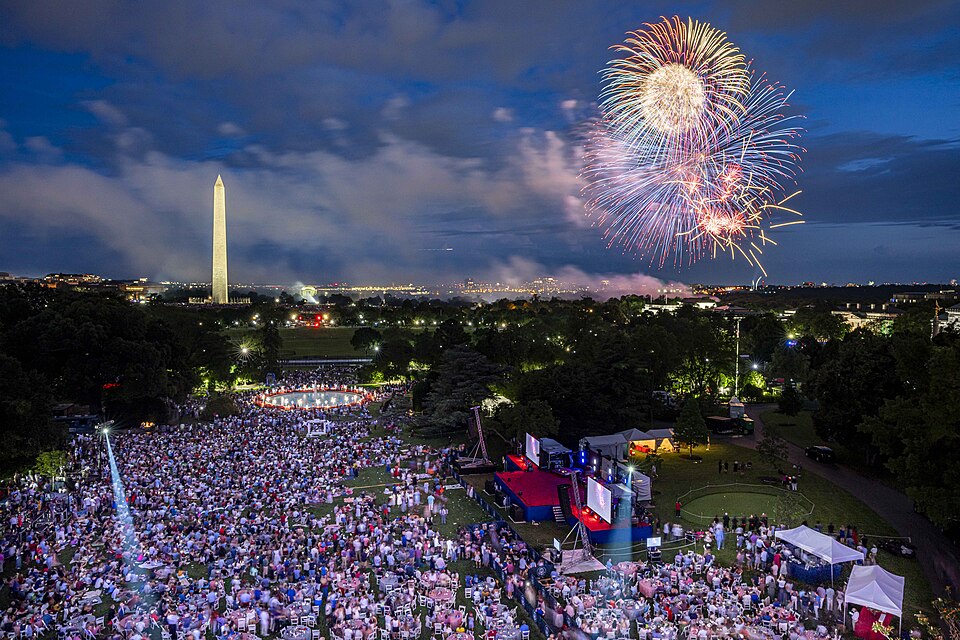
Trump July 4 Mall Speech Mixes Partisan SAVE Act Push With Semiquincentennial Tributes
President Trump used his July 4 "Salute to America 250" address on the National Mall to press for the partisan SAVE America Act while honoring veterans and marking the semiquincentennial.[1]
The speech was delayed by roughly two hours after a storm forced an evacuation of the Mall, and Trump again warned of a "communist menace" while praising recent military actions and touting strict voter ID and citizenship rules in the SAVE bill.[2][1]
On June 22-23 Congress cleared the bipartisan 21st Century ROAD to Housing Act — an almost 60-provision package designed to boost homebuilding and limit big investors' purchases — and sent the enrolled bill to Mr. Trump after an 85-5 Senate vote and a 358-32 House vote.[3][4] Mr. Trump abruptly canceled a planned June 24 signing in the Capitol, posting that he would not sign the housing bill "until such time as we pass the desperately needed SAVE AMERICA ACT," and the House later transmitted the enrolled bill to the White House, starting a 10-day signing window.[5][6]
Coverage shifted sharply as the White House move provoked bipartisan outrage and GOP infighting: some outlets hailed the housing package as a rare bipartisan achievement and a Trump win, but Republicans on the Hill called the sudden refusal to sign inexplicable and politically damaging, and House conservatives have used a floor blockade and procedural fights to try to force action on SAVE while the Senate is on recess.[7][8][9]
The mainstream summary presents Trump's July 4 speech primarily as a blend of patriotic tributes and partisan advocacy for the SAVE America Act, but it downplays the significant backlash from both sides of the aisle regarding his refusal to sign the bipartisan housing bill. Halina Bennet argues that this tactic of holding the housing bill hostage undermines governance and deepens rifts within the Republican Party, portraying it as a cynical maneuver that risks a rare legislative achievement. The summary does not capture how Trump's insistence on linking the housing bill to the SAVE Act may be perceived as prioritizing culture-war politics over widely supported policy reforms, which could alienate voters seeking tangible results in housing affordability. Furthermore, the analysis highlights that the SAVE Act's controversial provisions may lack the necessary support to overcome a Senate filibuster, suggesting that Trump's demands are more about posturing than a viable legislative strategy. This critical perspective is essential to understanding the implications of Trump's actions beyond the celebratory framing of the semiquincentennial event itself.
Additionally, the mainstream account fails to mention the extreme weather conditions affecting the July 4 celebrations, with over 160 million people under heat alerts across the East Coast, which could have influenced attendance and the overall atmosphere of the event. This context is crucial, as it adds another layer to the challenges faced during the speech and may have affected public perception of Trump's address amidst ongoing climate-related issues. The absence of this detail in the mainstream summary suggests a missed opportunity to fully contextualize the event's significance and the public's reception of Trump's political messaging during a moment of national celebration.[10][11]
Show source details & analysis (33 sources)
📊 Relevant Data
The SAVE America Act would require individuals to provide documentary proof of U.S. citizenship when registering to vote in federal elections and photo identification when voting.
H.R.22 - 119th Congress (2025-2026): SAVE Act — Congress.gov
More than 160 million people were under heat alerts as the extreme heat wave affected the East Coast and other regions ahead of and during the July 4, 2026 holiday weekend.
The Fourth of July U.S. heat wave, in seven diagrams, charts and maps — NBC News
Daily high temperature records were broken or tied in multiple East Coast cities on July 2-3, 2026, including Washington DC at 102°F (previous record 101°F from 1898), Philadelphia at 103°F (tied 1901 record), Boston at 101°F (previous 98°F from 1963), and New York City Central Park at 100°F (first since 2012).
Heat records broken from DC to Boston, more to come Friday — CNN
📌 Key Facts
- The 21st Century ROAD to Housing Act passed the Senate on Monday, June 22, 2026 (85–5) and the House on Tuesday, June 23, 2026 (358–32), sending the bipartisan package to President Trump (21st Century ROAD to Housing Act).
- The package contains nearly 60 provisions aimed at boosting housing supply—rolling back permitting rules, streamlining environmental reviews, pilot grant programs, factory‑built home changes, an innovation fund, veteran supports—and includes explicit limits on institutional investor purchases of single‑family homes (with a carveout for new construction) (nearly 60 provisions).
- President Trump canceled the planned signing in the Capitol’s Statuary Hall and posted on Truth Social on Wednesday, June 24, 2026 that he would not sign the bill “until such time as we pass the desperately needed SAVE AMERICA ACT,” calling SAVE a “National Emergency” (Truth Social post).
- After a meeting with Speaker Mike Johnson, the House transmitted the enrolled 21st Century ROAD to Housing Act to the White House on Thursday, June 25, 2026, starting a 10‑day window for Trump to sign or veto before it would become law automatically if he takes no action (enrolled 21st Century ROAD to Housing Act).
- Trump’s refusal to sign drew bipartisan uproar and GOP backlash—Senators such as Thom Tillis and John Cornyn called the move inexplicable, while House conservatives led by Rep. Anna Paulina Luna enacted a floor blockade to press for passage of the SAVE America Act (Anna Paulina Luna).
- House GOP leaders attempted procedural fixes to advance the SAVE America Act—including a Rules Committee maneuver on June 29, 2026 to merge SAVE into the NDAA and a June 30, 2026 procedural vote that failed—while the Senate’s two‑week July 4 recess (beginning June 24) left the SAVE measure stalled (Rules Committee vote).
- Across the semiquincentennial events, Trump used high‑profile speeches—at Mount Rushmore on July 3 and on the National Mall (the “Salute to America 250”) on July 4, 2026 (the Mall event was delayed by storms and evacuations)—to warn of a “communist menace,” tout recent military actions, honor veterans, and again press for passage of the SAVE America Act and changes such as abolishing the filibuster (Salute to America 250).
📊 Analysis & Commentary (10)
"The author criticizes President Trump for refusing to sign a major, bipartisan housing bill unless Congress first advances his SAVE America voting bill — arguing this is cynical 'hostage' politics that undermines governance, deepens GOP infighting, and risks blowing up a rare legislative achievement."
"The author argues that the 21st Century ROAD to Housing Act is a modest but genuinely useful bipartisan bill — focused on limiting investor purchases and speeding construction — and that political brinkmanship (notably the president withholding a signature pending unrelated legislation) risks losing a practical step toward improving housing affordability."
"This Slow Boring explainer focuses on the SAVE America Act and associated executive moves, matching reporting about Trump conditioning his signing of a major bipartisan housing bill on passage of the SAVE Act; the author primarily explains the legislation and argues critically that using the SAVE Act as leverage is constitutionally fraught, politically self‑defeating, and risks sabotaging a valuable bipartisan housing compromise."
"The (garbled) Slow Boring opinion piece titled 'Nobody likes a party crasher' appears to be criticizing the Trump‑linked spectacle and House conservative blockade that upended a bipartisan housing victory — arguing these 'party‑crashing' tactics are self‑defeating, damage governance, and hurt the Republican party politically rather than advancing real policy."
"This Newt Gingrich opinion piece is a patriotic commentary tied to the July 4/250th‑anniversary context (closely related to recent July 3–4 presidential/semiquincentennial events) arguing that the Declaration is a radical, enduring bulwark against socialism and global tyranny and that celebrating it now is a necessary political reply to rising anti‑American socialist currents."
"The Politico Playbook piece critiques President Trump’s July 4 National Mall semiquincentennial spectacle — arguing the administration turned a unifying celebration into a partisan platform (pushing the SAVE Act and sharp rhetoric), a move made worse by logistical/security/weather disruptions and the sidestepping of a bipartisan housing bill."
"A Slow Boring opinion piece argues that saving capitalism requires bold, systemic land‑use reform — large‑scale upzoning and permitting overhaul — and critiques political actors and incremental bills (like the recent housing package/White House maneuvering) for failing to confront the zoning‑driven housing supply crisis."
"This Slow Boring commentary is a pro‑housing, pro‑upzoning critique tied to the recent bipartisan housing bill and White House theatrics: the author praises supply‑side reform but argues passage alone won’t help unless upzoning is implemented, permitting and financing barriers are fixed, and developer overbidding/speculation are checked — and they criticize political stunts (e.g., conditioning a signing on unrelated demands) that delay real construction."
"The author argues that contemporary appeals to Jane Jacobs are often rhetorical and omit the necessary economics: Jacobs’ urbanist insights are valuable but incomplete, and housing policy must pair placemaking concerns with explicit, pro‑supply economic reforms rather than using 'Jacobs' as a blanket argument against development."
"This Fox News opinion piece responds to America 250's reflection on the nation's history by arguing that 'government‑sponsored' race-conscious policies have long divided the country, and the remedy is to stop treating people primarily by race and instead invest in individual opportunity (especially education), resisting actors who profit politically from keeping race at the center."
📰 Source Timeline (33)
Follow how coverage of this story developed over time
- On Saturday, July 4, 2026, Trump delivered his Salute to America 250 keynote on the National Mall after a roughly two-hour weather evacuation of the Mall.
- During the speech, Trump honored specific veterans, including several World War II veterans and one of the first Black officers to lead a Special Forces team in combat in Vietnam, presenting them before historically significant U.S. flags.
- PBS reports Trump again used the address to stump for the SAVE America Act, explicitly tying it to his broader message on elections and emphasizing support for the Second Amendment while reviving denunciations of communism ahead of the November midterms.
- Trump joked about seeking a third presidential term during the July 4 speech, a line PBS notes he delivered while contrasting himself with the WWII 'greatest generation.'
- PBS adds detail that storms and extreme heat disrupted holiday events across the East Coast, prompting cancellations in Hartford, Harrisburg and Wilkes-Barre, an evacuation in Philadelphia, a temporary shelter-in-place at Boston's fireworks and concert, and time shifts for fireworks in New York and Pittsburgh.
- On Saturday, July 4, 2026, after a two-hour storm-related evacuation of the National Mall, President Trump delivered his delayed ‘Salute to America’ speech in Washington, D.C.
- In the July 4 Mall speech, Trump claimed that in Venezuela and Iran ‘we wiped it out, wiped out their military’ and specifically likened U.S. attacks on Iran’s navy to the 1898 Battle of Manila Bay, saying the U.S. had recently sunk ‘the entire Iranian navy, 159 ships to the bottom of the sea.’
- Trump again attacked communism, saying, ‘Our warriors did not fight communism on battlefields across the world, only to have that menace rear its ugly head right back here in America,’ and calling it ‘like a cancer’ that has to be ‘cut out.’
- He used the July 4 address to again advocate for the SAVE America Act’s requirements that voters prove U.S. citizenship to register and show ID before casting ballots, telling the crowd, ‘You won’t have cheating on the elections anymore, it’s very simple.’
- The speech also included tributes to specific veterans, including World War II veterans, an early Black Special Forces combat team leader in Vietnam, Civil War Medal of Honor recipient William Harvey Carney, and NASA astronauts, as well as praise for police and farmers.
- NPR/Associated Press specify that Trump's Mount Rushmore speech on Friday, July 3, 2026, began with 'soaring rhetoric' about American exceptionalism before shifting into warnings of a 'sinister threat of communism' that 'evoked the Red Scare of the 1950s.'
- The report directly quotes Trump comparing communism's danger to 'World War I, World War II, Pearl Harbor or even 9/11' and notes this language echoed several of his recent speeches but was notable because it was delivered at a national park honoring past presidents.
- The article contrasts Trump's speech with a July 4, 2026 address in New York City by Mayor Zohran Mamdani, who as a democratic socialist described America as a nation of 'contradictions' working toward its founding ideals.
- The piece adds concrete heat-related impacts to semiquincentennial events: Philadelphia canceled its Salute to Independence parade on Friday, July 3; Washington's Great American State Fair shut down in early afternoon that day before reopening at 5 p.m.; the Capitol Fourth concert opened gates later than usual but proceeded; and an Independence Day parade planned for Saturday, July 4 in Washington was canceled.
- The article reports on-the-ground color from the National Mall on Friday, July 3, including crowds at The Great American State Fair in triple-digit heat, with vendors selling $9 lemonades and $23 turkey legs, and mentions Glenn Brooks, pardoned by Trump for Jan. 6 participation, attending and praising the event.
- It notes that while much of the eastern U.S. endured a brutal heat wave, the Pacific Northwest, including Seattle and Issaquah, experienced cooler 60s temperatures and light showers as residents prepared for July 4 and World Cup festivities.
- Article confirms that on Friday, July 3, 2026, at Mount Rushmore, Trump said, 'Communism is a mortal threat to American liberty... It is the greatest threat to our country, including World War I, World War II, Pearl Harbor or even 9/11.'
- Coverage notes that the Mount Rushmore address began with 'soaring rhetoric about American exceptionalism' before shifting into a darker, highly political warning about communism.
- The report explicitly contrasts Trump's speech with traditionally more unifying, apolitical Independence Day remarks by presidents such as Gerald Ford and Ronald Reagan at similar events.
- The article situates the Mount Rushmore speech as part of a broader July 4, 2026 holiday backdrop that includes a severe heat wave canceling Philadelphia's Salute to Independence parade on Friday and a Washington, D.C., Independence Day parade scheduled for Saturday, July 4, being canceled.
- Piece adds that Trump is slated to deliver another speech on the National Mall in Washington on Saturday, July 4, 2026 before what organizers describe as a historically large fireworks display.
- On Friday night, July 3, 2026, President Trump delivered a July 4 semiquincentennial kickoff speech at Mount Rushmore warning of a 'resurgence of the communist menace' and framing communism as incompatible with patriotism.
- During the speech he explicitly said the 'only way' to ensure Republicans win the midterm elections is to abolish the Senate filibuster and pass the SAVE America Act, which would require proof of U.S. citizenship at voter registration and photo ID at the polls.
- Trump linked the SAVE America Act to American identity and culture in a nationally televised patriotic address, describing critics of American history as 'radicals' and 'extremists' and asserting that newcomers must 'love our country' to belong.
- On Tuesday, June 30, 2026, House leaders began the July 4 recess early after the failed rule vote blocked Speaker Mike Johnson from merging the SAVE America Act with the NDAA.
- CBS framed the early departure explicitly as a consequence of some GOP members blocking Johnson's merger strategy, underscoring that the House floor remains effectively shut down heading into the recess.
- On Tuesday, June 30, 2026, 14 Republicans, including House Majority Leader Steve Scalise, voted against the procedural rule to advance the NDAA paired with the SAVE America Act; Scalise switched his vote in a procedural move so leadership can bring the rule back.
- Speaker Mike Johnson told reporters on June 30 that leadership would "work on that over the next day and a half" and said he expects to "get everybody to a yes," framing the blockade as driven by Senate Democrats refusing to act.
- Rep. Anna Paulina Luna publicly labeled Johnson's plan to merge SAVE with the NDAA as "a procedural head fake" and said she wants her amendment to write voter ID and proof-of-citizenship provisions directly into the NDAA text, though she acknowledged they could still be stripped in conference.
- Rep. Tom Burchett said on June 30 that "until we've exhausted every avenue, it's still our issue," underscoring that hardliners see the SAVE America Act as a House problem, not just a Senate blockade.
- The article reiterates that President Trump abruptly canceled a landmark housing-bill signing last week to use it as leverage for SAVE, and notes he has since called on House holdouts to end their legislative blockade, posting "No more grandstanding, please!" after a multi-hour White House meeting with Speaker Johnson.
- As of Monday, June 29, 2026, President Trump told reporters in the Oval Office that the 21st Century ROAD to Housing Act is 'so unimportant' and 'a yawn' compared to the SAVE America Act.
- The article confirms that Trump deliberately skipped a planned signing ceremony with Speaker Mike Johnson and Majority Leader John Thune last week, leaving the housing bill’s fate uncertain.
- Lawmakers note that under the Constitution the 21st Century ROAD to Housing Act will automatically become law if Trump neither signs nor vetoes it within 10 days of its arrival at the White House, because current congressional recesses do not amount to full adjournment for a pocket veto.
- The story details that the housing bill contains nearly 60 bipartisan provisions aimed at boosting homebuilding, helping first-time buyers, and banning hedge funds from buying up housing stock, a provision Trump had personally urged Congress to include.
- Sen. Elizabeth Warren said on June 28, 2026, that Congress handed Trump the bill 'on a silver platter' and that if he 'cared about the American people, he'd have already signed the damned thing.'
- On Tuesday, June 30, 2026, the House voted 198-224 against a procedural rule to advance several measures, including an NDAA package paired with the SAVE America Act, with 14 Republicans voting no.
- More than a dozen conservative Republicans, including Rep. Anna Paulina Luna, continued a coordinated floor blockade that has left the House effectively shut down, forcing GOP leaders to punt votes last week and again this week.
- Speaker Mike Johnson used a rare procedural maneuver to try to resend the SAVE America Act to the Senate by merging it into the NDAA, arguing the Senate might be more likely to act on the voter-ID bill if attached to a traditionally bipartisan defense measure.
- President Donald Trump publicly urged the holdouts last week on Truth Social to stop "grandstanding" and end the blockade, but they have continued opposing the leadership plan.
- Luna and other rebels insist the SAVE America Act must be attached to the NDAA as an amendment, or via an amendment that directly adds voter proof-of-citizenship requirements to the defense bill, arguing Johnson's approach would not force Senate action and would allow the measure to be stripped.
- On Monday, June 29, 2026, the House Rules Committee voted 8-4 to approve a special rule that would merge the annual National Defense Authorization Act with the SAVE America Act before sending the combined package to the Senate.
- Rep. Chip Roy, who sits on the Rules Committee and previously backed the SAVE-related floor blockade, was present but did not vote on the rule.
- Rep. Anna Paulina Luna, leading the SAVE protest, publicly rejected Speaker Mike Johnson's merger tactic and demanded that her SAVE amendments be made in order so the voter-ID language appears in the actual NDAA text.
- Speaker Mike Johnson warned on June 29 that continuing the conservative blockade would be 'self-defeating' and said he would urge members on Tuesday, June 30, to back the rule so the House can move forward.
- The Tuesday, June 30 rule vote is slated to cover three items: the House NDAA, a fiscal 2027 State Department and foreign-operations spending bill, and a resolution marking the one-year anniversary of Trump's One Big Beautiful Bill Act, now branded the Working Families Tax Cuts.
- Rep. Jim McGovern, the top Rules Committee Democrat, argued during the June 29 debate that the Senate would simply strip out SAVE even if it is merged procedurally with the NDAA and said the GOP proposal is 'dead on arrival' in the upper chamber.
- Luna and Rep. Tim Burchett reiterated they will keep the floor blocked absent assurances about the SAVE Act's fate in the Senate, with Luna calling the ongoing standoff 'legislating' rather than obstruction.
- In a brief interview outside the U.S. Capitol published Friday, June 26, 2026, former House Speaker Kevin McCarthy said he supports the SAVE America Act and that President Trump should use 'every available tool' to pressure the Senate to pass it.
- McCarthy said Trump is 'going to try everything he can' to get the SAVE America Act through the Senate, explicitly backing the president's hardball approach.
- The article confirms that the Senate recessed on Wednesday, June 24, 2026, for a two‑week July 4 break, leaving the SAVE America Act stalled until lawmakers return.
- Fox News reports that, as of Thursday, June 25, 2026, the House has transmitted the 21st Century ROAD to Housing Act to the White House for Trump's signature following a meeting between Speaker Mike Johnson and the president.
- Because the enrolled housing bill has now been received by the White House, Trump has 10 days from Thursday, June 25, 2026, to sign or veto it before it would automatically become law if he takes no action.
- The piece notes the House has not yet passed an updated SAVE America Act version that incorporates several additional Trump priorities, including a mail‑in voting crackdown, bans on men competing in women's sports, and prohibitions on child sex change procedures.
- On Wednesday, June 24, 2026, President Trump again conditioned signing the bipartisan housing affordability bill on Senate passage of the SAVE America Act, reiterating that he will not sign it until SAVE passes.
- The article specifies that earlier in 2026 Trump refused to sign a FISA-style warrantless surveillance reauthorization, a program that supplies most of the intelligence in his daily brief, unless SAVE America was attached; the authority still has not been reauthorized.
- On Thursday morning, June 25, 2026, House Freedom Caucus members held a press conference attacking the Senate for recessing until July 13 instead of staying to work on SAVE America, with Rep. Byron Donalds saying "The Senate sucks" and Rep. Scott Perry vowing to "do whatever it takes" to get the bill to Trump's desk.
- Shortly after that June 25 news conference, House GOP leadership canceled Friday votes and announced just one vote for Thursday afternoon, even as leaders publicly claimed they were willing to stay in Washington to work.
- House Speaker Mike Johnson was scheduled to meet President Trump at the White House on the afternoon of Thursday, June 25, 2026, to discuss how to "get the agenda moving again" amid the standoff.
- Senate Majority Leader John Thune and Sen. Lisa Murkowski are quoted on June 24-25 reaffirming that SAVE America lacks the 60 votes to advance and rejecting Trump's calls to change Senate rules to pass it.
- On Thursday, June 25, 2026, House Speaker Mike Johnson is scheduled to meet President Trump at the White House to try to resolve the House floor blockade tied to the SAVE America Act.
- House GOP leaders were forced to cancel a series of House votes on Wednesday, June 24, 2026, after the conservative bloc refused to end its blockade.
- Rep. Anna Paulina Luna told Fox News Digital on Wednesday, June 24, 2026, that she has the votes to maintain the blockade and that 'there's going to be no votes this week.'
- Johnson has floated folding a 'skinny' version of the SAVE America Act into a third GOP-only reconciliation package, focused on grant funding to encourage states to require federally verified REAL IDs for voting.
- Luna publicly rejected Johnson's reconciliation idea on June 24, 2026, arguing that the SAVE America Act cannot be enacted through reconciliation unless the Senate fires the parliamentarian.
- House Majority Leader Steve Scalise said leadership is 'not giving up on it yet' but is preparing contingencies if the blockade continues.
- The article specifies that the blocked House agenda includes government funding bills, a third reconciliation package incorporating defense spending and fraud safeguards, and the annual defense policy bill.
- The Senate left Washington for a two-week recess late Wednesday, June 24, 2026, limiting prospects for quick movement on the SAVE America Act or related negotiations.
- On Thursday, June 25, 2026, CBS reported growing bipartisan uproar after President Trump canceled the signing ceremony for the 21st Century ROAD to Housing Act and demanded passage of the SAVE Act first.
- Massachusetts Democratic Rep. Stephen Lynch, in a June 25 CBS Morning News interview, urged Trump to sign the bipartisan housing bill and discussed how its provisions are intended to help Americans struggling with housing costs.
- The CBS segment underscores that both Democrats and some Republicans are now publicly pressing the president to sign the housing bill despite his linkage to the SAVE Act voter ID measure.
- On Wednesday, June 24, 2026, House GOP leaders pulled a series of votes after a group of conservatives led by Rep. Anna Paulina Luna blocked nearly all legislation.
- Luna told Fox News Digital the House floor will see 'no votes this week' and that the blockade will continue 'as long as it takes' until the Senate passes the SAVE America Act.
- Speaker Mike Johnson is scheduled to meet President Trump at the White House on Thursday, June 25, 2026, in an effort to resolve the impasse.
- Johnson has floated putting a narrower SAVE America Act provision into a third budget reconciliation bill, creating a grant program to encourage state use of federally verified REAL IDs at the polls.
- Luna publicly rejected reconciliation as an adequate path for the SAVE America Act and said it cannot be done that way unless the Senate fires the parliamentarian.
- The Senate left Washington for a two-week July 4 recess on Wednesday, June 24, 2026, without acting on the SAVE America Act, reducing prospects for quick resolution.
- On Wednesday, June 24, 2026, President Trump canceled plans to sign the bipartisan 21st Century ROAD to Housing Act and stated on social media that he would not sign the bill, which he called "of minor importance," until Congress approved the SAVE America Act.
- NPR reports that Trump appears more focused on ensuring Republican loyalty to him personally than on securing a governing majority that can pass his broader legislative agenda, according to correspondent Franco Ordoñez’s analysis.
- The article notes that many Republicans wanted to tout the housing bill as a legislative victory on cost-of-living issues ahead of the midterm elections and worry that Trump’s cancellation could alienate voters and undercut his economic message.
- It reiterates that Trump has said for months he will not sign any bill until Congress passes the SAVE America Act and that he claims the measure would ensure Republicans never lose another election for at least 50 years.
- PBS details that the housing bill signing ceremony on June 24, 2026 was to be held in the Capitol's Statuary Hall, with a stage, presidential emblem and signing desk already set up when Trump canceled via Truth Social about an hour before departure.
- The interview emphasizes that Republican senators present were "shocked" and "dumbfounded," underscoring that they learned of the president's refusal to sign only from his social-media post.
- PBS clarifies that Speaker Mike Johnson has not yet formally transmitted the bill to the White House, so the 10‑day constitutional clock for the bill to become law without the president's signature has not started.
- The piece adds that Trump largely did not allow questions about the housing bill or SAVE America Act during the subsequent June 24 closed-door GOP lunch, instead engaging primarily in a heated exchange with Sen. Bill Cassidy over the Iran war.
- PBS reports that some Republican senators are now openly questioning whether Trump is "intentionally, deliberately trying to blow up their congressional majorities," reflecting the depth of intra‑party concern.
- On Wednesday, June 24, 2026, Democratic congressional leaders held a press appearance criticizing President Trump for canceling the planned signing ceremony for the bipartisan housing affordability bill.
- During that appearance, Democrats emphasized that the bill had passed with wide bipartisan majorities in both chambers and condemned Trump’s stated condition that he will not sign it until the SAVE America Act is passed.
- On Wednesday, June 24, 2026, multiple Republican senators publicly criticized Trump's refusal to sign the 21st Century ROAD to Housing Act unless the SAVE America Act passes.
- Sen. Thom Tillis said Trump's move is effectively handing Democrats a 'huge' victory and called the situation nonsensical given the bill's bipartisan affordability focus.
- Sen. John Cornyn described the president's decision as 'inexplicable' and questioned whether there is any precedent for a president blocking his own priority bill at this stage.
- The article notes that Trump is slated to attend a closed-door lunch with already-frustrated Senate Republicans later on June 24 to push for the SAVE America Act despite the bill lacking filibuster-proof support.
- Republican frustrations also stem from Trump's earlier decisions to derail reauthorization of 'the nation’s key counter-terrorism tool,' upset a memorandum of understanding with Iran, and nearly sink a $70 billion immigration enforcement package with an 'anti-weaponization' fund demand.
- On Wednesday, June 24, 2026, Trump posted on social media that "Today's Housing News Conference and Signing is hereby cancelled" until Congress passes the SAVE America Act, which he called a 'National Emergency.'
- The canceled signing was scheduled for Wednesday, June 24, 2026, at the Capitol for a bipartisan housing bill aimed at increasing home construction and affordability.
- House Republican leaders, including Majority Leader Steve Scalise and Financial Services Chair French Hill, were holding a press conference praising the housing bill when news broke that Trump had canceled the signing; Speaker Mike Johnson told reporters he was still confident Trump would eventually sign it.
- Sen. Elizabeth Warren, a key Democratic architect of the bill, criticized the move on CNBC on June 24, saying it 'doesn't make any sense' and arguing it shows 'complete indifference' to families' housing cost pressures.
- Warren also argued that Trump's tariffs, energy policies and the Iran war are keeping inflation and borrowing costs higher, undermining housing affordability.
- Rep. Sharice Davids of Kansas posted on X that Trump was refusing to sign the bipartisan bill 'all because of political games' and urged him to 'Stop the nonsense and sign the BIPARTISAN bill.'
- On Wednesday, June 24, 2026, Trump told advisers and allies he will not sign the 21st Century ROAD to Housing Act unless Congress first passes the SAVE America Act voting bill, going beyond merely postponing the signing ceremony.
- The article reports that senior White House and campaign advisers view the SAVE America Act as central to Trump's 2026 strategy and that they are preparing to blame Democrats for blocking the housing bill if the SAVE measure fails.
- New York Times sources detail that several Senate Republicans privately acknowledge the SAVE bill does not have 60 votes and that some see Trump's refusal to sign the housing bill as risky heading into the midterms.
- The story describes internal GOP discussions that the White House could let the housing bill languish unsigned for weeks or months while continuing to demand action on SAVE, rather than using a pocket veto or formal veto threat immediately.
- On Wednesday, June 24, 2026, President Trump publicly canceled that day's planned signing ceremony for the bipartisan housing bill, which White House officials had just told reporters he would sign in the afternoon.
- Trump issued a Truth Social post saying, "Today’s Housing News Conference and Signing is hereby cancelled until such time as we pass the desperately needed SAVE AMERICA ACT, which I consider to be a National Emergency."
- MS NOW’s account emphasizes that, until the last few hours before the event, the White House had been signaling support and preparing Trump to take credit for the bill as "becoming law."
- The article highlights the political context that Republicans were holding Capitol Hill news conferences touting the bill and the president’s support at the same time he was online announcing he would not sign it.
- On Wednesday, June 24, 2026, Trump canceled the planned signing ceremony for the 21st Century ROAD to Housing Act, which had been scheduled for that day.
- In a Truth Social post on June 24, 2026, Trump said the signing was canceled "until such time as we pass the desperately needed SAVE AMERICA ACT," which he called a "National Emergency."
- Trump publicly labeled the ROAD to Housing Act an "Elizabeth 'Pocahontas' Warren centric housing bill" and "of minor importance" compared with lower interest rates, FISA reauthorization and passage of the SAVE America Act.
- The article reiterates that the House passed the ROAD to Housing Act on Tuesday, June 23, 2026, by a 358–32 vote, highlighting broad bipartisan support.
- Trump urged Republicans to "terminate the filibuster" to approve the SAVE America Act and other GOP priorities, saying Democrats would do so "in hour one" if roles were reversed.
- The piece summarizes that the SAVE America Act would establish voter ID and citizenship verification ahead of the midterm elections, framing it as a core Trump priority over the housing bill.
- On Wednesday, June 24, 2026, President Trump is scheduled to sign the 21st Century ROAD to Housing Act at 12 p.m. in the Capitol's Statuary Hall.
- Trump will be joined at the signing ceremony by House Speaker Mike Johnson and Senate Majority Leader John Thune and will also meet Republican senators on the Hill to discuss the SAVE America Act.
- The article details that the bill contains more than 45 provisions, including: a pilot program to convert vacant commercial buildings into affordable housing; streamlined environmental reviews; expanded federal funding for factory-built homes; elimination of the chassis requirement for certain homes; an innovation fund for supply-boosting communities; veteran housing supports; and explicit limits on institutional investors' purchases of existing single-family homes (with a carveout for new construction).
- Cited data show that as of 2025 large institutional investors (those owning more than 1,000 homes) held about 500,000 properties, roughly 0.34% of total U.S. housing stock and about 3% of single-family rentals overall, but with much higher concentrations in some metros.
- A 2026 Government Accountability Office analysis is referenced noting that in Jacksonville, Florida, investors own more than 20% of single-family rental homes, and that between 2018 and 2024 Dallas and Phoenix each added at least 16,000 investor-owned homes, increases of 177% and 114% respectively.
- Trump publicly characterized the housing bill on Truth Social on the morning of June 24 as "of minor importance" compared with lower interest rates, FISA, and especially the SAVE America Act, while still proceeding with the signing.
- On Tuesday, June 23, 2026, the House approved the housing package 358-32, matching earlier reports of strong bipartisan support but providing an updated Associated Press account.
- The article details core policy aims in plain language: reducing federal regulations, streamlining environmental reviews, speeding construction, and curbing large corporate landlords' ability to buy single-family homes.
- It emphasizes that the bill represents one of the most sweeping efforts in decades to increase housing supply and lower prices, with negotiators citing a roughly 47% post-pandemic rent increase and a median first-time-buyer age of 40.
- Rep. Maxine Waters highlighted rent increases and age of first-time buyers, while House Financial Services Chair French Hill framed the bill as the first measurable, accountable housing-law overhaul in years.
- The story underscores broad stakeholder backing across landlord groups, large property owners, tenant advocates, and low-income renter organizations, noting its unusual level of bipartisan support in a polarized Congress.
- NPR reiterates that the 21st Century ROAD to Housing Act passed the House on Tuesday, June 23, 2026, by a 358-32 vote and passed the Senate on Monday, June 22, 2026, with overwhelming bipartisan support.
- The article emphasizes Realtor.com’s estimate that the U.S. was short by more than 4 million housing units as of last year, framing the bill explicitly as a supply-gap response.
- NPR underscores that one of the bill’s main implementation challenges will be that mortgage rates and land costs remain high, meaning Americans may not feel effects for some time.
- On Tuesday, June 23, 2026, the House approved the 21st Century ROAD to Housing Act in a 358-32 vote after the Senate's overwhelming bipartisan vote on Monday, confirming final passage and sending the bill to President Trump.
- The article highlights that House GOP leaders fast-tracked the bill after Monday's Senate passage.
- It emphasizes that the legislation is marketed as aiming to 'increase housing supply and lower prices' by limiting corporate purchases of single-family homes, streamlining environmental reviews, and removing regulatory barriers to speed construction, while also noting expert skepticism about how much the corporate-purchase cap can affect affordability.
- The piece quotes a presidential proclamation calling the measure 'the most comprehensive and consequential housing legislation in the history of our country,' underscoring how the White House is framing the bill.
- The article quotes Redfin chief economist Daryl Fairweather saying that removing private equity will not suddenly free up large numbers of homes for first-time buyers, reinforcing that supply shortages are the central driver of high prices.
- The Fox News article, published June 23, 2026, reports the House vote on the 21st Century ROAD to Housing Act as 358-32, taken under suspension of the rules at Speaker Mike Johnson's direction.
- It describes the bill as "largely" incorporating President Trump's proposal to ban large institutional investors from purchasing single-family homes, characterizing it as a major Trump legislative win.
- Fox notes that every Democrat present voted for the measure and that opposition came solely from Republicans, with more Democrats than Republicans backing the bill.
- The story adds that some conservative Republicans voted no specifically to protest the failure to attach the SAVE America Act, which includes voter ID, mail voting limits, and restrictions on transgender participation in women's sports.
- Rep. Anna Paulina Luna is quoted urging colleagues to "stand firm" until the SAVE America Act advances, linking the housing vote to broader fights over election rules and Section 702 surveillance reauthorization.
- Rep. Chip Roy is cited criticizing the package as containing "big government garbage & spending" and objecting to progressive provisions, illustrating intra-GOP policy objections distinct from the SAVE America Act protest.
- Fox reiterates that the president is expected to sign the bill "as soon as Wednesday," June 24, 2026, emphasizing the immediacy of enactment.
- On Tuesday, June 23, 2026, the House approved the 21st Century ROAD to Housing Act, sending the bipartisan housing package to President Trump for his consideration.
- The final House vote followed the earlier 85-5 Senate approval and reflected substantial bipartisan support, with both party leaders framing the bill as a rare cooperative achievement on domestic policy.
- The New York Times article emphasizes that the measure is expected to be signed by President Trump, with White House officials signaling support for the investor-purchase limits and other core provisions.
- NPR reports that the House passed the 21st Century Road to Housing Act on Tuesday, June 23, 2026, by a vote of 358 to 32.
- The article characterizes the measure as the largest piece of federal housing legislation in decades, with particular focus on affordability and supply.
- NPR details a key provision: a ban on additional single-family home purchases by corporate investors that already own at least 350 houses, preventing them from buying more to use as rentals.
- The piece notes research from Realtor.com estimating the U.S. was short more than 4 million housing units in the prior year, framing the bill’s emphasis on supply-side reforms.
- The report cites Redfin data that a family now needs about $117,000 in annual income to afford a typical U.S. home, nearly $30,000 more than the median household income.
- NPR connects current 6.5% average mortgage rates to higher borrowing costs following the Iran war, adding macroeconomic context to the affordability crisis.
- Housing economist Jeanna Kenney of Villanova is quoted stressing that easing supply constraints is central and that making supply "easier" will help over the long term.
- The story notes that nationally, corporate investors account for only about 3% of the single-family rental market and includes expert concerns that the investor ban could chill investment and reduce rehabilitation of otherwise unmarketable properties.
- On Monday, June 22, 2026, the Senate passed the 21st Century ROAD to Housing Act in an 85-5 vote, described as the most sweeping federal housing legislation in decades.
- The article emphasizes that the package emerged from a bicameral agreement announced last week by the Senate Banking Committee and the House Financial Services Committee, resolving differences between earlier Senate and House versions.
- Sen. Elizabeth Warren highlighted that the final bill contains more than 45 housing provisions focused on increasing supply, streamlining environmental reviews, updating manufactured-housing chassis rules, creating an innovation fund for communities growing housing supply, and supporting veteran housing programs.
- The White House specifically backed the provision limiting institutional investor purchases of certain single-family homes, which supporters say is intended to reduce competition for prospective owner-occupants.
- House Financial Services Chair Rep. French Hill and Ranking Member Rep. Maxine Waters both publicly endorsed the compromise text and signaled that House leaders are expected to move the bill quickly now that members are returning from recess.
- Senate Majority Leader John Thune framed the bill last week as part of Republicans' broader agenda to address cost-of-living pressures for "hardworking Americans."
- On Monday, June 22, 2026, the Senate passed the 21st Century ROAD to Housing Act and sent it to the House after months of delay.
- The article describes the package as having nearly 60 provisions, including rolling back some permitting regulations, launching several pilot grant programs, and establishing new limits that block or restrict investor purchases of housing stock, a provision pushed by President Trump.
- Sen. Elizabeth Warren emphasized the bill as a way to 'beat back private equity' and prevent America becoming a 'nation of renters,' while also highlighting changes to the federal definition of manufactured housing, pre-approved plan books, and waivers of some environmental review rules for new home construction.
- Sen. Bernie Moreno’s provision on pre-approved housing designs to speed home construction is confirmed as part of the final package, and he says the bill sends a signal to states and localities to reduce regulatory burdens on builders.
- Senate Banking Chair Tim Scott is cited stressing that the package is deficit-neutral and does not provide new federal funding even as it attempts to expand supply via incentives tied to local construction activity and tweaks to small-dollar mortgage availability.