
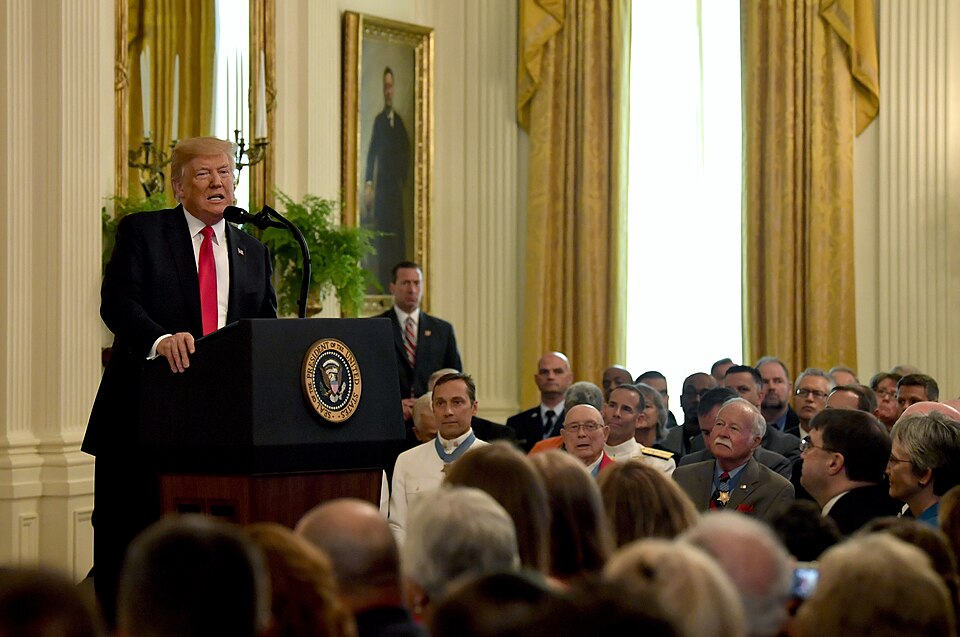
Trump Awards Medal Of Honor To Three Vietnam And Afghanistan Veterans
President Trump presented the Medal of Honor at the White House on June 18, 2026, to three veterans: retired Marine Maj. James Capers Jr., posthumous recipient Col. John W. Ripley, and retired Army Maj. Nicholas Dockery.[1]
Trump presented the medals in an East Room ceremony while Ripley's family accepted his award posthumously, and senior officials attended including Defense Secretary Pete Hegseth and U.S. Ambassador to the U.N. Mike Waltz.[1] Capers was honored for leading his wounded Vietnam reconnaissance team to safety after severe injuries during a March-April 1967 patrol.[1] Ripley received the posthumous medal for blowing the Dong Ha bridge in April 1972 to halt a North Vietnamese assault.[1] Dockery was honored for leading his platoon through a four-hour Taliban ambush in Kapisa Province, Afghanistan, in October 2012.[1]
Rep. Don Bacon introduced amendments in early 2026 to waive the five-year time limit for Medal of Honor upgrades for all three veterans. The House passed H.R. 7194, the Nicholas Dockery Medal of Honor Act, on February 3, 2026, and separate bills for Ripley and Capers also cleared Congress. President Trump signed the measures into law in March 2026, including H.R. 7211, which he signed on March 26 to authorize Ripley's upgrade.
About 3,552 Medals of Honor have been awarded since 1861, with 63 living recipients as of 2026. A total of 270 Medals of Honor were awarded for actions in the Vietnam War (235 during the war and immediate aftermath plus 35 later), and 21 were for actions in Afghanistan since 2001. Social media posts praised the three as national heroes and highlighted Capers' memoir and his pioneering role as the first African-American Marine in 3rd Force Recon.
The mainstream summary does not highlight the significant context surrounding the recipients' actions that led to their honors. While it mentions the specific feats of Maj. Capers, Col. Ripley, and Maj. Dockery, it omits the broader implications of their service, particularly Capers' pioneering role as the first African-American Marine in 3rd Force Recon, which is emphasized in social media discussions. This aspect not only underscores his individual bravery but also reflects on the racial dynamics within the military during the Vietnam War era, a point that resonates with ongoing conversations about diversity and representation in the armed forces.
Additionally, the summary does not address the cultural and societal implications of the Medal of Honor awards in the context of declining patriotism among younger generations, as noted in analyses from the U.S. Army War College. This perspective suggests a growing divide in how military service and patriotism are perceived across different age groups, which could be crucial in understanding the reception of such honors in contemporary society. The celebration of these veterans thus serves as a focal point in a larger narrative about national identity and values, which the mainstream account fails to capture fully.
Show source details & analysis (1 source)
📊 Relevant Data
Approximately 3,552 Medals of Honor have been awarded in total since 1861, with 63 living recipients as of 2026.
Medal of Honor FAQs — Congressional Medal of Honor Society
A total of 270 Medals of Honor were awarded for actions in the Vietnam War (235 during the war and immediate aftermath plus 35 later), and 21 for actions in Afghanistan since 2001.
List of Medal of Honor recipients for the Vietnam War; List of post-Vietnam War Medal of Honor recipients — Wikipedia
📌 Key Facts
- On June 18, 2026, Trump held a Medal of Honor ceremony at the White House for three veterans.
- Retired Marine Maj. James Capers Jr. was honored for a March–April 1967 Vietnam reconnaissance patrol where he led his wounded team to safety despite severe injuries.
- Marine Col. John W. Ripley received a posthumous medal for destroying the Dong Ha bridge in April 1972 to halt a North Vietnamese assault.
- Retired Army Maj. Nicholas Dockery was awarded for leading his platoon through a four-hour Taliban ambush in Kapisa Province, Afghanistan, in October 2012.
- The ceremony was attended by senior officials including Defense Secretary Pete Hegseth and UN Ambassador Mike Waltz.
📰 Source Timeline (1)
Follow how coverage of this story developed over time