
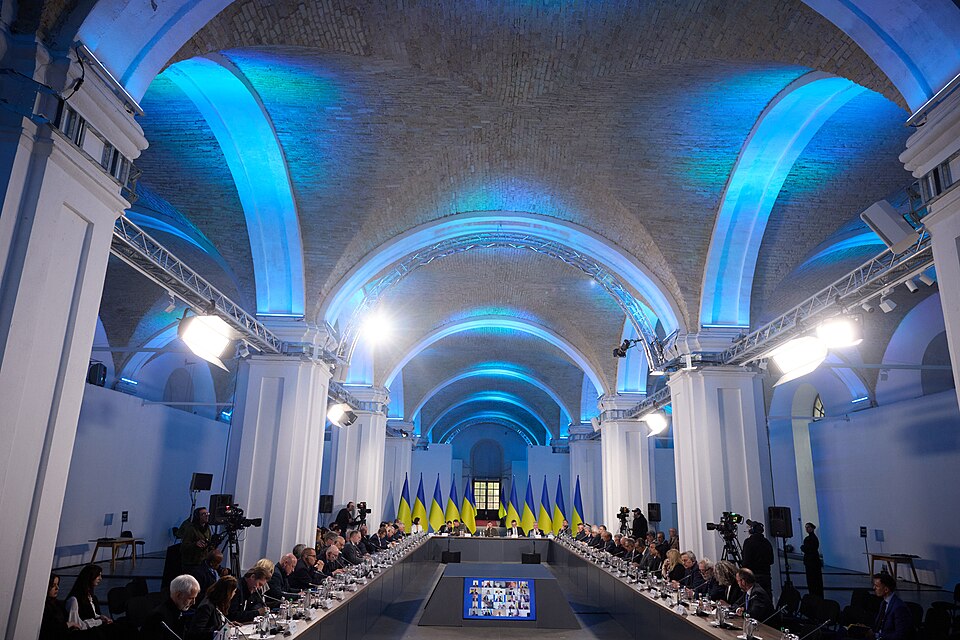
G7 Leaders Pledge Stronger Ukraine Air Defenses And New Russia Sanctions After Trump, Zelenskyy Talks
G7 leaders pledged to strengthen Ukraine's air defenses and to step up sanctions on Russia at their summit in Évian-les-Bains on June 16-17, 2026.[1]
The joint declaration promised more air-defense deliveries, measures to bolster Ukraine's energy resilience, and to consider licenses for Ukrainian production of Western weapons including Patriot missiles.[1] The leaders also endorsed President Trump's tentative Iran ceasefire memorandum and a France- and U.K.-led maritime mission to protect traffic through the Strait of Hormuz.[2]
On June 14, President Trump held separate calls with Vladimir Putin and Volodymyr Zelenskyy.[3] Russian aide Yuri Ushakov said the Trump-Putin call lasted just under an hour and that Trump offered to press allies and Kyiv toward ending hostilities.[3] Trump told G7 leaders he would refocus U.S. diplomacy on the Russia-Ukraine war after negotiating the Iran truce.[4]
Early coverage framed the summit as a united push to shore up Ukraine and squeeze Russian energy revenues. Later reporting, however, highlighted Trump's bilateral outreach to both Kyiv and Moscow.[3] Ukrainian President Volodymyr Zelenskyy later said he had accepted an unconditional ceasefire offered by Trump, a claim he said Putin rejected.[1]
The mainstream summary emphasizes the G7's collective commitment to bolster Ukraine's defenses and impose sanctions on Russia, yet it overlooks the significant implications of Trump's bilateral diplomacy. While the summary mentions Trump’s calls with both Zelenskyy and Putin, it does not address how this approach reflects a broader trend of prioritizing deal-making over traditional diplomatic processes, as critiqued by Jack Blanchard and Dasha Burns in Politico. They argue that such transactional politics may undermine long-term stability and credibility in U.S. foreign policy, a nuance that adds depth to the reporting on the G7 summit's outcomes.
Furthermore, the mainstream account fails to mention the current strategic landscape in which Russia is reportedly reallocating air defense systems from frontline positions to protect Moscow, highlighting vulnerabilities that Ukraine might exploit. As of April 2026, there are at least 89 Pantsir-S1 systems around Moscow, indicating a shift in Russian military strategy that could impact the effectiveness of the G7's commitments to Ukraine. This context underscores the urgency of the G7's pledges and the potential risks of relying on short-term diplomatic gestures, as noted by Sean Speer in City Journal, who advocates for sustained and enhanced support for Ukraine's defense efforts.[5][6][7]
Show source details & analysis (13 sources)
📊 Relevant Data
Russia has redeployed air defense systems from frontline positions to protect Moscow, including moving Pantsir-S1 and S-400 units, as Ukrainian long-range drones have penetrated defenses with increasing frequency.
Russia is air-lifting air defense systems onto Moscow rooftops; Russia withdraws air defences from front line to protect Moscow — Defence Blog; The Telegraph
As of April 2026, OSINT analysts verified at least 89 Pantsir-S1 systems within a 50 km radius of Moscow, part of two dense air defense rings protecting the capital with around 130 total positions.
Continuous drone strikes on Moscow begin; air defense rings... — Kanal13 / OSINT analyses
📌 Key Facts
- At the G7 summit in Évian‑les‑Bains on June 16–17, 2026, G7 leaders issued a joint statement pledging to strengthen Ukraine’s air defenses, bolster its energy resilience, consider granting licenses to manufacture Western weapons (including requests to produce Patriot missiles), and step up economic pressure on Russia’s oil and gas sector (G7 leaders).
- On June 17, 2026 the G7 formally endorsed President Trump’s tentative Iran ceasefire memorandum as a “historic opportunity” and the leaders’ declaration included a planned France‑ and U.K.‑led international maritime mission to help resume traffic through the Strait of Hormuz (formal declaration).
- On Sunday, June 14, 2026 President Trump held separate phone calls with Vladimir Putin and Volodymyr Zelenskyy; Russian aide Yuri Ushakov said Trump’s call with Putin lasted just under an hour and that Trump told Putin he was ready to influence European allies and Kyiv toward ending hostilities (Yuri Ushakov).
- Ukrainian President Volodymyr Zelenskyy attended the G7 on June 16, 2026, met with leaders for about 75 minutes, and said afterward that the “entire G7 supports Ukraine unanimously,” backing increased Patriot missile supplies and potential licensed production (Volodymyr Zelenskyy).
- During the summit the U.K. and France moved against Russia’s so‑called “shadow fleet” of sanction‑evading tankers — the U.K. boarded and detained the tanker Smyrtos in the English Channel, and French authorities said their navy intercepted the Cameroon‑flagged Deliver in the Mediterranean (Smyrtos).
- The summit and surrounding days were framed by intense long‑range strikes and drone activity: Ukrainian long‑range drones have struck deep into Russia (as far as 1,500 kilometers), while both sides reported hundreds of drones launched and large numbers claimed shot down, producing civilian casualties and damage on both sides.
- Zelenskyy told audiences on June 25, 2026 that Ukraine “accepted an unconditional ceasefire” put forward by President Trump but that Vladimir Putin refused, and he accused Belarus of building military‑style infrastructure along the border even as Kyiv said Belarusian signal repeaters used to guide Russian drones had been turned off (accepted an unconditional ceasefire).
📊 Analysis & Commentary (3)
"The Politico Playbook piece argues that Vice President J.D. Vance is inheriting and amplifying a transactional, deal‑making governing style (the 'art of the deal'), and the author criticizes that shift as likely to favor short‑term headlines and political theater over durable policy, alliance management and institutional norms (contextualized against recent Trump diplomacy and G7 developments)."
"The Persuasion piece critiques Mark Leonard’s gloomy thesis that “Europe is doomed,” arguing instead that while Europe faces real strategic and economic strains, recent allied actions (like G7 commitments on air defences and sanctions) and targeted reforms make collapse avoidable — the author rejects fatalism and urges pragmatic policy fixes rather than surrender to doomism."
"Though the supplied text was unreadable, the piece titled 'Keep the Mission, Expand the Resources' reads like a City Journal commentary urging Western leaders to maintain the mission of supporting Ukraine and to expand concrete resources — air defenses, weapon production and sanctions — rather than retrench; it is primarily an argument endorsing stronger, sustained material and industrial backing as reflected in reporting of the G7 pledge and related diplomatic moves."
📰 Source Timeline (13)
Follow how coverage of this story developed over time
- Zelenskyy said in his June 24, 2026 late-night address that Russia is redeploying a significant share of its air defenses to protect Moscow, Valdai (where Putin has a residence), and the Kerch Bridge, claiming that ‘in the Moscow region alone’ Russia has amassed hundreds of air-defense launchers and that nearly 90 launchers have been moved to Valdai from other regions.
- Zelenskyy said that in new overnight strikes reported June 25, 2026, Ukrainian long-range drones hit two Russian oil refineries in Ufa (about 1,500 km from the front line) and an oil depot in Russia’s Krasnodar region (about 300 km from Ukraine).
- He asserted that Ukraine’s long-range drones can now fly more than 1,500 kilometers, and that months of drone attacks on Russian energy infrastructure have caused fuel shortages and disrupted Russian army supply lines.
- Zelenskyy reiterated that Ukraine has accepted an unconditional ceasefire demanded by U.S. President Donald Trump, while saying Putin has refused and that a year of U.S.-led peace efforts has produced no major breakthrough.
- Trump, who had previously been critical of Zelenskyy, publicly called the Ukrainian president ‘courageous’ on Wednesday, June 24, 2026, and said he is ‘doing pretty well’ in the war.
- Zelenskyy said that Belarus appears to have turned off signal repeaters on its territory that Kyiv alleges were used to help guide Russian drone attacks, after he warned Minsk last week and threatened action against the relay stations.
- Despite those repeaters being switched off, Zelenskyy said on June 25 via Telegram that Belarus is completing road and storage infrastructure along the border suitable only for military use, while Belarusian President Alexander Lukashenko said he recently met Zelenskyy’s representatives, warned them not to attack Belarus, and insisted Minsk does not want to enter the war but will ‘stand alongside Russia.’
- Ukrainian authorities ordered a mandatory evacuation starting July 1, 2026 for about 1,000 people still living in part of the Chernihiv region along the border with Russia and Belarus, citing security concerns.
- Ukraine’s air force said Russia launched a ballistic missile and 90 long-range drones overnight into Thursday, June 25, 2026; officials said one drone hit a gas station in Sumy region, injuring four people, and that Russian forces have attacked gas stations in that region 13 times in June.
- Russia’s Defense Ministry claimed its air defenses downed 269 Ukrainian drones between late Wednesday and early Thursday, and several Russian airports temporarily restricted flights during the attacks.
- French authorities said the French navy intercepted the Cameroon-flagged tanker Deliver in the Mediterranean, describing it as part of Russia’s ‘shadow fleet’ carrying oil from Primorsk and suspected of evading sanctions.
- On Wednesday, June 24, 2026, NATO Secretary-General Mark Rutte met President Donald Trump in the Oval Office to discuss alliance burdens and the Iran war fallout.
- Rutte told Trump that, despite isolated disappointments, European allies 'have been there with you' and noted that 4,000 to 5,000 U.S. planes took off from European bases before the Iran-U.S. ceasefire.
- Trump reiterated grievances that some NATO members refused to help him restart oil trade through the closed Strait of Hormuz and renewed threats to leave the 77-year-old alliance ahead of next month's NATO summit in Turkey.
- Defense Secretary Pete Hegseth is conducting a six‑month Pentagon review of U.S. forces in Europe and recently criticized allies at NATO headquarters for not allowing U.S. strikes on Iran from European bases.
- Earlier on June 24, leaders of Germany, France, the UK, Italy and Poland met in Berlin to coordinate ahead of the Ankara NATO summit; Rutte joined remotely, and they signaled conditional support for an Iran peace deal if 'conditions are in place.'
- Early Saturday, June 20, 2026, Russian guided bombs hit a low-rise apartment block in Kharkiv's Kholodnohirskiy district, killing at least one person and injuring nine, including a 6-year-old child.
- On Friday evening, June 19, 2026, a Russian drone strike on a civilian car elsewhere in Kharkiv killed a man and injured the woman driving.
- Later on June 20, 2026, Russian guided bombs struck the outskirts of Sumy, killing one civilian man and damaging at least 20 private houses.
- Ukraine's air force reported it shot down 92 of 99 Russian drones launched overnight, while seven drones struck targets in three locations.
- Russian authorities said their air defenses repelled a Ukrainian drone attack on an oil refinery in Tyumen in Western Siberia, reporting no damage after staff were evacuated.
- Russia's Defense Ministry claimed its forces shot down 177 Ukrainian drones overnight, including two downed on approach to Moscow.
- On June 16-17, 2026, at the G7 summit in Evian-les-Bains, leaders issued a joint statement pledging to strengthen Ukraine's air defenses and ensure its energy supply while stepping up economic pressure on Russia.
- Zelenskyy said the G7 summit "delivered important results" for Ukraine and specifically cited agreement on "additional strengthening" of its air defense and support for its energy resilience.
- The G7 statement promised Ukraine more air defense capabilities, though without specifying systems, and said leaders would consider granting Ukraine licenses to manufacture Western weapons, including Kyiv's request to produce Patriot missiles.
- French President Emmanuel Macron described the summit as producing an "unprecedented convergence" among G7 leaders, including President Donald Trump, on maintaining support for Ukraine.
- German Chancellor Friedrich Merz said the outcome showed G7 backing for Ukraine is "as strong as seldom before" and sends a clear signal to Moscow.
- Russia's Bryansk region governor alleged a Ukrainian drone struck a bus carrying a children's soccer team on June 17, 2026, killing one woman and injuring eight, while Ukraine's General Staff denied conducting drone operations there at that time and called the claim a fabrication.
- A Russian drone strike overnight into June 17, 2026, hit a children's equestrian sports school in Ukraine's Sumy region, killing horses but causing no human casualties, according to regional officials.
- Russia's Defense Ministry claimed its air defenses downed 157 Ukrainian drones from late June 16 into early June 17, 2026.
- On June 17, 2026 in Évian-les-Bains, G7 leaders signed a joint statement that both applauded the ceasefire with Iran and promised to impose tougher sanctions on Russia; President Trump signed this statement.
- Trump said he would read the Iran memorandum of understanding aloud and take questions at his June 17 G7 closing news conference to preempt confusion about the framework.
- The article adds that Trump will dine with French President Emmanuel Macron at the Palace of Versailles after his June 17 press conference.
- During the final day of the G7 summit on Wednesday, June 17, 2026, leaders collectively endorsed Trump’s tentative Iran agreement in a formal declaration, calling it a 'historic opportunity' and saying they are ready to contribute to implementation despite the text not being public.
- The declaration outlines a planned international maritime mission led by France and the U.K. to facilitate resumption of traffic through the Strait of Hormuz by protecting merchant vessels and verifying mine clearance.
- G7 leaders also issued declarations reiterating support for Ukraine, vowing increased deliveries of air defense systems and tougher sanctions on Russia’s oil and gas industries, while Trump signaled ongoing focus on drug trafficking and migrant smuggling.
- The summit schedule included sessions focused on artificial intelligence and economic growth, with invited leaders from India, South Korea, Kenya and Brazil joining some discussions.
- During G7 sessions in Evian-les-Bains on Monday and Tuesday, June 15-16, 2026, leaders moved to put the Ukraine war ‘back on top’ of the agenda after months in which the Iran war dominated discussions.
- On June 16, Trump said sanctions on some Russian oil shipments, which the U.S. had temporarily eased in March 2026 and extended during the Iran war, can ‘go back in place’ as more oil again moves through the Strait of Hormuz.
- Ukrainian President Volodymyr Zelenskyy attended the G7 on June 16 and met leaders for about 75 minutes, saying afterward that the entire G7 supports Ukraine unanimously and backing increased Patriot missile supplies and potential licensed production.
- The article confirms that on Monday, June 15, 2026, Ukraine officially opened European Union membership negotiations, which Kyiv views as a long‑term security guarantee alongside but distinct from NATO membership.
- Trump stated publicly at the summit that he ‘wouldn’t mind’ sending the Iran ceasefire memorandum to Congress for review, an added domestic‑process detail beyond earlier accounts of the draft agreement.
- The U.K. government announced new sanctions during the summit targeting Russia’s ‘shadow fleet’ of oil and gas tankers and associated financial networks, including ships used to move liquefied natural gas from the sanctioned Arctic LNG 2 project.
- At the G7 summit in Évian-les-Bains on June 16, 2026, President Trump publicly criticized Israel's weekend strikes in Lebanon as 'vicious' and 'too much' and said they occurred 'two hours before we're signing the agreement' with Iran.
- Trump linked the Israeli strikes in Beirut to last-minute complications in finalizing the Iran truce that is expected to be formalized Friday in Switzerland.
- He emphasized that 'without the United States, there would be no Israel' and claimed 'without me, there would be no Israel,' framing U.S. leverage over Israeli actions as personal as well as strategic.
- On Tuesday, June 16, 2026, G7 leaders opened a working session on Ukraine in Evian-les-Bains, with Ukrainian President Volodymyr Zelenskyy attending in person.
- French President Emmanuel Macron welcomed Zelenskyy before the session and said he would try to persuade President Trump to keep backing Ukraine and increase pressure on Russia for a peace deal.
- President Trump told reporters at the summit that after announcing an agreement to end the 3½‑month U.S. war against Iran, his administration would now "be focusing" on resolving the Russia‑Ukraine war.
- The article reiterates that Russia launched a large overnight barrage hours before the summit that killed 11 people and set fire to a religious landmark in Kyiv, framing it as backdrop to the G7 talks.
- Ukraine on Monday, June 15, 2026, officially began European Union accession negotiations, with the Trump administration maintaining that Ukraine cannot join NATO while the war continues.
- G7 leaders also scheduled a separate working session on "ending crises and ensuring stability in the Middle East" with leaders of Egypt, Qatar and the United Arab Emirates joining.
- On Monday, June 15, 2026, G7 leaders opened their summit in Evian-les-Bains, France, with a packed June 16 agenda led by talks on ending Russia's war in Ukraine and addressing the Middle East crisis.
- The Ukraine discussions are occurring immediately after President Donald Trump announced an agreement to end the 3.5‑month‑old U.S. war against Iran.
- Macron said publicly he would use the summit to try to persuade Trump to continue supporting Ukraine and to increase pressure on Russia to reach a peace deal.
- The article confirms Trump told Macron that, with the Iran issue now 'finished,' he would focus next on the Russia‑Ukraine war.
- The piece notes that hours before the summit began, Russia launched a large overnight barrage that killed 11 people in Ukraine and set fire to a religious landmark in Kyiv.
- The article reports that Tuesday's G7 discussions in Evian will include a dedicated work session on 'ending crises and ensuring stability in the Middle East,' with leaders of Egypt, Qatar and the United Arab Emirates joining.
- CBS segment confirms that on Sunday, June 14, 2026, President Trump held separate calls with Volodymyr Zelenskyy and Vladimir Putin while Russia and Ukraine continued exchanging strikes.
- The report reiterates that the calls occurred as active strikes were ongoing, underscoring that there has been no ceasefire or pause in hostilities tied to the conversations.
- On Sunday, June 14, 2026, Putin’s call with President Trump lasted just under an hour, according to Russian aide Yuri Ushakov.
- Ushakov said Trump expressed readiness to influence European allies and Kyiv toward ending hostilities and suggested a quick end to the war could open a “new quality of U.S.-Russian relations.”
- Ushakov said Trump told Putin that recent Ukrainian strikes on Russian civilian targets complicate a settlement and that a U.S. agreement with Iran was close, with results possibly to be made public the same day.
- Ushakov said U.S. envoy Steve Witkoff and Jared Kushner are expected to travel to Russia soon.
- Zelenskyy said on Telegram that he had a “wonderful conversation” with Trump on June 14, thanked him for support, and said they agreed to continue talks in person at the G7 summit.
- The article reports new Ukrainian drone attacks overnight into June 14 that killed one person and wounded nine in a residential building in Russia’s Oryol region, killed another person in Bryansk region, and struck fuel storage in Yaroslavl region, about 440 miles from the Ukrainian border.
- Zelenskyy said the Yaroslavl strike hit an oil facility important for Russia’s reserves, as Ukraine steps up attacks on Russian oil and gas infrastructure.
- The piece reiterates that British forces boarded and detained the sanctioned tanker Smyrtos in the English Channel in the first UK-led operation of its kind, quoting Prime Minister Keir Starmer saying the action “delivers yet another blow to Russia.”
- The article notes Trump is marking his 80th birthday with a UFC fight on the White House lawn before flying overnight to France for the G7 summit, where Ukraine will be a major topic.