
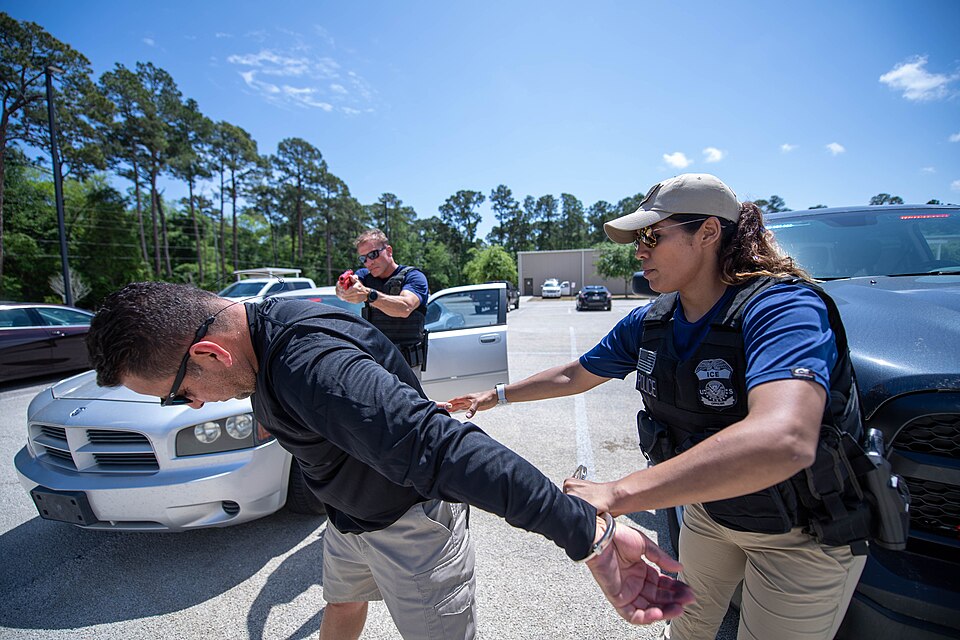
ICE Lengthens Academy And Orders Extra Training After Deadly Crackdown
U.S. Immigration and Customs Enforcement issued a memo in early June extending its core deportation-officer academy from 42 days to roughly 71 days, starting with July 2026 classes at the Federal Law Enforcement Training Center in Georgia.[1]
The memo also requires officers who finished the earlier 42-day academy to take a new "Advanced Field Officer" follow-on course, though ICE has not said how long that supplemental training will last.[1] DHS said the revamped program adds crowd-control tactics, high-risk vehicle-stop drills, a live-fire cover course and expanded medical instruction.[1] The department pointed to assaults on agents, including riots, sniper attacks and a claimed 1,300% rise in assaults, as the rationale for the changes.[1]
The 42-day compression was created under then-Homeland Security Secretary Kristi Noem as the agency rushed to hire thousands after a $75 billion funding surge in the One Big Beautiful Bill.[1] A February 2026 whistleblower complaint from former ICE instructor Ryan Schwank warned the shortened program was "deficient, defective, and broken" and said thousands of inadequately trained officers could be deployed.[1] Concerns intensified after ICE agents fatally shot U.S. citizens Renee Good and Alex Pretti during a Minneapolis enforcement crackdown that the administration later scaled back.[1]
The mainstream summary does not mention that prior to the 2025 hiring surge, ICE employed approximately 10,000 officers and agents, highlighting the scale of the increase in personnel following the funding boost from the One Big Beautiful Bill. This context is crucial as it underscores the urgency that led to the initial compression of training, which some argue resulted in significant gaps in critical training areas, including firearms and legal content. @steadystate2025 emphasizes that the reduction from 72 to 42 days eliminated essential instruction on the Constitution and use of force, framing the extension as a necessary correction to an ideology-driven hiring push.
Moreover, while the summary cites a claimed 1,300% increase in assaults on ICE officers, it does not provide the specific figures that illustrate this rise: 275 assaults reported in 2025 compared to just 19 in 2024. This stark contrast raises questions about the effectiveness of the previous training and the conditions that led to such a dramatic increase in violence against officers. The summary also overlooks the broader implications of the hiring spree, including concerns about background-check skips and the deployment of potentially unfit agents, which were pointed out by various commentators on social media. These elements together suggest that the changes in training protocols are not merely a response to recent incidents but part of a larger pattern of challenges stemming from rapid agency expansion and reduced training standards.[2][3]
Show source details & analysis (1 source)
📊 Relevant Data
Prior to the 2025 hiring surge, ICE Enforcement and Removal Operations employed approximately 10,000 officers and agents.
DHS reported 275 assaults on ICE officers from January 21 to December 31, 2025, compared with 19 assaults during the comparable period in 2024.
Radical Rhetoric by Sanctuary Politicians Leads to an Unprecedented 1300% Increase in Assaults — DHS
Before the shortened academy, ICE deportation officer training typically required 5 weeks of Spanish language training plus 13 weeks of basic immigration law enforcement training at FLETC.
ICE-D Handbook — ICE
📌 Key Facts
- An ICE memo issued in early June 2026 extends the core immigration enforcement officer academy from 42 days to roughly 71 days starting with July 2026 classes at FLETC in Georgia.
- ICE officers who completed the earlier 42‑day academy must now attend additional "Advanced Field Officer" follow-on training, though ICE has not said how long that supplemental course will last.
- DHS said the revamped program adds crowd-control tactics, high-risk vehicle-stop training, a live-fire cover course, and medical instruction in response to assaults on agents, including riots, sniper attacks, and a claimed 1,300% rise in assaults.
- The shorter academy was created under then–Homeland Security Secretary Kristi Noem during a rapid expansion funded by a $75 billion infusion in the One Big Beautiful Bill, and drew a February 2026 whistleblower complaint warning thousands of inadequately trained officers could be deployed.
- Concerns about training intensified after ICE agents fatally shot U.S. citizens Renee Good and Alex Pretti during a controversial Minneapolis crackdown earlier in 2026 that the administration later scaled back.
📰 Source Timeline (1)
Follow how coverage of this story developed over time