
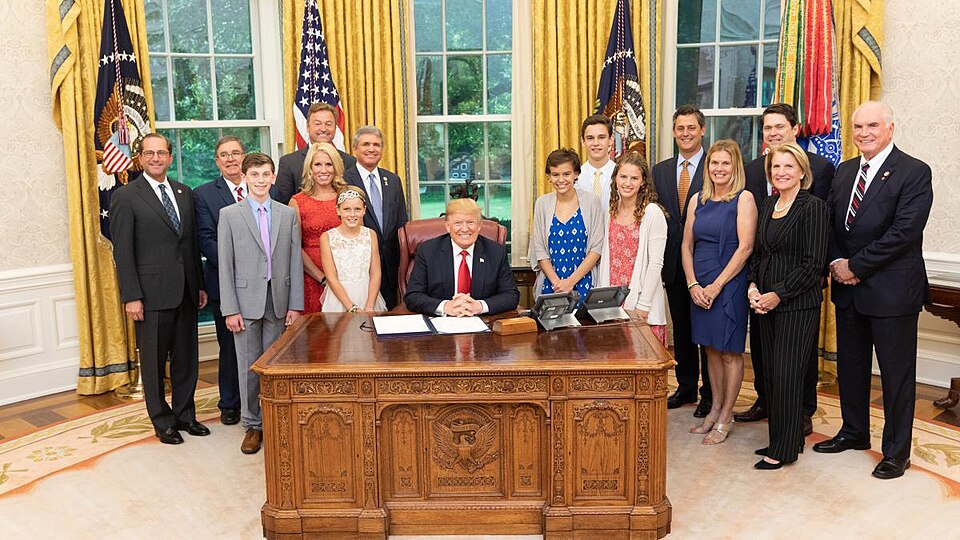
Trump Signs Secure America Act, Including Major Child Exploitation Enforcement Funding
President Donald Trump signed the $70 billion Secure America Act into law on Wednesday, June 10, 2026, in the Oval Office, locking in ICE and Border Patrol funding through the end of his term.[1]
The law frontloads roughly $38 billion for Immigration and Customs Enforcement, $26 billion for Border Patrol and $5 billion for DHS-controlled contingencies through September 2029.[2] Those allocations come as large, flexible lump sums that must be spent by the end of fiscal 2029, a structure that gives ICE and CBP broad discretion and omits many Democratic oversight demands.[3] The law also authorizes a major expansion of child-exploitation enforcement, funding about $108.5 million and authorizing 200 additional investigators for Homeland Security Investigations.[4]
Operation Metro Surge began in December 2025 and, in January 2026, federal agents fatally shot two U.S. citizens in Minneapolis, prompting Democrats to demand new limits on ICE and Border Patrol operations.[5] Those demands collapsed in talks and a partial DHS funding lapse began in mid-February 2026, after which House Republicans moved to a budget fast-track reconciliation process that allowed passage by simple Senate majority.[3]
Early mainstream coverage framed the Secure America Act as a partisan, $70 billion push to fund deportations and border enforcement without the oversight Democrats sought.[5] Later reports shifted attention to the law's child-exploitation provisions as a significant federal investment in online abuse investigations.[4]
The mainstream summary frames the Secure America Act primarily as a partisan funding bill for ICE and Border Patrol, but it does not mention the specific context of ICE's annual budget, which for fiscal year 2026 is approximately $11.3 billion. This figure highlights the significant scale of the funding being allocated through the Act, which is nearly six times the annual budget for ICE in one legislative move. The summary also downplays the implications of the $108.5 million allocated for child-exploitation enforcement, which comes in response to a dramatic rise in reports of online abuse—specifically, a 323% increase in child sex trafficking reports in 2025 due to new mandatory reporting requirements. This context suggests that the law's provisions on child exploitation are not merely an ancillary feature but a critical response to a growing crisis in online safety, a nuance that early coverage may have overlooked.
While the mainstream narrative emphasizes the lack of Democratic oversight and the partisan nature of the funding, perspectives from social media highlight that many view this legislation as a decisive victory for enforcement priorities, stripping Democrats of leverage in budget negotiations. This framing contrasts with the mainstream portrayal, which may not fully capture the enthusiasm among certain political factions for the aggressive funding and operational expansions included in the Act. The implications of this funding extend beyond immediate enforcement, reflecting broader political polarization on immigration policy that has intensified over the past two decades, as noted by sociologist Michael Hout.[6][7]
Show source details & analysis (14 sources)
📊 Relevant Data
ICE's enacted or requested annual budget for fiscal year 2026 is approximately $11.3 billion, including funding for operations, investigations, and enforcement activities.
FY 2026 Congressional Budget Justification — U.S. Department of Homeland Security
📌 Key Facts
- The Senate approved the $70 billion immigration‑enforcement reconciliation bill early Friday, June 5, 2026, clearing the way for a House vote later that week (the $70 billion immigration-enforcement reconciliation bill).
- The House advanced the package with a 213‑211 procedural vote and then adopted the final measure 214‑212 on Tuesday, June 9, 2026, largely along party lines as Republicans pushed the bill to final passage (213‑211 procedural vote).
- The GOP‑authored law, formally titled the Secure America Act, frontloads roughly $70 billion for ICE and CBP through September 2029 — roughly $38 billion for ICE, $26 billion for Border Patrol and $5 billion for DHS‑controlled contingencies (Secure America Act).
- Republicans used the budget reconciliation process to pass the package with a simple majority; the Senate approved the measure by a 52‑47 vote (with Sen. Lisa Murkowski the only Republican opposing), underscoring the partisan path the bill took (Sen. Lisa Murkowski).
- Contested add‑ons slowed final approval: language enabling a roughly $1.8 billion 'anti‑weaponization' compensation fund and about $1 billion in White House ballroom security funding drew GOP pushback — amendments to bar payouts failed but the Justice Department said it would not pursue the fund and the ballroom funding was stripped from the final package (anti-weaponization fund).
- President Donald Trump signed the Secure America Act into law in the Oval Office on Wednesday, June 10, 2026, with senior GOP leaders present, saying the bill takes DHS shutdowns 'off the table' and funds enforcement for the remainder of his term (President Donald Trump).
- The law includes a major expansion of child‑exploitation enforcement: it authorizes hiring 200 additional child‑exploitation investigators, allocates about $108.5 million for child trafficking and exploitation enforcement, and funds new forensic analysts and training programs for HSI and partner agencies (200 child exploitation investigators).
- Funding is packaged as large, flexible lump sums that must be spent by the end of fiscal 2029 — a structure that gives ICE and CBP broad discretion (and omits many Democratic‑sought operational guardrails such as warrant requirements and mandatory body‑worn cameras) (lump sums).
📰 Source Timeline (14)
Follow how coverage of this story developed over time
- On Wednesday, June 10, 2026, President Donald Trump signed into law Sen. Josh Hawley's provision funding 200 additional child exploitation investigators as part of the Secure America Act.
- The measure allocates $108.5 million for child trafficking and exploitation enforcement, which Hawley's office says is the largest federal investment ever made to combat child trafficking.
- DHS previously operated with only seven forensic analysts dedicated to child exploitation cases nationwide, highlighting the scale of the expansion.
- The law authorizes Homeland Security Investigations to hire 40 new forensic analysts and 30 new child exploitation investigators at the Victim Identification Laboratory in HSI's Child Exploitation Investigations Unit.
- It further allows HSI to employ an additional 130 forensic analysts and child exploitation investigators and to create a dedicated victim-identification training program for federal, state and local law enforcement.
- Former NFL quarterback Tim Tebow's March 3, 2026 testimony before Hawley's Senate Judiciary crime subcommittee, citing 338,000 unique U.S. IP addresses downloading or sharing child rape images in a matter of months, helped drive development of the provision from Hawley's Renewed Hope Act.
- On Wednesday, June 10, 2026, President Donald Trump signed the $70 billion homeland security funding bill in an Oval Office event attended by House Speaker Mike Johnson, Senate Majority Leader John Thune, House Majority Leader Steve Scalise and other lawmakers.
- Trump framed the law as taking DHS shutdowns for ICE and Border Patrol "off the table" through the end of his term and said he was "thrilled" to fund the Department of Homeland Security and give "heroes of ICE and Border Patrol" needed resources.
- Trump claimed at the signing that his administration has cut fentanyl crossing the border by almost 60% and said law enforcement is now focusing more on land crossings because maritime interdiction has become more effective.
- The article details fresh partisan messaging at the signing, with Trump accusing Democrats of trying for "more than 100 days" to block DHS funding and calling the Biden administration "probably the most corrupt ever," while Democrats such as Rep. Pete Aguilar criticized the measure as a "$70 billion blank check to ICE."
- Fox News reports that some conservatives previously tried to tie passage of the bill to codifying Trump's immigration executive orders, and that intra-party resistance to Trump's proposed $1.8 billion 'anti-weaponization fund' contributed to delays past his initial June 1 funding deadline.
- CNBC reports that on Wednesday, June 10, 2026, President Donald Trump signed a $70 billion immigration funding bill for ICE and CBP after months of delay, describing it as funding the agencies through the end of his term.
- The article states that Democrats had refused to fund ICE and CBP since January 2026, when an immigration surge in Minneapolis led to the deaths of two U.S. citizens at the hands of federal agents.
- CNBC specifies that Republicans used budget reconciliation to advance the package with a simple majority, with the Senate approving it 52-47 on Friday and the House 214-212 on Tuesday, both with zero Democratic votes.
- The piece notes that progress on the bill was nearly derailed by Trump's proposal for a $1.8 billion 'anti-weaponization' fund to pay allies who he said were wronged by the federal government, and that most Republicans voted against a Democratic measure to quash the fund.
- CNBC highlights the apparent conflict between Acting Attorney General Todd Blanche's statement less than a week earlier that plans for the anti-weaponization fund were 'dead' and Trump's June 7, 2026 'Meet the Press' comment that he would prefer the fund to move forward.
- On Wednesday, June 10, 2026, President Trump actually signed the Secure America Act into law in the Oval Office, ending the DHS immigration funding standoff.
- The final law funds ICE and parts of Customs and Border Protection through the end of the Trump administration, with Trump explicitly saying DHS will be fully funded for the remainder of his term.
- Trump and Republicans dropped the proposed $1 billion Secret Service funding tied to a planned East Wing ballroom renovation after internal GOP opposition.
- Senate Republicans ultimately forced the Justice Department to abandon its proposed 'anti‑weaponization' compensation fund; Acting Attorney General Todd Blanche testified the DOJ would not move forward with payouts, clearing the way for final passage.
- The article details that the House passed the bill 214–212 on Tuesday evening, June 9, 2026, following an 18‑hour Senate vote‑a‑rama late the prior week.
- Trump publicly framed the law as supporting 'heroes of ICE and Border Patrol' and said it would fund domestic law enforcement investigations and efforts against child exploitation.
- The article identifies the law as the Secure America Act and says President Donald Trump is expected to sign it on Wednesday, June 10, 2026.
- It specifies that the House passed the final bill 214-212 on Tuesday, June 9, 2026 after Republicans used their majority to push it through over unified Democratic opposition.
- The White House breakdown says the act provides $38 billion for Immigration and Customs Enforcement, $26 billion for the Border Patrol and $5 billion for unforeseen costs over three years, frontloading routine annual funding.
- The piece reports that politically toxic provisions for roughly $1 billion in new White House security, including for Trump's new ballroom, and a $1.8 billion compensation fund for allies who say they were unjustly investigated were scrapped from the final package.
- It notes the Senate completed its work on the legislation the prior week in an overnight, nearly party-line vote, with Sen. Lisa Murkowski as the only Republican to oppose it.
- The story emphasizes that the three-year funding is intended to support an ambition to deport about 1 million people per year and follows Democrats' failed push for oversight reforms such as warrant requirements and visible ID badges during operations.
- NPR’s June 10, 2026 Up First segment reiterates that the House on Tuesday, June 9, 2026, passed the immigration-enforcement reconciliation bill funding ICE and Border Patrol through fiscal 2029.
- The segment foregrounds that the House vote followed months of public debate over Operation Metro Surge and ICE conduct, which had contributed to a partial DHS shutdown before Republicans turned to reconciliation.
- It reinforces that President Trump is expected to sign the bill, locking in his enforcement agenda through 2029 without the Democratic oversight conditions they sought.
- On Tuesday, June 9, 2026, the House passed the Secure America Act in a 214-212 vote, largely along party lines, with independent Kevin Kiley joining all Democrats in opposition.
- The bill allocates $38 billion to ICE, $26 billion to CBP and $5 billion to DHS through September 2029 and now awaits President Trump's signature, which had not yet occurred at the time of this article.
- The article specifies that Democrats' earlier funding blockade led to a 75-day Department of Homeland Security shutdown beginning in mid‑February 2026 before a partial reopening in late April.
- Speaker Mike Johnson framed the vote as ending the "third Democrat government shutdown of this Congress" and accused Democrats of supporting "open borders" and "keeping criminal illegal immigrants in American communities."
- House Minority Leader Hakeem Jeffries called the bill a "blank check" that would "waste $70bn" on ICE without guardrails, while GOP leaders such as Steve Scalise cast a 'no' vote as tantamount to 'defunding the police.'
- Shortly before final passage, House Republicans defeated a Democratic amendment that would have barred financial settlements to individuals convicted of assaulting a police officer on January 6, 2021.
- On Tuesday, June 9, 2026, the House passed the ICE and Border Patrol funding bill 214-212, following a 213-211 procedural rule vote earlier in the day.
- The bill directs roughly $70 billion in Department of Homeland Security funding for ICE and Border Patrol to cover the remainder of President Trump’s term, using budget reconciliation so Republicans could pass it without Democratic votes.
- The legislation gives ICE more than triple its last annual budget via flexible lump sums usable through the end of fiscal year 2029, including $38 billion for ICE and $22 billion for Border Patrol.
- The $38 billion ICE allocation includes $7 billion for Homeland Security Investigations and $31 billion for immigration enforcement activities such as hiring attorneys, supporting cooperating local law enforcement, and technology including body cameras.
- The measure also appropriates $5 billion for border security and screening technology, including artificial intelligence systems, and $350 million earmarked for enforcement in jurisdictions that do not coordinate directly with ICE.
- Unlike the April 2026 DHS funding law, this package omits reforms Democrats had demanded, including requirements for judicial warrants for home entries, mask bans, mandatory body-worn cameras, and other oversight conditions on ICE and Border Patrol operations.
- Funds in this bill are structured as lump sums that must be spent by the end of FY 2029, rather than traditional one-year appropriations, giving the agencies broad discretion on timing and use within that window.
- NPR notes that while neither this bill nor the April DHS funding law adds money for internal ICE/CBP oversight offices, the April law did provide $20 million to the DHS inspector general specifically for detention-facility oversight.
- The article ties passage to the end of a 115-day DHS shutdown and standoff sparked after federal officers fatally shot two protesters in Minneapolis, which led Democrats to block prior ICE and Border Patrol funding absent enforcement reforms.
- Fox News reports the House passed the $70 billion immigration enforcement package on Tuesday, June 9, 2026, by a 214-212 vote, with all Democrats and independent Rep. Kevin Kiley opposed and every Republican present in favor.
- The article specifies the GOP-authored bill is formally titled the 'Secure America Act' and says it provides $38 billion for ICE, $26 billion for Border Patrol, and creates a $5 billion funding pool controlled by DHS Secretary Markwayne Mullin.
- Rep. Kevin Kiley explains he opposed the bill because it bypassed the regular bipartisan appropriations process via reconciliation and lacked enforcement reforms, saying the end run around annual appropriations is 'hugely problematic' and contributed to his switch to independent status.
- House Majority Leader Steve Scalise is quoted accusing Democrats of wanting 'open borders' and saying they 'have said they don't want to fund' enforcement, while GOP leaders defend their use of budget reconciliation as forced by Democratic resistance to DHS funding.
- The article reiterates that the measure funds ICE and Customs and Border Protection through fiscal year 2029 and frames the vote as a significant victory for Speaker Mike Johnson given the GOP's narrow House majority.
- On Tuesday, June 9, 2026, the House passed the immigration enforcement reconciliation bill 214-212 on a party-line vote, sending the previously approved Senate package to Trump's desk.
- The final bill contains no legislative restrictions on President Trump's proposed $1.776 billion anti-weaponization (1776) compensation fund after both chambers failed to adopt limiting amendments.
- In the Senate, the parliamentarian ruled that most amendments targeting the fund required 60 votes, and all but one Republican senator, Susan Collins of Maine, ultimately voted for the bill.
- House Republicans had virtually no opportunity to offer amendments on the fund under the chamber's leadership-driven process, and GOP lawmakers cited the risk of a Trump veto if restrictions were added.
- Retiring Sen. Thom Tillis, R-N.C., circulated a June 9, 2026 email blasting GOP colleagues for rejecting his amendment to block the fund and warning it would be a "political albatross" in the November elections.
- Independent Rep. Kevin Kiley of California, formerly a Republican, was the only member to technically cross party lines; every Republican voted for the bill and every Democrat voted against it.
- Roughly a dozen conservative House Republicans initially withheld support for the rule setting up debate, seeking to graft provisions from hardline immigration bill H.R. 2 before ultimately backing the package.
- On Tuesday, June 9, 2026, the House voted 213-211 along party lines to adopt the rule and formally take up the $70 billion ICE and CBP funding bill, with every Democrat voting no.
- The New York Times article frames the package explicitly as funding President Trump's deportation crackdown 'through the end of his term,' underscoring its multi-year scope and political intent.
- The story details renewed internal GOP resistance over including $1 billion in security funds for Trump's ballroom project and over the administration's previously announced $1.8 billion fund for people claiming victimization by the government, noting that statutory language ultimately remained silent on prohibiting such a fund even after failed Senate amendments.
- The article describes House Republicans' reliance on budget reconciliation as a deliberate abandonment of the 'normal, bipartisan appropriations process' traditionally used to fund major agencies, characterizing the maneuver as using a process 'never supposed to be employed for routine spending.'
- It recounts that Senate Republicans and Democrats earlier agreed to fund all of the government except ICE and CBP after Democrats demanded guardrails following federal agents' fatal shootings of two U.S. citizens in Minneapolis, and that conservatives in the House initially refused to back that partial bill until the White House ordered them to do so.
- The article reports that, during the intervening funding gap, President Trump asserted he was financing ICE and CBP with money embedded in the prior year's GOP tax law passed via reconciliation.
- On Tuesday, June 9, 2026, the House approved a 213-211 procedural test vote along party lines to advance the $70 billion, three-year immigration enforcement and border security bill.
- All Democrats present voted no; Republicans backed the rule, reflecting the narrow GOP majority and that Speaker Mike Johnson can spare only a handful of votes on final passage.
- The article reiterates that the Senate previously passed the GOP-authored measure 52-47, with Sen. Lisa Murkowski joining Democrats in opposition.
- Democrats, led by House Democratic Caucus Chair Pete Aguilar, criticized the bill as a "$70 billion blank check" for ICE and CBP and said new funding should be conditioned on accountability and oversight.
- The report notes that Democrats' refusal to fund ICE and CBP without reforms contributed to the longest federal shutdown in U.S. history, after which Republicans shifted to budget reconciliation to bypass them.
- It adds that intra-party GOP opposition to President Trump's proposed $1.8 billion anti-weaponization fund and $1 billion in security upgrades for his White House ballroom project delayed the measure before those items were stripped in final negotiations.
- The Senate approved the $70 billion immigration-enforcement reconciliation bill early Friday, June 5, 2026, after weeks of roadblocks.
- The House is scheduled to vote on the bill Tuesday, June 9, 2026, around 4:30 p.m. Eastern, with the Rules Committee having met Monday afternoon to prepare it for floor consideration.
- Speaker Mike Johnson said June 8 he expects the legislation to pass but noted a very small margin of error and attendance challenges during primary season.
- Funding-related language for $1 billion in White House ballroom construction was stripped from the bill amid rare GOP pushback and was not included in the final package.
- The Justice Department has said it will no longer pursue the nearly $1.8 billion "anti-weaponization" fund, but Senate amendments to formally bar such payouts were defeated during a marathon vote session before final passage.
- Republicans are using the budget reconciliation process to pass the ICE and Border Patrol funding with a simple Senate majority, and Democrats have refused to fund those agencies without reforms.