
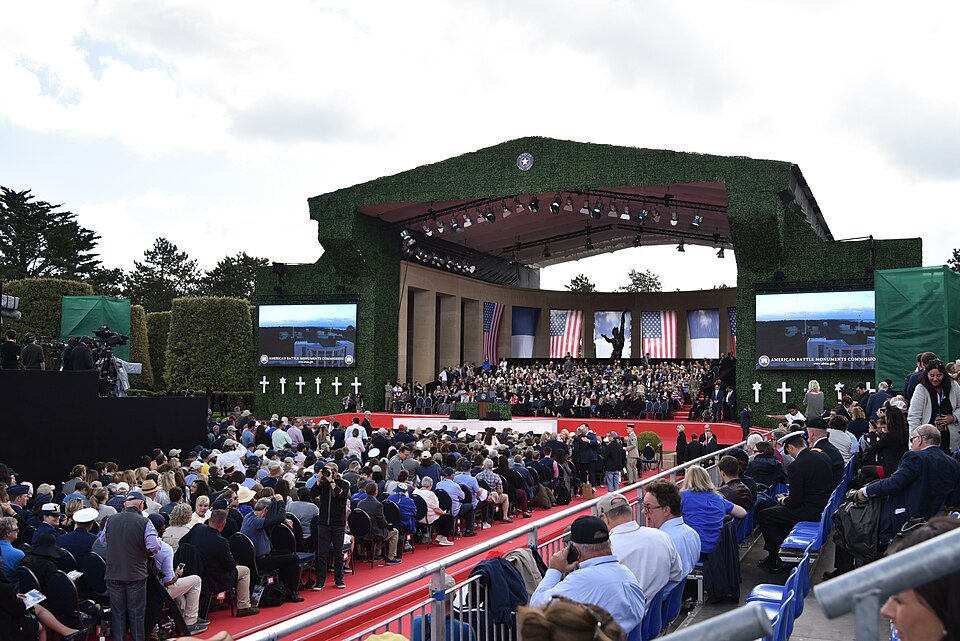
Defense Secretary Hegseth Links European Migration To 'Invasion' In D-Day Speech
Defense Secretary Pete Hegseth framed European migration as an "invasion" during a D-Day ceremony at the Normandy American Cemetery on Saturday, warning it threatens freedoms won in World War II.[1]
At the ceremony he said, "different European beaches are stormed by different dangerous ideologies." PBS He asked, "When will European capitals do something about that invasion?" PBS He warned that the permanence of the freedom won by Allied troops could be at risk if leaders failed to defend it.[1]
PBS noted Hegseth did not explicitly use the word "immigration" in the speech but said his rhetoric echoed broader Trump administration criticism of Europe over migration, borders, and alleged censorship of nationalist or far-right voices.[2] PBS also situated the remarks alongside same-day controversy in which Vice President JD Vance blamed immigration for a killing in the U.K., a claim condemned by Prime Minister Keir Starmer's office.[2] PBS pointed to the administration's December national security strategy warning Europe faces "civilizational erasure." PBS
PBS's early account emphasized the rhetorical echo with administration policy and the absence of an explicit "immigration" label.[2] The New York Times, in later reporting, said Hegseth explicitly framed European migration as an "invasion" and supplied additional quotations tying migration to threats against World War II freedoms.[1]
The mainstream summary frames Hegseth's comments as a straightforward warning about migration, but both Steve Sailer and Francis Fukuyama criticize the use of militarized language like 'invasion' to describe demographic changes. Sailer argues that such rhetoric is politically opportunistic and historically tone-deaf, while Fukuyama warns that equating migration with invasion undermines Enlightenment values and can normalize xenophobia. This critical perspective highlights a significant concern that the mainstream coverage does not address: the potential dangers of using historical military metaphors to shape contemporary immigration discourse, which could distort public understanding of both history and current policy choices.
Furthermore, the summary does not explore the broader implications of Hegseth's remarks in the context of the Trump administration's rhetoric on migration. Fukuyama emphasizes the importance of addressing migration through policy and reason rather than fear-driven narratives, suggesting that the invocation of D-Day is not just a rhetorical flourish but part of a larger trend that could erode democratic norms. This nuanced critique adds depth to the conversation that the mainstream summary overlooks, particularly regarding the potential impact on civic virtues and public discourse around migration issues.
Show source details & analysis (3 sources)
📌 Key Facts
- On Saturday, June 6, 2026, at a D-Day ceremony at the Normandy American Cemetery, Defense Secretary Pete Hegseth said "different European beaches are stormed by different dangerous ideologies" and asked, "When will European capitals do something about that invasion?" (Normandy American Cemetery).
- The New York Times reported that Hegseth explicitly framed European migration as an "invasion," tying current migration to threats against freedoms won in World War II and broadening his criticism to European leaders' handling of immigration and border enforcement (New York Times).
- Defense Secretary Pete Hegseth warned that the permanence of the freedom won by Allied troops could be at risk, saying freedom could prove temporary if leaders failed to defend it (Defense Secretary Pete Hegseth).
- PBS News noted Hegseth did not explicitly use the word "immigration" in the speech but that his rhetoric echoed broader Trump administration criticism of Europe over migration, borders, and alleged censorship of nationalist or far-right voices (PBS News).
- PBS situated Hegseth's remarks alongside same-day controversy in which Vice President JD Vance blamed immigration for the killing of Henry Nowak in the U.K. — a claim condemned by British Prime Minister Keir Starmer's office — and cited the administration's December national security strategy warning Europe faces "civilizational erasure" (Vice President JD Vance).
📊 Analysis & Commentary (2)
"Though the article text is corrupted, the title and URL indicate an opinion piece reacting to rhetoric like Hegseth’s D‑Day 'invasion' framing: the author questions militarized metaphors for migration, defends the legitimacy of national/cultural behavior (here, 'acting French'), and critiques political exploitation of historical memory — analysis provided with low confidence because the source text is unreadable."
"The author is criticizing recent rhetoric (e.g., Pete Hegseth’s D‑Day comments that called migration an "invasion") and arguing that Europe should resist fear-driven, illiberal responses and instead defend Enlightenment values — reason, rights, and the rule of law — while addressing real policy challenges through principled, practical measures."
📰 Source Timeline (3)
Follow how coverage of this story developed over time
- Article published Sunday, June 7, 2026, by the New York Times provides additional detail on Pete Hegseth's June 6 D-Day remarks at the Normandy American Cemetery.
- The Times emphasizes that Hegseth explicitly framed European migration as an 'invasion' and broadened his criticism to European leaders' handling of immigration and border enforcement.
- The reporting adds further quotations and characterization of Hegseth's rhetoric beyond the PBS account, underscoring how directly he tied current migration to threats against freedoms won in World War II.
- On Saturday, June 6, 2026, Defense Secretary Pete Hegseth told a D-Day ceremony at the Normandy American Cemetery that 'different European beaches are stormed by different dangerous ideologies' and asked, 'When will European capitals do something about that invasion?'
- Hegseth framed the issue as a threat to the permanence of freedom won by Allied troops, saying that freedom could prove temporary if leaders failed to defend it.
- The article notes Hegseth did not explicitly use the word immigration, but his rhetoric echoed broader Trump administration criticism of Europe over migration, borders, and alleged censorship of nationalist or far-right voices.
- The piece situates Hegseth's remarks alongside same‑day controversy over Vice President JD Vance blaming immigration for Henry Nowak's killing in the UK, which British Prime Minister Keir Starmer's office condemned, and cites the administration's December national security strategy warning Europe faces 'civilizational erasure.'