
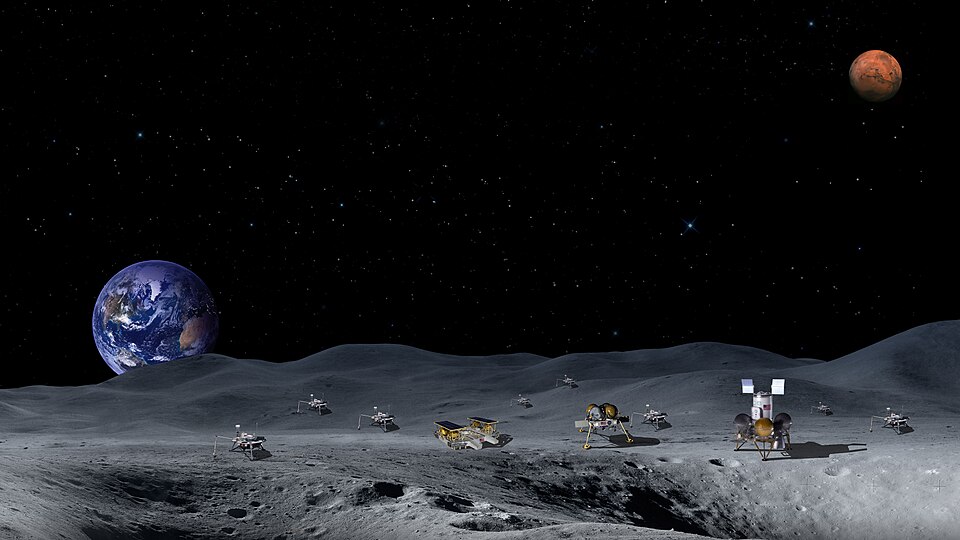
NASA Details Multi-Phase Lunar Base Plan With 2028 Astronaut Landing Goal
On Tuesday, May 26, 2026, NASA laid out a multi-phase plan at a Washington, D.C. news conference to build a lunar base and said it aims to land astronauts near the moon's south pole as soon as 2028.[1]
NASA said it awarded hundreds of millions in contracts to four U.S. companies, including Blue Origin and Firefly Aerospace.[2] Blue Origin will provide two landers to carry lunar terrain vehicles from Astrolab and Lunar Outpost, and Firefly will deliver the first lunar drones.[2] NASA said it now targets an Artemis III test flight in mid-2027 to practice Orion docking with crewed landers.[2] The agency aims for a two-astronaut landing as soon as 2028 and said landers, buggies and drones are ideally supposed to arrive before astronauts.[1]
The Artemis II crew's April 2026 lunar flyaround traveled deeper into space than Apollo-era missions, agency officials noted.[3] Program leaders described the effort as a three-phase build-up: an initial push through the 2028 landing, a second phase from about 2029 into the early 2030s to add infrastructure such as a power grid, and a third phase in the 2030s when permanent habitats would support extended astronaut stays.[1]
Moon Base program executive Carlos Garcia-Galan said the site could sprawl hundreds of square miles, with perimeter drones nicknamed 'MoonFall' marking corners, and Jared Isaacman said NASA expects roughly $20 billion in investment over seven years to help build a lunar economy and prepare for Mars.[2]
Show source details & analysis (4 sources)
📌 Key Facts
- On Tuesday, May 26, 2026, NASA held a news conference at its Washington, D.C. headquarters where officials outlined phase one, displayed physical models and announced that it awarded hundreds of millions in contracts to four U.S. companies, including Blue Origin and Firefly Aerospace (hundreds of millions in contracts).
- Blue Origin will provide a pair of landers to deliver lunar terrain vehicles built by Astrolab and Lunar Outpost to a site near the moon’s south pole; NASA says that landers, buggies and drones are ideally supposed to arrive before the first Artemis astronauts land (Blue Origin).
- Firefly Aerospace — which landed successfully on the moon in 2025 — was selected to deliver the first drones to the lunar surface as part of the base’s initial phase (Firefly Aerospace).
- NASA now targets an Artemis III test flight in mid-2027 to practice docking the Orion capsule in Earth orbit with crewed lunar landers being developed by Blue Origin and SpaceX, followed by a two-astronaut lunar landing as soon as 2028, with base hardware planned to be in place beforehand (Artemis III).
- The lunar base program is structured in three phases: an initial build-up through the 2028 landing, a second phase from about 2029 into the early 2030s to add infrastructure such as a power grid, and a third phase in the 2030s when permanent habitats will support extended astronaut stays (three phases).
- Program leaders described an envisioned base that could sprawl over hundreds of square miles, with perimeter drones nicknamed “MoonFall” stationed at the corners to respectfully mark U.S. assets while expecting reciprocity from other nations operating nearby (MoonFall).
- Administrator Jared Isaacman said NASA expects to invest about $20 billion over the next seven years to foster a lunar economy, conduct science and lay foundations for Mars expeditions, adding that “the grand return is close at hand and we will not slow down” (about $20 billion).
- NASA said the Artemis II crew’s April 2026 lunar flyaround traveled deeper into space than Apollo missions in the late 1960s and early 1970s, underscoring the program’s growing reach beyond previous human spaceflight milestones (Artemis II).
📰 Source Timeline (4)
Follow how coverage of this story developed over time
- On Tuesday, May 26, 2026, NASA said the Artemis II crew’s April 2026 lunar flyaround traveled deeper into space than Apollo missions in the late 1960s and early 1970s.
- NASA confirmed that during Artemis III, targeted for mid-2027, astronauts will practice docking the Orion capsule in Earth orbit with crewed lunar landers being developed by Blue Origin and SpaceX.
- NASA reiterated that the first Artemis astronaut landing at the south polar region is planned for as early as 2028, with all base hardware ideally arriving beforehand.
- Moon base program executive Carlos Garcia-Galan said that by the third phase in the 2030s, permanent habitats will allow extended astronaut stays, marking a point when NASA can say it is "permanently" on the moon and "not giving it up."
- Garcia-Galan described a envisioned base sprawled over hundreds of square miles, with perimeter drones nicknamed "MoonFall" stationed at the corners.
- Administrator Jared Isaacman said the MoonFall perimeter is intended to respect other nations' nearby spacecraft and equipment and that NASA expects reciprocal respect for U.S. assets.
- Isaacman emphasized that the base is meant to foster a lunar economy, support science, and lay foundations for a Mars expedition, adding that "the grand return is close at hand and we will not slow down."
- On Tuesday, May 26, 2026, NASA held a news conference at its Washington, D.C. headquarters where Moon Base program executive Carlos Garcia-Galan and Administrator Jared Isaacman publicly outlined the first phase of the lunar base and displayed physical models.
- Garcia-Galan said the envisioned lunar base could sprawl over hundreds of square miles, with a perimeter marked by drones nicknamed 'MoonFall' stationed at the corners.
- Isaacman described the perimeter drones as intended to respectfully mark territory around U.S. assets and said NASA expects reciprocity from other nations operating nearby.
- Garcia-Galan reiterated that the second phase, beginning around 2029, will build up permanent infrastructure such as a power grid, and that specialized permanent habitats to support extended astronaut stays are expected in the 2030s during a third phase.
- Isaacman said the goal of the moon base is to encourage a lunar economy while conducting science and laying foundations for a Mars expedition, adding, 'For those waiting patiently, the grand return is close at hand and we will not slow down.'
- The article confirms again that NASA targets an Artemis III test flight in mid-2027 to practice docking Orion in Earth orbit with crewed lunar landers, followed by a two-astronaut lunar landing as soon as 2028, and that Blue Origin’s landers will deliver lunar terrain vehicles from Astrolab and Lunar Outpost while Firefly Aerospace will deliver the first lunar drones.
- NASA officials emphasized that all contracted hardware — landers, buggies and drones — is ideally supposed to arrive on the lunar surface before the first Artemis astronauts land, planned for as early as 2028.
- On Tuesday, May 26, 2026, NASA outlined phase one of its moon base plan and awarded hundreds of millions of dollars in contracts to four U.S. companies, including Blue Origin and Firefly Aerospace.
- Blue Origin will provide a pair of landers to deliver lunar terrain vehicles built by Astrolab and Lunar Outpost to a site near the moon's south pole, with this hardware intended to arrive before the first base astronauts land.
- Firefly Aerospace, which landed successfully on the moon in 2025, was selected to deliver the first drones to the lunar surface as part of the base's initial phase.
- NASA now targets an Artemis III test flight in mid-2027 that will practice docking the Orion capsule in Earth orbit with crewed lunar landers from Blue Origin and SpaceX, with a two-astronaut lunar landing planned as soon as 2028.
- The lunar base is structured in three phases: an initial build-up through the 2028 landing, a second phase from 2029 into the early 2030s to add infrastructure including a power grid, and a third phase in the 2030s when permanent habitats will support extended astronaut stays.
- Moon base program executive Carlos Garcia-Galan described a base potentially sprawling over hundreds of square miles, with perimeter drones dubbed "MoonFall" serving as territorial markers around the site.
- NASA Administrator Jared Isaacman reiterated that NASA expects to invest about $20 billion over the next seven years into the moon base mission and said the effort aims to build a lunar economy and foundations for Mars expeditions.