
U.S. Narco-Boat Strike Campaign Death Toll Tops 207 As Legal Scrutiny Grows
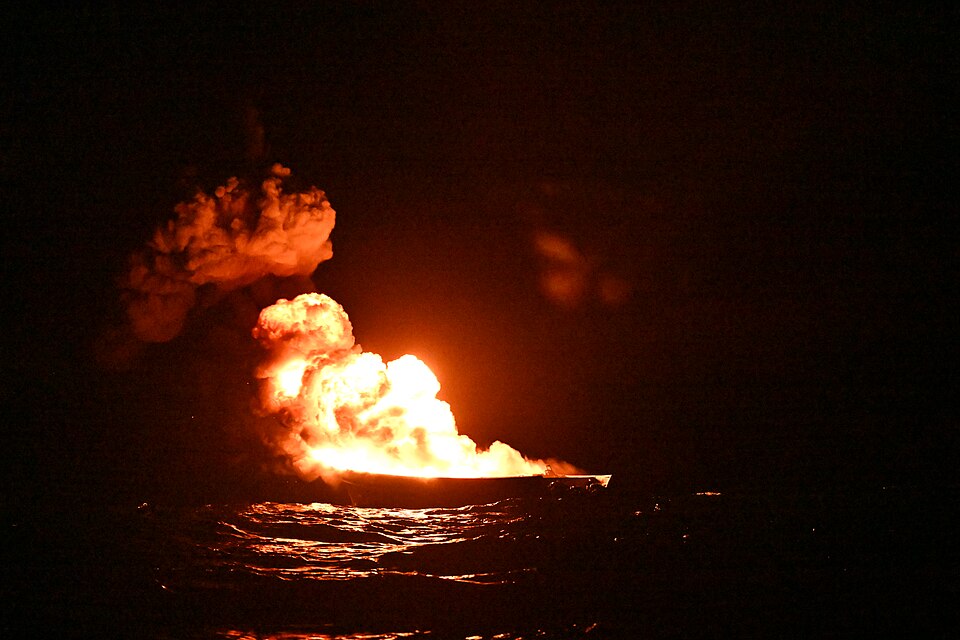
U.S. forces destroyed a suspected drug-smuggling boat in the eastern Pacific on Wednesday, June 3, 2026, killing two men and raising the campaign death toll to at least 207.[1]
U.S. Southern Command posted video showing the small boat speeding before it erupted in flames and said the strike was ordered by Gen. Francis L. Donovan.[1] SOUTHCOM labeled the crew "narco-terrorists" and said the vessel was transiting known smuggling routes.[1] The command has not publicly produced evidence that the targeted vessels were carrying drugs, a point highlighted by later reporting and fact checks.[2]
On September 2, 2025, the United States began a campaign of strikes on suspected drug-trafficking boats in the Caribbean and eastern Pacific.[2] By late May, reporting showed at least 59 boats had been struck and more than 200 people killed, and the total rose in part because some people initially reported as survivors were never recovered after earlier attacks.[3]
Field reporting has since questioned the military narrative, with relatives describing some victims as fishermen or paid laborers and noting the fast boats mainly carry cocaine rather than most fentanyl entering the United States.[4] Families have filed U.S. lawsuits and an Inter-American complaint, and the Pentagon inspector general has opened a review of whether the military followed the Joint Targeting Cycle while saying it will not assess the strikes' underlying legality.[5]
Show source details & analysis (13 sources)
📌 Key Facts
- As of Wednesday, June 3, 2026 (Central), U.S. military strikes on suspected drug‑trafficking vessels have killed at least 207 people since the campaign began on September 2, 2025, according to reporting by Fox News.
- By the May 30, 2026 strike, U.S. forces had struck at least 59 boats in the Caribbean Sea and eastern Pacific during the operation that began on September 2, 2025, per a PBS News summary.
- In a concentrated wave of attacks spanning May 26–June 3, 2026 (Central), U.S. Southern Command carried out multiple lethal strikes — May 26 (1 killed, 2 survivors), May 27 (2 killed), May 29 (3 killed), May 30 (3 killed) and June 3 (2 killed) — with SOUTHCOM releasing video of boats exploding and saying the June 3 operation was ordered by Gen. Francis L. Donovan (Fox News).
- SOUTHCOM has repeatedly described targeted vessels as “engaged in narco‑trafficking operations” and operated by “Designated Terrorist Organizations,” but the command has not publicly produced evidence the boats were carrying drugs, a point emphasized by reporting from CBS News.
- The Pentagon inspector general announced a self‑initiated review in May 2026 to determine whether the military followed the six‑phase Joint Targeting Cycle in these boat strikes, but the office said it will not assess the strikes’ legality (CBS News).
- The campaign faces growing legal scrutiny: relatives of a Venezuelan man filed a complaint with the Inter‑American Commission on Human Rights and families of two Trinidadian men have sued the administration in U.S. federal court alleging the strikes were unlawful, as reported by CBS News.
- Field reporting cited by NPR found relatives and neighbors of some people killed described them as laborers or fishermen paid about $500 per trip, and NPR noted the fast boats targeted primarily carry cocaine — not most fentanyl bound for the U.S. — raising questions about the strikes’ impact on fentanyl flows (NPR).
- The campaign’s opening strike on September 2, 2025 included a reported follow‑on “double tap” that killed two survivors clinging to wreckage, an action the White House confirmed and that has prompted congressional and legal concern about possible war‑crimes implications (CBS News).
- Fact‑checks have challenged administration claims about the strikes’ effects: PolitiFact rated President Trump’s claim that each destroyed boat “saves 25,000 American lives” as “Pants on Fire” and his claim that “drugs entering our country by sea are down 97%” as “False,” findings summarized by PBS News.
📰 Source Timeline (13)
Follow how coverage of this story developed over time
- The article reports that on Wednesday, June 3, 2026, the U.S. military destroyed an alleged drug-smuggling boat in the eastern Pacific Ocean, killing two men.
- CBS reiterates that the strike was the fifth in about a week and says this latest attack raises the death toll from the maritime strike campaign to at least 207 people since it began in early September 2025.
- U.S. Southern Command said the June 3 strike was ordered by Gen. Francis L. Donovan and took place along what it described as a known smuggling route, but the military again provided no evidence the vessel was actually carrying drugs.
- CBS notes that a video posted on X by SOUTHCOM shows the targeted boat speeding through the water before erupting in flames.
- The story restates that in the first strike in early September 2025, two survivors clinging to wreckage were killed in a follow-up strike while waving, and adds that some legal scholars maintain such a second strike on survivors would be illegal under any circumstances.
- The article updates that, as of this new strike, only three people are known to have survived any of the attacks and then been rescued, with two repatriated after an October 2025 'narco sub' strike and a third transferred to Costa Rican authorities after a March 2026 incident.
- CBS again notes that the Pentagon inspector general announced in May 2026 it will review whether the strikes followed the six-phase Joint Targeting Cycle but will not assess their underlying legality.
- SOUTHCOM said that on Wednesday, June 3, 2026, at the direction of commander Gen. Francis L. Donovan, Joint Task Force Southern Spear carried out a lethal kinetic strike on a vessel in the Eastern Pacific that it described as operated by Designated Terrorist Organizations.
- SOUTHCOM stated that intelligence had confirmed the vessel was transiting along known narco-trafficking routes in the Eastern Pacific and was engaged in narcotics-trafficking operations.
- The June 3 strike killed two men whom SOUTHCOM termed 'narco-terrorists'; no U.S. personnel were injured, and the command released video showing the small boat moving at speed before erupting in flames.
- The article reports that, with this operation, at least 207 people have now been killed in U.S. military strikes on suspected drug-trafficking vessels since the campaign began in September 2025.
- The piece details that in the week leading up to June 3, U.S. forces also carried out at least four other lethal strikes in the Eastern Pacific: a Saturday strike that killed three alleged narco-terrorists, a Friday strike that killed three, a Wednesday strike that killed two, and a Tuesday strike that killed one person and left two survivors.
- The report reiterates that in an earlier May operation in the Eastern Pacific, SOUTHCOM said a strike killed two alleged narco-terrorists and left one survivor, and notes that the command has generally not publicly produced evidence that the targeted vessels carried drugs or identified those killed.
- The article underscores that lawmakers, legal experts and human rights organizations continue to question the legal basis for using lethal military force against suspected traffickers outside a conventional battlefield, framing the June 3 strike as part of that contested campaign.
- On June 2, 2026, Secretary of State Marco Rubio told a Senate hearing that each U.S. boat strike has “a legal officer on the deck” who must determine whether a strike order is lawful, and that these decisions are made by the Department of War.
- As of a May 30, 2026 strike in the eastern Pacific that killed three men, U.S. forces had struck at least 59 boats in the Caribbean Sea and eastern Pacific, with a confirmed death toll of 205 people since the campaign began September 2, 2025.
- PolitiFact rated as “Pants on Fire” President Trump’s repeated claim that destroying each boat saves 25,000 American lives, finding no administration evidence about what drugs were on the boats and noting experts say such life‑saved estimates are impossible to substantiate.
- PolitiFact rated as “False” Trump’s claim that “drugs entering our country by sea are down 97%,” showing that Customs and Border Protection coastal seizures dropped but U.S. Coast Guard seizures at sea have sharply increased since the strikes began.
- The White House’s cited data for the “97%” figure relied on a narrow July–November 2025 slice of CBP air and marine seizure statistics, without explaining why those months were chosen or accounting for Coast Guard interdictions.
- The Associated Press article states that more than 200 people have been killed by U.S. strikes on alleged drug boats since the campaign began in September 2025, and more than 60 boats have been struck overall.
- It reports that October 2025 was the deadliest month of the campaign, with 45 people killed.
- The piece notes that the U.S. Coast Guard set a record in 2024 by seizing 225 metric tons of cocaine at sea, the final year of President Joe Biden's term, under the prior interdiction-focused strategy.
- AP field reporting from a Venezuelan region that some targeted boats departed from identified four men killed in strikes whose relatives and neighbors described them as laborers or fishermen paid about $500 per trip, raising questions about whether all victims were cartel members.
- The article underscores that the fast boats targeted in the Caribbean and eastern Pacific primarily carry cocaine, while most fentanyl reaching the U.S. is trafficked overland from Mexico, contradicting administration claims that the strikes are curbing fentanyl flows.
- Fox News confirms that on Saturday, May 30, 2026, at the direction of SOUTHCOM commander Gen. Francis L. Donovan, Joint Task Force Southern Spear conducted a lethal kinetic strike on a vessel in the Eastern Pacific, killing three men SOUTHCOM labeled 'narco-terrorists'.
- SOUTHCOM’s public statement said intelligence confirmed the May 30 vessel was transiting along known narco-trafficking routes in the Eastern Pacific and was 'engaged in narco-trafficking operations', and described the vessel as operated by 'Designated Terrorist Organizations'.
- Fox News reports SOUTHCOM descriptions of three additional strikes in the same campaign last week: a Friday, May 29 strike killing three men; a Wednesday, May 27 strike killing two; and a Tuesday, May 26 strike killing one person and leaving two survivors for whom SOUTHCOM says it activated U.S. Coast Guard search-and-rescue.
- The article reiterates that no U.S. forces were harmed in the May 30 strike, according to SOUTHCOM.
- CBS reports that on Saturday, May 30, 2026, the U.S. military carried out another strike on a boat accused of smuggling drugs in the eastern Pacific, killing three men and bringing the campaign death toll to 205.
- The article states this was the fourth U.S. strike on alleged drug-smuggling vessels announced in the week of May 24–30, 2026, in the Caribbean and eastern Pacific.
- SOUTHCOM again characterized the targeted vessel as being "engaged in narco-trafficking operations" and operated by a designated terrorist organization, but provided no public evidence to substantiate those claims.
- The piece underscores that the overall death toll rose slightly this week because some people previously reported by the U.S. military as survivors of earlier strikes have not been found.
- The article reiterates that the Trump administration has formally declared the U.S. to be in an armed conflict with Latin American drug cartels, framing these strikes under that policy.
- CBS recalls that in the first strike on September 2, 2025, the U.S. conducted a follow-on "double tap" strike that killed two survivors of the initial attack, a move some lawmakers have questioned as a possible war crime.
- The story notes that only three people are known to have survived U.S. boat strikes and then been rescued to date: two from a "narco-sub" in October 2025 (later repatriated to Ecuador and Colombia) and one survivor transferred to Costa Rican authorities after a March 2026 strike.
- CBS adds that families of two Trinidadian men killed in a prior Caribbean boat strike have sued the Trump administration in U.S. federal court, arguing the premeditated and intentional killings lack any plausible legal justification.
- U.S. Southern Command said it carried out another strike on an alleged drug-smuggling boat in the eastern Pacific Ocean on Saturday, May 30, 2026, killing three men.
- SOUTHCOM stated on X that the targeted vessel was "engaged in narco-trafficking operations" and operated by a designated terrorist organization, but it did not provide evidence for those claims.
- This was the fourth U.S. strike on alleged drug boats announced in the same week, bringing the reported campaign death toll to 205 people since operations began in early September 2025.
- SOUTHCOM said the May 30 strike was conducted at the direction of Gen. Francis L. Donovan, the top U.S. commander for Latin America.
- On Friday, May 29, 2026, U.S. Southern Command carried out another strike on an alleged drug-smuggling boat in the eastern Pacific Ocean that it says killed three men.
- The new attack is the third U.S. strike on alleged drug boats announced this week and raises the cumulative reported death toll from the campaign to at least 202 people since it began in early September 2025.
- Southern Command again described the targeted vessel as engaged in narco-trafficking and operated by a designated terrorist organization but provided no public evidence to support those claims.
- For the May 29 strike, Southern Command released what appears to be its first color video of such an attack, showing the small vessel engulfed in a fireball and debris scattered around it in the water.
- The White House has confirmed that in the initial Sept. 2, 2025 strike the U.S. conducted a follow-on 'double tap' strike that killed two survivors of the first attack, a move some lawmakers have questioned as a potential war crime.
- The overall death tally increased this week not only because of the May 29 strike but also because some people initially reported by the U.S. military as survivors of earlier strikes have never been found.
- CBS now reports the Trump administration's strikes on suspected drug-trafficking boats in the Caribbean Sea and eastern Pacific have killed at least 199 people as of Friday, May 29, 2026.
- The updated figure includes at least 22 people who initially survived a strike but were later hit again or died at sea during the campaign that began with a first attack on September 2, 2025.
- U.S. Southern Command says it alerts the U.S. Coast Guard when survivors are observed, but Mexico's navy said Coast Guard alerts about this month's strikes did not mention survivors, and the Coast Guard referred inquiries back to Mexico.
- The Pentagon inspector general said earlier in May 2026 that it plans to review whether the U.S. military followed the six-phase Joint Targeting Cycle in these operations, while explicitly not examining the legality of the strikes.
- Only three people are known to have survived strikes and then been rescued: two from a "narco sub" in October 2025 who were later returned to Ecuador and Colombia, and one survivor from a March 2026 strike who was transferred to Costa Rican authorities.
- Families of two Trinidadian men killed in a Caribbean strike have sued the Trump administration in U.S. federal court, alleging the "premeditated and intentional killings" lack any plausible legal justification.
- Relatives of 42-year-old Alejandro Carranza Medina filed a complaint in December 2025 with the Inter-American Commission on Human Rights, claiming he was fishing, not trafficking drugs, when his boat was destroyed by a U.S. missile.
- The article reiterates that the administration has declared the U.S. to be at war with Latin American drug cartels and notes that a September 2, 2025 "double tap" strike that killed two survivors drew congressional questions about whether it constituted a war crime.
- On Wednesday, May 27, 2026, U.S. Southern Command conducted another lethal kinetic strike on a vessel in the eastern Pacific suspected of drug trafficking, killing two men.
- SOUTHCOM released video on May 28, 2026 showing the targeted boat stationary on the water before an explosion, followed by smoke and fire.
- CBS notes that U.S. strikes on alleged drug-trafficking vessels in Latin American waters since early September have now killed at least 196 people, up from previous tallies of 194 deaths.
- The article reiterates that the Pentagon inspector general’s self-initiated review will examine whether the military followed the six-phase Joint Targeting Cycle but will not assess the legality of the strikes.
- The report underscores that the military has not publicly provided evidence that the targeted vessels were carrying drugs, raising concerns that some strikes may have killed civilians who did not pose an immediate threat to the United States.
- SOUTHCOM said that on May 26, 2026, at the direction of commander Gen. Francis L. Donovan, Joint Task Force Southern Spear conducted a lethal kinetic strike on a vessel operated by designated terrorist organizations in the Eastern Pacific.
- SOUTHCOM stated intelligence had confirmed the vessel was transiting along known narco-trafficking routes and was engaged in narco-trafficking operations.
- The command said one suspected narco-terrorist was killed and two others survived the May 26 strike and that the U.S. Coast Guard was immediately notified to launch search-and-rescue operations.
- SOUTHCOM characterized the targeted groups as "Designated Terrorist Organizations," describing the operation as part of a broader campaign against cartel-linked trafficking networks, and linked the strike to prior lethal actions on May 8 in the Eastern Pacific and in the Caribbean earlier in May.
- The article reiterates that no U.S. forces were injured in the May 26 operation.
- Article confirms that on Tuesday, May 26, 2026, a U.S. military strike on a suspected drug boat in the eastern Pacific killed one man and left two survivors.
- Video released by U.S. Southern Command shows the boat speeding through the water before exploding into flames, and SOUTHCOM says it immediately notified the U.S. Coast Guard to activate search-and-rescue for survivors.
- The report says the Trump administration’s campaign of blowing up alleged drug‑trafficking vessels in Latin American waters has been underway since early September and has killed at least 194 people, one more than the previously reported figure of at least 193.
- The article notes that the U.S. military has not provided evidence that any of the targeted vessels were actually carrying drugs.
- It adds that the Pentagon inspector general last week announced a self‑initiated evaluation of whether the U.S. military has followed the six‑phase Joint Targeting Cycle when carrying out these boat strikes, while explicitly stating the review will not assess the legality of the strikes.