
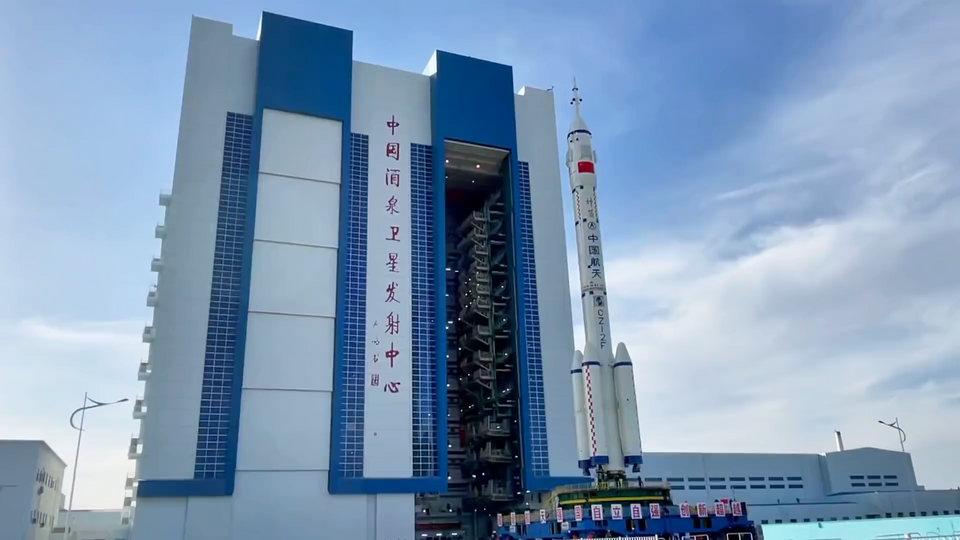
China Launches Shenzhou 23, Plans Yearlong Space Station Stay
China launched the Shenzhou 23 spacecraft Sunday night, May 24, 2026, from the Jiuquan Satellite Launch Center in northwestern China, carrying three astronauts, one slated for about a year aboard Tiangong to study long-duration spaceflight.[1]
The crew is commander Zhu Yangzhu, Zhang Zhiyuan and Lai Ka-ying, who was born and raised in Hong Kong, holds a doctoral degree in computer forensics and is the territory's first astronaut.[1] Shenzhou 23 will carry out dozens of science and application projects and perform an in-orbit crew rotation with the Shenzhou 21 team, which has been on Tiangong for more than 200 days.[1]
An emergency Shenzhou mission last year returned a crew that had been stranded on Tiangong after a damaged spacecraft, underscoring risks in China's human spaceflight operations.[2]
Chinese officials say long-duration research supports a push for a first crewed lunar landing by 2030, a timetable U.S. planners contrast with NASA's goal of landing astronauts as soon as 2028.[2]
Show source details & analysis (3 sources)
📌 Key Facts
- Shenzhou 23 launched Sunday night, May 24, 2026, from the Jiuquan Satellite Launch Center in northwestern China with three astronauts aboard (Shenzhou 23).
- The crew is commander Zhu Yangzhu, Zhang Zhiyuan and Lai Ka-ying (also reported as Li Jiaying); Lai, born and raised in Hong Kong, holds a doctoral degree in computer forensics and is the first astronaut from Hong Kong (Lai Ka-ying).
- One of the three Shenzhou 23 astronauts is scheduled to remain aboard the Tiangong space station for about one year to study human adaptability and performance limits in long‑duration spaceflight (Tiangong space station).
- Shenzhou 23 will carry out dozens of science and application projects and perform an in‑orbit crew rotation with the Shenzhou 21 crew, which has been on Tiangong for more than 200 days (Shenzhou 21 crew).
- An earlier emergency Shenzhou mission last year returned a team that had been stranded on Tiangong because of a damaged spacecraft (emergency Shenzhou mission).
- NPR links the mission to China’s broader goals, saying it advances China’s aim of a first crewed lunar landing by 2030 in contrast with NASA’s target of landing astronauts on the Moon in 2028 (first crewed lunar landing by 2030).
📰 Source Timeline (3)
Follow how coverage of this story developed over time
- Article confirms Shenzhou 23 launched Sunday night, May 24, 2026, from the Jiuquan Satellite Launch Center in northwestern China with three astronauts aboard.
- It names the crew as commander Zhu Yangzhu, Zhang Zhiyuan and Lai Ka-ying (also identified as Li Jiaying), and reiterates that Lai is the first astronaut from Hong Kong.
- It states that one of the three astronauts is scheduled to remain on the Tiangong space station for about one year to study human adaptability and performance limits in long-duration spaceflight.
- The piece notes that the Shenzhou 23 crew will complete an in-orbit rotation with the Shenzhou 21 crew, which has been on Tiangong for more than 200 days.
- It explicitly connects the mission to China’s goal of achieving its first crewed lunar landing by 2030 and contrasts this with NASA’s target of landing astronauts on the Moon in 2028.
- The article recalls that an earlier emergency Shenzhou mission returned a team that had been stranded on Tiangong because of a damaged spacecraft.
- Article specifies that Shenzhou 23 launched Sunday night, May 24, 2026, from the Jiuquan Satellite Launch Center in northwestern China.
- Names the full crew as commander Zhu Yangzhu, Zhang Zhiyuan and Lai Ka-ying (also identified as Li Jiaying in Mandarin transliteration).
- Clarifies that Lai Ka-ying was born and raised in Hong Kong, holds a doctoral degree in computer forensics, and is the first astronaut from Hong Kong.
- States that one of the three Shenzhou 23 astronauts is scheduled to remain aboard Tiangong for about one year to 'explore human adaptability and performance limits' in long-duration spaceflight.
- Notes that Shenzhou 23 will conduct dozens of science and application projects and perform an in-orbit crew rotation with the Shenzhou 21 crew, which has been on Tiangong for more than 200 days.
- Adds that an earlier emergency Shenzhou mission returned a team of astronauts stranded on Tiangong after a damaged spacecraft, described as occurring 'last year.'