
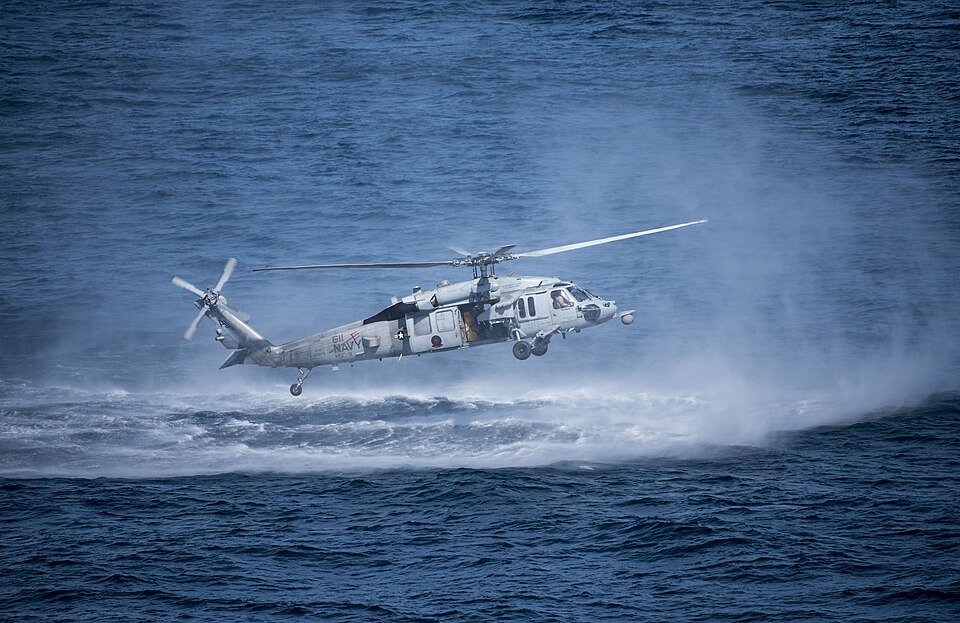
Military And Pilot Detail Rescue Of 11 After Atlantic Crash Off Florida
Eleven Bahamian adults were rescued alive after a Beechcraft BE30 ditched in the Atlantic about 80 miles off Melbourne, Florida, around 11 a.m. Tuesday, May 12, 2026.[1]
An emergency locator transmitter alerted Coast Guard watchstanders and started a multi-aircraft search that included a 920th Rescue Wing HH-60W, a Coast Guard C-27 Spartan and an HC-130J.[2] Air Force pararescue jumpers swam to a life raft, medically assessed each survivor and hoisted them one by one into the helicopter with only minutes of fuel remaining.[1] The survivors were flown to Melbourne Orlando International Airport and were reported in stable condition with no major injuries.[2]
The Beechcraft left Marsh Harbor in the Bahamas en route to Grand Bahama International Airport, though early accounts said the flight was headed to Freeport.[1] Pilot Ian Nixon said he lost both engines, all communications and avionics before ditching and that he and the 10 passengers spent hours in a life raft unsure whether the emergency beacon had activated.[3] Bahamian officials said the ditching occurred outside Bahamian territorial waters and another authority will lead the probe.[3] The Federal Aviation Administration has opened an investigation and the Coast Guard said the plane apparently went down after engine failure.[1]
Early coverage said the plane was bound for Freeport.[2] The New York Times later identified Grand Bahama International Airport as the intended destination.[1]
Newly released video shows the Air Force hoist operation that pulled the survivors from the raft.[4] At least one rescued passenger told CBS, "we got saved," when recalling the ordeal.[5] The Bahamian government arranged pilot Nixon's transport home after he received treatment for minor injuries in Melbourne, Florida.[3]
Show source details & analysis (6 sources)
📌 Key Facts
- The Beechcraft BE30 ditched in the Atlantic around 11 a.m. Tuesday, May 12, 2026, about 80 miles off Melbourne, Florida, after departing Marsh Harbor in the Bahamas; reports differ on whether the destination was Freeport or Grand Bahama International Airport.
- All 11 people aboard were Bahamian adults and were rescued alive; their identities have not been released.
- An emergency locator transmitter (ELT) signal alerted U.S. Coast Guard Southeast District watchstanders and prompted a multi‑aircraft search and rescue operation.
- A 920th Rescue Wing HH‑60W Jolly Green II helicopter — along with a Coast Guard C‑27 Spartan and an HC‑130J Combat King II from Patrick Space Force Base — located a life raft with 11 adults; Air Force pararescue jumpers swam to the raft, medically assessed survivors and they were hoisted individually into the helicopter.
- Crews hoisted all 11 survivors with only minutes of fuel remaining — the last person was lifted about five minutes before the helicopter reached its “bingo” fuel time — and the group had sheltered under a rain tarp as a thunderstorm moved in while they waited to be found (New York Times).
- The rescued occupants were flown to Melbourne Orlando International Airport and were reported in stable condition with no major injuries.
- Pilot Ian Nixon said he lost both engines, all communications and avionics before ditching the Beechcraft King Air 300 roughly 50 nautical miles off Florida’s east coast and was later treated for minor injuries at Holmes Regional Medical Center.
- The Federal Aviation Administration has opened an investigation, and the Coast Guard said the plane apparently went down because of engine failure.
- The Bahamas Aircraft Accident Investigation Authority said the ditching occurred outside Bahamian territorial waters and that another investigating authority would lead the probe.
- CBS aired newly released video showing the dramatic helicopter hoist and broadcast interviews in which at least one passenger said, “we got saved.”
📰 Source Timeline (6)
Follow how coverage of this story developed over time
- CBS aired a May 15, 2026 interview segment in which at least one rescued passenger described the ordeal and said "we got saved," providing a first-hand account of the emergency ditching and rescue.
- The pilot and a passenger recounted to CBS what happened as an emergency forced the Beechcraft to land in the Atlantic, elaborating on the human experience of the hours in the raft before the military helicopters arrived.
- The piece reiterates that all 11 people aboard were rescued alive by an elite U.S. Air Force unit after the crash landing in the Atlantic Ocean.
- Pilot Ian Nixon told CBS News he lost both engines, all communications and avionics before ditching the Beechcraft King Air 300 about 50 nautical miles off Florida’s east coast on Tuesday, May 12, 2026.
- Nixon said he was unable to reach Freeport or Miami Radio as the emergency unfolded and that the aircraft’s loss of navigation and radios was unlike anything he had experienced in more than 25 years of flying.
- Nixon and the 10 passengers spent hours on a life raft in rough weather, uncertain whether the emergency beacon had activated, before a U.S. Air Force aircraft from the 920th Rescue Wing located them.
- The Bahamian government arranged for Nixon’s transport home to Nassau after he was treated for minor injuries at Holmes Regional Medical Center in Melbourne, Florida.
- The Bahamas Aircraft Accident Investigation Authority said the ditching occurred outside Bahamian territorial waters and that another investigating authority will lead the probe; it declined to speculate on the cause at this stage.
- The New York Times identifies the aircraft as a Beechcraft BE30 that crashed around noon Tuesday, May 12, 2026, about 80 miles off Melbourne, Florida.
- All 11 people on board were Bahamian adults, and their identities have not yet been released, the Coast Guard said.
- The article reports the plane had departed Marsh Harbor Airport in the Bahamas bound for Grand Bahama International Airport, while earlier reports had indicated a Marsh Harbor-to-Freeport route.
- The Times describes that the 11 survivors spent about five hours in a life raft under a rain tarp as a thunderstorm moved in before being located.
- It details that Air Force pararescue jumpers swam to the raft, medically assessed each survivor in the water, and then hoisted them individually into the helicopter.
- Lt. Col. Matt Johnson said the helicopter crew hoisted the last survivor about five minutes before reaching its "bingo" fuel time, the point at which they had to depart or risk running out of fuel.
- The Federal Aviation Administration is investigating the crash and the Coast Guard said the plane apparently went down because of engine failure, while Bahamian authorities continue to investigate the cause.
- CBS aired newly released video on Wednesday, May 13, 2026, showing the U.S. Air Force helicopter hoist operation that rescued the 11 plane crash survivors off Florida's East Coast.
- The segment confirms the passengers remained stranded in the water for several hours before being located and winched aboard the HH-60W helicopter.
- The video package, reported by Cristian Benavides, visually documents the rescue sequence that previous written reports had only described.
- The crash occurred around 11 a.m. Tuesday, May 12, 2026, about 80 miles off the coast of Melbourne, Florida, after the twin‑engine turboprop departing Marsh Harbor, Bahamas, for Freeport experienced engine failure and ditched in the ocean.
- An emergency locator transmitter (ELT) signal from the aircraft alerted U.S. Coast Guard Southeast District watchstanders, prompting a multi‑aircraft search and rescue operation.
- A 920th Rescue Wing HH‑60W Jolly Green II helicopter already airborne on a training mission was redirected and, along with a Coast Guard C‑27 Spartan and an HC‑130J Combat King II from Patrick Space Force Base, located 11 Bahamian adults on a life raft who had been adrift for about five hours.
- Rescuers hoisted all 11 survivors into the helicopter with only minutes of fuel remaining before a nearby thunderstorm arrived, then flew them to Melbourne Orlando International Airport, where they were listed in stable condition with no major injuries reported.
- Maj. Elizabeth Piowaty, the HC‑130J aircraft commander, said it is extremely rare for all occupants to survive an ocean ditching and described the outcome as “pretty miraculous,” while Capt. Rory Whipple cited dehydration and crash‑related trauma as the main medical concerns.