
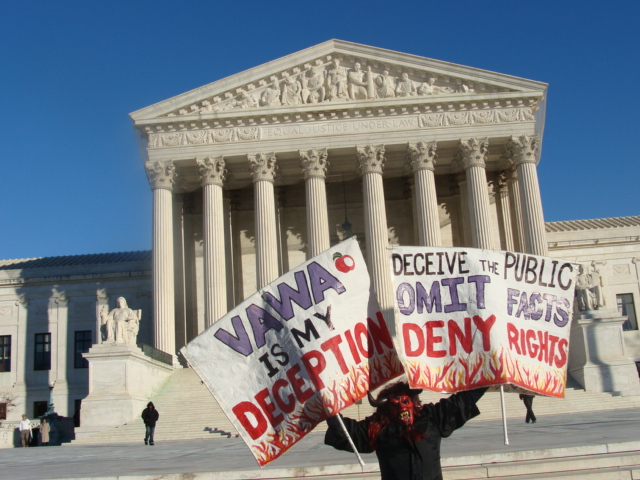
Supreme Court Weighs Whether Geofence Warrants Violate Fourth Amendment Privacy
On Monday, April 27, 2026, the Supreme Court heard arguments over whether geofence warrants for cellphones violate the Fourth Amendment, a case that could reshape police surveillance nationwide.[1]
The case arises from a 2019 bank robbery near Richmond, Virginia, where police used a geofence warrant served on Google to collect location histories and identified defendant Okello Chatrie's phone. During oral argument, several justices pressed government lawyers about whether bulk reverse-location searches resemble general warrants and how long police may access location histories without individualized probable cause.[2][1]
Geofence warrants ask companies for location data about all devices in a time-and-place area and have helped identify January 6 participants and suspects in high-profile bombings, but civil-rights groups warn they enable broad "reverse" searches. Scholars also warn such searches could worsen known policing disparities that already punish Black and Latino communities more severely.[2]
Early reports emphasized the court schedule and case details, while later pieces stressed privacy risks and showed a divided court.[3] and The New York Times described sharp questioning about whether treating location history as "voluntarily exposed" could extend to email and photos, deepening concerns about broad searches. A ruling could narrow or expand police access to cell-location tools and reshape common investigative steps like tower dumps and company data requests.
Show source details & analysis (4 sources)
📌 Key Facts
- On April 27, 2026, the Supreme Court heard a case that broadly examines how police use historical and real-time cell-location data, including geofence-style requests (New York Times).
- The case arises from a 2019 bank robbery near Richmond, Virginia involving defendant Okello Chatrie; police served a geofence warrant on Google to collect location history and Chatrie's phone was among the devices identified near the bank (Okello Chatrie).
- Justices pressed lawyers on whether bulk reverse-location searches resemble general warrants and on how long and how granularly police may access cell-location histories without individualized probable cause, and they asked how a ruling might affect routine investigative tools such as tower dumps and data requests to major tech companies (tower dumps).
- Oral arguments on April 27, 2026 showed the Court appeared divided, with typical conservative-liberal alignments described as 'scrambled' (NPR).
- Justice Neil Gorsuch warned that treating Google location history as 'voluntarily exposed' could extend to all cloud data; Justice Amy Coney Barrett suggested evaluating the issue through a 'reasonable expectation of privacy' rather than pure third-party doctrine; and Justice Sonia Sotomayor highlighted that phones track users to sensitive places (Justice Neil Gorsuch).
- Chief Justice John Roberts asked what would prevent the government from using geofence warrants to identify everyone at a church or political organization; Deputy Solicitor General Eric Feigin said he saw 'no categorical protection' for churches and argued users who 'don't want it known' they visited sensitive places can turn off location history (Chief Justice John Roberts).
- Law professors warned that upholding geofence warrants could 'unleash a much broader wave of similar reverse searches,' and an NYU Policing Project brief urged the Court to avoid both a total ban and a regime with 'no judicial supervision or constitutional safeguards' (NYU Policing Project brief).
- Geofence warrants have been used in other high-profile investigations, including identifying some January 6, 2021 U.S. Capitol riot participants and in the search for the person who planted pipe bombs outside the Democratic and Republican national party headquarters (January 6, 2021 U.S. Capitol riot).
📰 Source Timeline (4)
Follow how coverage of this story developed over time
- On Monday, April 27, 2026, the Supreme Court appeared divided in oral arguments over geofence warrants, with typical conservative-liberal alignments described as 'scrambled.'
- Justice Neil Gorsuch pressed the defense lawyer that a ruling treating Google location history as 'voluntarily exposed' could extend to all cloud data, including email and photos.
- Justice Amy Coney Barrett remarked that she has 'no idea how my data is stored' and suggested analyzing the issue through 'reasonable expectation of privacy' rather than pure third-party doctrine.
- Justice Sonia Sotomayor noted that phones track users everywhere, including to sensitive locations like brothels and cannabis shops, underscoring privacy concerns about continuous tracking.
- Chief Justice John Roberts asked what would prevent the government from using geofence warrants to identify everyone at a church or political organization, and Deputy Solicitor General Eric Feigin responded that he saw 'no categorical protection' around churches.
- Feigin argued that users who 'don't want it known' that they visited sensitive places like abortion clinics can turn off location history, a claim that drew skeptical follow-up from Justices Kagan and Barrett.
- Justice Elena Kagan posed hypotheticals about locating a suspect's phone in a home; Barrett warned Feigin that arguing there is no search when entering a private home would be 'a tough argument.'
- The PBS article specifies that the Supreme Court is hearing arguments on Monday, April 27, 2026, beginning at 10 a.m. Eastern time, in a case arising from a 2019 bank robbery near Richmond, Virginia, committed by defendant Okello Chatrie.
- It details that police used a geofence warrant served on Google to collect location history from devices near the robbed bank and that Chatrie's phone was among a handful of devices identified in the area at the time of the crime.
- The piece notes that the second case being argued the same day involves Bayer's effort to block thousands of state Roundup cancer lawsuits, indicating the geofence case is one of two arguments on the April 27 docket.
- It highlights that geofence warrants were used to identify some January 6, 2021 U.S. Capitol riot participants and in the search for the person who planted pipe bombs outside the Democratic and Republican national party headquarters.
- The article cites law professors warning that a ruling upholding geofence warrants could "unleash a much broader wave of similar reverse searches," and describes an NYU Policing Project brief urging the Court to avoid both a total ban and a regime with "no judicial supervision or constitutional safeguards."
- On Monday, April 27, 2026, the Supreme Court heard a case that more broadly examines how police use historical and real-time cell location data, including but not limited to geofence-style requests, to identify criminal suspects.
- The New York Times account details specific questioning by justices about whether bulk, reverse-location searches resemble general warrants and about how long and how granularly police may access cell location histories without individualized probable cause.
- The article reports that several justices pressed lawyers on how a ruling might affect common investigative tools such as tower dumps and data requests to major tech companies, signaling concern over potential disruption to routine law-enforcement practices.