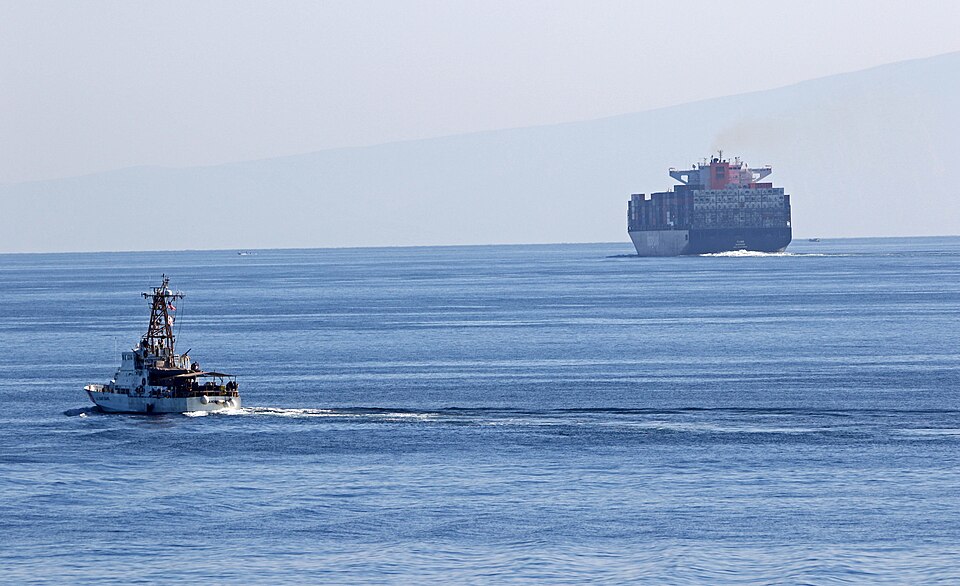
Iran Closes Hormuz Again And Fires On Ships After U.S. Keeps Port Blockade
Iran's military reclosed the Strait of Hormuz and fired on commercial vessels after the United States kept a naval blockade of Iranian ports. Tehran said it moved after U.S. officials announced the blockade would remain in place despite a short, 10-day ceasefire that had briefly prompted Iran to say the strait was open. Revolutionary Guard gunboats opened fire on a tanker and an unknown projectile struck a container ship, the UK Maritime Trade Operations center said. TankerTrackers.com reported two India-flagged vessels, including a supertanker carrying Iraqi oil, were forced to turn back, and U.S. Central Command said dozens of ships have been sent away since the blockade began. U.S. officials also signaled plans to board and seize Iran-linked ships worldwide in response, according to the Wall Street Journal.
Markets reacted sharply when Iran first said the strait was open, sending oil prices down and U.S. stocks to fresh highs. The S&P 500 rose roughly 0.8 to 1.1 percent and closed at record highs as traders grew hopeful the conflict would not trigger a worst-case global shock. Brent and U.S. crude plunged about 9 to 11 percent to roughly the mid-80s to low-90s dollars a barrel on reopening claims before bouncing on the reclosure and renewed risk. Analysts warned many higher prices could stick even if oil falls, and some forecasters said U.S. pump prices might drop below four dollars within days. Market strategists on social media said the S&P gain reflected confidence in American leverage while others warned a failed truce could trigger a historic crash.
Coverage shifted quickly from optimism about a brief reopening to concern after Iranian and U.S. statements clashed and Tehran reasserted military control. Early reports and Trump comments framed the strait as open and helped spark rallies. Later reporting by PBS, The New York Times and the Christian Science Monitor showed mixed Iranian messages and the military's reassertion of strict controls tied to the U.S. blockade. That shift matters because initial optimism briefly cut oil risk premia, but the renewed closure and threats of further action have reintroduced market and shipping uncertainty.
📌 Key Facts
- Iran briefly declared the Strait of Hormuz “completely open” during a 10‑day ceasefire but then reimposed strict military control and effectively closed the strait again after the U.S. said its naval blockade of Iranian ports would remain in place; Tehran ties the closure directly to the continuation of the U.S. blockade.
- Iranian Revolutionary Guard gunboats opened fire on at least one tanker and an unknown projectile struck a container ship; tracking groups reported Indian‑flagged vessels (including a supertanker) were forced to turn back after being fired upon.
- U.S. Central Command and allied trackers said roughly two dozen ships were ordered back toward Iran since the blockade began, and U.S. officials are preparing imminent boardings and seizures of Iran‑linked vessels worldwide.
- The back‑and‑forth over Hormuz and mixed U.S./Iran messaging produced sharp market moves: Brent and U.S. crude plunged about 8–11% (Brent near $90 a barrel, U.S. crude under $85) while the S&P 500 and Nasdaq hit fresh record highs on investor optimism that energy risks might ease.
- U.S. gasoline prices began falling (U.S. average ~ $4.08/gal) and analysts (GasBuddy) projected national averages could dip below $4 or to $3.65–$3.85 within weeks, but energy firms and economists warned of lingering effects—damaged facilities, supply disruption and ‘sticky’ price increases that could keep inflation elevated for months to come.
- Iranian statements about reopening were inconsistent: the foreign minister said passage was allowed on a ‘coordinated route,’ while other Iranian negotiators warned passage would not remain open if the U.S. blockade persisted; Pakistan and other mediators were working to arrange further talks and Iran said it had received new U.S. proposals.
- The closure and attacks in the strait since the war began have helped trigger a global energy shock (Rystad estimated up to $50 billion in damage) and increased political pressure on President Trump, who has publicly framed developments as breakthroughs while simultaneously keeping the blockade and threatening renewed military action.
- Regional and policy reactions included a surge in European equity markets on reopening hopes (e.g., CAC 40 and DAX gains), mixed Asian market moves, and a U.S. Treasury decision to extend a pause on sanctions for some Russian oil shipments to help ease shortages tied to the Iran war.
📊 Analysis & Commentary (1)
"The WSJ editorial responds to reports that the Strait of Hormuz is open — praising the possible policy win and market relief but warning against declaring victory and urging continued pressure to verify and lock in concessions."
📰 Source Timeline (19)
Follow how coverage of this story developed over time
- Confirms sequence that Iran announced reopening of the Strait of Hormuz on Friday, then reversed course Saturday after Trump insisted the U.S. port blockade would 'remain in full force' until a deal.
- Provides detailed Iranian justification that the U.S. blockade violates the ceasefire, via a statement from Iran's Supreme National Security Council vowing to prevent any 'conditional and limited reopening'.
- Adds specific British military sourcing: UK Maritime Trade Operations reports Revolutionary Guard gunboats opened fire on a tanker and an unknown projectile damaged containers on another vessel.
- Reports India summoned Iran's ambassador over firing on two India-flagged merchant ships, noting Iran had earlier allowed some India-bound ships through.
- Notes Iran's new supreme leader Ayatollah Mojtaba Khamenei issued defiant remarks that the navy is 'ready to inflict bitter defeats' and that he has not been seen in public since his elevation.
- Gives updated operational figure from U.S. Central Command that U.S. forces have sent 23 ships back to Iran since the blockade began on Monday.
- States Iran's joint military command declared 'control of the Strait of Hormuz has returned to its previous state' under strict military management, tying closure explicitly to continuation of the U.S. blockade.
- Reports that Iran says it has received new U.S. proposals and that Pakistani mediators are working to arrange another round of direct negotiations.
- WSJ confirms that on the heels of Iran re-closing the strait and firing on ships, U.S. officials now plan imminent boardings and seizures of Iran-linked ships worldwide.
- It explicitly links the expanded U.S. boarding plan to Iran's claim that the strait is now 'strictly controlled' by its military.
- Iran's joint military command said control of the Strait of Hormuz has 'returned to its previous state' under strict military management and will remain closed as long as the U.S. blockade of Iranian ports is in effect.
- Revolutionary Guard gunboats opened fire on a tanker transiting the strait, and an unknown projectile struck a container ship, damaging containers, according to the UK Maritime Trade Operations center.
- TankerTrackers.com reported two Indian-flagged vessels, including a supertanker carrying Iraqi oil, were forced to turn around after being fired upon.
- Iran had briefly announced reopening of the strait on Friday following a 10-day truce between Israel and Hezbollah, which triggered a fall in oil prices before this renewed closure.
- Iranian Deputy Foreign Minister Saeed Khatibzadeh told the Associated Press the U.S. blockade is 'risking the international community' and the 'whole ceasefire package,' underscoring how Tehran links the Hormuz closure to the blockade.
- The article explicitly notes that Iran's closure of the strait since the war began has helped cause an energy crisis roiling the global economy and inflicting political damage on President Trump.
- IRGC joint military command issued a new statement Saturday saying control of the Strait of Hormuz has 'returned to its previous state' and is under 'strict management and control by the armed forces' until the U.S. fully lifts its blockade of Iranian ports.
- Trump, speaking aboard Air Force One on April 17, explicitly said he might not extend the ceasefire with Iran and warned that in that case 'we'll have to start dropping bombs again' while keeping the naval blockade in place.
- Iran on Friday said the Strait of Hormuz was 'completely open' to commercial ships on a coordinated route, while Trump simultaneously declared the strait 'completely open and ready for business' but insisted the U.S. naval blockade remains in full force 'as it pertains to Iran only.'
- Trump claimed Iran was removing 'all sea mines' from the strait with U.S. help, and NPR reports that announcement helped trigger tumbling oil prices and a stock market rally before Iran's military reasserted tight control.
- The U.S. Treasury Department announced an extension of its pause on sanctions on Russian oil shipments to ease shortages from the Iran war, despite Treasury Secretary Scott Bessent publicly ruling out such a move just two days earlier.
- Iran officially stated that control of the strait had reverted to its previous, tightly controlled status under the armed forces.
- Tehran warned it would continue blocking transit as long as the U.S. naval blockade of Iranian ports continues.
- The timing is pegged to Trump's televised comments the previous evening that the blockade would stay in place until a comprehensive deal, including nuclear issues, is reached.
- New York Times live coverage reports that shipping analysts saw no large return of ship traffic to the Strait of Hormuz on Friday despite Iran's announcement that it is 'completely open.'
- Iranian officials are sending mixed messages, with the foreign minister saying Hormuz is completely open under a 'coordinated route' while other officials insist vessels still need permission, signaling Tehran does not want to give up leverage.
- President Trump frames Iran's claim as a breakthrough but states that the American naval blockade of Iranian ports will remain in place until a broader deal to end the war is reached.
- Iranian negotiator Mohammad Bagher Ghalibaf warns that the passage will not stay open if the U.S. blockade continues, undercutting the idea of a stable reopening.
- The article links the Hormuz announcement to a two‑week truce period that expires next week and notes that hopes for a framework peace deal are rising but still uncertain.
- The Trump administration has extended a sanctions exemption on the sale of some Russian oil, explicitly described as an effort to lower prices by allowing legal purchases of otherwise blacklisted crude.
- Iran’s Civil Aviation Organization says eastern air routes in Iranian airspace have reopened for international transit flights and that flight operations will 'gradually resume' at some airports after a shutdown that began when U.S.-Israeli strikes started on Feb. 28.
- Pakistan’s army chief and prime minister conducted high‑profile trips, with Field Marshal Syed Asim Munir meeting top Iranian negotiators in Tehran and Pakistani leaders visiting Saudi Arabia, Qatar and Turkey as part of mediation efforts.
- A top Iranian official publicly declared the Strait of Hormuz 'completely open.'
- President Trump stated that the U.S. naval blockade on Iranian ports would remain in force despite Iran's statement.
- Brent crude futures fell 9.1% to $90.38 a barrel and the U.S. benchmark fell 11% to $83.85 a barrel on the news.
- The S&P 500 and Nasdaq composite indexes closed at fresh record highs following the easing-tension signals.
- Trump, at a Turning Point USA event in Phoenix, claims he 'worked out a deal with Iran' to get commerce flowing through the Strait of Hormuz.
- He tells supporters that Iran 'has just announced that the Strait of Hormuz is fully open and ready for business,' presenting it as a 'great and brilliant day for the world.'
- Trump characterizes the Iran war as a 'little excursion' and tells the crowd to 'wait 'til you see prices fall,' citing that oil was down that day.
- The speech is explicitly framed as part of a western swing-state tour aimed at shoring up GOP midterm prospects amid an unpopular war and high gas prices.
- PBS reiterates that Iran has declared the Strait of Hormuz open to commercial traffic and that Trump publicly backed that move on social media.
- Adds that this announcement came while he simultaneously insisted the U.S. blockade of Iran's ports could remain in force.
- CBS explicitly ties Friday's stock rally to announcements from both President Trump and Iran that the Strait of Hormuz is open.
- The piece frames market reaction in terms of optimism about Hormuz, not just Iran's statement, underscoring the role of U.S. messaging.
- CBS MoneyWatch positions this as a broad market upswing, not only a crude-price move, indicating investors reacted across asset classes.
- Mini-report quotes the Iranian foreign minister saying the Strait of Hormuz has been reopened for passage in line with the 10-day Israel-Lebanon ceasefire.
- It adds that President Trump posted on Truth Social that the U.S. blockade of Iran's key ports remains in effect despite Iran's reopening claim.
- Specific price levels: Brent futures around $90 a barrel, U.S. crude under $85, down more than $10 from a week earlier.
- GasBuddy analyst Patrick De Haan projects the U.S. gasoline national average could fall below $4 as soon as this weekend.
- De Haan forecasts prices could reach $3.65-$3.85 per gallon within one to two weeks if crude prices hold.
- He estimates that by Labor Day roughly half of the roughly $1-per-gallon war-driven price spike may be reversed.
- De Haan says fully unwinding the price shock could take until late 2026 or early 2027, roughly a week of normalization for every day of disruption.
- Rystad Energy estimates up to $50 billion in damage to Middle East oil and gas facilities from the conflict.
- KPMG oil and gas chief Angie Gildea warns reopening Hormuz is not a 'full reset' and that price impacts could linger for months.
- Provides exact intraday price moves: WTI down $10.33 (10.91%) to $84.36 and Brent down $8.89 (8.94%) to $90.05.
- Updates U.S. average gasoline prices to $4.08 per gallon for regular, down from $4.17 on April 9.
- Quotes Iran Foreign Minister Seyed Abbas Araghchi on X declaring the Strait of Hormuz 'completely open' to all commercial vessels on a coordinated route during the ceasefire.
- Reports that a U.S. blockade of Iranian ports and vessels remains in effect, with Trump reaffirming this on Truth Social.
- Adds CENTCOM detail that 19 ships have complied with U.S. directions to turn around and return to Iran since the blockade began earlier in the week.
- Notes same-day U.S. market reaction: S&P 500 up 1.09%, Dow up 1.84%, Nasdaq up 1.28% as of 2 p.m. ET.
- Reports Trump telling Bloomberg that a deal with Iran to end the war is 'mostly complete' and that Iran has agreed to suspend its nuclear program indefinitely, along with his openness to extending the two-week ceasefire.
- Clarifies that while Hormuz has been declared 'completely open' during a 10-day ceasefire, many price increases already baked into the U.S. economy are expected to persist.
- Introduces Mark Zandi's argument that many prices are 'sticky' and will remain permanently higher even as oil retreats.
- Details knock-on effects like higher airfares, ride-hailing and delivery costs, construction materials, and potential car-sales slowdowns.
- Highlights growing food-bank demand and possible fertilizer shortages if shipments through Hormuz lag, implying further food inflation.
- AP piece reports U.S. crude down 10.8% to $81.28 and Brent down 10.3% to $89.13 intraday after Iran said the Strait of Hormuz is 'fully open.'
- Confirms the S&P 500 up 0.8% in early trading, with the Dow up 678 points (1.4%) and the Nasdaq up 1%, extending a three-week winning streak.
- Adds Trump quote that the war 'should be ending pretty soon,' linking political rhetoric to market optimism.
- Notes specific stock movers: State Street up 2.9%, Fifth Third Bancorp up 1.9% on earnings beats; Netflix down 11.5% despite strong profit due to guidance and Reed Hastings leaving the board.
- Reports sharp drop in the 10-year Treasury yield from 4.32% to 4.24% as lower oil eases inflation fears.
- Details that European markets leapt (CAC 40 +2%, DAX +2.2%) on Iran's announcement, while Asian markets, which closed earlier, fell.
- Pinpoints that the latest leg down in oil prices was triggered by the April 17 Hormuz 'open' announcements, not just general ceasefire hopes.
- Shows that equity optimism and the S&P 500 record are tied to this perceived easing of energy risk.
- Reinforces that markets are highly sensitive to official statements about the strait, even in advance of fully normalized traffic.
- CBS reports that U.S. stocks hit new heights on Thursday, explicitly characterized as extending the prior day’s record gains.
- The segment attributes the latest leg of the rally specifically to investor optimism that a resolution to the war with Iran could be reached quickly.
- CBS positions this as a continuation of a record‑setting move rather than an isolated up day, underscoring momentum in market sentiment tied to the conflict.
- Confirms the S&P 500 rose 0.8% on April 15, 2026, and set a fresh all‑time high, surpassing its prior January peak.
- Details that the index had fallen nearly 10% into a correction in late March and has since rebounded more than 10% over about two weeks.
- Attributes much of the rebound to expectations that the Iran war will not trigger a worst‑case global economic scenario and that oil flows from the Persian Gulf will normalize.
- Reports that regional officials told the Associated Press the U.S. and Iran have an ‘in principle agreement’ to extend a ceasefire to allow further diplomacy.
- Notes Brent crude settled at $94.93 a barrel on the day — well above the roughly $70 pre‑war level but down from a $119 peak — illustrating partial easing of earlier oil‑price panic.
- Provides specific bank earnings updates: Bank of America reported $8.6 billion in Q1 profit and cited a ‘resilient American economy,’ and Morgan Stanley jumped 4.5% on better‑than‑expected results.
- Describes that earlier AI‑related fears that hit certain companies and private‑credit firms have eased somewhat, with some AI‑exposed stocks recovering 2026 losses.