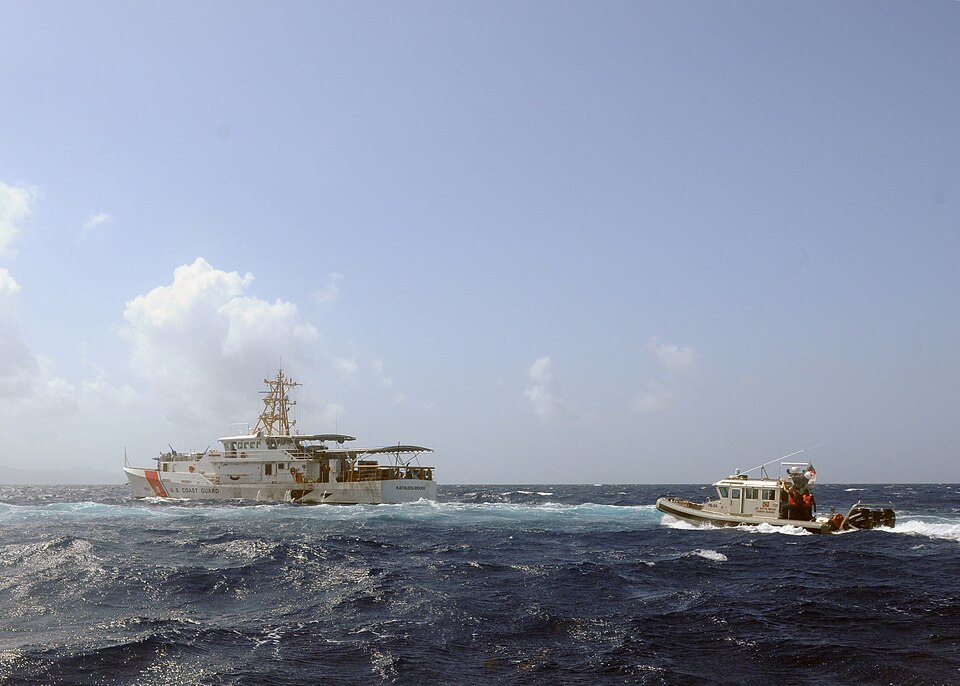
U.S. Strike On Alleged Drug-Smuggling Boat In Caribbean Kills 3 As Lethal Campaign Grows
The U.S. military struck an alleged drug-smuggling boat in the Caribbean Sea on April 14, killing three people.
Pentagon and U.S. Southern Command officials confirmed the strike and released a video on X showing a small open boat exploding. Southern Command said the strike targeted a vessel it accused of carrying drugs but declined to provide evidence or explain sources or methods. The strike is part of a broader U.S. campaign that began in September 2025 and has hit dozens of small boats across the Caribbean and eastern Pacific. CBS reported the administration's campaign has killed at least 181 people and struck at least 54 vessels, while the New York Times noted officials have not disclosed targeting criteria. Legal experts have raised questions about whether the killings meet law-of-war standards and what legal authority the administration is using for peacetime lethal force.
Early U.S. and administration statements framed the strikes as lawful anti-narcotics operations targeting drug traffic at sea. Later reporting by outlets such as CBS and the New York Times shifted that account by highlighting the absence of public evidence and by quoting legal experts who doubted the strikes' legal basis. Reporting also placed the strikes in a wider frame, noting Southern Command's campaign drew scrutiny as Washington threatened to use similar "kill" tactics to enforce its blockade of Iranian ports. That linkage has stoked debate online and among allies about escalation risks and the campaign's transparency. Social media voices warned of wider consequences if such tactics spread to Middle East chokepoints. @MarioNawfal warned that strikes risking closure of routes could take 25 million barrels per day offline, while @Intelligencer41 called the blockade a surgical squeeze that keeps non-Iran trade moving.
📌 Key Facts
- On April 14 U.S. forces struck and destroyed a small open boat in the Caribbean Sea, killing three people; the Pentagon and U.S. Southern Command confirmed the strike, said no survivors were picked up, and published a video of the explosion on X.
- The Caribbean strike is part of a wider Southern Command campaign of lethal strikes on suspected drug‑smuggling vessels in the Caribbean and eastern Pacific that began in September 2025; commanders and media accounts say dozens of boats have been attacked — CBS counts at least 54 vessels — and CBS reports the campaign has killed at least 181 people (other outlets report more than 160).
- Southern Command and the Pentagon have repeatedly declined to provide evidence that the destroyed vessels were carrying drugs and have refused to disclose targeting criteria or 'sources and methods,' prompting critics to question the administration’s narcotics claims and transparency.
- Legal scholars and experts have raised serious questions about whether the strikes meet law‑of‑war standards and what statutory authority the administration is relying on to use lethal force in peacetime in this region.
- Administration rhetoric and operational language have emphasized aggressive 'kill' tactics tested in prior strikes (including operations tied to Venezuela), and President Trump warned Iranian boats approaching a Hormuz blockade would be 'immediately ELIMINATED' using the same system, signaling willingness to apply the approach beyond the Caribbean.
- U.S. military planning has reportedly broadened to include more forcible measures at sea — officials have discussed boarding and seizing Iran‑linked tankers and commercial ships as part of a naval crackdown branded 'Economic Fury' — raising concerns about escalation and legal exposure.
- Reporting on related naval operations highlights operational secrecy and enforcement challenges: commanders tout interdictions and blockade enforcement, while analysts and ship‑tracking firms document AIS spoofing/jamming and ambiguity about how ships’ origins and cargoes are being verified in contested waters.
📰 Source Timeline (22)
Follow how coverage of this story developed over time
- The New York Times confirms via Pentagon and Southern Command that the April 14 strike destroyed a small open boat, killing three people, with no survivors picked up.
- The article reports that the U.S. military released a video of the strike showing a boat and a large explosion but has declined to provide evidence that the vessel carried drugs.
- NYT adds context that this strike is part of a classified or semi-classified campaign that has hit dozens of small boats in the Caribbean and eastern Pacific since 2025, with the U.S. refusing to disclose targeting criteria.
- Legal experts quoted in the article raise questions about whether these killings meet law-of-war standards and what statutory authority the administration is using for peacetime lethal force in this region.
- U.S. military conducted a new strike Sunday on a boat in the Caribbean Sea it accused of ferrying drugs, killing three people.
- CBS reports the Trump administration's boat-strike campaign has killed at least 181 people since early September.
- At least 54 vessels have been targeted across the Caribbean and eastern Pacific during this campaign.
- Southern Command has not provided evidence that any of the destroyed vessels were actually carrying drugs and again declined to discuss 'sources or methods.'
- The latest strike was publicized with a video on X showing the targeted boat and its destruction in a large explosion.
- Critics are questioning the legality of the strikes and the administration has offered little evidence for its 'narcoterrorist' claims.
- Introduces a parallel, less kinetic tactic: deploying unmanned sea drones to clear suspected mines in Hormuz.
- Frames drone mine‑clearing as a way to reduce risk to U.S. sailors while still pressing Iran.
- Beyond potential 'kill' tactics against fast boats, U.S. forces now plan to board and seize Iran-linked oil tankers and commercial ships in international waters.
- The WSJ report frames this as a broadening naval crackdown under the branded 'Economic Fury' operation, extending beyond the Middle East.
- Trump links continuation of the Hormuz blockade explicitly to closing an Iran deal, saying it will remain 'until we get it done'.
- He describes a scenario where U.S. 'people' enter Iran with Iranian cooperation to secure enriched uranium once an agreement is in place.
- Since September 2025, U.S. Southern Command has carried out dozens of lethal strikes on suspected drug‑trafficking vessels in the Caribbean and eastern Pacific, killing more than 160 people and destroying dozens of boats.
- President Trump explicitly warned on Truth Social that any Iranian boats approaching the blockade would be 'immediately ELIMINATED' using the same 'system of kill' employed against drug‑smuggling boats at sea, calling it 'quick and brutal.'
- Fox’s reporting specifies that U.S. and Israeli strikes have sunk more than 155 Iranian naval vessels, largely gutting Iran’s conventional navy, leaving fast‑attack boats as the surviving core threat.
- Expert Farzin Nadimi estimates Iran may have 3,000–4,000 small boats in total, with roughly 800–900 capable of carrying anti‑ship missiles, many dispersed in hardened tunnels, underground launch sites, and civilian buildings along the Gulf coast.
- Article details Iran’s dispersal, concealment and potential swarm‑attack tactics using drones and small craft to complicate U.S. targeting and increase the risks of applying Caribbean‑style 'kill' tactics in the Strait of Hormuz.
- Confirms that U.S. Navy reports it has turned back 10 Iranian‑flagged tankers at sea under the blockade regime.
- Reports that Iran has vowed to block shipping lanes in the Persian Gulf and the Red Sea in response to the U.S. blockade.
- CENTCOM specifies that the blockade is being enforced 'impartially against all vessels of all nations entering or leaving coastal areas or ports in Iran,' with ships avoiding Iranian ports said not to be affected.
- A U.S. official says the blockade line is in the Gulf of Oman beyond the Strait of Hormuz, and that U.S. forces are relying on more than AIS beacons to determine a ship’s origin, though details are withheld for operational security.
- CENTCOM reiterates that naval warships are warning they are ready to board merchant ships and use force to compel compliance.
- Analyst Ana Subasic of Kpler is quoted directly characterizing the environment as 'extremely high risk' and saying most vessels that crossed Hormuz after the blockade began have halted or reduced movement.
- The article highlights evidence that some Iran‑linked or sanctioned ships are jamming or faking their locations, adding texture to earlier reports about AIS spoofing and enforcement gaps.
- Iranian Maj. Gen. Ali Abdollahi Aliabadi explicitly threatened to halt shipping in the Red Sea, in addition to the Persian Gulf and Sea of Oman, if the U.S. maintains its blockade of Iranian ports.
- Aliabadi framed the blockade as undermining security for Iranian commercial vessels and as a potential violation of the ongoing ceasefire.
- CENTCOM asserted that in the first 48 hours of the blockade, no ships successfully transited to or from Iranian ports past U.S. forces and that nine oil tankers turned back under orders, adding more specifics to U.S. enforcement claims.
- Identification of specific sanctioned tankers (Rich Starry, Elpis, Murlikishan) and non‑sanctioned but Iran‑linked ships (Alicia, Christianna, Peace Gulf) passing through Hormuz after the blockade order.
- Behavioral details: Rich Starry re‑entered Hormuz and switched off AIS near Qeshm Island; Elpis stopped broadcasting in the same area shortly afterward.
- At least two other vessels near Iran’s coastal waters also turned off their AIS transponders in recent days, removing themselves from public tracking.
- Explicit acknowledgement by CBS that AIS signals can be spoofed and destinations misreported, illustrating how Iran and shippers may be masking port calls and testing U.S. enforcement rules that purport not to impede non‑Iranian‑port traffic.
- U.S. officials now publicly characterize the blockade as having 'completely halted' trade in and out of Iranian ports by sea.
- Iran’s military joint command, via Maj. Gen. Ali Abdollahi, threatens to block any exports or imports in the Persian Gulf, Sea of Oman and Red Sea if the U.S. blockade continues.
- The article notes that Iran has not fully relaxed its own restrictions on Hormuz, despite Trump having described that as a condition for the current truce.
- It confirms that Israel and Lebanon have agreed, per U.S. announcement, to 'launch direct negotiations' in Washington over ending fighting between Israel and Hezbollah.
- It provides updated, NGO‑sourced and official casualty numbers for Iran, Lebanon, Israel, Persian Gulf states and U.S. forces, refining earlier toll estimates.
- CBS highlights Trump’s assertion that another round of peace talks with Iran could begin within days, sharpening earlier, vaguer references to ongoing diplomacy.
- It confirms that some vessels are still moving through the Strait of Hormuz despite the blockade of Iranian ports.
- Oil prices have now fallen on news that mediators say the U.S. and Iran reached an “in principle agreement” to extend the ceasefire, after earlier spikes when the blockade began.
- U.S. stocks have surged toward record highs last set in January on hopes that the fighting may end soon.
- CENTCOM provides initial operational data: six merchant vessels ordered back into Iranian waters in the first 24 hours, zero ships passing the blockade.
- Casualty figures across Iran, Lebanon, Israel, Gulf Arab states and U.S. forces are updated, framing the human cost behind the market swings.
- Trump publicly characterizes the war as “very close to over” while reaffirming threats to target bridges and power plants, signaling to markets and allies how he sees the trajectory.
- Documents that U.S. guided‑missile destroyers in particular are executing the blockade and that one destroyer used radio communications to interdict two outbound oil tankers from Chabahar.
- Adds CENTCOM’s quantified claim that in the first 24 hours, no ships transited past the blockade and six merchant vessels complied with orders to return to Iranian ports.
- Includes Adm. Brad Cooper’s statement that within roughly 36 hours of implementation, U.S. forces had “completely halted economic trade going into and out of Iran by sea.”
- European governments are developing a longer‑term coalition plan, including mine‑clearing operations, to reassure shipping companies and normalize flows through Hormuz after hostilities end.
- Macron explicitly said the envisioned mission will exclude the U.S., Israel and Iran, classing them as 'belligerent' parties.
- Despite prior public reluctance, Germany is now poised to take part in a Hormuz mission and could formalize that position imminently.
- China is explicitly identified as the largest buyer of Iranian crude and therefore particularly exposed to, and angered by, the U.S. Hormuz blockade.
- Chinese Foreign Ministry spokesperson Guo Jiakun publicly criticized the blockade as a “dangerous and irresponsible move” that worsens confrontation and jeopardizes safe passage.
- The article ties market and shipping risks more directly to an upcoming Trump–Xi summit and a dedicated preparatory meeting with U.S. Ambassador David Perdue, linking energy chokepoint policy to broader strategic talks with Beijing.
- Updates that the ceasefire from the prior week is still holding but the showdown over Hormuz continues as the U.S. blockade actually takes effect.
- Adds the prospect of a second Islamabad round of talks as a new political variable alongside the previously reported market moves and price volatility.
- Specifies casualty totals across the region and U.S. deaths, which the earlier market-focused story did not foreground.
- Saudi Arabia is pressuring the U.S. to drop the Hormuz blockade out of concern that Iran might retaliate by closing Bab al-Mandeb, another key chokepoint for oil shipments.
- Gulf energy exporters’ worries now explicitly include the risk of simultaneous disruption at both Hormuz and Bab al-Mandeb, which would have deeper market consequences than those already seen from the blockade alone.
- Same trading day detail that Brent crude briefly topped $100 and then settled at $99.36 per barrel, below its intraday high and well under its prior ~$119 wartime peak.
- Specific U.S. equity market reaction on Monday: S&P 500 up about 0.6%, Dow Jones Industrial Average up 102 points (~0.2%), and Nasdaq composite up 0.8% late in the session.
- Quote from Iranian military and Revolutionary Guards statement via state media warning that ‘NO PORT in the region will be safe’ and that security in the Persian Gulf and Sea of Oman is ‘either for everyone or for NO ONE.’
- Analyst framing from Wells Fargo Investment Institute that markets are taking encouragement from signs ‘that the broader ceasefire seems to be holding, for now,’ tempering worst‑case fears.
- Corporate earnings color: Goldman Sachs reported $5.63 billion in quarterly profit, beating expectations but with weaker fixed income/commodities/currency trading revenue, and its stock fell 1.9%.
- Wall Street Journal explicitly ties the latest jump in oil and aluminum prices to President Trump’s now-active naval blockade on ships entering or exiting Iranian ports, rather than just a "planned" blockade.
- The article reports that aluminum prices have surged to a four-year high because the affected region produces nearly a tenth of global aluminum supply.
- It details downstream real-economy effects in Asia: some factories are cutting production, a growing number of gas stations are rationing fuel, and airports are short of jet fuel with some airlines already trimming flights.
- The piece frames the blockade as potentially turning a regional war into a broader global economic and financial shock, emphasizing that the depth of damage depends on how long disruption of the Strait of Hormuz lasts.
- Confirms Brent and WTI both jumped more than 7% Monday, with Brent at $102.30 and WTI at $104.20 as the blockade start approached.
- Adds equity‑market reaction: Dow futures down 477 points (~1%), S&P 500 and Nasdaq futures off about 0.7%.
- Details that traffic through the Strait of Hormuz has already plunged from about 129 ships per day prewar to roughly 10 per day in April.
- Provides analyst assessment that the announced blockade is narrower than initial fears because the U.S. Navy will allow transits between non‑Iranian ports.
- Notes that U.S. gasoline prices have already moved above $4 a gallon as a result of the earlier war‑driven disruption.