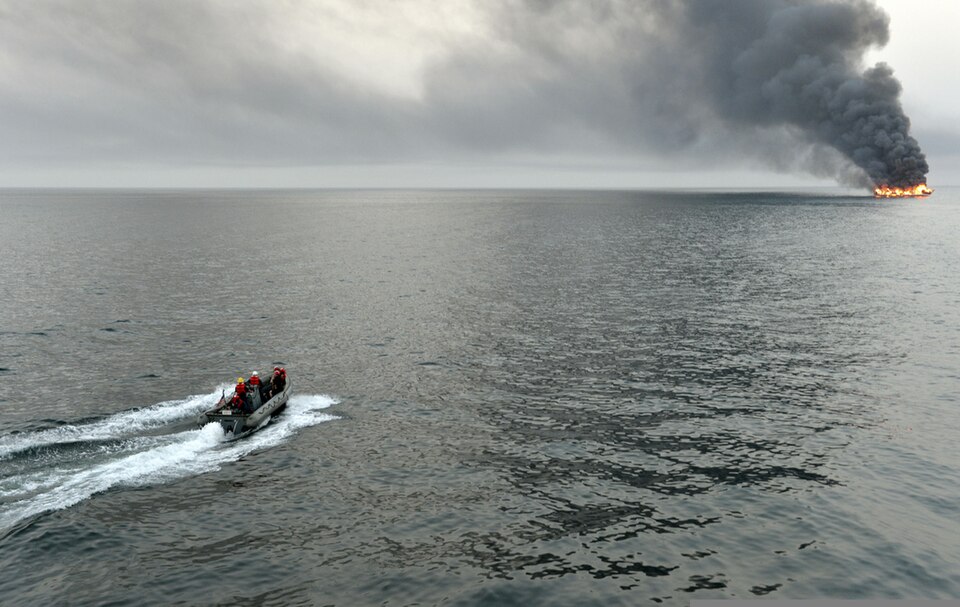
After Islamabad Talks Fail, Trump Orders Partial Blockade of Iranian Ports and Warns China of ‘Big Problems’ and Possible 50% Tariff Over Any Military Aid to Tehran
President Trump ordered U.S. forces to begin a partial naval blockade of Iranian ports and to interdict vessels that have paid Tehran’s tolls after a 21‑hour round of Islamabad talks led by Vice President JD Vance collapsed over Iran’s refusal to give an “affirmative” pledge not to pursue a nuclear weapon. CENTCOM set the operation to start at 10 a.m. Eastern Monday and said ships transiting between non‑Iranian ports would not be impeded; Trump instructed the Navy to “seek and interdict every vessel in international waters that has paid a toll to Iran.” Two U.S. destroyers transited the Strait of Hormuz to begin mine‑clearing operations, and administration officials say limited strikes inside Iran remain under consideration as part of a toolkit to sustain pressure. Tehran denounced the move as illegal “piracy” and warned of retaliation, while mediators from Pakistan and Oman urged renewed diplomacy and some Western leaders signaled reluctance to join a coalition enforcement mission.
The announcement sent oil sharply higher and equity markets lower as traders priced in the risk of further disruption: Brent crude jumped above $100 a barrel on the news, recalling that roughly one‑fifth of traded oil flowed through Hormuz before the war. That strategic leverage, however, is not uniform: recent customs data indicate less than 40% of China’s imported crude transits the Strait, a nuance that complicates Washington’s broader pressure campaign as Trump simultaneously warned China of “big problems” and threatened a “staggering” 50% tariff if Beijing is caught supplying military aid to Iran. U.S. intelligence officials have suggested possible Chinese shipments of man‑portable air‑defense systems, which Beijing denies. Allies are divided—Britain and France are discussing a multinational minesweeping and peace mission, while the U.K. prime minister has publicly declined to join a blockade—and analysts question the long‑term sustainability and political cost of controlling Hormuz.
Public reaction and social media quickly framed the move as high risk: some commentators called the blockade an act of war that could escalate confrontations with third‑party shipping interests, others warned it would harden Tehran’s position and deepen global economic pain. Critics argue bombing or blockades may not produce decisive political concessions in a conflict many Iranians view as existential, while proponents describe it as a way to impose immediate costs and force Iran back to the table. For now, Washington says it remains open to diplomacy even as military and economic levers are deployed, leaving markets, regional partners, and global consumers to weigh the immediate and longer‑term consequences.
📊 Relevant Data
In 2023, 74.5% of active-duty US Air Force officers were White, 9.2% Black or African American, 3.7% Asian, with racial minorities comprising 25.5% overall.
2023 Demographics Report — Department of Defense
Racial disparities in US household energy burdens are partly due to Black and Hispanic households being more likely to live in older homes with poor insulation and older appliances, leading to higher energy costs.
National study finds energy bills hit minority households the hardest — Binghamton University
Less than 40% of China's imported crude oil passes through the Strait of Hormuz, based on Chinese customs data from recent years.
Trump exaggerates Chinese oil dependence on Strait of Hormuz — CEDMOhub
The top nationalities providing seafarers for the global merchant fleet in 2023 include the Philippines (largest supplier), followed by the Russian Federation, Indonesia, and China.
SEAFARERS-REPORT-final.pdf — International Chamber of Shipping
📌 Key Facts
- U.S.-led marathon talks in Islamabad (led by Vice President JD Vance, joined by envoys including Steve Witkoff and Jared Kushner) ran roughly 21 hours and collapsed when Iran refused to give an "affirmative" pledge not to pursue a nuclear weapon or the means for a rapid breakout; Pakistan is pressing for a second round of talks (the "Islamabad Process") before the cease-fire ends.
- Iran’s counterproposal centered on retaining control over the Strait of Hormuz, stopping attacks on its proxies (including Hezbollah) and receiving war reparations/unfrozen funds (reported demand ~$27 billion); U.S. demands included handing over or selling Tehran’s highly enriched uranium and reopening Hormuz to non‑Iranian shipping.
- President Trump ordered a partial naval blockade of Iranian ports and a targeted interdiction of vessels that have paid Iran’s ‘tolls,’ with CENTCOM scheduling the action to begin at 10 a.m. Eastern on Monday; U.S. officials say transits through the Strait to non‑Iranian ports will continue.
- Initial implementation steps included two U.S. destroyers transiting the Strait to begin mine‑clearance and enforcement preparations; Trump said other nations would participate though coalition membership is unclear — the U.K. declined to join a blockade but offered minesweeping help while France and Britain plan talks on a multinational mission.
- The move overlays Iran’s prior de facto control of the strait (allowing mainly Iranian‑approved ships and charging fees reportedly up to ~$2 million per transit); analysts warn a blockade risks large disruption to global energy markets — the Strait normally handles about 20% of traded oil — and Brent crude jumped to roughly $100–$102 a barrel after the talks collapsed.
- Economic pain for Iran could be large (one estimate cited ~$435 million per day in lost trade if an effective blockade holds), while Iranian officials called the blockade "illegal" and "piracy," threatened retaliation and warned of broader Gulf instability and higher gas prices for U.S. consumers.
- U.S. policymakers are weighing military escalation options alongside the blockade — from limited strikes inside Iran to the less‑favored possibility of a renewed bombing campaign — even as aides say Trump remains open to diplomacy; Trump has previously threatened strikes on Iranian energy infrastructure and used extreme rhetoric about Iran.
- Trump publicly warned China it would face "big problems" and threatened a "staggering" 50% tariff if Beijing is "caught" supplying military aid (including air‑defense systems) to Iran; U.S. intelligence assessments are described as not yet definitive about Chinese transfers of MANPADS, China denies providing weapons, and some U.S. lawmakers voiced support for hardline measures.
📰 Source Timeline (22)
Follow how coverage of this story developed over time
- Trump, speaking to reporters Saturday, said China would have 'big problems' if it supplies air defense systems to Iran, explicitly tying this to potential Chinese support for Tehran.
- U.S. intelligence assessments, described as not yet definitive, indicate China may be preparing to supply, or may already have supplied, man‑portable air defense systems (MANPADS) to Iran, though there is no evidence so far that such Chinese‑origin weapons have been used against U.S. or Israeli forces.
- U.S. officials believe a shoulder‑fired weapon of this general type was likely used to shoot down a U.S. F‑15E fighter jet over Iran earlier in April, the first loss of a manned U.S. aircraft in Iran in the current conflict.
- The article specifies that Trump’s warning comes ahead of a high‑stakes Trump–Xi summit in Beijing expected in May, after an earlier postponement due to the Iran conflict.
- China’s embassy in Washington formally denied the reports, stating that China 'never provides weapons to any party to the conflict' and calling the allegations untrue.
- UKMTO mariner notice quoted here specifies that the 'restrictions included the entirety of the Iranian coastline, including ports and energy infrastructure', giving sharper geographic definition than prior reporting.
- The AP report highlights that Iran has been allowing only 'some ships perceived as friendly' to pass and charging 'considerable fees,' expanding on the picture of Tehran's de facto toll regime as economic coercion.
- Article restates that about 20% of traded oil normally moves through the Strait of Hormuz and notes that Tehran’s closure has already pushed up prices on gasoline, food, and other basics 'far beyond the Middle East,' underscoring global consumer impact.
- Confirms that, after the original inconclusive 21-hour talks in Islamabad referenced in this story, Pakistan is now actively trying to organize a second round dubbed the 'Islamabad Process.'
- Clarifies that the goal of the second round is to reach a 'workable understanding' before the current cease-fire ends around April 22 to avoid renewed full-scale fighting.
- Reports that Pakistan is currently in contact with both U.S. and Iranian officials and is waiting for their replies on whether they will rejoin talks.
- Trump told Fox News’ 'Sunday Morning Futures' that if China is 'caught' supplying military aid to Iran, it would face a 'staggering' 50% tariff.
- Trump said he thinks China may have provided some aid 'at the beginning' of the conflict but claimed they would not do so now, implicitly tying behavior to his tariff threat.
- Rep. Tim Burchett, a Republican on the House Foreign Affairs Committee, publicly backed Trump’s hard line, saying China 'has an interest not to tick off' Trump and predicting he would actually impose the tariff.
- Burchett characterized the Iran regime as 'demonic' and asserted that 'the only thing they understand is total destruction,' framing Trump’s Iran policy as preventing 'World War III' despite higher gas prices.
- The piece reiterates that the U.S. blockade on the Strait of Hormuz is scheduled to take effect early Monday, with Trump describing it to Fox host Maria Bartiromo as an 'all in, all out' effort to stop Iran from selectively selling oil.
- Confirms broadcast‑news characterization that Trump 'called for a blockade of the Strait of Hormuz' immediately after the Islamabad talks collapsed, consistent with but less detailed than the existing print account of his order.
- Provides additional, albeit high‑level, commentary from a retired U.S. Navy vice admiral about potential operational and escalation risks, echoing concerns already being raised by defense analysts and market watchers online.
- CBS describes the negotiations as 'marathon peace talks in Pakistan,' aligning with but not expanding on prior reporting that Islamabad conversations ran for 21 hours and failed.
- NPR reinforces that the Islamabad talks failed specifically over Iran’s refusal to give an 'affirmative commitment' not to seek a nuclear weapon or the tools to rapidly develop one, via a direct quote from Vice President Vance.
- It adds detail that Iran is exploiting disrupted traffic by charging foreign ships up to about $2 million to pass through the Strait of Hormuz, even as some oil still flows, a figure not spelled out in the earlier piece.
- The article makes the point that Trump’s decision to begin the naval blockade at 10 a.m. ET today will likely undercut the prospects for future talks, rather than serving as a bridge back to negotiations.
- NPR’s segment connects the blockade to climbing oil prices and notes Iran feels it is in a strong negotiating position after withstanding weeks of heavy U.S. and Israeli bombing.
- Clarifies that CENTCOM has publicly scheduled the blockade start for 10 a.m. Eastern Time Monday.
- Specifies CENTCOM’s pledge not to impede freedom of navigation for vessels transiting the Strait of Hormuz to and from non‑Iranian ports.
- Adds UK Prime Minister Keir Starmer’s refusal to join the blockade and focus instead on minesweeping and reopening the Strait.
- Notes President Macron’s plan, with Britain, to organize a conference to create a 'peaceful multinational mission' in the Strait.
- Updates Brent crude to $102.24 a barrel in response to mounting tension.
- U.S. demands in Islamabad included that Iran 'hand over or sell' its highly enriched uranium stockpile, while Tehran sought $27 billion in unfrozen funds and war reparations.
- Vance, Witkoff, and Kushner are described by Trump as becoming 'very friendly' with Iran’s top three negotiators even as the talks failed, underscoring the odd mix of personal rapport and hardline positions.
- Iran’s lead negotiator, Mohammed Bagher Ghalibef, publicly accused Washington of 'excessive' demands and said the U.S. had 'failed to win Iran’s trust.'
- ISW’s analysis that only Iranian and Iranian‑approved ships are currently passing through Hormuz, highlighting the extent of Iran’s practical control over the strait before the U.S. blockade.
- Maleki’s estimate of $435 million per day in lost Iranian trade if the blockade is effective, providing a concrete sense of the economic pressure Washington is trying to generate.
- Confirmation via Trump’s Truth Social post of the exact start time and scope of the blockade on ships entering or exiting Iranian ports.
- CENTCOM clarification that U.S. forces will continue to allow transits through the Strait of Hormuz for vessels not using Iranian ports.
- On‑the‑record Iranian military statement calling the impending blockade 'illegal' and 'piracy' and threatening broader insecurity for Gulf and Arabian Sea ports if Iran’s own are targeted.
- Clarifies that from 10 a.m. Eastern Monday, U.S. forces plan to block ships entering or departing Iranian ports and coastal areas while letting vessels transit between non‑Iranian ports, adding operational detail to earlier blockade descriptions.
- Reports that Iran has already choked off most shipping through the Strait of Hormuz since late February, allowing mainly its own ships and a few others, so the U.S. action overlays Iran’s de facto closure rather than replacing open passage.
- Adds concrete oil market reaction ahead of the blockade’s start: Brent crude jumped more than 7% at the open to around $102 a barrel, after retreating following last week’s cease-fire announcement.
- Quotes a senior adviser to Iran’s supreme leader threatening 'large, untouched levers' in response to a blockade, suggesting preparations for non‑naval retaliation.
- Includes Ghalibaf’s direct appeal to American consumers, warning they will miss $4–$5 gas, which links Iran’s leverage directly to U.S. domestic pain at the pump.
- Notes Trump’s public insistence that the cease-fire is 'holding well' and his claim to be indifferent to whether Iran returns to talks, even as the U.S. moves toward a blockade and considers renewed strikes.
- Provides another major‑network confirmation that the blockade announcement followed 'a marathon round of talks' that failed over the weekend.
- Adds no new specifics on strike planning or blockade rules but reinforces that the blockade is already being publicly framed as a done decision, not merely 'vowed' or hypothetical.
- Wall Street Journal reports that oil prices rose and stock markets in Japan, South Korea and Australia fell following the collapse of U.S.–Iran peace talks.
- CENTCOM statement, as cited by WSJ, says a blockade will begin Monday morning of all maritime traffic entering and exiting Iranian ports.
- Article reiterates that President Trump and advisers are considering resuming limited military strikes in Iran, tying that prospect directly to current market moves.
- Reiterates that the public justification for the Hormuz blockade is the failure of "peace talks" in Pakistan, language that could matter for how the administration sells this to Congress and the public.
- Provides additional confirmation from a major U.S. broadcast outlet that Trump is personally framing the move as stepping up pressure on Iran immediately after negotiations collapsed.
- Provides granular timeline for Vance’s Islamabad shuttle: about an 18‑hour Air Force Two flight from Joint Base Andrews to Islamabad via Paris, negotiations beginning shortly after his arrival and running more than 16 hours over under three days.
- Names U.S. Special Envoy for Peace Missions Steve Witkoff and Jared Kushner as part of the delegation and notes that they traveled separately but joined Vance in Pakistan.
- Documents that senior Pakistani officials gave Vance a red‑carpet welcome with an honor guard and flowers, signaling Islamabad’s role and optics in hosting the talks.
- WSJ reports Trump and his advisers are considering resuming limited military strikes inside Iran as an additional tool alongside the Strait of Hormuz blockade to try to break the diplomatic stalemate.
- Officials say a resumption of a "full-fledged bombing campaign" is also on the table but is viewed as less likely, given concerns about destabilizing the region and Trump’s stated aversion to prolonged wars.
- Another option under discussion is structuring the current blockade as more temporary, while Washington pressures allies to assume long-term responsibility for naval escort missions through the strait.
- Aides insist Trump "remains open" to a diplomatic solution even as these escalation options are weighed.
- The WSJ article explicitly positions the announced blockade as a 'risky new showdown' whose core dynamic is a war of attrition between Tehran’s tolerance for economic and military pressure and global markets’ tolerance for disrupted oil flows.
- It ties the blockade order tightly to the breakdown of the 21‑hour Islamabad talks led by Vice President JD Vance, reinforcing that this was an immediate response to Iran’s refusal of U.S. nuclear terms, rather than a long‑planned step.
- It adds sourced skepticism from U.S. officials and outside analysts that, while the U.S. certainly has the capability to mount a blockade, the long‑term sustainability and political costs of maintaining control of Hormuz are in doubt.
- Confirms from Pakistani officials that the U.S. 15‑point plan includes reopening the Strait of Hormuz as a key demand, not just nuclear assurances.
- Adds that Iran’s 10‑point counterproposal centers on retaining control over the Strait of Hormuz, cessation of attacks on its proxies including Hezbollah, and war‑damage compensation.
- Provides additional on‑record quotes from JD Vance clarifying that the U.S. wants not only a verbal assurance but an 'affirmative commitment' Iran will not seek a nuclear weapon or the means for rapid breakout.
- Shows Iranian officials publicly signaling that control of the Strait of Hormuz is a red‑line issue tied to national 'rights,' reinforcing that it is not just a bargaining chip.
- Trump publicly states from Islamabad that the Navy will 'immediately' start a blockade to stop ships entering or leaving the Strait of Hormuz, going beyond prior 'plan' language.
- He specifies an enforcement rule: the Navy is to 'seek and interdict every vessel in International Waters that has paid a toll to Iran,' declaring that such ships will not have 'safe passage on the high seas.'
- The article emphasizes that other nations will participate in the blockade, though Trump does not name them, raising questions about coalition structure and legality.
- It highlights the economic stakes by recalling the strait handled about 20% of global oil supplies before the war and warning a blockade could further rattle oil and gas markets.
- The piece reiterates and contextualizes Trump’s earlier statement that 'a whole civilization will die tonight' — criticized as genocidal rhetoric — as he again threatens to 'finish up' Iran and to strike civilian infrastructure.
- It notes that Pakistani mediators, the EU, Oman and Russia are all calling for continued diplomacy or 'painful concessions,' showing immediate international reaction to both the failed talks and blockade declaration.
- Spells out that Trump is framing the blockade as denying ‘safe passage’ specifically to vessels that have paid Iran’s ‘illegal’ tolls, not an absolute halt to all shipping once his ‘all being allowed to go in, all being allowed to go out’ condition is met.
- Details that Trump is publicly characterizing Iranian toll‑collection as ‘WORLD EXTORTION,’ language likely to shape how the administration sells the campaign to allies and oil markets.
- Documents that Trump’s threats to destroy Iranian power plants and energy infrastructure were repeatedly postponed in short increments (five days, then ten days) at what he claims was Tehran’s request, suggesting a pattern of brinkmanship more than a single, one‑off decision.
- Includes Iranian responses that any U.S. strike on energy infrastructure would be treated as an attack on the Iranian people and met with retaliation, underscoring the potential for major escalation if Trump carries out his threats.
- Clarifies that the 21-hour Islamabad talks ended without agreement because, according to Trump, Iran would not provide an "affirmative" pledge not to pursue a nuclear weapon, even though he says "most points were agreed to."
- Adds that two U.S. destroyers or warships transited the Strait of Hormuz on Saturday, for the first time since the war began, to start clearing IRGC-laid mines, showing initial implementation of the blockade and mine-clearance order previously announced on Truth Social.
- Includes Trump’s televised claim that his April 7 threat to wipe out Iran’s "whole civilization" was instrumental in forcing Tehran into direct talks, and his prediction that Iran will "give us everything we want" if pressure continues.
- Provides public mediator reactions from Pakistan’s foreign minister and Oman’s foreign minister urging extension of the ceasefire and continuation of negotiations, giving a fuller diplomatic backdrop to the blockade decision.
- Features Rob Malley’s assessment that both sides believe they hold the upper hand, which he argues makes the kind of concessions needed for a deal unlikely under current conditions.