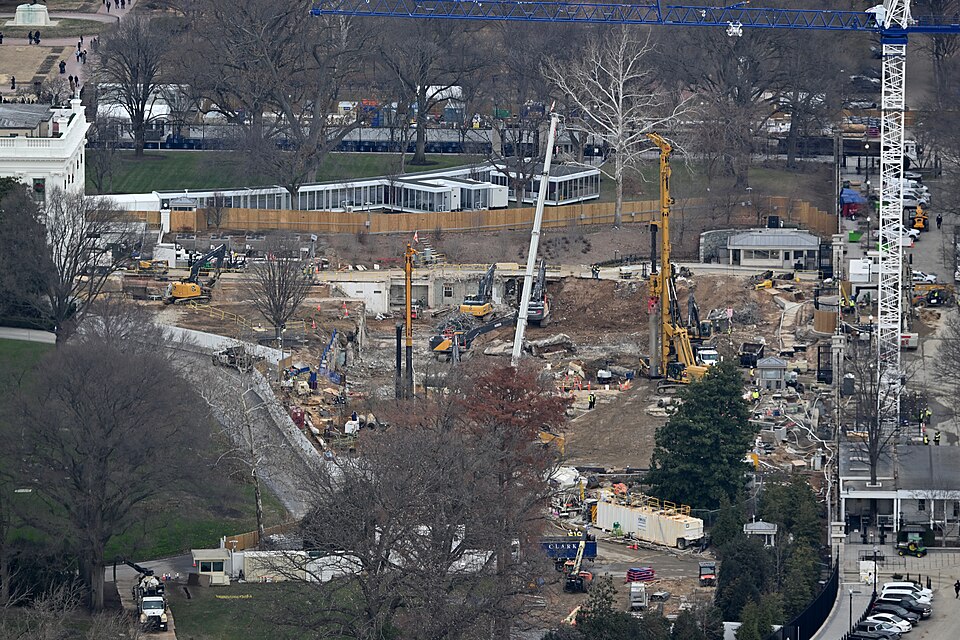
D.C. Appeals Court Allows Trump White House Ballroom Work to Continue Temporarily While Ordering New Review of Security Claims
A D.C. Circuit panel ruled 2–1 on Friday that construction of the White House East Wing ballroom may continue through April 17 while the Trump administration seeks Supreme Court review, temporarily blocking U.S. District Judge Richard Leon’s order to halt work by April 14 “until Congress authorizes its completion.” The East Wing demolition began in October 2025 for a roughly 1,000‑seat, at least $300 million ballroom — which President Trump has said will sit above an upgraded, highly protected bunker with bulletproof glass — and the National Trust for Historic Preservation said it is not concerned about the three‑day extension while urging broader public consultation.
📌 Key Facts
- The D.C. Circuit ruled 2-1 that construction of the White House East Wing ballroom may continue temporarily until April 17.
- The appeals-court stay blocks U.S. District Judge Richard Leon’s prior order that construction must stop by April 14 “until Congress authorizes its completion.”
- The temporary continuation gives the Trump administration time to seek Supreme Court review of the dispute.
- Demolition of the East Wing began in October 2025; the planned ballroom is expected to seat about 1,000 guests and to cost at least $300 million.
- Former President Trump publicly described an upgraded “big complex” bunker under the ballroom, saying it would be protected by high-grade bulletproof glass.
- The National Trust for Historic Preservation said it had no concern about construction continuing the extra three days and emphasized its broader goal of public consultation on the project.
📊 Relevant Data
The East Wing of the White House, constructed in 1902 and expanded in 1942, primarily served as office space for the First Lady's staff and as a receiving area for visitors and guests attending functions.
East Wing Fact Sheet — White House Historical Association
The Presidential Emergency Operations Center (PEOC) is a bunker located beneath the East Wing of the White House, originally built during the Roosevelt administration and used for emergency command during events like 9/11.
Presidential Emergency Operations Center — Wikipedia
Historical White House renovations, such as the Truman-era reconstruction, required congressional approval and funding for major structural changes, setting a precedent for legislative oversight on significant alterations.
Letter to the President of the Senate and to the Speaker of the House on Establishing a Commission on Renovation of the Executive Mansion — Harry S. Truman Library
The White House Endowment Trust is a private, non-profit fund that finances the maintenance and preservation of the White House's public rooms and historic collections through private donations.
White House Endowment Trust — Wikipedia
Corporate donors to the White House ballroom project have received $279 billion in government contracts over the past five years, with two-thirds of the 24 known corporate donors holding recent contracts.
Corporate Donors to Trump's White House Ballroom Beset by Conflicts Received $279 Billion in Government Contracts in the Past Five Years — Public Citizen
The tech industry, including major companies like those donating to the ballroom, spent over $61.5 million on lobbying in 2024, employing one lobbyist for every two members of Congress.
Big Tech Cozies Up to New Administration After Spending Record Sums on Lobbying Last Year — Issue One
📰 Source Timeline (2)
Follow how coverage of this story developed over time
- The D.C. Circuit ruled 2–1 that construction of the White House East Wing ballroom may continue until April 17 while the Trump administration seeks Supreme Court review.
- The appeals court’s stay blocks Judge Richard Leon’s prior order that construction must stop by April 14 "until Congress authorizes its completion."
- The article specifies that the East Wing demolition began in October 2025, that the ballroom is expected to seat 1,000 guests and cost at least $300 million, and that Trump publicly described an upgraded "big complex" bunker under the ballroom protected by high‑grade bulletproof glass.
- The National Trust for Historic Preservation said it has no concern about construction continuing the extra three days and emphasized its broader goal of public consultation on the project.