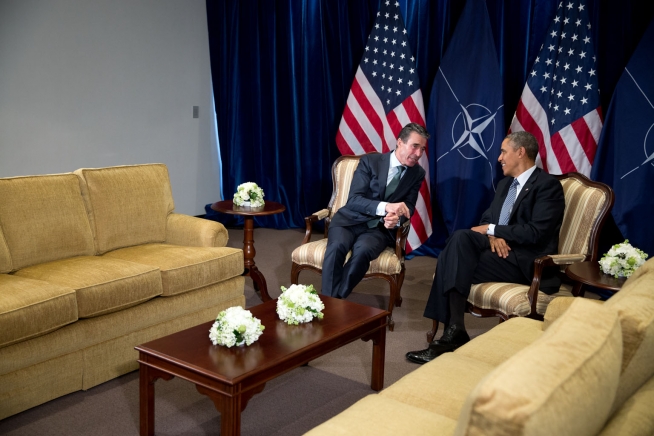
Trump Repeats NATO Withdrawal Talk After Meeting With Secretary‑General Rutte
President Donald Trump reiterated his complaint that "NATO WASN'T THERE WHEN WE NEEDED THEM" and confirmed he has discussed the U.S. potentially leaving the alliance after a closed‑door White House meeting Wednesday with NATO Secretary‑General Mark Rutte. The talks were expected to ease Trump’s anger over NATO’s limited role in the Iran war and the closure of the Strait of Hormuz, but his all‑caps social‑media posts after the meeting signaled he remains aggrieved and again questioned the alliance’s reliability. White House press secretary Karoline Leavitt acknowledged earlier in the day that Trump had discussed leaving NATO, even though a 2023 U.S. law requires congressional approval for any withdrawal — legislation that was championed by current Secretary of State Marco Rubio when he was a senator. Trump also revived his grievance over Greenland, mocking it as a "big, poorly run, piece of ice" after earlier unsuccessful efforts to press for U.S. control of the territory, undercutting standard diplomatic messaging. The episode is feeding online debate in the U.S. and Europe over whether Trump is using public threats as leverage on burden‑sharing or genuinely willing to test the legal limits on a unilateral break with NATO in the middle of a major Middle East conflict.
📌 Key Facts
- On April 9, 2026, President Trump met privately at the White House with NATO Secretary‑General Mark Rutte to discuss NATO’s role in the Iran war and Strait of Hormuz crisis.
- After the meeting, Trump posted in all caps that "NATO WASN'T THERE WHEN WE NEEDED THEM, AND THEY WON'T BE THERE IF WE NEED THEM AGAIN."
- White House press secretary Karoline Leavitt said earlier Wednesday that Trump had discussed the possibility of the U.S. leaving NATO with Rutte.
- A 2023 U.S. law bars any president from pulling out of NATO without congressional approval, a measure then‑Sen. Marco Rubio — now Trump’s secretary of state — championed.
- Trump also complained on social media about NATO’s stance on Greenland, referencing his earlier push for U.S. control over the Danish territory and calling it a "big, poorly run, piece of ice."
📊 Relevant Data
The United States accounts for approximately 62% of NATO's total defense spending, which amounted to $1.59 trillion in 2025, while other NATO members contribute the remaining 38%.
Charted: The U.S. Dominates NATO Defense Spending — Visual Capitalist
In 2026, only 38% of Republicans say the US benefits at least a fair amount from being part of NATO, down from 49% in 2025, compared to higher support among Democrats.
Republicans have become less likely to say NATO membership benefits the US — Pew Research Center
Black households in the US face higher energy burdens, spending a greater percentage of income on energy bills compared to White households, with the Iran conflict exacerbating these disparities through rising gas prices and economic pressures.
'No End In Sight': How the Iran Conflict Is Reshaping Black American Politics and the Economy — The Black Wall Street Times
Black families pay more on average to heat their homes than White families, with energy burdens (the percentage of income spent on energy) being higher for Black households, influenced by factors like housing quality and income levels.
Black families pay more to keep their houses warm than average — Phys.org
📰 Source Timeline (1)
Follow how coverage of this story developed over time