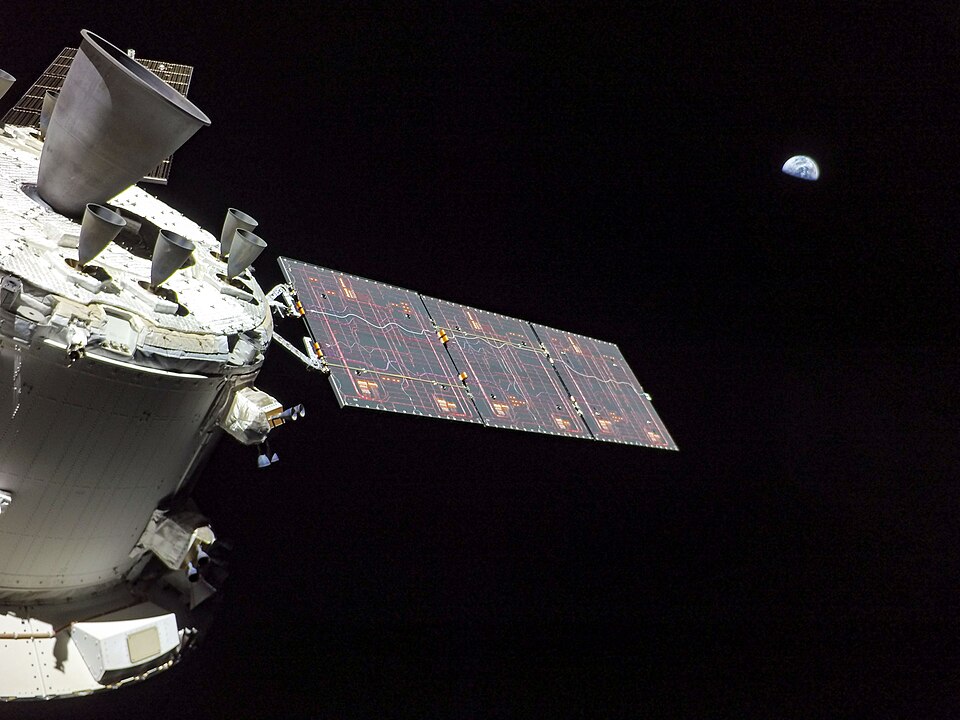
Artemis II Shares First Orion Earth Photos After Translunar Injection Burn
NASA released the first high‑resolution photos of Earth taken from the Orion capsule by commander Reid Wiseman shortly after Orion completed its translunar injection (TLI) burn, which committed the four‑person Artemis II crew to a free‑return trajectory toward the Moon. Launched April 1, 2026 on the Space Launch System with Wiseman, Victor Glover, Christina Koch and Jeremy Hansen aboard, Artemis II performed about a 5‑minute‑50‑second TLI burn to send Orion on a roughly 10‑day lunar flyby that will carry the spacecraft some 252,000+ miles from Earth before returning.
📌 Key Facts
- Artemis II launched successfully from Kennedy Space Center’s Pad 39B on April 1, 2026 (liftoff about 6:35 p.m. ET) on NASA’s Space Launch System — the SLS’s second launch and Orion’s first crewed flight.
- The four‑person crew is commander Reid Wiseman, pilot Victor Glover, mission specialist Christina Koch and Canadian astronaut Jeremy Hansen; the flight marks demographic firsts cited in coverage (first woman and first Black astronaut to go beyond low Earth orbit on this program, and the first non‑U.S. citizen on a lunar mission).
- After an eight‑minute ascent Orion entered a highly elliptical ~24‑hour Earth orbit, completed proximity‑operations tests using the separated ICPS upper stage, and then performed a translunar injection (TLI) burn (service‑module OMS‑heritage engine firing ~5 minutes 50 seconds around 7:50 p.m. EDT) to reach a free‑return trajectory to the Moon.
- NASA released the first high‑resolution photos of Earth taken by the Artemis II crew shortly after the TLI burn — including full‑disk images showing auroras and zodiacal light — photographed from Orion (images credited to commander Reid Wiseman in reporting).
- Mission profile: a roughly 8–10 day lunar flyby/figure‑eight on a free‑return trajectory that will take Orion several thousand miles beyond the Moon (reports cite a maximum distance ~252,000+ miles, surpassing the Apollo 13 record) before a planned Pacific splashdown off Southern California.
- Minor, non‑mission‑threatening issues were reported and managed: an Orion toilet/fan problem that was rebooted and restored, a brief cabin‑pressurization leak alarm later determined false, and a water‑dispensing concern — none of which altered the trajectory or TLI timeline.
- Launch preparations included a two‑day countdown beginning March 31, fueling of roughly 700,000–760,000 gallons of cryogenic propellants into SLS, and a months‑long troubleshooting period earlier in the campaign to repair hydrogen leaks and an upper‑stage helium pressurization line that delayed prior launch attempts; weather forecasters projected about an 80% chance of favorable conditions for the opening window.
- NASA and administration officials framed Artemis II as a test/dress‑rehearsal step in a multi‑year, multi‑mission Artemis plan to resume regular crewed lunar missions and build toward a sustained lunar presence; reporting also notes a schedule reshuffle that would use Artemis III for LEO lander tests and target a crewed lunar landing later in the program.
📊 Relevant Data
NASA's 2025 astronaut candidate class includes no Black individuals, marking the first such class without Black recruits since 1987.
NASA astronaut class appears to be first without Black recruits in 40 years — Mashable
In the 2022 NAEP mathematics assessment for eighth grade, average scores were 285 for White students, 253 for Black students (gap of 32 points), 261 for Hispanic students (gap of 24 points), and 306 for Asian students (21 points above White).
NAEP Report Card: 2022 NAEP Mathematics Assessment — The Nation's Report Card
📊 Analysis & Commentary (3)
"A personal, pro‑exploration commentary that connects the imminent Artemis II moon mission to feelings of cosmic perspective, generational curiosity, and the enduring cultural importance of returning humans to the moon despite program delays."
"An opinion piece taking the NASA Artemis II launch as evidence that the U.S. is serious about returning humans to lunar space — praising the mission’s symbolic and technical gains and crew diversity while warning against political hype, ongoing delays, cost pressures and the need for sober, sustainable program management."
"A pro‑Artemis WSJ editorial praises the Artemis II lunar flyby as a generational achievement and warns that sustaining moon landings, a lunar base and a Mars pathway depends on sustained political will and budgetary priority rather than technological limits."
📰 Source Timeline (35)
Follow how coverage of this story developed over time
- NASA released the first high‑resolution photos of Earth taken by the Artemis II crew from the Orion capsule, including a full‑disk image showing both Northern and Southern lights and visible zodiacal light.
- The photos were taken by commander Reid Wiseman shortly after the translunar injection burn, with the crew described as "glued to the window" taking pictures as they viewed the globe from pole to pole.
- NASA Administrator Jared Isaacman told CBS News this mission is "the opening act" in a series of Artemis flights that will send astronauts to and from the Moon with "great frequency" as the U.S. plans a long‑duration lunar presence.
- The NPR newsletter reiterates that NASA’s Artemis II mission has left Earth’s orbit and is en route to the Moon after its translunar injection burn.
- It frames this as a top national story but does not add technical or operational details beyond those already reported in the existing Artemis II coverage.
- NASA confirms Orion’s main engine fired for 5 minutes and 50 seconds at about 115 miles altitude, completing the translunar injection burn that broke Earth orbit.
- Mission commander Reid Wiseman and Canadian astronaut Jeremy Hansen describe the crew’s reaction to the burn, calling the achievement an “unbelievable technical accomplishment” and saying they are now “100% on our way to the moon.”
- NASA officials report minor issues — a water dispensing-system concern and a cabin‑pressurization leak warning — but say they were handled without altering the plan and that the leak alarm was a false indication.
- Flight director Judd Frieling explains the cabin‑leak alert and says controllers quickly verified there was no actual leak, while NASA’s Lori Glaze says the agency is “not tracking any issues of concern.”
- The article specifies that Artemis II will use a lunar gravity assist to sling Orion around the far side of the Moon and return for splashdown in the Pacific Ocean off San Diego in about eight days.
- The four Artemis II astronauts conducted a live interview with Fox News’ Trace Gallagher from Orion shortly after completing the trans‑lunar injection burn.
- Mission specialist Christina Koch described adapting to microgravity, including sleeping in different orientations and the crew’s effort to ‘make this space capsule a home.’
- Pilot Victor Glover recounted the emotional impact of receiving the final ‘go for launch’ and the experience of solid rocket booster ignition, saying he had to balance professionalism with the ‘kid inside’ wanting to cheer.
- Commander Reid Wiseman reiterated that after the trans‑lunar injection burn the crew is now ‘100% on our way to the moon,’ with lunar gravity set to take over in a couple of days as Orion swings around the far side.
- The crew emphasized the performance and hard work of NASA’s Exploration Ground Systems and launch control teams in getting the mission off the ground despite earlier program setbacks.
- Fox piece emphasizes that the translunar injection burn is the 'most critical engine firing' of the mission and explicitly marks the transition from Earth‑orbit operations to deep‑space travel.
- NASA says Orion is now on a 'free‑return trajectory' that naturally loops around the Moon and brings the spacecraft back to Earth without another major propulsion burn.
- Orion Program Manager Howard Hu reports Orion performed better than expected during crew‑guided maneuvers, praising pilot Victor Glover for doing 'exactly what he needed to do.'
- Article notes the crew completed a prior perigee‑raise burn to set the correct orbital geometry before TLI, a procedural detail not spelled out in the earlier summary.
- Jeremy Hansen’s quoted message to mission control highlights crew morale and frames the burn as proof of 'what we are capable of' globally, adding color on crew perspective.
- NASA’s Mission Management Team met earlier Thursday and formally cleared Orion and its four‑person crew for the trans‑lunar injection (TLI) burn after reviewing what it called near‑flawless performance.
- The shuttle‑era Orbital Maneuvering System engine on Orion’s service module fired for 5 minutes 50 seconds starting at about 7:50 p.m. EDT, accelerating the spacecraft to roughly 25,000 mph and breaking it free of Earth’s gravity for a four‑day trek to the moon.
- NASA expects Artemis II to take the crew farther from Earth than any humans have traveled before, up to about 252,455 miles as they swing behind the lunar far side, surpassing Apollo 13’s distance record.
- NASA Administrator Jared Isaacman says Artemis II will be followed by Artemis III next year in low‑Earth orbit to rehearse rendezvous and docking with SpaceX and Blue Origin landers, and that the agency plans to spend $20 billion over seven years to ramp up to a moon landing roughly every six months and build a base near the lunar south pole.
- CBS reiterates that the translunar injection burn was completed Thursday night, confirming the mission is successfully on course to the Moon.
- The segment frames the maneuver as allowing the four-person crew to leave Earth’s orbit and head for the Moon, consistent with NASA’s description.
- NASA used the separated ICPS upper stage as a target so the Artemis II crew could manually fly Orion in a simulated docking approach, testing how the new spacecraft handles under manual control.
- Pilot Victor Glover, a Navy test pilot, hand-flew the maneuver and described the handling and visual cues over the loop, with Houston responding that they "enjoyed your excitement" at seeing the stage out the window.
- The Orion capsule’s toilet initially failed after launch because a fan was not operating, temporarily disabling urine collection; the crew and ground teams rebooted the system and restored normal function.
- The translunar injection burn is described as increasing the spacecraft’s speed by about 800 miles per hour to send Orion on its trajectory around the Moon, and was expected roughly an hour after the interview segment.
- NASA’s Mission Management Team met Thursday and formally cleared the Orion spacecraft and its four‑person crew for the critical trans‑lunar injection (TLI) burn Thursday evening.
- The TLI burn using the shuttle‑heritage Orbital Maneuvering System engine is scheduled for 7:49 p.m. EDT and will last 5 minutes 51 seconds at perigee of a highly elliptical Earth orbit that takes Orion to more than 40,000 miles altitude.
- The burn is designed to accelerate Orion to about 25,000 mph to break Earth’s gravity for a four‑day trek to the Moon, with a planned maximum distance of roughly 252,455 miles from Earth as the crew swings behind the lunar far side.
- NASA Administrator Jared Isaacman says another Orion crewed mission, Artemis III, is planned in low‑Earth orbit next year to rehearse rendezvous and docking with SpaceX and Blue Origin lunar landers, as part of a $20 billion, seven‑year push toward a Moon landing every six months and a south‑polar base.
- MS NOW notes that Artemis II’s Orion capsule with four astronauts on board is orbiting tens of thousands of miles above Earth in preparation for heading toward the Moon.
- The article emphasizes visual imagery—a 'breathtaking view of Earth'—from the latest NASA update as the crew prepares to begin the translunar leg.
- CBS piece emphasizes that the mission will specifically loop around the far side of the Moon — language that helps clarify the trajectory for general audiences.
- Reiterates that this is NASA’s first crewed lunar mission since 1972 in a broadcast news context, underscoring historic framing and public messaging.
- Confirms Artemis II is on a free‑return trajectory that keeps Orion in Earth’s gravitational influence, sending it past the moon to about 5,000 miles above the surface before returning to Earth for splashdown.
- Details that about a day after launch, Orion will perform a translunar injection burn to begin the lunar leg of the mission.
- Reports that the crew has already conducted a proximity operations test in high‑Earth orbit, with pilot Victor Glover manually flying Orion and telling controllers, “Overall guys, this flies very nicely.”
- Quotes Artemis II mission scientist Barbara Cohen explaining that from 5,000 miles the moon will appear “like a basketball held at arm’s length” when the crew passes the far side.
- Notes that this mission is designed to push humans farther into deep space than ever before and to use the astronauts themselves as subjects of biomedical experiments.
- After an eight‑minute ascent, two upper‑stage burns placed Artemis II into a highly elliptical 24‑hour Earth orbit to test Orion before heading to the Moon.
- Commander Reid Wiseman said the first 24 hours are a 'crazy first day' focused on checking Orion’s environmental control and life‑support systems, including CO₂ scrubbing, water, and toilet functions.
- Mission specialist Christina Koch reported a fault with Orion’s toilet system shortly after reaching orbit; flight controllers said the toilet 'cannot spin up' and instructed the crew to use contingency bags for urine while engineers work on a fix.
- Pilot Victor Glover manually flew Orion around the spent upper stage to verify handling, describing the capsule’s thrusters as giving 'a little rumble, like driving on a rocky road.'
- Axios pegs the Artemis II launch time at about 6:35 p.m. ET from Kennedy Space Center’s Pad 39B.
- President Trump delivered televised congratulations to NASA and the crew on Wednesday night, calling the four astronauts “brave people” and saying “God bless those four unbelievable astronauts.”
- The article explicitly notes that Artemis II is the first crewed mission for the Orion spacecraft and the second launch of the Space Launch System.
- NASA Administrator Jared Isaacman has reshuffled the Artemis schedule so Artemis III will now be a low-Earth-orbit test of SpaceX and/or Blue Origin landers, with the next crewed Moon landing pushed to Artemis IV in 2028.
- The story emphasizes Artemis II’s demographic milestones: Victor Glover and Christina Koch as the first person of color and first woman to travel beyond low Earth orbit, and Jeremy Hansen as the first non-American to go beyond that mark.
- CBS segment reiterates that four astronauts are currently on an "historic, unprecedented mission" flying around the far side of the Moon and back, confirming the mission remains underway after launch.
- The piece frames the mission status in terms of the crew's current trajectory around the Moon rather than only the liftoff event, underscoring continued nominal operations post-launch.
- Features expert commentary from Derrick Pitts, chief astronomer at the Franklin Institute, and on-the-ground reporting from CBS correspondents Cristian Benavides and Kris Van Cleave, adding interpretive context on the mission’s significance and operational status.
- Confirms that Artemis II launched successfully at 6:35 p.m. EDT on Wednesday, April 1 from Kennedy Space Center’s Launch Complex 39B.
- Restates that this is the first crewed journey beyond low Earth orbit since 1972 and that the crew will fly a multi‑day trajectory around the far side of the Moon before a planned Pacific Ocean splashdown.
- Includes fresh on‑the‑day political reactions, quoting President Donald Trump’s Truth Social statement celebrating the launch and House Speaker Mike Johnson’s public message praying for the crew’s safety and linking the mission to a 'Golden Age' of U.S. spaceflight.
- PBS segment reiterates that Artemis II is the first time in more than 50 years the U.S. has sent astronauts back toward the moon.
- Confirms the mission is a roughly 10‑day voyage expected to send the crew farther into space than any humans before them.
- Adds on‑the‑ground color that the launch proceeded from Kennedy Space Center in front of spectators and media, but introduces no material technical or programmatic facts beyond existing coverage.
- President Donald Trump posted on Truth Social on Tuesday, calling Artemis II "among the most powerful rockets ever built" and saying America is "WINNING, in Space, on Earth, and everywhere in between."
- Trump explicitly ties Artemis to his administration, noting the program was established during his first term in 2017 as part of a broader push to return American astronauts to the Moon.
- Fox reiterates that Artemis II faced earlier delays over fuel and helium leaks but is now scheduled to launch at 6:24 p.m. EST, with Trump framing it as proof the U.S. "dominates" in space.
- CBS segment focuses on the four-person Artemis II crew making final preparations to board the Orion capsule ahead of launch.
- It emphasizes that the boarding and launch are now imminent, framed as the last phase before liftoff for the mission around the Moon.
- Confirms Artemis II’s two-hour launch window opens Wednesday at 6:24 p.m. ET, with a backup window Thursday at 7:22 p.m. ET.
- Describes Artemis II explicitly as a roughly 10‑day lunar flyby ‘dress rehearsal’ comparable to Apollo 8 and 10, with three Americans and one Canadian on board.
- Clarifies that NASA has ‘rejiggered’ the schedule so Artemis III will test SpaceX and/or Blue Origin lunar landers in low Earth orbit, with the first crewed Moon landing now targeted for Artemis IV in 2028.
- Includes on‑record comment from NASA Chief Historian Brian Odom that the mission “signals a picking up where we last left off,” reflecting NASA’s own framing of Artemis II’s historical significance.
- Reiterates that the full ‘stack’ had to be rolled back to the Vehicle Assembly Building in February to fix technical issues, underlining the recent pre‑launch troubleshooting.
- NASA began loading more than 700,000 gallons of hydrogen and oxygen propellant into the SLS on April 1, 2026, hours before an evening liftoff, with live coverage starting at 12:50 p.m. EDT.
- Commander Reid Wiseman posted on X on the eve of launch, saying "It is time to fly," underscoring NASA’s go‑for‑launch posture after previous hydrogen‑leak delays.
- The mission profile is described as a non‑stopping, non‑orbiting lunar fly‑around that will take the crew about 4,000 miles beyond the Moon before a U‑turn and Pacific splashdown, setting a new human distance record.
- The article notes that Christina Koch and Victor Glover are slated to be the first woman and first Black astronaut, respectively, destined for the Moon, and that Canadian astronaut Jeremy Hansen will be the first non‑U.S. citizen to launch on a lunar mission.
- King Charles III sent a letter to Hansen calling him a "bridge between nations and generations," and NASA Administrator Jared Isaacman posted that "The next era of exploration begins" on X, reflecting international and institutional framing of the launch.
- CBS piece reiterates that Artemis II is expected to launch Wednesday evening, conditional on weather.
- It emphasizes the mission profile in plain terms: a nine-day flight looping around the Moon’s far side and returning to Earth, framed as going farther from Earth than any prior human crew.
- It focuses on current preparations and the countdown rather than technical fueling details.
- Launch team has completed the initial poll and approved beginning fueling ('tanking') of the Space Launch System rocket.
- Tanking is scheduled to start at 8:29 a.m. EDT, loading about 756,000 gallons of cryogenic propellants into SLS.
- Breakdown of propellant loads: core stage to receive roughly 537,000 gallons of liquid hydrogen at –423°F and 196,000 gallons of liquid oxygen at –297°F; the upper stage to receive about 17,000 gallons of LH2 and 5,000 gallons of LOX.
- NASA Administrator Jared Isaacman (as quoted here) calls Artemis II an "extremely challenging" test flight and says the crew will go farther and potentially faster than any humans before, framing it as the 'opening act' in a series of regular moon missions leading to a 2028 landing and eventual moon base.
- NPR specifies the Artemis II crew: NASA astronauts Reid Wiseman, Victor Glover, Christina Koch, and Canadian Space Agency astronaut Jeremy Hansen.
- Launch is targeted for as early as Wednesday, April 1 at 6:24 p.m. Eastern, with a NASA livestream scheduled to begin at 12:50 p.m. Eastern.
- NASA officials say the roughly 10‑day mission will take the crew on a figure‑eight trajectory around the moon and back, sending humans the farthest they have ever been from Earth.
- Space Force launch weather officer Mark Burger puts the chance of favorable launch conditions at about 80%, while senior NASA test director Jeff Spaulding describes the expected atmosphere in the firing room during the final 10‑second countdown.
- Engineers plan to start loading about 760,000 gallons of liquid oxygen and liquid hydrogen into the 322‑foot SLS starting around 7:34 a.m. ET Wednesday, a process expected to take roughly 5.5 hours.
- NASA officials say they are not working any significant technical problems heading into the final day of the countdown, and they are optimistic that a previously leaking quick‑disconnect fitting repaired after a February dress rehearsal will perform without leaks.
- The Artemis II crew’s detailed pre‑launch schedule is outlined: they will be awakened about two hours after fueling begins, then briefed on weather, suit up in orange pressure suits, and head to Pad 39B for a targeted 6:24 p.m. liftoff at the opening of a two‑hour launch window.
- Weather officers continue to project about an 80% chance of favorable conditions for launch, with only possible brief delays from afternoon clouds or isolated showers.
- NASA has formally begun the two‑day launch countdown on Monday, March 31, 2026, for the Artemis II mission.
- A pre‑launch news conference is scheduled for 1 p.m. EDT on March 31 as part of the countdown activities.
- Launch director Charlie Blackwell‑Thompson says the team is in "excellent, excellent shape" and managers report the rocket is doing well after repairs, with forecasters expecting cooperative weather.
- The article reiterates that hydrogen fuel leaks delayed the original February launch target and that a clogged helium pressurization line required a return to the hangar late last month, but that the vehicle returned to the pad about 1½ weeks ago.
- NASA confirms a roughly six‑day primary April launch window (first six days of April) before a stand‑down to the end of the month.
- Confirms the Artemis II mission profile as a lunar fly-around that sends the crew several thousand miles beyond the moon before a U-turn back to Earth, with no lunar orbit insertion or landing.
- Details the initial 25-hour high, lopsided Earth orbit and use of the separated upper stage as a visual docking-practice target, keeping Orion at least 10 meters away.
- Emphasizes crew composition details: Christina Koch as record-holder for longest single spaceflight by a woman and first all-female spacewalk participant; Victor Glover as first Black astronaut to live on the ISS; Jeremy Hansen as the Canadian rookie; Reid Wiseman as commander and former head of NASA’s astronaut corps.
- Notes that SLS is shorter than Saturn V but more powerful at liftoff due to strap-on boosters, and that it reuses salvaged shuttle engines and hydrogen fuel, which have been the source of repeated hydrogen leak issues.
- Adds that recent hydrogen leaks during a February fueling test and helium-flow issues forced slips from earlier launch windows into April.
- NASA conducted its L‑minus‑two‑day mission management team review Monday and formally polled 'go' to proceed toward the April 1 launch attempt.
- The countdown officially began at 4:44 p.m. EDT Monday, with a targeted liftoff time of 6:24 p.m. EDT Wednesday, April 1.
- NASA detailed the fueling plan: the SLS core stage will be loaded with 537,000 gallons of liquid hydrogen and 196,000 gallons of liquid oxygen, while the ICPS upper stage will take about 24,000 additional gallons.
- Launch Director Charlie Blackwell‑Thompson’s timeline is specified, including a 7:44 a.m. start to propellant loading and a final 30‑minute built‑in hold at T‑40 minutes before terminal count.
- NASA reaffirmed an 80% chance of favorable weather and laid out the planned trajectory: passing 4,100 miles above the lunar far side next Monday before an April 10 Pacific splashdown off Southern California.
- Article spotlights Apollo‑era engineers and staff in their 80s and 90s reacting to Artemis II, noting that no large Apollo reunion is planned and many will watch from around Kennedy Space Center.
- Identifies NASA Administrator Jared Isaacman (a 43‑year‑old billionaire who previously flew to space) as pushing to speed up Artemis from roughly one flight every three years, which he considers unacceptable.
- Reports Isaacman has added a dedicated Earth‑orbit test flight to practice docking with lunar landers before attempting a landing mission.
- Says Isaacman released a blueprint for a lunar base, including a 'battalion' of drones and rovers, projected to cost about $20 billion over the next seven years, with NASA’s Carlos Garcia‑Galan promising extensive camera coverage to build public excitement.
- Frames the near‑term geopolitical goal as beating China back to the lunar surface, with NASA aiming for a 2028 crewed landing and China targeting 2030.
- NASA officials say there are no technical issues currently threatening a Wednesday, April 1, 2026 launch attempt; the main concern is weather, with an 80% chance of favorable conditions.
- NASA explicitly confirms multiple launch opportunities through April 6 for Artemis II, not just April 1.
- Acting exploration-systems chief Lori Glaze and ground-systems manager Shawn Quinn both state that preparations are going smoothly and that the team considers itself "very, very close" and "ready."
- The mission profile is reiterated as a roughly 10‑day flight that will send the crew on a looping figure‑eight trajectory more than 230,000 miles from Earth, passing about 4,000–6,000 miles above the lunar surface before returning.
- The NPR piece highlights that Artemis II will be the first time a woman, a person of color, and a non‑American astronaut travel on a mission around the Moon.
- Confirms scheduled Artemis II launch for Wednesday, April 1, at 6:24 p.m. EDT on the Space Launch System rocket.
- Details that prior delays were caused first by hydrogen fuel leaks and later by upper‑stage propellant pressurization problems, which NASA now says are resolved.
- Reiterates that this is SLS’s first crewed flight and only its second launch overall, and the first crewed flight of the Orion deep‑space capsule, named Integrity.
- Includes new on‑camera comments from commander Reid Wiseman stressing that Artemis II is a test mission with contingency plans that could range from an early return to a full nine‑day lunar fly‑around.
- Frames Artemis II as part of a step‑by‑step $20 billion, seven‑year Artemis plan described by NASA Administrator Jared Isaacman, explicitly tying the mission to a U.S. race with China to return humans to the lunar surface and establish a permanent presence.
- NASA has set the launch countdown to begin at 4:44 p.m. ET Monday, with a targeted liftoff at 6:24 p.m. ET Wednesday, April 1, for Artemis II.
- Mission commander Reid Wiseman emphasized that, despite saying the crew and vehicle are ready, they have “not for one second” assumed the launch will go and are prepared for multiple scrub-and-try-again attempts.
- Forecasters currently predict about an 80% chance of acceptable weather, with high winds and thick clouds as the main concerns.
- Ground systems manager Shawn Quinn said the recent launch countdown pre‑test briefing was “one of the cleanest” they have ever had, with no significant open work.
- If they launch at the opening of the window, the crew’s free‑return trajectory around the moon will take them to roughly 252,799 miles from Earth, about 4,144 miles beyond the Apollo 13 distance record.
- CBS segment reiterates that the four‑astronaut Artemis II crew has arrived at Kennedy Space Center in Florida for final launch preparations.
- Confirms timing that the launch is planned for next week within the existing April 1 window.
- Provides CBS’s framing that this is a 'historic mission to return humans to deep space for the first time in over 50 years,' but adds no operational details beyond what is already known.
- CBS specifies the four-person Artemis II crew arrived Friday afternoon at Kennedy Space Center after spending two weeks quarantining in Houston.
- The segment characterizes this phase as 'the dawn of a new lunar era for NASA' and frames the mission as a major return to crewed lunar orbit.
- CBS space contributor Christian Davenport appears on 'The Takeout' to preview the mission, adding on‑air expert context though no new technical milestones are detailed in the text.